From the Overflow of the Heart, the Mouth Speaks (Luke 6:43-45)

Jesus said, “A healthy tree does not bear bad fruit, nor does a poor tree bear good fruit. Every tree is known by the fruit it bears; you do not pick figs from thorn bushes or gather grapes from bramble bushes. A good person brings good out of the treasure of good things in his heart; a bad person brings bad out of his treasure of bad things. For the mouth speaks what the heart is full of.” (Good News Translation)

I often find public confessions on television to be a rather disingenuous affair. Typically, celebrity apologies only take shape when one has been caught saying something and are called on the carpet.

Then, when the apology finally comes, it’s predictably odd and incongruent. The person says something to the tune of, “I’m sorry if I hurt anybody by what I said. Saying that really wasn’t me. I’m not really like that.”

Well, apparently you are! The offending words came out of your mouth, not somebody else’s. It is a lot easier, however, to see a problem in another and name it. To see and deal with our own stuff is different.

Just the other day, I made an off-the-cuff comment to a colleague. The person has an unusual first name (from my perspective) and so I blurted a quick pun of it in front of others when I greeted them. I thought nothing of it.

But later in the day, the person came to me privately. They gently let me know that my pun of their name was hurtful. My only saving grace was that I listened, didn’t go off on an explanation of why I said it, and offered a heartfelt apology with the promise to not use their name in that way again.

Jesus said that out of the overflow of the heart the mouth speaks. The words we say out loud betray what is truly inside us. In truth, I said what I said to my colleague, because I find their name to be strange. What was actually inside me came out of my mouth. And I’m an introvert. I can’t even imagine what extroverts have to go through!

To illustrate his point, Jesus used the metaphor of a tree. If the roots, the trunk, and the branches are good and healthy, then you can be sure the tree will produce good healthy fruit. However, if the tree is diseased, or infested with insects and rotting from the inside out, then no one can expect anything other than bad fruit that is not fit to consume.

Good Tree and Bad Tree, by Bible Art

If the fruit is bad, the tree is bad. If the words are hateful, sarcastic, passive-aggressive, manipulative, conniving, racist, hurtful, ignorant, mean, unjust, foolish, and either subtly or overtly abusive, then the person has a dark heart and is need of redemption, not excuses.

Conversely, if the words are affirming, encouraging, loving, compassionate, gentle, caring, direct, helpful, peaceful, kind, giving hope and life, then there is a good heart behind it.

Yes, bad hearts can parrot good words. However, those words are not genuine but mere rote recitations to achieve some sort of personal agenda.

And, of course, good people will occasionally say dumb or hurtful words – as I did with my colleague. In such times, let it be a reminder that we all have some shadowy places within our hearts – and that we must depend on God’s grace to enlighten those dark spaces.

It is best to observe patterns rather than focus on isolated events where either good or bad words were said. A consistent pattern of invalidating another’s experiences or feelings; intimidating or threatening others; dismissing or discounting someone’s input; or being unnecessarily blunt, are all major red flags pointing to a severe heart issue.

Evil does exist in the world. And if we are not vigilant to its insidious role in the crafting of words, wickedness can easily smack us upside the head when we aren’t looking.

The heart cannot be concealed forever. Eventually, the virtuous person will be shown as such by the stream of speech which pours forth from their heart, as if it were living water for others to drink and enjoy. Their words reflect their good character.

The wicked person, however, cannot keep the bad words down. Those vile words sit in the soul, poisoning and making the person ill. Then, all of a sudden, the evil words come up and out with a great vomitous heave and spew impurity and unholiness all over the innocent. Their words betray their foolish and poor character.

Every tree that does not bear good fruit will be cut down and thrown into the fire. The wicked heart will not be able to speak ill of others with impunity forever. They will be called to account for their abusive words, whether overtly violent, or subtly undermining.

The righteous heart, however, shall experience divine pleasure and reward, as if the careful construction of helpful and building up words win first-prize at the great heavenly fair.

The good person loves and does not hate. They are so far from harming anyone that they even pray and wish well for their enemies. They pray for blessings on those who curse them. There is an honest striving to speak good words to everyone, regardless of who they are.

The upright heart thinks the best of everyone and holds nothing over someone else’s head. A good heart condemns no one, leaving all judgment to God alone. It is patient with the most exasperating of people, praying they might come to their senses and become spiritually healthy.

The righteous are able to use their speech to admonish their neighbor with care and affection. They freely forgive, happily give, liberally encourage, and use their tongue to speak words of life. Indeed, their speech is wise, humble, full of grace, and above all, loving.

If there is a problem with words, it will not do to simply change the speech. That’s because it is a heart issue. And the heart must be willing to change and be transformed by sheer mercy.

Fortunately, God is the expert on renovating dilapidated hearts and performing effective heart transplants.

Jesus is the gracious carpenter. God is the divine surgeon. The Holy Spirit is the energetic power source. They are ready for the work. Will you consent to let them in?

Almighty God, to you all hearts are open, all desires known, and from you no secrets are hid: Cleanse the thoughts of our hearts by the inspiration of your Holy Spirit so that we may perfectly love you, and worthily magnify your holy Name; through Christ our Lord. Amen.

Wear the Right Clothes (1 Samuel 2:18-21)

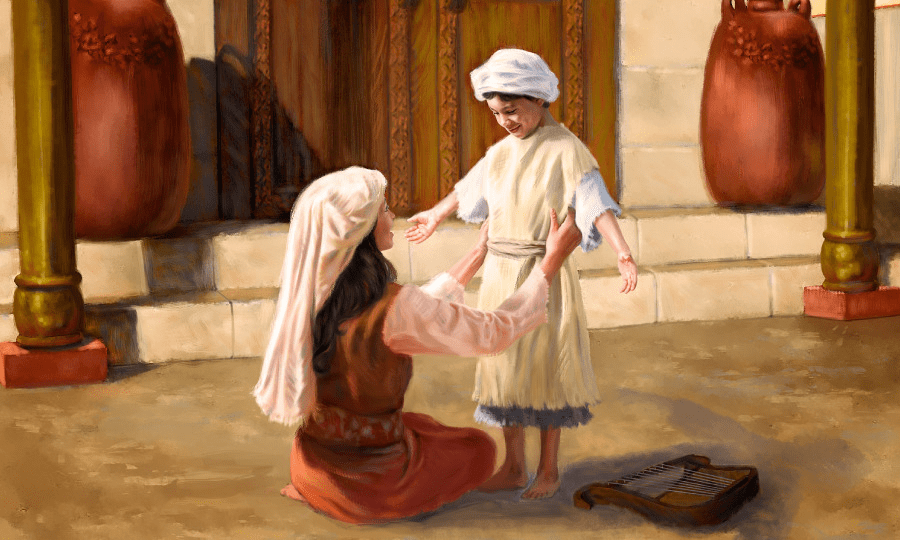
Hannah fits Samuel with a priestly robe, by Unknown artist

But Samuel was ministering before the Lord—a boy wearing a linen ephod. Each year his mother made him a little robe and took it to him when she went up with her husband to offer the annual sacrifice. Eli would bless Elkanah and his wife, saying, “May the Lord give you children by this woman to take the place of the one she prayed for and gave to the Lord.” Then they would go home. And the Lord was gracious to Hannah; she gave birth to three sons and two daughters. Meanwhile, the boy Samuel grew up in the presence of the Lord. (New International Version)

Hannah had to deal with infertility, a rival who taunted her mercilessly, and the societal shame of it all. But the God who is rich in mercy heard Hannah’s prayer at the Tabernacle in Shiloh. She was given a son, Samuel.

And when he was old enough – about 3 or 4 years of age – Hannah and her husband Elkanah presented Samuel to Eli the priest at the Tabernacle. She had vowed to do so if the Lord granted her a son. Hannah made good on that promise.

It turns out that the small boy Samuel was head-and-shoulders above the adult priests. Eli and his two sons, Hophni and Phineas, were no good, too small for the office of priest they occupied. Their service to God was anything but that. They served themselves, especially the two sons.

Eli’s adult children blatantly engaged in sacrilege, aggressively grabbing whatever they wanted from the sacred space of the Tabernacle. They made a mockery of the Lord’s instructions regarding sacrifices and worship in that holy place. The two of them cursed others (which would come back on them soon enough).

In contrast, the boy Samuel was a blessed child. His dear mother Hannah would make him a new priestly robe year after year as he served faithfully. His growing stature, and the need for clothing which suited him, were a light shining in the darkness of two sons who were outfitted in priestly garb that didn’t spiritually fit them at all.

The thing about our clothes is that they can either be an expression of who we truly are; or they can be a covering which hides the true identity. The story makes it plain that Samuel had a beautifully handcrafted robe which suited him perfectly. But Hophni and Phineas inherited priestly threads that seemed like ill-fitting hand-me-downs.

All of us are either revealing who we really are for all to see with unabashed authenticity, or we are concealing ourselves behind a disingenuous false façade, so that our true self is obscured and hidden in the shadows.

We are embodied people living on a physical earth. Our clothes aren’t just mere coverings of the body; they are a material means of communicating important immaterial aspects of ourselves and the world. The elaborate garb of the priest has significance, and ought not to be taken lightly.

In the case of Eli’s sons, they used their clothing to fleece incoming worshipers who were making genuine animal sacrifices to God. The priestly outfits themselves were not the problem; at issue was two people committing sacrilege against the Lord, and injustice toward the Lord’s people.

Material things neither contaminate nor purify a person; the heart does that. We just need to ensure that material objects like clothing are set apart for specific and good purposes. Those clothes ought to be congruent with the person and the task at hand. And clothing ought never to demean or deceive ourselves or others.

Although we aren’t told what sort of clothing Hannah wore, I’m sure that everything she wore spoke to her humility before others, devotion to God, and spirit of doing what is right and just. The Lord gave her clothes fitted for a mother by blessing Hannah with even more children. I can imagine that the biblical writers had women like her in mind when they wrote some of their words:

I want women to enhance their appearance with clothing that is modest and sensible, not with elaborate hairstyles, gold, pearls, or expensive clothes. They should make themselves attractive by doing good, which is appropriate for women who claim to honor God. (1 Timothy 2:9-10, CEB)

It is not fancy hair, gold jewelry, or fine clothes that should make you beautiful. No, your beauty should come from inside you—the beauty of a gentle and quiet spirit. That beauty will never disappear. It is worth very much to God. (1 Peter 3:3-4, ERV)

For all of us, we are encouraged to wear actual and metaphorical clothing that is consistent with what is good:

Right living was my clothing. Fairness was my robe and turban. (Job 29:14, ERV)

Because we belong to the day, we must live decent lives for all to see. Don’t participate in the darkness of wild parties and drunkenness, or in sexual promiscuity and immoral living, or in quarreling and jealousy. Instead, clothe yourself with the presence of the Lord Jesus Christ. And don’t let yourself think about ways to indulge your evil desires. (Romans 13:13-14, NLT)

Therefore, as God’s chosen people, holy and dearly loved, clothe yourselves with compassion, kindness, humility, gentleness and patience. (Galatians 3:12, NIV)

The boy Samuel lived up to the priestly clothes he was wearing; they fit him like a hand in a glove. But the adults who should have known better, Eli and his sons, dressed down their priestly garments and demeaned the office of priest for the people they should have been serving.

It is high time to dress appropriately and clothe ourselves with Christ, so that the very life of Jesus may flow powerfully in us and through us, to the glory of God. Amen.

The Contrast of Good and Bad (1 Samuel 2:11-17)

Top picture: Eli’s sons commit sacrilege; Bottom picture: Hannah and Elkanah bring the boy Samuel to the tabernacle; by William de Brailes, c.1230 C.E.

Elkanah and Hannah went back home to Ramah, but the boy Samuel stayed to help Eli serve the Lord.

Eli’s sons were priests, but they were dishonest and refused to obey the Lord. So, while people were boiling the meat from their sacrifices, these priests would send over a servant with a large, three-pronged fork. The servant would stick the fork into the cooking pot, and whatever meat came out on the fork was taken back to Eli’s two sons. That was how they treated every Israelite who came to offer sacrifices in Shiloh. Sometimes, when people were offering sacrifices, the servant would come over, even before the fat had been cut off and sacrificed to the Lord.

Then the servant would tell them, “The priest doesn’t want his meat boiled! Give him some raw meat that he can roast!”

Usually the people answered, “Take what you want. But first, let us sacrifice the fat to the Lord.”

“No,” the servant would reply. “If you don’t give it to me now, I’ll take it by force.”

Eli’s sons did not show any respect for the sacrifices that the people offered. This was a terrible sin, and it made the Lord very angry. (Contemporary English Version)

Stories in the Old Testament of the Bible typically have two or more contrasting characters within them. One of the characters is good and the other not so much. The narrative is set up without having to tell us who is good and who is bad because the unfolding story makes it patently obvious.

This method of contrast is meant for us to look at the narrative and say to ourselves that we don’t want to go down the bad path but to walk in the good way of helpful obedient service.

In today’s story, we clearly see that, in the case of Eli’s sons, the apple doesn’t fall far from the tree. Old Eli the priest is a contrast to the boy priest-in-residence Samuel.

Eli had many faults, especially when it came to dealing with his sons, who were also priests. Eli seems to have continually had an issue with not listening very well – which ended in making a mess of things.

His sons took the casualness to an entirely new level of bad. They were not only worthless but also interfered in the people’s sincere worship of God. The sons were more than simply incompetent; they were also downright evil.

The Law made it clear how the priests and their portion of the sacrificial animals was to occur. There were detailed instructions on the importance of what part of the animal the priests received; and that the sacrifice needed to have the fat boiled off before it was given to the priest. (Leviticus 7:30-36)

But Eli’s sons took whatever they wanted, and did whatever they wanted, with calloused impunity. They disregarded divine instructions. If they wanted to roast their meat, they did. If they decided to have a different part of the animal, they took it from the worshiper. The sons did not care about anyone, and especially about God. They were bullies of the worst kind.

When sincere worshipers tried to stop the insanity of the priests’ blatant neglect, the servant of the priests threatened them. Although Eli himself did not do this detestable practice, we are meant to see in the narrative that he is an absent father and grossly negligent as a priest.

That entire incompetent and insensitive situation raised the ire of a holy God. It would not end well for Eli and his sons. That particular branch of the Levite priesthood was completely eradicated by the direct judgment of the Lord.

The contrast between Eli and Samuel – both serving as priests – has an unexpected twist. Whereas one would reasonably expect Eli to be the good mentor because of his age and experience, it turns out that the much younger Samuel is the actual mentor to the good and right life of priesthood. Eli needed to take his cues from a child. But, alas, he did not.

Hannah presenting Samuel to Eli, by John Flaxman, 1783

Many adults seem to think that children have nothing to teach them. We who are the big people believe we’re the teachers, leaders, and mentors. Yet, in the kingdom of God, age hasn’t got much to do with it. In fact, generally speaking, children are closer and wiser to knowing how God’s kingdom works, often better than the adults do.

In many respects, I am more like an eight year old boy than the actual father and grandfather that I am. I consider that a good thing. It serves me well in living the spiritual life. And as a boy in an adult body, I say we need to take children more seriously. How can we do that?

Listen carefully. Listen with the intent to understand and learn. The best way of talking to a child is listening to them. Hear both what they’re saying and not saying. Jesus insisted that we must become like little children before we can enter the kingdom of heaven. (Matthew 18:2-5)

Since we are to become like children, there’s no reason not to do your very best in getting on a child’s level and hearing what they have to say. After all, they’re the experts on being kids. The young Samuel is our model: “Speak, Lord, for your servant is listening.” (1 Samuel 3:10)

Validate a child’s emotions, especially their fears. In truth, kids are some of the bravest souls on the planet. They typically have no real hang-ups on connecting with other people, whereas many adults have a lot of anxieties and fears concerning other people.

So, when a child is afraid of something, it’s wise to take notice. They have a special radar to reality that most adults lost a long time ago. I’ll bet the children of the community knew the score of Eli and his sons well before the adults caught on to it.

Observe children’s artworks. For those interested in learning from a child, their drawings with crayons say a lot; their sand sculptures and garbage art speak loads to us if we observe and take notice. Kids are communicating their worldview and how they make sense of things.

Art is about understanding life and the human spirit, connecting to the past and other cultures, and expressing emotions. Becoming open to what children create is a pathway to the divine and to what is important in this world. Eli’s sons removed the art and craft of priesthood; they made it a mere exchange of goods and services. And God was not happy with this arrangement. It took away something significant about connecting with the Lord.

By contrasting the way of Samuel with the way of Eli and his sons, we begin to see the wide chasm between a one-dimensional bullying approach to being a priest, with a multi-dimensional, beautiful, and authentic expression of priesthood that embodies the conduit between heaven and earth.

How will you go about living your life? What does the way you do things say about God?

Holy God, infuse in us your ability to remain present to your people. Help us to be there for the people who need us – for the young, the old, the needy, and the brokenhearted. Enflame our hearts with a spirit of service and obedience. And enable us to be open and ready to love. Amen.

Accept Your Shadow Side (Acts 7:30-40)

“Forty years later, in the desert near Mount Sinai, an angel appeared to Moses in the flame of a burning bush. When Moses saw it, he was amazed at the sight. As he went to take a closer look, the voice of the Lord called out to him, ‘I am the God of your ancestors—the God of Abraham, Isaac, and Jacob.’ Moses shook with terror and did not dare to look.

“Then the Lord said to him, ‘Take off your sandals, for you are standing on holy ground. I have certainly seen the oppression of my people in Egypt. I have heard their groans and have come down to rescue them. Now go, for I am sending you back to Egypt.’

“So God sent back the same man his people had previously rejected when they demanded, ‘Who made you a ruler and judge over us?’ Through the angel who appeared to him in the burning bush, God sent Moses to be their ruler and savior. And by means of many wonders and miraculous signs, he led them out of Egypt, through the Red Sea, and through the wilderness for forty years.

“Moses himself told the people of Israel, ‘God will raise up for you a Prophet like me from among your own people.’Moses was with our ancestors, the assembly of God’s people in the wilderness, when the angel spoke to him at Mount Sinai. And there Moses received life-giving words to pass on to us.

“But our ancestors refused to listen to Moses. They rejected him and wanted to return to Egypt. They told Aaron, ‘Make us some gods who can lead us, for we don’t know what has become of this Moses, who brought us out of Egypt.’ (New Living Translation)

We humans are a confusing paradox of sinner and saint. We are majestic people, created in the image and likeness of a good God. We are also profoundly fallen, touched by sin in every area of our lives. Our hearts exist with both light and darkness, having the capacity for both incredible altruism as well as inexplicable evil.

So then, it will do no good to retreat into binary definitions of people as being either good or bad. No, we shine and shadow at the same time. What really gets us into a terrible mess is when we ignore or deny our shadow selves. We then demonize the other while claiming purity for ourselves.

This is precisely what occurred when Stephen stood and spoke to a group of his fellow Jews. They stubbornly refused to acknowledge their shadow side. And it resulted in Stephen’s stoning and death. Whereas Stephen lifted and brought to light the unseemly aspects of their collective heritage, the people wanted nothing to do with it.

The Martyrdom of Stephen

In our present day, responses that do not want to acknowledge the shadow side include statements such as, “Quit being so negative. We focus on the positive. Expel this recalcitrant troublemaker once and for all!”

Oy. Acceptance cuts two ways. We must accept both our blessings and our curses. The acceptance of reality will not occur apart from a solid self-acceptance of who we are and how we are feeling in any given situation. On the practical level, it works something like the following story…

Several years ago, I went on a leadership retreat in the Canadian wilderness. We were so far out in the sticks that we needed special first aid training before leaving because if someone got severely injured it would be hours before any medical attention could be received. There was no cell phone service, no towns, no anything except mile after square mile of wilderness. 

One day, I was canoeing with a group of leaders, far out into the Canadian wilderness where there were no towns or people anywhere near us. It was very windy on this day in late May – which meant the water was still ice cold in Canada. One of the canoes capsized. We had to act quickly and deliberately – which was no small feat in a stiff wind. More than fifteen minutes would result in hypothermia for the two people in the water.

I did not like being in that situation. In fact, I didn’t much like the Canadian wilderness. Too many black flies and giant mosquitoes for me. My shadow side was coming out. But here I was, and I had to accept the reality I was in. One of the lessons I learned in that moment was that acceptance can sit alongside other reactions and emotions.

For example, a person can be outraged by an injustice, as Stephen was, and accept that it is a reality. Acceptance does not mean complacency or giving up. We can accept something while at the same time trying to make it better.

I also needed to accept what was happening inside of me. I was cold and worried. Trying to push those feelings away would have only added to the stress of the situation. If I failed to accept what was true about myself, I would be less able to deal with the situation, and so, would compromise my ability to help two people at risk.

I needed to accept the entire circumstance, including myself. Accepting what is inside gave me more influence over the situation, not less. Self-acceptance became the key to acceptance of unwanted conditions, and more importantly, acceptance of one another as human beings.

In that moment of rescuing two people (which ultimately proved successful) I became aware of a part of myself – the part that gets afraid and irritated – and chose not to stuff it or deny its existence.

I became the guy who talked to the panicked people in the water and kept them as calm as possible so that the others could get them out. I was able to do my part to help fearful people because I acknowledged and accepted my own fear.

Unlike my situation, however, Stephen’s experience ended in martyrdom. Just because we respond rightly, is no guarantee that everything will work out for our benefit. Rather, we say and do the things we must say and do, while leaving the results to a sovereign Lord.

It is our responsibility to work on ourselves, not others. And acceptance is the path to get there, all of it – including the shadow side – and not just part of it.

Jesus, let your mighty calmness lift me above my fears and frustrations. By your deep patience, give me tranquility and stillness of soul in you. Make me in this, and in all things, more and more like you. Amen.