The Almighty Has Dealt Bitterly with Me (Ruth 1:18-22)

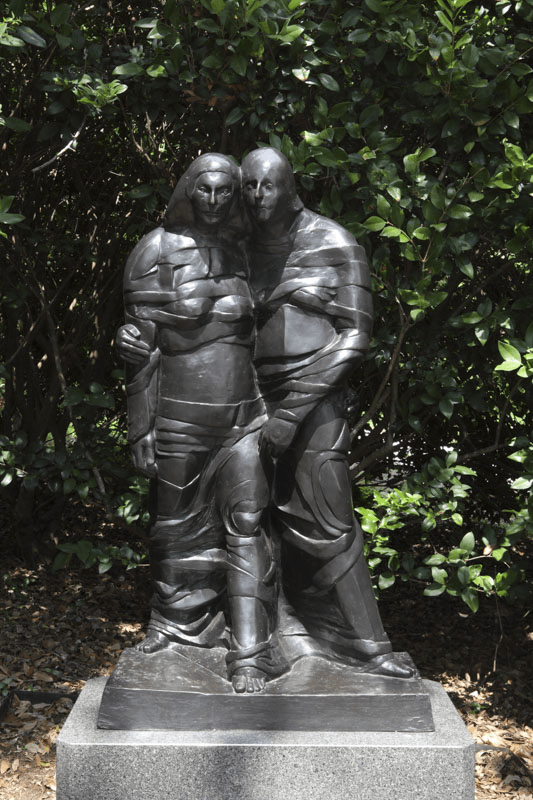
Statue of Ruth and Naomi, by Leonard Baskin (1922-2000)

When Naomi saw that she was determined to go with her, she said no more to her.

So the two of them went on until they came to Bethlehem. When they came to Bethlehem, the whole town was stirred because of them, and the women said, “Is this Naomi?” She said to them,

“Call me no longer Naomi;
    call me Mara,
    for the Almighty has dealt bitterly with me.
I went away full,
    but the Lord has brought me back empty;
why call me Naomi
    when the Lord has dealt harshly with me
    and the Almighty has brought calamity upon me?”

So Naomi returned together with Ruth the Moabite, her daughter-in-law, who came back with her from the country of Moab. They came to Bethlehem at the beginning of the barley harvest. (New Revised Standard Version)

A famine in Judah had brought Naomi and her husband Elimelech to the country of Moab. While there, they had two sons who eventually married two Moabite women: Orpah and Ruth. Over time, each of the husbands died, leaving Naomi and her two daughters-in-law as widows.

Naomi heard that things were finally better in her native Judah. So, she decided to go there, alone. Naomi encouraged her daughters-in-law to remain with their own people and remarry. Orpah did so. Ruth, however, wasn’t having it.

Ruth was determined to stay with her mother-in-law – which meant that she would enter Judah as a foreigner. Despite Naomi’s insistence that Ruth do what is best for herself, Ruth stuck with Naomi.

Once they arrived, the people of Naomi’s hometown were surprised to see the two of them. Naomi was not shy about communicating her bitterness in losing a husband and two sons. She commented that God had turned against her and made her life hard and bitter.

In saying that the Lord had emptied her and brought calamity, Naomi was not speaking against God. Rather, Naomi was expressing some significant theology that has become lost to many modern day Christians around the globe.

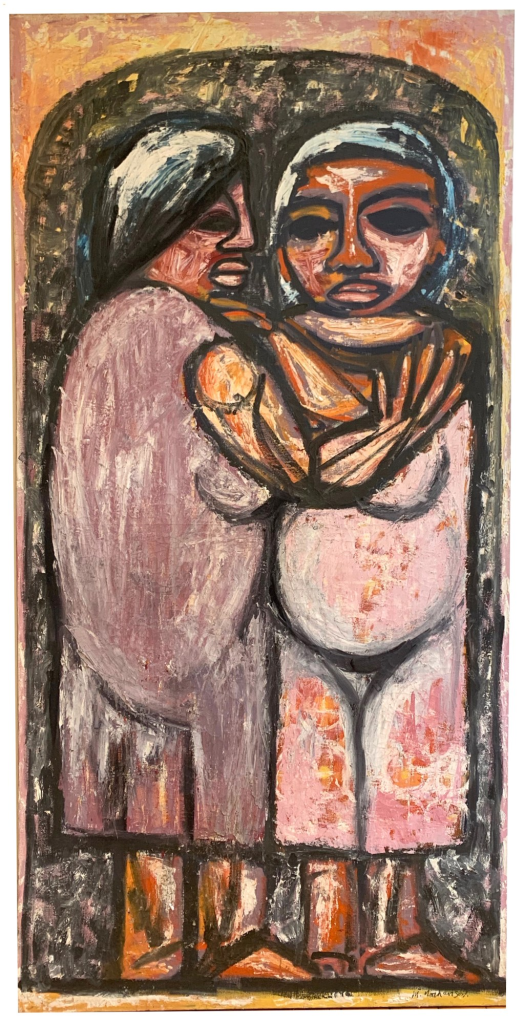
Ruth and Naomi, by Morris Nathanson (1927-2022)

I believe that Ruth was not expressing something malevolent about God, but rather made a statement of faithful recognition, not unlike what Job had to say when he lost his family and his health:

“Naked I came from my mother’s womb, and naked shall I return there; the Lord gave, and the Lord has taken away; blessed be the name of the Lord.” (Job 1:21, NRSV)

No one can escape the dark side of life. Yet, we can deal with that darkness intelligently. It is most necessary to be aware that light creates a shadow that was not there before. The bigger and brighter the light, the bigger and darker the shadow.

There is a centuries old idiom which says, “You can’t have your cake, and eat it, too!” This is a proverbial way of saying that we cannot expect everything to always be good in this life; we must also accept that we cannot always have our way, and that we will go without, experiencing loss.

Whether we want to acknowledge it, or not, an integral part of life is receiving some bad things from God. The Lord does not just go around dispensing everyone’s wishes and making everything a utopia of unicorns and butterflies.

God is most certainly benevolent; yet God also brings darkness to people. We cannot have the Light of the world without experiencing the world’s darkness. Another way of stating this is that a very big God creates quite a large shadow.

In Christianity, the predominant symbol is the cross. The Cross of Christ is both light and dark. Christians may reflexively associate the cross with salvation from sin, while forgetting that the cross is an instrument of torture and death, a tool of execution, like an electric chair.

We must honor the axis crossing at the center of the cross. It is the place of equilibrium, the place of wholeness, where we have the opportunity of integrating all of that unwanted grief and loss into our lives. Failing to do this, let alone neglecting to acknowledge the shadowy places of our hearts, brings harm and hurt to ourselves and to the world.

Naomi acknowledged the shadow. She accepted the darkness, which enabled her to return to her homeland of Judah, the very place where the God of light and dark is worshiped.

I’m not talking about the sort of darkness that is malevolent and mean-spirited, the darkness which comes from Satan. I’m talking about the darkness which weans us away from all things and the ways that hinder us from knowing God.

This is what St. John of the Cross was referring to in naming the dark night of the soul. In our quest to experience union with God, we journey through the darkness, and learn that purification isn’t simply putting something impure away. Purity of heart comes through joining with the God who is pure love itself.

“In the dark night of the soul, bright flows the river of God.”

St. John of the Cross

God loves us so much as to be nailed to a cross and suffer darkness. The Christian is to take up their cross and follow Jesus. That is, we embrace the darkness with an honest engagement of God and God’s world, and through a vulnerable assessment of our own shadow.

For if we fail to acknowledge our shadow, we shall fail to be in union with God.

Not only do many people disown the parts of themselves they don’t like, but they do the same with God – thus making God into their own image of how God should be, instead of taking God as God is.

If you have ears to hear, take this to heart: To accept and honor your own shadow is a profound and necessary spiritual discipline. By “shadow” I mean all of the characteristics of myself that I withhold from others, so that they will only see what I want them to see.

We often put a false self out into the world, for others to see. It is a sort of psychological clothing we wear, much as we have actual clothing. Whether the clothes are real or metaphorical, we dress ourselves in the particular way we want to be seen.

Naomi was a true Israelite, showing her honest true self. There was no separation or division between the inner self and the self she presented to others.

I tend to think that Naomi knew something about God that many don’t know today – and was therefore able to be faithful to both her people and her God.

It is no wonder, then, that Ruth wanted to remain with her mother-in-law Naomi, who was a real person acknowledging the real God.

Almighty God and Father, maker of heaven and earth, of all that is seen and unseen: You are the God of light who illumines our way. And You are the God of darkness who is shadowed in mystery. In knowing You, may I know myself; and in knowing myself, may I more fully know You. Amen.

Be Honest (Job 42:7-9)

Job’s Sacrifice, by William Blake (1757-1827)

After the Lord had finished speaking to Job, he said to Eliphaz, “I am angry with you and your two friends, because you did not speak the truth about me, the way my servant Job did. Now take seven bulls and seven rams to Job and offer them as a sacrifice for yourselves. Job will pray for you, and I will answer his prayer and not disgrace you the way you deserve. You did not speak the truth about me as he did.”

Eliphaz, Bildad, and Zophar did what the Lord had told them to do, and the Lord answered Job’s prayer. (Good News Translation)

After all of Job’s terrible trouble in losing everything and everyone he cared about; after all of the longwinded speeches of his supposed friends; and after God’s breaking of silence through unanswerable questions; the epilogue of the story brings us God’s verdict concerning Job and his situation.

God finally dispenses his assessment, and renders his judgment. The Lord was not at all happy with Job’s companions; and was pleased with Job. Therefore, God made a decision against the companions, and for Job.

Four times in three verses, God refers to Job as “my servant,” but does not describe the friends as such. It is Job, and not Job’s friends, who spoke truth. Only Job spoke words consistent with reality.

At best, the friends spoke unhelpful words. At the worst, their words were hurtful and full of hubris. In retrospect, they probably should have at least kept their mouths shut. And ideally, they could have been true comforters, and consoled Job in his agony.

This gets at something which I believe we all need to get a firm hold upon: Not extending help, mercy, and consolation to those in dire straits, pisses-off God.

It irks God because it is a misrepresentation of God’s basic character, and distorts God’s true nature.

Being dishonest and pretending to be okay when one is not…

telling someone who is hurting to suck it up and confess their sin…

believing that the world operates according to good guys getting health and wealth, and bad guys getting sickness and poverty…

downright angers the holy and merciful God of the universe.

Job, unlike the Three Stooges he had as friends, affirmed what is right and true:

  • God is the Sovereign of the universe who dispenses both good and bad (Job 2:10)
  • God is the One who gives and who takes away (Job 1:21)
  • God is the Lord to whom we must bow in willing submission (Job 42:5-6)

In the dialogue with his friends, Job rightly insisted that God is sometimes an enemy, and that God’s inexplicable silence and absence is unjust and destructive.

I don’t want you to easily pass over what I just referred to, or to flip-out over it. In truth, God is both present and absent. And God’s absence hurts. Sometimes, it hurts like hell. We must affirm that God is sometimes silent. There are times when it feels like God is on vacation and is paying no attention.

I want you to get ahold of this important dimension to the spiritual life:

Human pretentions and posturing only present a false self to God and the world. That sort of behavior angers God. The Lord wants honest vulnerability.

Whereas Job’s friends insisted on maintaining theological respectability and an ordered theological system, Job essentially said, “To hell with all that!”

And Job was right.

Job contended with God. He cried, yelled, and exposed his innermost thoughts and feelings to God. Job was real. No phoniness existed with him. Yet, Job did not forsake God, curse God, or say there was no God.

The genuine spiritual life is always a tricky and risky combination of devotion and confrontation toward God.

Job presented his true self to God.

Job’s friends presented to God what they believed God wanted to see and hear.

There is a big difference between those two approaches.

God affirmed Job. God was against Job’s friends.

Maybe today it is necessary to rethink what you have always believed it is which gets God’s affirmation, and what raises God’s ire.

If we cannot be honest about what we are really thinking, and about how we are really doing, then we are hopeless people. In that state, no one can help us. And God is not pleased.

The final verdict of God is that only the prayers of one who speaks truth, like Job, will be effectively heard. Less honest prayers, like those of Job’s wife and friends, are foolish and ineffective.

One of the big overall messages of the Book of Job is this: For God’s sake, be honest!

My own culture is one of Midwest nice. That’s a nice way of saying that Midwesterners are mostly dishonest creatures. Every Midwesterner I know, understands being nice and polite to someone’s face, and then speaking gossip and slander to their back.

Ask any Midwestern American how they are doing, and they’ll tell you, “Just fine,” or “Great!” or “The sun is shining,” or some other deflection or blathering lie about how they are really doing. More than once, I have actually heard a depressed person with suicidal ideation tell another person that they are “doing fine today.”

That sort of claptrap gets us nowhere, especially with God. The Lord is okay with you and I telling him what we really think, even if we are extremely upset with God. God isn’t bothered by our anger, yelling, or messed-up thinking. But God is bothered by our pretending, our dishonesty, and our false presentations.

None of this means that we must wear our heart on our sleeve. In fact, I have found that persons who declare to me that they “tell it like it is,” are some of the most false people on the planet. It’s usually a sign that I’m not going to get from them how they are really feeling. It usually means they’re angry, and want to talk smack against someone, without ever examining themselves.

Don’t be a jerk. There are nice jerks, and obnoxious jerks, but in the end, they’re all just jerks. You and I really can speak honest words of truth, without being a jerk about it.

Job was honest, real, raw, hurt, angry, sad, lonely, and grieving out of his mind. And he was no jerk. And God affirmed him.

Personally, I’d rather have God’s affirmation than anyone else’s. How about you?

Almighty God, help us to speak and act truthfully in all situations. May we be honest with ourselves and with others, building trust and integrity in our relationships. Thank you for your example of truth and honesty. Help us to follow in your footsteps and to live with authenticity.

Guide us to be honest even when it is difficult, recognizing that honesty is the foundation of trust and respect. Help us to confront our own falsehoods and to seek the truth in all aspects of our lives. May we create environments where honesty is valued and encouraged, fostering open and transparent communication.

We pray for those who struggle with honesty, asking for your guidance and support in their journey towards truthfulness. Thank you for the clarity and peace that comes from living honestly. Help us to embrace and uphold this value every day. Amen.

A Great Reversal (Esther 8:1-17)

Reversal, by Margarita Lypiridou, 2021

That same day King Xerxes gave Queen Esther the estate of Haman, the enemy of the Jews. And Mordecai came into the presence of the king, for Esther had told how he was related to her. The king took off his signet ring, which he had reclaimed from Haman, and presented it to Mordecai. And Esther appointed him over Haman’s estate.

Esther again pleaded with the king, falling at his feet and weeping. She begged him to put an end to the evil plan of Haman the Agagite, which he had devised against the Jews. Then the king extended the gold scepter to Esther and she arose and stood before him.

“If it pleases the king,” she said, “and if he regards me with favor and thinks it the right thing to do, and if he is pleased with me, let an order be written overruling the dispatches that Haman son of Hammedatha, the Agagite, devised and wrote to destroy the Jews in all the king’s provinces. For how can I bear to see disaster fall on my people? How can I bear to see the destruction of my family?”

King Xerxes replied to Queen Esther and to Mordecai the Jew, “Because Haman attacked the Jews, I have given his estate to Esther, and they have impaled him on the pole he set up. Now write another decree in the king’s name in behalf of the Jews as seems best to you, and seal it with the king’s signet ring—for no document written in the king’s name and sealed with his ring can be revoked.”

At once the royal secretaries were summoned—on the twenty-third day of the third month, the month of Sivan. They wrote out all Mordecai’s orders to the Jews, and to the satraps, governors and nobles of the 127 provinces stretching from India to Cush. These orders were written in the script of each province and the language of each people and also to the Jews in their own script and language. Mordecai wrote in the name of King Xerxes, sealed the dispatches with the king’s signet ring, and sent them by mounted couriers, who rode fast horses especially bred for the king.

The king’s edict granted the Jews in every city the right to assemble and protect themselves; to destroy, kill and annihilate the armed men of any nationality or province who might attack them and their women and children, and to plunder the property of their enemies. The day appointed for the Jews to do this in all the provinces of King Xerxes was the thirteenth day of the twelfth month, the month of Adar. A copy of the text of the edict was to be issued as law in every province and made known to the people of every nationality so that the Jews would be ready on that day to avenge themselves on their enemies.

The couriers, riding the royal horses, went out, spurred on by the king’s command, and the edict was issued in the citadel of Susa.

When Mordecai left the king’s presence, he was wearing royal garments of blue and white, a large crown of gold and a purple robe of fine linen. And the city of Susa held a joyous celebration. For the Jews it was a time of happiness and joy, gladness and honor. In every province and in every city to which the edict of the king came, there was joy and gladness among the Jews, with feasting and celebrating. And many people of other nationalities became Jews because fear of the Jews had seized them. (New International Version)

“So the last will be first, and the first will be last.”

Jesus (Matthew 20:16)

Knowing that someone is not who they present themselves as can be maddening. They’re selfish and enamored with having authority, yet everyone thinks they are okay.

Haman was a bad man who camouflaged himself as important. As the right hand man to King Xerxes of the vast Persian Empire, Haman valued position, power, and attention above all else. But his arrogance proved to be his downfall.

People who are concerned to be seen as important can never get enough. Haman was not satisfied to be the prime minister in the empire, even though millions of people bowed down to him.

Mordecai, a Jew, Queen Esther’s cousin, refused to bow down. He saw the pride and arrogance within Haman to have what only belongs to God.

Haman could not stomach this one Jew dismissing his power and authority. As a person who wanted only “yes men” around him, Haman was determined to eradicate Mordecai. And even that was not enough for him. So, Haman proposed the destruction of all Jews.

He was supposedly an imperial expert on “the Jewish problem.” So, King Xerxes listened to him when he hatched a devious strategy to rid the empire of all Jews. A decree was made that on a particular day the Jews could be destroyed and plundered.

But the real plan that resets all other plans is the plan of God. And God’s plans are for good, not evil; and for Jewish life, not death.

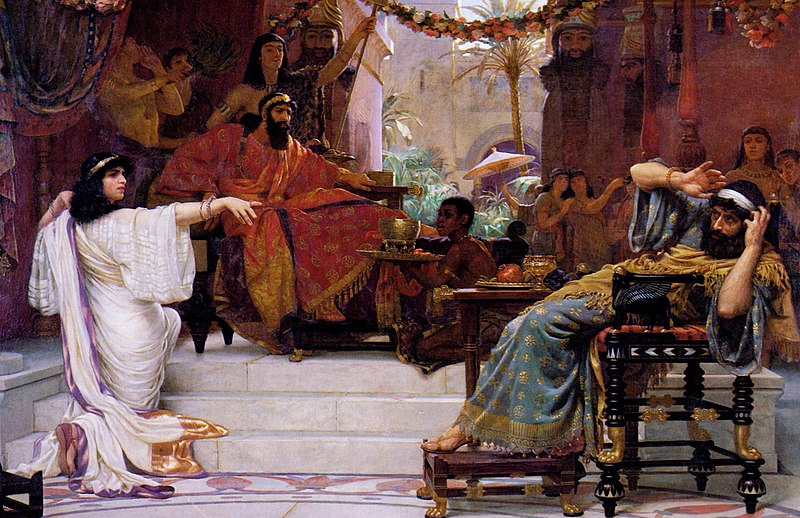
Esther Denouncing Haman, by Ernest Normand, 1888

Pride and arrogance never ends well for the proud and arrogant person. They may have their way for a while, but ultimately such people find that their evil plans come back on themselves.

So, one night when the king was unable to sleep, he had the annals of the kingdom read to him. He heard of Mordecai’s successful effort at saving the king’s life from an assassination plot. The king also learned that Mordecai had never been properly recognized and rewarded.

One of the main differences between the proud and the humble is that arrogant people are obsessed with recognition and rewards; whereas the humble person cares about what is right and just, viewing good deeds as their own reward.

As the king’s trusted right hand man, Haman was consulted as to what ought to be done for someone the king wants to honor. The proud person always believes the honored person is themselves.

So, Haman, believing Xerxes wanted to honor him, suggested an elaborate recognition ritual involving a parade and plenty of accolades.

The king, however, had this in mind for Mordecai. He ordered Haman to be the one who made sure the recognition happened. And that’s not all. Haman would also get retribution for his evil heart.

Behind the scenes of royal power and scuttlebutt, Esther and her people were praying and fasting. Esther had her own plans for good, and not for evil.

Of course, Haman believed that a banquet was being given in his honor by the queen. In reality, not at all.

Esther revealed to the king the true plot and hate against her own people. Enraged, King Xerxes demanded who would dare presume to do such a thing against his beloved queen and her people.

With Haman directly in front of them, Esther pointed out the adversary. And then, the gallows which Haman had made to hang Mordecai were used for his own execution. Thus ended the story of the villain Haman.

There was still, however, the problem of the royal decree to destroy the Jewish people on an appointed day. Haman had been dealt with, but there were still wide-ranging consequences of his actions that remained in effect, and that could only be dealt with at the political level.  

Queen Esther interceded to the king on behalf of her people. Although a decree from the king cannot be revoked, yet another decree could be written in another’s name that would counteract the first. And this is precisely what Mordecai and Esther did, with the king’s full knowledge and blessing to it.

Today’s Old Testament lesson is a great reversal of fortunes if there ever was one. The high position of Haman and his extreme hatred and arrogance are gone. The Jewish people, on the precipice of annihilation, are not only alive, but had the opportunity to pushback on their enemies. Mordecai was not hanged on a gallows, but became in charge of Haman’s entire estate.

This was a restoration beyond what anyone could have thought or imagined. And that is the sort of reversal which God specializes in.

You cannot fool God, so don’t make a fool of yourself! You will harvest what you plant. If you follow your selfish desires, you will harvest destruction, but if you follow the Spirit, you will harvest eternal life. Don’t get tired of helping others. You will be rewarded when the time is right, if you don’t give up. (Galatians 6:7-9, CEV)

God, I am far too often influenced by what others think of me. May I not pretend to be either richer or smarter or nicer than I really am. Please hinder me from trying to attract attention. Don’t let me gloat over praise on one hand or be discouraged by criticism on the other. Nor let me waste time weaving imaginary situations in which the most heroic, charming, witty person present is myself. Show me how to be humble of heart, like you. Amen.

Have Enough Sense to Learn Some Life Lessons (Proverbs 19:24-29)

Some people are too lazy to put food in their own mouths.

Arrogance should be punished, so that people who don’t know any better can learn a lesson. If you are wise, you will learn when you are corrected.

Only a shameful, disgraceful person would mistreat his father or turn his mother away from his home.

My child, when you stop learning, you will soon neglect what you already know.

There is no justice where a witness is determined to hurt someone. Wicked people love the taste of evil.

A conceited fool is sure to get a beating. (Good News Translation)

I believe one good practice is to ponder the biblical proverbs and write them in our own words. So, here is today’s Proverbs lesson in my own colloquial words, with a brief bit of commentary:

There are folks who have gotten so used to laziness that they don’t even use their hands to feed themselves.

It’s important not to enable such persons to be this way by bringing them food and feeding them. It reinforces bad behavior, and will only frustrate you if you give-in to the rationalizations from the lazy person.

Arrogant fools need sense enough to see that foolish stupidity leads to punishable consequences; but a person with good sense learns the humility of being corrected without having to be harshly punished.

Part of what makes a person foolish and arrogant is that they honestly believe they’re an exception to the rules, that they can do what they want and not suffer the consequences. Conversely, the wise person doesn’t always need to learn the hard way. They listen to correction and accept it, thus avoiding adverse consequences from continuing in a particular way.

Kids without any sense at all are a disgrace to their parents; they steal from mom and dad and refuse to care for them in their need.

A parent’s greatest shame is when one of their children ignore what they’ve been taught and use the parents to get what they want. And then when mom and dad have a need, the kid has every excuse in the book to not help them. Unfortunately, there are times when a parent must take action to protect themselves from a wayward child. It isn’t healthy to let your children use you with impunity.

If you have no inclination to learn, you will eventually become as dumb as a brick.

Anyone who doesn’t take the stance of being a life-long learner will end up losing what little knowledge they have. That’s because memory is tied to actionable learning. If you don’t use it, you’ll lose it.

A witness who lies brings harm to both the court system and the persons involved; he is just like a criminal who commits crimes and revels in a lie as if it was a delicious meal.

Sadly, there are some people in this old fallen world who take delight in lying, cheating, and stealing. It gives them a twisted feeling of superiority and control to manipulate a person or a system. So, beware of the one who has no conscience.

The only thing an arrogant fool can expect to get in this life (and the next) is punishment.

A fool is a fool because they neither learn a lesson from observing what happens to others, nor learn from their own mistakes, misplaced words, and bad behavior. Although they shouldn’t be surprised whenever they are fired from a job, arrested by the police, or have a spouse leave them, they are; somehow they feel entitled to live as they please and have others accommodate to their life.

The biggest chunk of the Book of Proverbs (chapters 10-22) are wise sayings framed mostly in couplets. The majority of the verses are a contrast between the wise and the foolish, the righteous and the wicked, the good and the bad.

The contrasts are meant to demonstrate consequences. If we make decisions and live our lives in a good and right way, then it is likely that we will be successful and have some overall happiness.

However, if we choose to go through life like the fool, then we should expect some rather adverse consequences.

For example, both parents and children need to make some responsible choices in order to live well. Parents are to put a great deal of effort into raising, training, and loving their children so that they can be successful in life. Children are to respond by accepting parental teaching and seeking to live into the wisdom taught to them.

And yet, there are parents who are uncommitted to preparing their children for adulthood. And there are adult children who want nothing to do with anything their parents tell them, believing their mom or dad to be stupid or out of touch. However, sooner or later, they will learn a hard lesson.

A happy family is a beautiful thing; a contentious bunch of relatives always walks away hurt.

Every day is an opportunity to build on a wise foundation of life. The sorts of decisions we make, and why we make them, is of upmost significance for a good, right, and just way of living. And this wisdom, ideally, is to be passed on by both words and actions.

No matter who we are – whether parents or children, community leaders or citizens, managers or employees, neighbors or nations, we are all to grow in maturity by learning to make wise choices in life which bless others, and thus, bless yourself.

We are neither to live arrogantly and selfishly, nor are we to allow bad attitudes and behaviors to exist within our families, communities, and workplaces.

The beginning of wisdom in living a good life is to know God and be a life-long learner of sacred wisdom literature. This is the first and most important choice of all.

All-wise and all-powerful God of the universe, you have given dominion over this earth, in order that we may steward good and right living which allows all life to thrive and flourish. Give us wisdom to use all that you have given, so that no one may suffer from our foolish stupidity, and that the generations yet to come may know that there is a good God in heaven who blesses those who do right and forsake evil. Amen.