

Make Good Choices (1 Kings 14:1-8)

At that time Abijah son of Jeroboam became ill, and Jeroboam said to his wife, “Go, disguise yourself, so you won’t be recognized as the wife of Jeroboam. Then go to Shiloh. Ahijah the prophet is there—the one who told me I would be king over this people. Take ten loaves of bread with you, some cakes and a jar of honey, and go to him. He will tell you what will happen to the boy.” So Jeroboam’s wife did what he said and went to Ahijah’s house in Shiloh.

Now Ahijah could not see; his sight was gone because of his age. But the Lord had told Ahijah, “Jeroboam’s wife is coming to ask you about her son, for he is ill, and you are to give her such and such an answer. When she arrives, she will pretend to be someone else.”

So when Ahijah heard the sound of her footsteps at the door, he said, “Come in, wife of Jeroboam. Why this pretense? I have been sent to you with bad news. Go, tell Jeroboam that this is what the Lord, the God of Israel, says: ‘I raised you up from among the people and appointed you ruler over my people Israel. I tore the kingdom away from the house of David and gave it to you, but you have not been like my servant David, who kept my commands and followed me with all his heart, doing only what was right in my eyes. You have done more evil than all who lived before you. You have made for yourself other gods, idols made of metal; you have aroused my anger and turned your back on me.

“‘Because of this, I am going to bring disaster on the house of Jeroboam. I will cut off from Jeroboam every last male in Israel—slave or free. I will burn up the house of Jeroboam as one burns dung, until it is all gone. Dogs will eat those belonging to Jeroboam who die in the city, and the birds will feed on those who die in the country. The Lord has spoken!’

“As for you, go back home. When you set foot in your city, the boy will die. All Israel will mourn for him and bury him. He is the only one belonging to Jeroboam who will be buried, because he is the only one in the house of Jeroboam in whom the Lord, the God of Israel, has found anything good.

“The Lord will raise up for himself a king over Israel who will cut off the family of Jeroboam. Even now this is beginning to happen. And the Lord will strike Israel, so that it will be like a reed swaying in the water. He will uproot Israel from this good land that he gave to their ancestors and scatter them beyond the Euphrates River, because they aroused the Lord’s anger by making Asherah poles. And he will give Israel up because of the sins Jeroboam has committed and has caused Israel to commit.”

Then Jeroboam’s wife got up and left and went to Tirzah. As soon as she stepped over the threshold of the house, the boy died. They buried him, and all Israel mourned for him, as the Lord had said through his servant the prophet Ahijah. (New International Version)
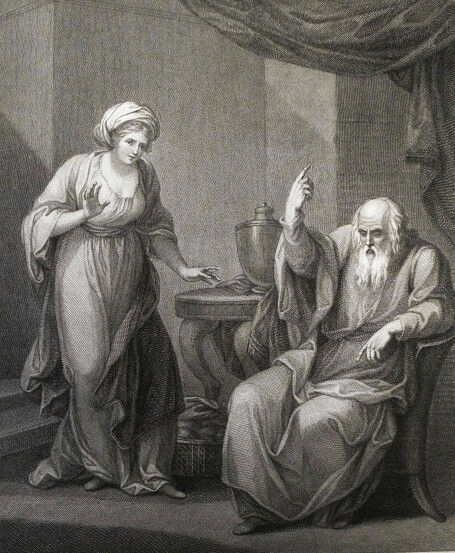
The prophet Ahijah and the wife of Jeroboam, 1853

It’s a sad reality that whenever we make choices to live against the grain of who are meant to be as humans, we not only harm ourselves, but other people also end up as collateral damage. Our own individual decisions may be independent, but the ramifications of those choices are always interdependent in scope and complexity.

The very same prophet who prophesied the rise of Jeroboam and his reign also prophesied his calamitous ending. Along with the establishment of a monarchy in Israel, there was also an ascension of divine prophets to the royal kings whenever things were going awry.

The prophet Ahijah had let King Jeroboam know, at the outset of his reign, that his longevity would depend upon his own faithfulness and attentiveness to God’s law (1 Kings 11:38). But Jeroboam failed to do this, and it doomed him and his family. The immediate death of Jeroboam’s young son was the confirmation of the divine judgment that would eventually come.

It behooves us all to consider the Apostle Paul’s words concerning fidelity toward God and our decisions as persons:

Make no mistake, God is not mocked. A person will harvest what they plant. Those who plant only for their own benefit will harvest devastation from their selfishness, but those who plant for the benefit of the Spirit will harvest eternal life from the Spirit. Let’s not get tired of doing good, because in time we’ll have a harvest if we don’t give up. So then, let’s work for the good of all whenever we have an opportunity, and especially for those in the household of faith. (Galatians 6:7-10, CEB)

Jeroboam turned his back on God, in favor of going with his own ingenuity and pragmatic actions to secure his rule and reign in Israel. No matter who we are – whether king or commoner, rich or poor – it is our personal and collective responsibility to ensure that sound, wise, and good decisions are being made with an eye toward the benefit of all persons.

This then, begs the question: What are our priorities and practices?

Prophetic utterances in Holy Scripture typically center in human arrogance and mistreatment of other people. And this is why following the commands of God are to be supremely important to the believer – because the instructions given to humanity from the Lord are meant for humility and justice toward others.

I believe that if we seek to live into the spirit of God’s law, we will continually labor to make good choices for the common good of everyone. Important social, economic, and political policies and practices won’t just spring up from nowhere to benefit humanity; they must be intentionally cultivated by people who make it a priority to pay attention to such matters and follow through with the right, the just, and the good.

Let’s persevere in doing good; and not succumb to the pragmatic, just to get something done that we want.

Almighty God our heavenly Father, you declare your glory and show forth your handiwork in the heavens and in the earth: Deliver us in our various occupations from the service of self alone, that we may do the work you give us to do in truth and beauty and for the common good; for the sake of him who came among us as one who serves, your Son Jesus Christ our Lord, who lives and reigns with you and the Holy Spirit, one God, for ever and ever. Amen.


From Good to Bad (1 Kings 11:26-40)

Also, Jeroboam son of Nebat rebelled against the king. He was one of Solomon’s officials, an Ephraimite from Zeredah, and his mother was a widow named Zeruah.

Here is the account of how he rebelled against the king: Solomon had built the terraces and had filled in the gap in the wall of the city of David his father. Now Jeroboam was a man of standing, and when Solomon saw how well the young man did his work, he put him in charge of the whole labor force of the tribes of Joseph.

About that time Jeroboam was going out of Jerusalem, and Ahijah the prophet of Shiloh met him on the way, wearing a new cloak. The two of them were alone out in the country, and Ahijah took hold of the new cloak he was wearing and tore it into twelve pieces. Then he said to Jeroboam, “Take ten pieces for yourself, for this is what the Lord, the God of Israel, says:

“‘See, I am going to tear the kingdom out of Solomon’s hand and give you ten tribes. But for the sake of my servant David and the city of Jerusalem, which I have chosen out of all the tribes of Israel, he will have one tribe. I will do this because they have forsaken me and worshiped Ashtoreth the goddess of the Sidonians, Chemosh the god of the Moabites, and Molek the god of the Ammonites, and have not walked in obedience to me, nor done what is right in my eyes, nor kept my decrees and laws as David, Solomon’s father, did.

“‘But I will not take the whole kingdom out of Solomon’s hand; I have made him ruler all the days of his life for the sake of David my servant, whom I chose and who obeyed my commands and decrees. I will take the kingdom from his son’s hands and give you ten tribes. I will give one tribe to his son so that David my servant may always have a lamp before me in Jerusalem, the city where I chose to put my Name. 

“However, as for you, I will take you, and you will rule over all that your heart desires; you will be king over Israel. If you do whatever I command you and walk in obedience to me and do what is right in my eyes by obeying my decrees and commands, as David my servant did, I will be with you. I will build you a dynasty as enduring as the one I built for David and will give Israel to you. I will humble David’s descendants because of this, but not forever.’”

Solomon tried to kill Jeroboam, but Jeroboam fled to Egypt, to Shishak the king, and stayed there until Solomon’s death. (New International Version)

The prophet Ahijah speaking to the future king, Jeroboam, by Gerard Hoet, 1728

The Good and the Bad

People were originally created by a good God for the purpose of goodness. After forming the first people, Adam and Eve, God looked at humanity and said that it was “very good.” (Genesis 1:26-28, 31)

Yet, even though we all have been created good, that which is bad entered the world by means of the devil. And ever since that time, people in every era have struggled between their inherent design and their innate desires for something different. (Genesis 3:1-20)

Even King Solomon, with all of his great and God-given wisdom, eventually drifted into the bad. He succumbed to allowing other gods to come alongside the worship of the One true God. And there were consequences to those choices.

Recovering the Word “Sin”

“Sin” is a word that isn’t much used anymore. On the one hand, this is okay since the term has been much abused by many a misguided preacher. Yet, on the other hand, it’s a word which needs to be recovered, so that we will learn to avoid the bad and live into our good as image-bearers of God.

As the head of all Israel and Judah, Solomon had a grand kingdom. His father, David, was a man after God’s own heart. So, God established a covenant with David that there would always be one of his descendants on the throne. Solomon followed in his father’s footsteps and expanded the borders of Israel, bringing a level of prosperity and wealth never seen before or since.

And yet, either despite or because of Solomon’s wild success, bits of disobedience began to occur. Perhaps Solomon simply rested on his own laurels; or maybe he could not envision anything other than ongoing abundance. But for whatever reason, King Solomon started gravitating toward having more than he needed and ignored the instructions given to the people by God:

The king, moreover, must not acquire great numbers of horses for himself or make the people return to Egypt to get more of them, for the Lord has told you, “You are not to go back that way again.” He must not take many wives, or his heart will be led astray. He must not accumulate large amounts of silver and gold. (Deuteronomy 17:16-17, NIV)

And that is precisely what happened. Solomon had 700 wives (women of royal birth) and 300 concubines (women of common origin). And all those women served a variety of gods in a cornucopia of religious practices – some of which were downright inhumane and unjust. (1 Kings 11:1-13)

None of us are immune from falling into the guilt and shame of disobedient sin. For Solomon, this had the consequence of having the kingship almost completely ripped from his descendants to another man’s, Jeroboam.

Individuals, institutions, and nations have the potential for both great good, as well as heinous evil. When anyone begins to be concerned only for themselves and rests on their success, instead of the Lord, they have set up themselves for a collapse through the displeasure of God.

Stories of people who topple into sin are all close to the same – having some power, they use it to assert control over another person or group to obtain whatever they want. King Solomon violated God’s law. Not only that, but when he saw his control threatened, he sought to kill Jeroboam. Perhaps Solomon thought he was above all this, and believed he could do whatever he wanted. But he couldn’t.

Sin causes us to sell-out our principles 

Sin only begets more sin until we deal with it. Sin will always distort the truth so that we minimize the impact of our words, choices, and actions. Truth celebrates openness and honesty; sin seeks the shadows and prizes secrecy. 

The first step to dealing with sin is not to minimize it, ignore it, or pretend it isn’t a big deal. If we do not go down this path of truth, then we will be forever encrusting our lives with ways of ensuring that no one ever knows the sinful secrets. 

In fact, much of religious legalism is nothing more than a person piling on the rules in order for others to not see the sin that hides deep within. In Christianity, turning from the sin and receiving the grace of forgiveness in Jesus Christ is the true and real path to spiritual wholeness, happiness, and success in life.

Results that satisfy us do not necessarily satisfy God

Solomon accomplished what he wanted – some of it very good, and some of it very bad. The good was celebrated, and the bad was covered up. Yet, God sees all of it, celebrating with us the good, but not going with us down the path of self-indulgent sin.

We cannot simply assume that because we do something, and there was no immediate lightning strike, that it was okay. It does not matter if it happened yesterday, last month, or twenty years ago. If we did not deal with the sin, God is not satisfied because he wants to dispense grace; love and a flourishing soul cannot happen if we keep putting things out-of-sight out-of-mind. To only satisfy ourselves is being a spiritual cannibal who eats other people alive.

Outward success and abundance means little to God if the inward state leadership is a vacuous soul, bereft of authentic spiritual connection, with no determination toward God’s intentions for a particular course of action. 

Sin is not something to simply be managed; it is to be put to death through the cross of Christ, and applied to life through intentional spiritual practices meant to genuinely connect with God. 

For the Christian, to do less is to wander into a morass of consequences that damage others, not to mention harming ourselves. So, let us do the work of soul care so that the common good of all will thrive in the grace of God in Christ.

God, you have given all peoples one common origin.
It is your will that they be gathered together
as one family in yourself.
Fill the hearts of mankind with the fire of your love
and with the desire to ensure justice for all.
By sharing the good things you give us,
may we secure an equality for all
our brothers and sisters throughout the world.
May there be an end to division, strife and war.
May there be a dawning of a truly human society
built on love and peace.
We ask this in the name of Jesus, our Lord. Amen.

Have a Healthy Spiritual Heart (Matthew 12:9-14)

Going on from that place, he went into their synagogue, and a man with a shriveled hand was there. Looking for a reason to bring charges against Jesus, they asked him, “Is it lawful to heal on the Sabbath?”

He said to them, “If any of you has a sheep and it falls into a pit on the Sabbath, will you not take hold of it and lift it out? How much more valuable is a person than a sheep! Therefore it is lawful to do good on the Sabbath.”

Then he said to the man, “Stretch out your hand.” So he stretched it out and it was completely restored, just as sound as the other. But the Pharisees went out and plotted how they might kill Jesus. (New International Version)

The juxtaposition of this story is pronounced: A man with a shriveled hand stretched it out and is healed by Jesus in full view of everyone in the synagogue; and the synagogue leaders with shriveled hearts withhold their hearts from Jesus, and are not healed of their paralyzed beliefs.

Asking questions out of a desire to make a point, instead of asking out of sincere curiosity, is a telltale sign of the small and shriveled heart. And the surefire signal that the heart is wadded-up like a crumpled piece of paper, is the concern for policy and procedure over people.

There was, of course, an allowance for life-threatening medical situations to be attended to on the Sabbath. The man’s shriveled hand, however, didn’t fall into this category. Jesus could have handled the question of healing by stating that he would do it the next day. That certainly would have protected him and quelled any concerns of his orthodoxy.

But Jesus didn’t go there.

Jesus heals the man with a withered hand, from a 17th century Arabic copy of the Gospels

Instead, he deliberately made a stink in front of everyone. Why? Because the whole situation already stunk to high heaven. The ensconced handling of the law by the religious authorities was calloused to real human need. In other words, such a view of the law was ungodly.

Somewhere along the line, the command of a Sabbath day’s rest had turned from a devoted time for community renewal to an opportunity for showing off one’s religiosity and personal piety.

And the height of offense for Jesus was that God was used as the justification for the peacocking to happen. It is to place the supreme spirituality of a holy person above the hard reality of human need and pain. Jesus wanted nothing to do with such a charade of law.

The divine purpose of the Sabbath command was the health of the entire community – even including animals. It’s meant to be a day of mercy, and not a day of restrictions to the point of perpetuating or even causing ill health.

In truth, to not heal on the Sabbath is a travesty of God’s law.

This isn’t only an ancient problem, but also a contemporary issue, as well. One reason so many modern people today believe that Christianity (and, in some cases, all religion) is nothing but a bunch of goofiness, is that there are far too many Christians and churches who espouse a reading of Scripture that is unhealthy instead of healthy.

Whenever Holy Scripture is used a weapon to keep women in check, existing power structures in place, and people different from one’s religious tradition out of congregational life, then such a practice will eventually be challenged by Jesus. And, ironically, all the nice religious folk will turn on Christ and plot how to be rid of him altogether.

And who, pray tell, wants to be a part of that sort of goofiness?

The bottom line, for many people, is their wealth, money, property, and resources. And if someone happens to get in the way of those economic resources, well then, we’ll simply reinterpret existing biblical commands to protect and maintain our stuff.

For Jesus, the whole point of the banter in the synagogue was to actually help the man right in front of him – to do the right thing on the Sabbath day, and not the hard-hearted thing of nothing.

Sabbath is intended to give everyone, without exception, an opportunity to “be” instead of “do.” The Sabbath is designed for the interests and betterment of all creation, all humanity, and not the other way around. The very fact that the upstanding religious folk even have to be told this, signals that they have drifted very far from the actual commands of God.

“If Jesus had been more diplomatic, he may have reformed Judaism, but he would not have won the world. He would not have give us a gospel that serves the depth intention of the law by freeing us from a slavish service to its surfaces.”

Frederick Dale Bruner

In short, Jesus healed the man’s shriveled hand. But the pious religious persons were not healed of their shriveled hearts. Instead, they were mad as hell. They held an after-church meeting in the parking lot about how to do away Jesus, once and for all.

They did this because the entire movement of maintaining religious power and authority was being threatened to the core.

There are those who hate the one who upholds justice in court and detest the one who tells the truth. (Amos 5:10, NIV)

Therefore, I strongly urge every believer in Jesus Christ to be completely devoted to the Scriptures of the Old and New Testaments, by actually reading them every day; instead of relying upon slick preachers who tell you what you like to hear.

Be discerning and wise in the reading, hearing, and study of God’s Holy Word. It’s a matter of health and illness, hope and despair, life and death. Don’t have a shriveled heart; have a healthy heart, my friend.

Almighty God, to you all hearts are open, all desires known, and from you no secrets are hid: Cleanse the thoughts of our hearts by the inspiration of your Holy Spirit, that we may perfectly love you, and worthily magnify your holy Name; through Christ our Lord. Amen.

Have Some Spiritual Discernment (Deuteronomy 13:1-5)

Prophet, by Théophile Alexandre Steinlen, 1902

Prophets or interpreters of dreams may promise a miracle or a wonder, in order to lead you to worship and serve gods that you have not worshiped before. Even if what they promise comes true, do not pay any attention to them. The Lord your God is using them to test you, to see if you love the Lord with all your heart. Follow the Lord and honor him; obey him and keep his commands; worship him and be faithful to him. 

But put to death any interpreters of dreams or prophets that tell you to rebel against the Lord, who rescued you from Egypt, where you were slaves. Such people are evil and are trying to lead you away from the life that the Lord has commanded you to live. They must be put to death, in order to rid yourselves of this evil. (Good News Translation)

It’s a foolish notion that a servant of God can have a moonlighting gig with another god. A shortsighted philosophy believes that worshiping God on the Sabbath allows one to then do whatever they want on the other six days. And a downright deadly act is to become enamored with a miracle and then follow the miracle worker who did it, even though they want nothing to do with devotion to the Lord.

It only takes one bad apple to spoil the whole bushel basket of them. Just one rotten egg in a six egg omelet will ruin the entire thing. And one bad prophet amongst the people will end up destroying the congregation. Evil isn’t something to dabble with; instead, wickedness is something to rid yourself of altogether.

“If your right eye causes you to stumble, gouge it out and throw it away. It is better for you to lose one part of your body than for your whole body to be thrown into hell. And if your right hand causes you to stumble, cut it off and throw it away. It is better for you to lose one part of your body than for your whole body to go into hell.” Jesus (Matthew 5:29-30, NIV)

Jesus declared that believers must take decisive, drastic, and radical action against idolatry. Serving other gods, along with the one true God, requires an amputation. The biblical text of both Testaments leaves us no room to believe that it’s okay to dabble in things that the Lord condemns. And if we think we are not hurting anybody to hold onto such a thought, we very much need to think again.

True prophets and preachers don’t lead people into idolatry, no matter how spectacular their omens, wonders, or miraculous signs. False prophets and preachers exist only to test the sincerity of a believer’s love for the Lord. Israel was to take decisive and radical measures to rid themselves of false gods. Failing to do so would certainly lead to idolatry.

These are the regulations and the case laws that you must carefully keep in the fertile land the Lord, your ancestors’ God, has given to you to possess for as long as you live on that land:

You must completely destroy every place where the nations that you are displacing worshipped their gods—whether on high mountains or hills or under leafy green trees. Rip down their altars and shatter their sacred stones. Burn their sacred poles with fire. Hack their gods’ idols into pieces. Wipe out their names from that place.

Don’t act like they did toward the Lord your God! (Deuteronomy 12:1-4, CEB)

Believers of every era need to learn that the occurrence of supernatural manifestations, and/or wild success in ministry, does not automatically authenticate the prophet or preacher.

Theology always takes precedence over miraculous signs and wonders. A growing church doesn’t necessarily mean that God’s favor rests upon it, anymore than a declining church signals God’s displeasure. This is why we are to never add to or take away from God’s Word to people. (Deuteronomy 12:32)

“It is the nature of false prophets to create a conscience where there is none, and to cause conscience to disappear where it does exist.”

Martin Luther

If Christians are ever invited to disobey and rebel against the words and ways of Jesus, they are to refuse the offer. This, of course, requires actually knowing God’s Word and handling the worship of God and the interpretation of God’s Word with great care, humility, and wisdom.

There are many times that false preachers are quite sincere, believing that they are proclaimers of truth, when they are really leading others astray. We are always to be students of Holy Scripture, consistently discerning the difference between truth and error, right and wrong. Let us be careful to avoid the situation of the believers in the New Testament book of Hebrews:

In fact, though by this time you ought to be teachers, you need someone to teach you the elementary truths of God’s word all over again. You need milk, not solid food! Anyone who lives on milk, being still an infant, is not acquainted with the teaching about righteousness. But solid food is for the mature, who by constant use have trained themselves to distinguish good from evil. (Hebrews 5:12-14, NIV)

Let’s be people who take the time and effort to grow in the grace and knowledge of the Lord Jesus; and be patient and humble enough to learn over time what truly pleases the Lord.

Blessed God, give your servant a discerning heart to govern, lead, and teach your people, so that we may all be able to distinguish between right and wrong, doing your divine will and obeying your divine commands, to the glory of Jesus Christ, in the power of the Holy Spirit. Amen.