2 Kings 23:15-25 – Repent, Renew, and Reform

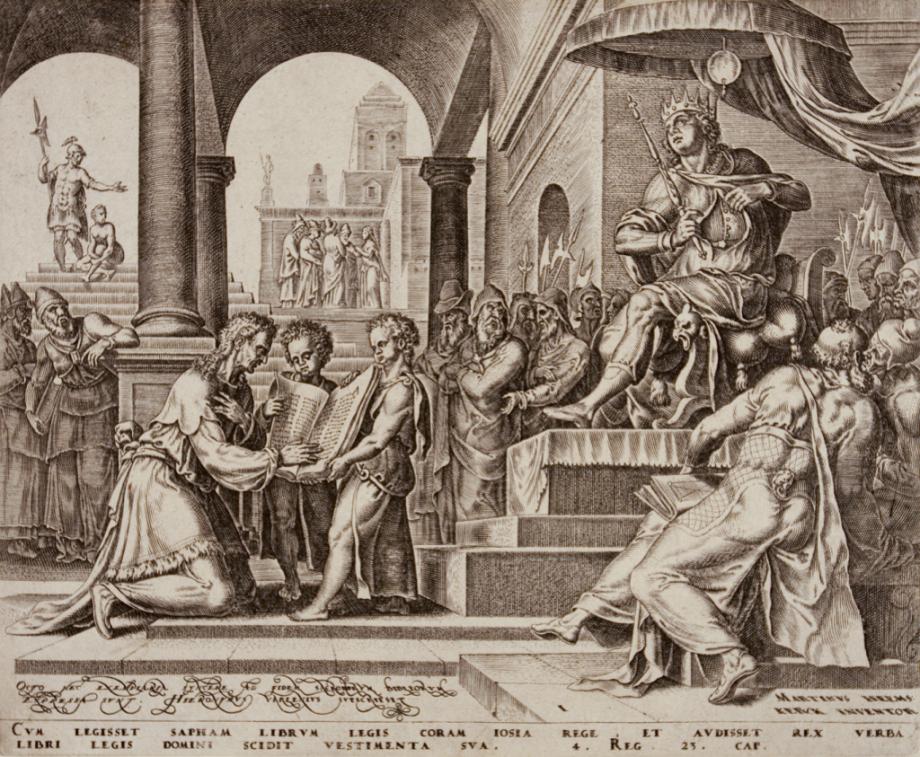
The Book of the Law, Read to King Josiah by Dutch artist Maerten van Heemskerck, c.1569

The king smashed all the altars to smithereens—the altar on the roof shrine of Ahaz, the various altars the kings of Judah had made, the altars of Manasseh that littered the courtyard of The Temple—he smashed them all, pulverized the fragments, and scattered their dust in the Valley of Kidron. The king proceeded to make a clean sweep of all the sex-and-religion shrines that had proliferated east of Jerusalem on the south slope of Abomination Hill, the ones Solomon king of Israel had built to the obscene Sidonian sex goddess Ashtoreth, to Chemosh the dirty-old-god of the Moabites, and to Milcom the depraved god of the Ammonites. He tore apart the altars, chopped down the phallic Asherah-poles, and scattered old bones over the sites. Next, he took care of the altar at the shrine in Bethel that Jeroboam son of Nebat had built—the same Jeroboam who had led Israel into a life of sin. He tore apart the altar, burned down the shrine leaving it in ashes, and then lit fire to the phallic Asherah-pole.

As Josiah looked over the scene, he noticed the tombs on the hillside. He ordered the bones removed from the tombs and had them cremated on the ruined altars, desacralizing the evil altars. This was a fulfillment of the word of God spoken by the Holy Man years before when Jeroboam had stood by the altar at the sacred convocation.

Then the king said, “And that memorial stone—whose is that?”

The men from the city said, “That’s the grave of the Holy Man who spoke the message against the altar at Bethel that you have just fulfilled.”

Josiah said, “Don’t trouble his bones.” So, they left his bones undisturbed, along with the bones of the prophet from Samaria.

But Josiah hadn’t finished. He now moved through all the towns of Samaria where the kings of Israel had built neighborhood sex-and-religion shrines, shrines that had so angered God. He tore the shrines down and left them in ruins—just as at Bethel. He killed all the priests who had conducted the sacrifices and cremated them on their own altars, thus desacralizing the altars. Only then did Josiah return to Jerusalem.

The king now commanded the people, “Celebrate the Passover to God, your God, exactly as directed in this Book of the Covenant.”

This commanded Passover had not been celebrated since the days that the judges judged Israel—none of the kings of Israel and Judah had celebrated it. But in the eighteenth year of the rule of King Josiah this very Passover was celebrated to God in Jerusalem.

Josiah scrubbed the place clean and trashed spirit-mediums, sorcerers, domestic gods, and carved figures—all the vast accumulation of foul and obscene relics and images on display everywhere you looked in Judah and Jerusalem. Josiah did this in obedience to the words of God’s Revelation written in the book that Hilkiah the priest found in The Temple of God.

There was no king to compare with Josiah—neither before nor after—a king who turned in total and repentant obedience to God, heart and mind and strength, following the instructions revealed to and written by Moses. The world would never again see a king like Josiah. (The Message)

The Book of the Law Found, Unknown artist, 1913

To say that King Josiah cleaned house is a significant understatement. Having found the Book of the Law, which was lost for generations deep within the temple, Josiah took its words to heart and set about a campaign of reformation like no king before him. 

Indeed, Josiah was determined to restore and implement the Law in the life of the nation of Judah. His zeal knew no bounds. Josiah was doggedly relentless and actively radical in returning the Jews to the true worship of Yahweh.

Josiah did more than reinstitute the Passover and other festivals of the Lord. The king first upended the alternative pagan worship which had become embedded in Judah like a death-dealing cancer. Josiah surgically removed it with ruthless precision. 

King Josiah made ashes out of Asherah poles; put pagan priests out of business permanently; and did away with everything contrary to the worship of the One true God, including spiritual mediums, household gods, and sacrificial high places. In order to turn his heart fully to God, he did away with all competing gods.

Repentance, renewal, and reformation requires a two-fold process: 1) Turning away from what is false; and 2) Turning toward what is true.

Turning from spiritually unhealthy ways of living – without turning to God – is merely a half repentance. Furthermore, turning to God – without turning one’s back on damaging lifestyles – is a form of denial and is dangerous. 

We are to put off the old clothes of spiritual insensitivity and social injustice. We are to put on the new clothes of righteousness and peace. We are to forsake the old inner person of shame in order to embrace the new life of freedom and joy. 

There needs to be a radical removal of sin, so as to replace it with what is just and right. And, keep in mind, that none of this is pretty or romantic. Repentance and renewal is a messy ugly process of dispelling darkness and letting light shine. It is not for the faint of heart.

Where to begin? Make a fierce, brutally honest spiritual inventory of your life. No one can turn from something they are not really aware of. So, create in your schedule some time in the week to connect with God and do the following: 

  • Identify some areas for change, then list the obstacles to turning away from them (e.g., fear, despair, financial repercussions, etc.). Face those obstacles honestly and forthrightly. 
  • Form a rudimentary plan to forsake the old ways and embrace new paths of righteousness. This is only a beginning. Let God take that process and direct it in redemptive and purifying ways.

Holy God, you are jealous for your own glory. Today, I decide to identify and put away all that is contrary to your righteousness and will for my life. And I choose to turn to you with all my heart. In body, soul, and spirit I belong to you. Amen.

2 Kings 22:11-20 – Humble Yourself

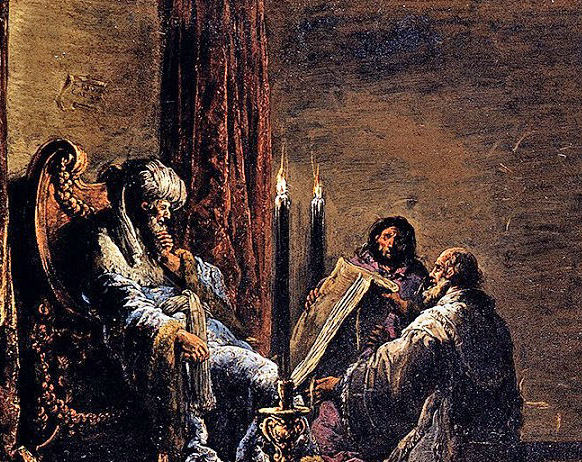
The Scribe Shaphan Reading The Book Of Law To King Josiah by Leonaert Bramer (1596-1674)

When Josiah heard what was in The Book of God’s Law, he tore his clothes in sorrow. At once he called together Hilkiah, Shaphan, Ahikam son of Shaphan, Achbor son of Micaiah, and his own servant Asaiah. He said, “The Lord must be furious with me and everyone else in Judah, because our ancestors did not obey the laws written in this book. Go find out what the Lord wants us to do.”

The five men left right away and went to talk with Huldah the prophet. Her husband was Shallum, who was in charge of the king’s clothes. Huldah lived in the northern part of Jerusalem, and when they met in her home, she said:

You were sent here by King Josiah, and this is what the Lord God of Israel says to him: “Josiah, I am the Lord! And I will see to it that this country and everyone living in it will be destroyed. It will happen just as this book says. The people of Judah have rejected me. They have offered sacrifices to foreign gods and have worshiped their own idols. I cannot stand it any longer. I am furious.

“Josiah, listen to what I am going to do. I noticed how sad you were when you read that this country and its people would be completely wiped out. You even tore your clothes in sorrow, and I heard you cry. So, I will let you die in peace before I destroy this place.”

The men left and took Huldah’s answer back to Josiah. (Contemporary English Version)

It is hard to fathom that things spiritually degenerated so much in the kingdom of Judah that the Book of Law, God’s Word to Israel, was completely lost. The Law was tucked so far back in the temple, and had gathered so much dust, that everyone simply forgot it existed. 

Maybe we in the Western world can relate to this more than we think. When a plethora of Bibles and translations exist, yet they gather dust on the shelf, and we have not cracked it open since….?

We are approaching the end of the Christian Year which annually culminates in Christ the King Sunday. As we journey with Jesus and ascend his holy hill, we anticipate corporately acknowledging Christ’s lordship. A good and biblical way to do so is through penitent humility. 

King Josiah’s officials found the Book of the Law and brought it to him. After they read the words, which had not been uttered for a very long time, the king was completely undone with humble repentance. He realized the life of the nation did not revolve around the majesty and kingship of God, and it cut him to the core of his being.  

An appropriate response to the realization of God’s sovereignty and Christ’s lordship is humility. Without humility, there is no going forward; there is only the ghastly state of remaining stuck in one place with ancient dust accumulating on our static hearts. However, with humility there is repentance; and with repentance there opens up the grand vistas of hope, new life, and fresh beginnings.

“It was pride that changed angels into devils; it is humility that makes men as angels.”

St. Augustine

I (humbly) ask that you try something quite different from your regular experience today. Put on some old clothes then carefully read the words of today’s Old Testament Scripture lesson. Take the time to acknowledge a sin of omission in your life. Then, tear your clothes; yes, rip your shirt. 

Allow yourself to feel, like Josiah, the realization of missing the mark. Yet do not remain in this condition. Drink in the grace of God in Christ and receive the forgiveness that is yours in Christ. The trajectory of our Christian lives is determined by the depth of humility we experience and filling the hole with mercy.

It’s difficult to be submissive. To acknowledge, without denial, that we are in a bad place and will reorient our lives takes a lot of courage and humility. If pride and arrogance are the original sin, then the remedy to that malady is a meek and obedient spirit. 

No matter who we are, people are meant and designed by their Creator to live a humble life of submission to the moral and ethical will of God.

Humility is the cornerstone to every good thing in this life.  Jesus said:

“Blessed are the poor in spirit, for theirs is the kingdom of heaven… Blessed are the meek, for they will inherit the earth.” (Matthew 5:3, 5 NIV)

The door of God’s kingdom swings-open on the hinges of humility. The Apostle Paul, seeking to follow his Master Jesus in his teaching and humility said:

“Since God chose you to be the holy people he loves, you must clothe yourselves with tenderhearted mercy, kindness, humility, gentleness, and patience.” (Colossians 3:12, NLT)

Basic human relations are to be firmly grounded in humility. The old prophet made his expectations clear:

“He has told you, O mortal, what is good; and what does the Lord require of you but to do justice, and to love kindness, and to walk humbly with your God?” (Micah 6:8, NRSV)

Life is truly life when it is based in humility. We live with the confidence of the psalmist:

“God leads humble people to do what is right, and he teaches them his way.” (Psalm 25:9, GW)

In the end, we are to bow to the God of the Word, for the Word is life.

Awesome God, although I might not always perceive your majesty and sovereignty, you stand above all creation as the Lord whom I am to submit to in all things.  I come to you in great humility of heart and vow to obey everything I read in your Holy Word through Jesus Christ, my King. Amen.

Hebrews 4:12-16 – Jesus Is Our Great High Priest

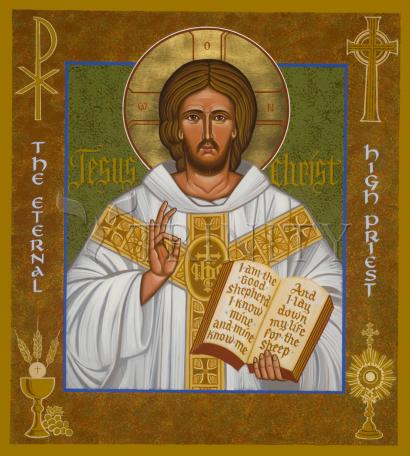
Jesus, the Eternal High Priest, by Joan Cole

For the word of God is alive and active. Sharper than any double-edged sword, it penetrates even to dividing soul and spirit, joints and marrow; it judges the thoughts and attitudes of the heart. Nothing in all creation is hidden from God’s sight. Everything is uncovered and laid bare before the eyes of him to whom we must give account.

Therefore, since we have a great high priest who has ascended into heaven, Jesus the Son of God, let us hold firmly to the faith we profess. For we do not have a high priest who is unable to empathize with our weaknesses, but we have one who has been tempted in every way, just as we are—yet he did not sin. Let us then approach God’s throne of grace with confidence, so that we may receive mercy and find grace to help us in our time of need. (New International Version)

Church Persecution and Christian Suffering

The book of Hebrews was originally a sermon preached to a group of believers who had come to Christ out of Judaism. From the book of Acts, we know there were thousands of Jewish Christians who were dispersed from Jerusalem when Stephen was martyred.  A great persecution broke out, and many believers fled west to places like Galatia, Ephesus, Greece and Rome. 

The Jewish believers were immigrants in a foreign land, looking to practice their faith without harm. Yet, their experience was anything but ideal. These followers of Christ found fellow ethnic Jews in the places where they went, yet those Jews had no use for these people that they believed were in some sort of aberrant cult.

What is more, the surrounding Gentile culture did not understand Christianity, at all, and many of those who held to pagan religions bought into rumors, such as, that Christians were cannibals who ate at what’s called the Lord’s Table.

So, here we have a situation where these displaced Christians had no respect from both Jews and Gentiles. As a result, they had a difficult time carrying out business because no one trusted them. They were essentially alone in the world. 

Losing Their Grip

Initially, they embraced their identity as Christians and held up quite well under the stress. However, over time, their resolve began to slowly erode. The followers of Jesus began to question their adverse situation. 

They began listening to their fellow Jews throw doubts on their faith. The hard life was not improving, maybe even becoming worse.  Eventually, the church came to a point where they began re-considering their whole way of life as Christians, and their faith commitment started slipping. The Christians actually considered leaving the Church and Christianity and going back to their old life in Judaism.

The Message of Hebrews

It was at this point that a vigorous believer in Jesus came to town, saw the situation of the church, and preached a spirited message to them. The preacher called them to hold tight to their commitment – to see Jesus afresh and anew as superior over all the Old Testament, as the fulfillment of all the promises of God. 

So, then, throughout the book of Hebrews we have this wonderful explanation and exposition of how to make sense of Jesus and the Old Testament, and of what Jesus really means to the church. Throughout his sermon, the preacher occasionally paused his teaching and gave the people a stiff warning about falling away from Christ. He called the church to be bold and confident in Christ, to stand up to the suffering, and to confront their temptations so that they would persevere in their commitment to Jesus Christ for the rest of their lives.

God’s Word and Work

We pick up the teaching and the exhortation in chapter four. Hebrews 4:12-16 is composed of two distinct sections that are paired together for a reason.  Verses 12-13 give us a graphic visual of the penetrating work of God’s Word, of the reality that God can get deep inside us. The next section, verses 14-16, lays out God’s response to our being under divine scrutiny – that there is grace and mercy available because of Jesus, our great high priest who is superior to every priest of the Old Testament to the point of being the last and permanent priest forever! 

These verses are bound together because we all need to struggle with the tension between God’s Word to us, and our words to God; between God’s judgment that opens our souls on a spiritual operating table, and God’s grace which jumpstarts our broken hearts. Our most fundamental need is for God’s mercy in Jesus Christ.

The Christian Life

It is important that our outer lives and our inner lives match each other. Whenever the two are out of sync, we come under the judgment of God’s Word. These early Hebrew Christians had slowly drifted from the truth so that their inner and outer lives did not line up well.

Some of them still performed the outward duties of being a Christian yet were inwardly despising their hard situation. A growing vacuum developed on their insides as they slowly started letting go of Jesus as their object of devotion. Their hearts began to harden because of their hard lives. 

On the other hand, there were other Hebrew Christians who began drifting in a different way. Inwardly, they tried to maintain their devotion and commitment to Christ. Yet these believers began compromising their outward life to match the culture around them. In both cases of hardening inwardly, and of compromising outwardly, they each shared the situation of drifting away from their original commitment to Christ.

Even today, it is a real temptation to try and avoid suffering, to grow weary of our present circumstances and look for a way to get out from under the pain and find a quick fix.  Whenever we find ourselves in such a situation, the remedy is to be reminded that we must continue to hold firmly to the faith we profess because of who Jesus is.

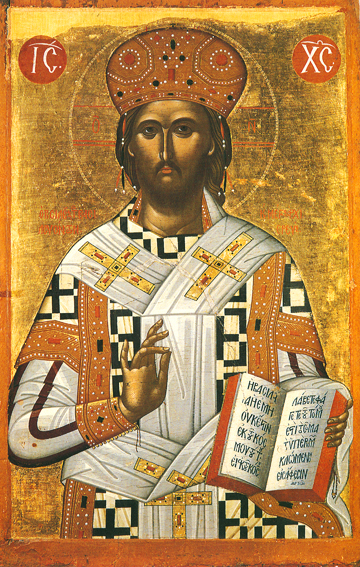
15th Century Orthodox icon of Christ the Great High Priest

Jesus As Permanent High Priest

Jesus is our great high priest. In the Old Testament, among the twelve tribes of the ancient Israelites, the tribe of Levi made up the class of priests. One of those Levites, always a descendent of the original Levite priest, Aaron, had the task of once a year entering a place called the Holy of Holies, which was at the center of the Temple, to offer a bloody sacrifice on behalf of the people, to atone for their sins from the previous year.

Jesus is our great and ultimate high priest. He did not enter the temporary sacrificial system to deal with sins for only a year. Jesus not only took on the role of high priest, but became the sacrifice, as well. As a result, we now have a thorough and permanent forgiveness of sins through Christ. So, the Hebrew Christian who considered going back to an old outdated system needed to be brought back to his senses and embrace again the once-for-all sacrifice of Jesus. 

As they considered Jesus, the believers needed to remember that Christ was not so far removed from them that the church could not relate to Jesus. Rather, Jesus is able to sympathize with each and every trouble, trial, and temptation we face because he faced the very same kind of sufferings. 

The only difference between Christ and his followers is that Jesus did not succumb to the trouble, but persevered and secured for us deliverance from sin, death, and hell. Jesus is the One who deserves every bit of our commitment, allegiance, and devotion. Christ is the One whom we are to worship inside and out.

Approaching God with Boldness

Let us then approach Jesus with confidence, with boldness, knowing that with him there is mercy and grace. Jesus not only suffered for us in the past; he also suffers with us now, in the present. We, as believers, are in union with Jesus. Christ is our great high priest, the One intimately involved in every nook and cranny of our lives. He knows what you and I are going through and is ready to give grace to help right now. 

Approaching Jesus has nothing to do with being good enough to do so. Coming to Jesus is about grace. Whenever we drift from Jesus and are confronted with God’s Word cutting us to the heart, the end result is not wrath or judgment; the result is mercy and grace.

Like the early Hebrew Christians, we all face situations out of our control that wear us down and cause us to become weary. In our tired state, we can be tempted to let our commitment to Christ slide in some small way. Over time, the small compromises of faith can snowball into a big slide away from God. 

Yet, Jesus is not sitting in heaven frustrated or confounded. God is not looking for a reason to punish people. It is just the opposite. Jesus, the Son of God, our great high priest, is looking for a reason to give grace and help us in our time of need. Christ is waiting for us to approach the throne of grace with confidence. Right now, Jesus is alive. He is scanning the world and the church, looking to extend mercy to those who need it. 

Asking for Help

We must avoid a spiritual hardening of heart which estranges us from approaching Jesus. Every one of us needs help. We are not God. We have weaknesses. We have confusion. We have limitations of all kinds. We need help.  And every one of us has something else: guilt and shame. At the bottom of our hearts, we feel undeserving, and so, avoid coming to Jesus. Yet, we need with family, loneliness, work, health, finances.

So, what to do? I can try to deny it all and be a superman who doesn’t need any help. I can try to drown it all with alcohol. I can be obsessive and compulsive about controlling events and/or people. I can simply succumb to discouragement. Here is what God declares: Jesus Christ became a High Priest to shatter despair with hope, to rescue that drowning person and that anxious individual.

God planned for a High Priest, a Savior, a Redeemer, and a gracious Helper. You and I are not trapped. We have Jesus. 

The book of Hebrews is all about a call to commitment – an invitation to come to Jesus.  And it is the most important invitation you will ever receive. Let us approach the throne of grace with confidence….

This is the confidence we have in approaching God: That if we ask anything according to his will, he hears us.  And if we know that he hears us – whatever we ask – we know that we have what we asked of him. Spirit of God, lead us into your will. Help us in all things. Fill our hearts and lives to overflowing with divine mercy and grace so that what comes out of our mouths and the actions we do are compassionate, kind, and good, through our great High Priest, Jesus Christ. Amen.

Ephesians 6:10-20 – Spiritual Combat

A final word: Be strong in the Lord and in his mighty power. Put on all of God’s armor so that you will be able to stand firm against all strategies of the devil. For we are not fighting against flesh-and-blood enemies, but against evil rulers and authorities of the unseen world, against mighty powers in this dark world, and against evil spirits in the heavenly places.

Therefore, put on every piece of God’s armor so you will be able to resist the enemy in the time of evil. Then after the battle you will still be standing firm. Stand your ground, putting on the belt of truth and the body armor of God’s righteousness. For shoes, put on the peace that comes from the Good News so that you will be fully prepared. In addition to all of these, hold up the shield of faith to stop the fiery arrows of the devil. Put on salvation as your helmet, and take the sword of the Spirit, which is the word of God.

Pray in the Spirit at all times and on every occasion. Stay alert and be persistent in your prayers for all believers everywhere.

And pray for me, too. Ask God to give me the right words so I can boldly explain God’s mysterious plan that the Good News is for Jews and Gentiles alike. I am in chains now, still preaching this message as God’s ambassador. So, pray that I will keep on speaking boldly for him, as I should. (New Living Translation)

When I think of the Apostle Paul, I think of a guy who had a bucket load of boldness, who did not sidestep tough situations, but who fearlessly stepped into the world with the good news of God’s grace in Christ. 

Maybe Paul was that way because of prayer and the prayers of God’s people. Maybe what stands in the way of people knowing Jesus and believers maturing in faith is a profound lack of intense, consistent, and sustained prayer. Maybe too many of God’s people have been duped by the enemy of our souls to retreat in a bubble of fear, unable to effectively engage God’s big world with confidence.

Paul told the Ephesian Church what kind of practical and vital obligations were needed to put aside fear and flourish as Christians….

Be strong in the Lord because we are in an invisible war.

There is an unseen world all around us. We serve an invisible God, and we have an invisible enemy. Satan and all his wicked spirits exist. They are organized for war with methodical schemes and strategies designed to blunt our spiritual development and the expansion of God’s benevolent kingdom. The enemy seeks to render us ineffective in our walk with Christ, unproductive for God, and all knotted up inside in a broken mess so that we are weak, not strong.

The names of our invisible enemy in Scripture tells us the kind of diabolical and methodical work he is doing to snare us: 

  • Satan (the adversary who opposes us)
  • Lucifer (the shining one who comes looking like the light but only delivers darkness)
  • Beelzebub (lord of the flies, who is a false god promising protection and help apart from God)
  • Belial (the evil one, who seeks to have us engage in sin instead of righteousness)
  • Tempter (offering alternative plans to the will of God)
  • Accuser (the false judge, using criticism to bully people into shameful submission)
  • Prince of this world (the architect behind all systemic evil)
  • Devil (the diabolical one who engages in spiritual guerilla warfare against God’s people)

The unseen wicked spirits of this dark world pull out whatever technique they can to turn us from knowing who we are in Christ and how we are to really live. They seek to distract us from our mission, to keep us busy fighting among ourselves, so that we will put our ultimate confidence in anything or anyone but Christ.

Put on the armor of God and prepare for spiritual battle.

Satan is a defeated foe. The nails that crucified the Lord Jesus, and the power of God that raised him from the dead, ensured Satan’s doom.

Although we stand in the victory of the Lord Jesus, the world, the flesh, and the devil still dog us at every turn. So, we must discover and dislodge every threat to our spiritual growth and the mission of the church to step into the world with the gospel of grace. 

Jesus said he will build his church and the gates of hell will not prevail against us. The picture is not one of the church being defensive and only responding to threats, but of a church pushing forward and storming the gates. 

The promise we have is that we can engage the enemy to the point of hell itself – and will not be burned by demonic enemy fire. Therefore, we are not to hunker down in self-protective foxholes; we are to engage the enemy with our spiritual armor on.

  • Put on the belt of truth. We need to combat the demonic lies. The truth will set us free. Lies will place us in bondage. Shame will keep us in the dark shadows. We are to embrace Jesus who is the way, the truth, and the life. The truth is that we belong to God. We are not to fight demonic fire with fire. Instead, we fight Satan with the waters of baptism, remembering who we are in Christ. Just as the wicked witch of the west was killed with water, so we are to fling our baptismal water in the face of the enemy and watch him melt away.
  • Put on the breastplate of righteousness. It protects our heart as we push forward and engage the enemy. Satan is aiming for our hearts, so it is vital that they are well-guarded. Our hearts belong to God. Before we chose God, God chose us before the creation of the world to be holy and blameless (Ephesians 1:4).         
  • Put on the gospel shoes of peace. Satan and his minions are trying to cause chaos, unrest, and division.  We are to be ready for his methods through embracing God’s peace and harmony with others. We are to use our shoes, both for digging in and standing firm, and stepping forward into situations as peace-makers. Those who ready themselves with the gospel of peace live differently, openly, with grace and integrity.

Take up your spiritual weapons and do battle.

Whereas the spiritual armor is protective, giving us a solid defensive posture, our spiritual weapons help us to go on the offense and walk into the struggle.

  • Take up the shield of faith. Extinguish all the nasty flaming arrows of the evil one. The Roman phalanx was a rectangular military formation where the army took their shields and connected them together for protection and the ability to push forward, engaging the enemy. This tactic helped the Romans to conquer most of the known world of the time. It was based not on individual ability but on the strength of the entire army working together. The devil seeks to divide and conquer. Yet, there is strength in numbers, that is, as long as we work together!  Linking our shields together through unity, fellowship, and encouragement is absolutely necessary if we are going to win the battle.
  • Take up the helmet of salvation. Active transformation through the renewing of our minds enables us to avoid retreating and going back to old sinful patterns of thinking. We need mindfulness, not mindlessness, aware of who we are in Christ and actively occupying our thoughts with God’s Word.
  • Take up sword of the Spirit. This is the word of God. The written word is to be the spoken word. Our primary offensive weapon in the battle against the evil one is God’s Word. It needs to be read, memorized, meditated upon, learned, talked about, and, used by speaking it aloud.

Be alert and pray.

Prayer is to undergird everything we do. The early church was effective and successful through prayer. They all joined together constantly in prayer (Acts 1:14). They devoted themselves to the apostles’ teaching and to the fellowship, to the breaking of bread and to prayer (Acts 2:42). After they prayed, the place where they were meeting was shaken. And they were filled with the Holy Spirit and spoke the word of God boldly (Acts 4:31).  The early apostles re-arranged their busy schedules so that they could give their attention to prayer and the ministry of the word (Acts 6:4). Believers in Jesus pray.

Whenever prayer takes a back seat to everything else, believers end up fighting the wrong battles with the result of a lot of friendly fire where people get spiritually and emotionally hurt. Our battle is not with flesh and blood human beings; it is with Satan and his wicked spirits. Fight them, not each other!

Conclusion

The spiritual forces we are up against are wicked, evil, cunning and do not observe any kind of Geneva Convention rules when it comes to war. They are out for blood. Therefore, we must be ready and put on our spiritual armor, take up our spiritual weapons, and move forward with the word of God and prayer. This present darkness requires that we be at our best. Our very lives depend on it.