The Lord Was With Him (1 Chronicles 11:1-9)

All Israel came together to David at Hebron and said, “We are your own flesh and blood. In the past, even while Saul was king, you were the one who led Israel on their military campaigns. And the Lord your God said to you, ‘You will shepherd my people Israel, and you will become their ruler.’”

When all the elders of Israel had come to King David at Hebron, he made a covenant with them at Hebron before the Lord, and they anointed David king over Israel, as the Lord had promised through Samuel.

David and all the Israelites marched to Jerusalem (that is, Jebus). The Jebusites who lived there said to David, “You will not get in here.” Nevertheless, David captured the fortress of Zion—which is the City of David.

David had said, “Whoever leads the attack on the Jebusites will become commander in chief.” Joab son of Zeruiah went up first, and so he received the command.

David then took up residence in the fortress, and so it was called the City of David. He built up the city around it, from the terraces to the surrounding wall, while Joab restored the rest of the city. And David became more and more powerful because the Lord Almighty was with him. (New International Version)

Originally, in the Hebrew Bible, 1 and 2 Chronicles were one book, not two; and the Chronicles are the final book of Hebrew Scripture. The Greek translation of the Hebrews Bible – the Septuagint – was accomplished around the turn of the second century B.C.E. and made Chronicles two books because of its length.

Compilers of Christian Scripture moved the location of Chronicles from the end of the Old Testament and put it alongside the other historical books of 1 and 2 Samuel, and 1 and 2 Kings – mostly because Chronicles is generally a restatement of those books for a different generation of Jews living in the post-exilic period along with Ezra and Nehemiah.

Chronicles largely retells the story of the ancient Israelites, and then summarizes their history before focusing primarily on the reigns of King David and King Solomon. Yet, it is more than a retelling.

Chronicles is a restatement that emphasizes the importance of faithfulness to God and highlights the necessity of taking God’s Law seriously.

Religious reforms play an important part of Chronicles. Removing idols, obeying God’s Torah and God’s prophets, and honoring the proper worship of God are central to ensuring that a Babylonian exile never happens again – that the people will see the consequences of infidelity to the Lord, and live in the right and just ways handed down to them.

King David is pictured as a politically unifying figure of all Israel and Judah because he sought to conscientiously and faithfully live according to God’s commands. Later generations of kings did not do so, which led to the people losing their land and their temple.

David had proved himself as the right person for the job of leading the people. After becoming king, he used his position and authority to do God’s will. And it was a long time in coming; David patiently waited for the Lord’s timing and purpose to be accomplished.

Although anointed by the prophet Samuel as king while Saul was still in his reign, it took years for David to be enthroned as the actual king. David had several opportunities to make himself king by killing Saul (who was trying to kill David) but he allowed God to enthrone him in God’s own good time.

Rarely does anything the Lord promise come to fruition immediately. We must wait patiently for deliverance from painful trials of faith and the return of Christ. God makes promises. Then we persevere until those promises are fulfilled.

All of David’s waiting finally dissipated into kingly action. Before there were kings, judges ruled in Israel. And before that, Joshua led the people into the Promised Land. They had a mandate to expel the Canaanites. Those instructions from God only partially happened. There were still remnants and pockets of resistance. The Jebusites, ensconced in the city of Jebus (Jerusalem) were the most stubborn.

Part of the reason there were Canaanites still living in the land was the former King Saul’s failure to follow through on God’s plan. One of the first acts of King David was to finish and fulfill the complete takeover of the land.

David was willing to attempt something nobody else could do, and that no one believed could be done. If we were a fly on the wall during discussions about this, I can imagine a coterie of people saying to the king, “We tried that before. It won’t work. You cannot get rid of the Jebusites. This is a fool’s errand.”

Pessimism and passivity certainly do not dislodge anything, and the people had fallen into a cynicism that believed they needed to put up with the current situation.

Whenever a group of people fall into passive defeatism, criticism is rife because folks are not working together toward shared goals and solutions. Instead of addressing problems, there is merely complaining about whatever they don’t like.

On the other side of it, the Jebusites were smug in their self-confidence, showing their bravado through being blowhards. However, they had not yet faced David. If they thought another king like Saul was coming along, they were in for a big wake up call.

The Lord almighty was with David. And that is what made all the difference.

King David did not accept the status quo. He worked toward accomplishing the Lord’s will, as he understood it. And his faith always led to effective action.

Almighty and eternal God, so draw our hearts to you, so guide our minds, so fill our imaginations, so control our wills, that we may be wholly yours, utterly dedicated unto you; and then use us, we pray you, as you will, and always to your glory and the welfare of your people; through our Lord and Savior Jesus Christ. Amen.

Spiritual Strength (Daniel 10:2-19)

At that time I, Daniel, mourned for three weeks. I ate no choice food; no meat or wine touched my lips; and I used no lotions at all until the three weeks were over.

On the twenty-fourth day of the first month, as I was standing on the bank of the great river, the Tigris, I looked up and there before me was a man dressed in linen, with a belt of fine gold from Uphaz around his waist. His body was like topaz, his face like lightning, his eyes like flaming torches, his arms and legs like the gleam of burnished bronze, and his voice like the sound of a multitude.

I, Daniel, was the only one who saw the vision; those who were with me did not see it, but such terror overwhelmed them that they fled and hid themselves. So I was left alone, gazing at this great vision; I had no strength left, my face turned deathly pale and I was helpless. Then I heard him speaking, and as I listened to him, I fell into a deep sleep, my face to the ground.

A hand touched me and set me trembling on my hands and knees. He said, “Daniel, you who are highly esteemed, consider carefully the words I am about to speak to you, and stand up, for I have now been sent to you.” And when he said this to me, I stood up trembling.

Then he continued, “Do not be afraid, Daniel. Since the first day that you set your mind to gain understanding and to humble yourself before your God, your words were heard, and I have come in response to them. But the prince of the Persian kingdom resisted me twenty-one days. Then Michael, one of the chief princes, came to help me, because I was detained there with the king of Persia. Now I have come to explain to you what will happen to your people in the future, for the vision concerns a time yet to come.”

While he was saying this to me, I bowed with my face toward the ground and was speechless. Then one who looked like a man touched my lips, and I opened my mouth and began to speak. I said to the one standing before me, “I am overcome with anguish because of the vision, my lord, and I feel very weak. How can I, your servant, talk with you, my lord? My strength is gone and I can hardly breathe.”

Again the one who looked like a man touched me and gave me strength. “Do not be afraid, you who are highly esteemed,” he said. “Peace! Be strong now; be strong.”

When he spoke to me, I was strengthened and said, “Speak, my lord, since you have given me strength.” (New International Version)

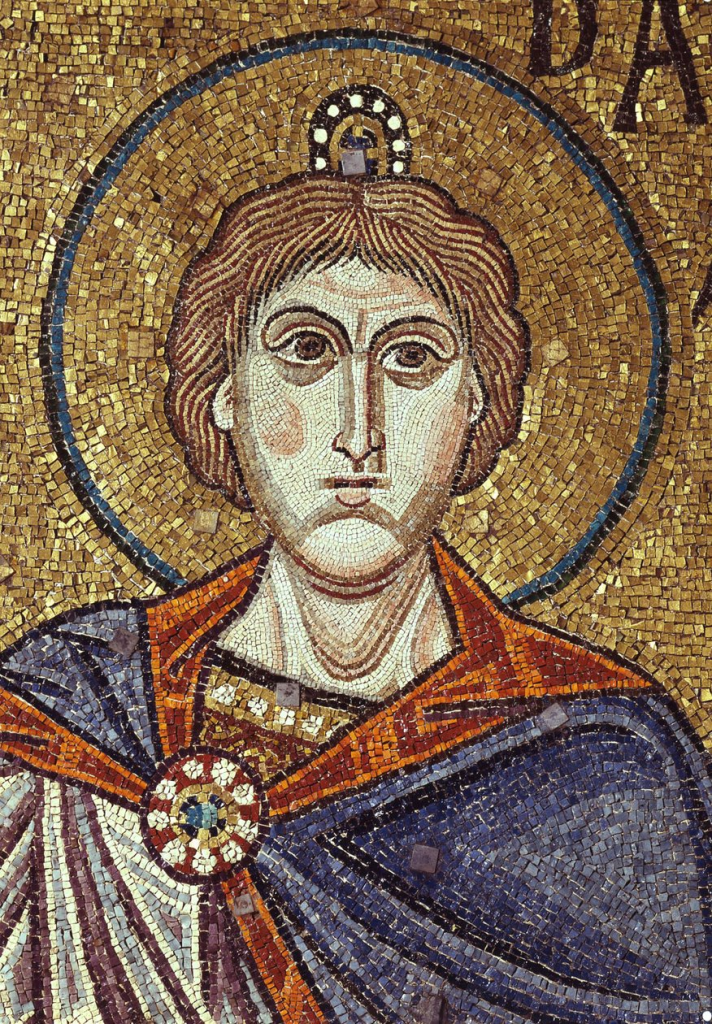
Byzantine mosaic of the prophet Daniel, 12th century, in St. Mark’s Basilica, Venice, Italy

Perhaps you, like me, have had the experience of praying, and feeling as if those prayers were only bouncing off the ceiling and never heard by God. But the Lord has been watching and listening all along. Although we may not get an immediate response, we will most certainly receive an answer to our prayers.

I am encouraged that God listened and was attentive to Daniel. The prophet had put himself in a position to hear God, so that when the Lord responded, Daniel was able to receive what was given to him.

The spiritual disciplines which Daniel was practicing almost seems like the guy was observing Lent. For three weeks, he gave up certain foods, did not eat meat, drank no wine; and he didn’t take a bath. He did all of this because he was troubled in spirit.

Daniel’s outward practices were congruent with his inward disposition. This is a far cry from our modern predilection for keeping up appearances, even though we are dying inside. But Daniel was not like us. He stopped his normal routines in order to give himself to prayer and a partial fast.

The Jews had been in exile for 70 years, and there was no sign of them going back to Jerusalem. And that troubled Daniel to no end – because the prophet Jeremiah had said the people would be in captivity for that long (Jeremiah 29:10). Daniel knew that fulfillment of the Lord’s promises would come by living in Palestine, and not by being exiled in Babylon.

While Daniel and his friends were together in a prayer meeting, Daniel experienced a vision; it was as if the veil separating this three-dimensional space from the spiritual dimension was lifted, and Daniel could see what was happening in the invisible realm.

Daniel’s prayers were being heard; they were not bouncing off the ceiling. And they were heard, I believe, because Daniel prayed according to his understanding of what God wants. He desired to participate in what God wanted, and not what he himself necessarily wanted.

And that is essentially what the Lord Jesus taught his followers in how to pray. We need not try and persuade God, as if we must be spiritual lawyers advocating for what we want. The Lord does not operate by twisting arms or harassing people; and neither ought we to try and treat God that way.

Prayer puts us in sync with what God wants. And as we desire to do God’s will, our prayers will reflect that desire. We only then need to ask. (Matthew 6:5-15; James 4:1-3)

Although God answers prayer, those responses are not always immediately put into effect. Daniel’s vision allowed him to see that there are other forces at work – dark forces – that oppose what God is doing. Sinister monkey wrenches are thrown into good plans and responses for people.

Behind the scenes of our lives, there are invisible powers which are influencing people. This is why our ultimate struggle is not on this visible realm; it is, instead, against the invisible demonic spirits of this present evil age.

Daniel saw and heard that behind the affairs of this world is a hierarchy of evil which seeks to control us for purposes contrary to God’s justice, peace, and goodness. Yet there is also an angelic host who are involved in ensuring that the Lord’s will is accomplished on this earth as it is always done in heaven.

Therefore, sometimes our delays in answered prayer have nothing to do with us; it may be because there is a great conflict happening in a dimension that you and I don’t see. In fact, if we do not have immediate answers to prayer, this is precisely the best time to persevere in prayer and not give up.

Through our perseverance in prayer, like Daniel, we are strengthened in faith. Our connection with God brings us peace and courage, emboldening us for continued wrestling in prayer and dealing with the structural and systemic evil that exists everywhere.

Faith is a belief in things we cannot see. Hope is the confidence of things which can happen. Love is a culmination of faith and hope coming together in order to make a difference in this fallen world. The Lord provides all the strength we need for the struggle. And there is perhaps no better model of how to deal with things and gain spiritual power than the prophet Daniel.

Strengthen us, O Lord, by your grace, so that we may overcome all spiritual enemies; and with pure hearts serve you; through Jesus Christ our Lord, who lives and reigns with you and the Holy Spirit, one God, for ever and ever. Amen.

“I Choose You!” (Ephesians 1:3-6)

Blessed is the God and Father of our Lord Jesus Christ, who has blessed us with every spiritual blessing in the heavenly realms in Christ. For he chose us in Christ before the foundation of the world that we should be holy and blameless before him in love. He did this by predestining us to adoption as his legal heirs through Jesus Christ, according to the pleasure of his will—to the praise of the glory of his grace that he has freely bestowed on us in his dearly loved Son. (New English Translation)

There is perhaps no greater sense of worth, security, and love, than stating with sincerity and conviction to another, “I choose you!”

That is exactly what God has done for us. In fact, the Lord chose us and included us before we were even born into this world. Our identity is secure in belonging to God because it isn’t based in any of the screw-ups I did yesterday or the bad decisions I made years ago. Christian identity is based solely and completely by the choice and action of God, in Christ, through the Spirit.

People tend to live up to how they view themselves, to how they self-identify. So, it is critical to our well-being how we truly understand self, others, and God.

If we see ourselves as never getting ahead and needing to lie, cheat, and steal to obtain anything in this life, then we will view ourselves as common thieves.

If we think the only way to have love and security in this life is to hustle for it – to make ourselves as presentable as we possibly can, then we will view ourselves as basically unlovely and search for love in all the wrong places by trying to keep up appearances.

If we look at ourselves as stupid, then we will tend to make poor decisions even when it’s in our ability to make good choices because we see ourselves as unable to compete with those smarter than us. 

The common theme in all these scenarios are people living apart from God. Without the Lord Jesus, we are like lost street children trying to survive from day to day. What we need, what we search for and long for, is to have a good, blessed life in a loving home, a place to belong in a world of disconnection.

To be “blessed,” to have “blessing” in the Holy Scriptures, is to have God’s stamp of approval on your life. It is to know, experience, and feel Divine favor resting upon you.

The picture being painted at the very beginning of Paul’s letter to the church at Ephesus is of wayward children roaming the streets as orphans. The Ephesians were ensconced in their idol worship of Artemis, the fertility cult goddess. They were going about life without a whim about the true and living God.

Out of sheer grace, God plucked them from their worthless condition and adopted them. God placed blessing upon them because of love and gave them a reason to rejoice and praise.

What’s more, the Ephesians were chosen and predestined for holiness and purity. God set them apart for divine blessing. It’s as if God brought them into the kingly palace, provided lavishly for them, and let them have the run of the place. They get to enjoy every privilege that comes with being children of the king.

The focus and orientation of today’s New Testament lesson is about how tremendously special the believer in Jesus really is. And it has nothing to do with how presentable we are to a holy God. Instead, out of the vast storehouse of blessed grace, God chose and adopted. The Lord looked upon you and me with googly divine eyes and said, “I choose you!”

God chooses from a place of divine pleasure. Yes, that’s right. God chooses, predestines, and adopts with a willing heart because it brings great pleasure and divine joy to do so!

There was no arm-twisting from the Father to the Son in securing redemption for lost humanity. And there was no persuasion necessary for the Father and Son to send the Spirit for our ongoing benefit and help in this life. Each redemptive event of Jesus was done out of the grace and love of God in Christ through the Spirit.

Do you see how God views you? Do you know how special you truly are?  Have you an understanding of the incredible position and majesty you have as a human being in God’s image and likeness?

As a child of the king, you live up to the position you know you possess. Freedom from worry and anxiety don’t come from willpower, but from an understanding that God owns all things, and we will never be in need. 

Deliverance from the power of darkness doesn’t come by trying to do better; it comes through the knowledge that God has redeemed us and chosen us to live in the gracious realm of divine love forever. There is no need to hustle for love with God because you and I already have it.

The believer has every spiritual blessing in Christ. God has your back. We belong to God. And to belong to Jesus Christ is to be blessed. It makes all the difference in the world. It is our reason for gratitude and praise, and for settled peace and glorious rest.

Gracious God, your loving activity has snatched me from the barren streets of sin and brought me into a realm of incredible blessing. Thank you for blessing me and giving me a place to belong forever; through Jesus Christ, my Lord and Savior, who with you and the Holy Spirit reign forever and ever in a celebration of redeeming love.  Amen.

Donkey Talk (Numbers 22:22-28)

The angel of the Lord meets Balaam with a sword, from “Bible Pictures and What They Teach Us” by Charles Foster, 1897

Balaam was riding his donkey to Moab, and two of his servants were with him. But God was angry that Balaam had gone, so one of the Lord’s angels stood in the road to stop him. When Balaam’s donkey saw the angel standing here with a sword, it walked off the road and into an open field. Balaam had to beat the donkey to get it back on the road.

Then the angel stood between two vineyards, in a narrow path with a stone wall on each side. When the donkey saw the angel, it walked so close to one of the walls that Balaam’s foot scraped against the wall. Balaam beat the donkey again.

The angel moved once more and stood in a spot so narrow that there was no room for the donkey to go around. So it just lay down. Balaam lost his temper, then picked up a stick and whacked the donkey.

When that happened, the Lord told the donkey to speak, and it asked Balaam, “What have I done that made you beat me three times?” (Contemporary English Version)

This is one of those stories which speaks for itself. It’s clear to see that the diviner Balaam made a jackass of himself. A dumb donkey could see things better than a famous seer.

The nation of Moab was afraid of Israel. Balak the Moabite got in touch with Balaam the diviner in order for him to put a curse on Israel. Even though Balaam had the sense to know that he could only speak what God told him, he was influenced by Balak through vanity, and enticed with a small fortune. So, off he went to Moab.

But God was angry with Balaam. Three times the angel of the Lord stood in the road to oppose Balaam. The donkey knew what was up, but Balaam was too dense – stubborn as a jackass – to what was going on. It took God talking through the donkey before Balaam could finally see the angel.

When God wants to speak and accomplish a divine purpose, the Lord can use anything or anybody to achieve it – even by means of a talking donkey.

In fact, throughout Holy Scripture, God oftentimes uses the weak to further the divine agenda. Whenever God determines something, it will happen, usually by means nobody ever expects.

Look at your situation when you were called, brothers and sisters! By ordinary human standards not many were wise, not many were powerful, not many were from the upper class. But God chose what the world considers foolish to shame the wise. God chose what the world considers weak to shame the strong. And God chose what the world considers low-class and low-life—what is considered to be nothing—to reduce what is considered to be something to nothing. (1 Corinthians 1:26-28, CEB)

If God can use a donkey as a teacher, then none of us need ever be discouraged. The Lord can and will use us to make a difference in this world. God takes special delight in choosing and using the nobodies of this world to fulfill divine purposes and to communicate important messages.

This is why we can always bank of the promises of God – because nothing and nobody can ever stand in the way of the Lord’s will. God is creative and determined, using whatever means and whomever God wants, in order to bring about the good and the right and the just, in this old fallen world.

Most of us don’t have to worry about having a big head or a vain spirit or being a famous prophet like Balaam. The majority of us struggle more with having a lower view of ourselves than we actually are.

God created us according to the divine will and in divine wisdom. The Lord has equipped you with your particular DNA both biologically and spiritually. And, most of all, each one of us has been stamped with the divine image and likeness of God. We carry within our very being the stuff of our Creator.

So, I hope it won’t take some donkey talk to help you see and understand who you are and what your purpose on this earth is for. And there is no need to consult a dubious diviner to try and obtain something that you already possess. Not even a jackass does that.

Our Father in heaven,
Reveal who you are.
Set the world right;
Do what’s best—
    as above, so below.
Keep us alive with three square meals.
Keep us forgiven with you and forgiving others.
Keep us safe from ourselves and the Devil.
You’re in charge!
You can do anything you want!
You’re ablaze in beauty!
    Yes. Yes. Yes. Amen. (Matthew 6:9-13, MSG)