It Is Not Yet My Time (John 7:1-9)

Later Jesus was going about his business in Galilee. He didn’t want to travel in Judea because the Jews there were looking for a chance to kill him. It was near the time of Tabernacles, a feast observed annually by the Jews.

His brothers said, “Why don’t you leave here and go up to the Feast so your disciples can get a good look at the works you do? No one who intends to be publicly known does everything behind the scenes. If you’re serious about what you are doing, come out in the open and show the world.” His brothers were pushing him like this because they didn’t believe in him either.

Jesus came back at them, “Don’t pressure me. This isn’t my time. It’s your time—it’s always your time; you have nothing to lose. The world has nothing against you, but it’s up in arms against me. It’s against me because I expose the evil behind its pretensions. You go ahead, go up to the Feast. Don’t wait for me. I’m not ready. It’s not the right time for me.”

He said this and stayed on in Galilee. (The Message)

For some Jews in the ancient world, if the Messiah were to come, it would certainly happen in the most celebrated month of the Jewish year (Tishri, in the Fall season).

The New Year celebration happens on the first and second of the month; the Day of Atonement on the tenth day (Yom Kippur); and leads to the joyous celebration of the fifteenth to twenty-second days in the Festival of Tabernacles (Booths or Shelters, also known as “Sukkot”).

That is the time of year in which faithful followers of God leave their homes and live in temporary shelters. It serves as a powerful reminder of their deliverance and divine preservation in the wilderness. It’s a celebration of the harvest, a time to remember the Israelites’ journey through the Sinai desert and God’s protection throughout that time. 

This festival also symbolizes unity and inclusivity, and looks forward to the Messianic age when all nations will come to Jerusalem to worship God.

The Feast of Tabernacles, by Bible Art

So, it only made sense to the people who knew Jesus, that he would want to make a big splash during the month of Tishri – a time of high celebration where everyone is together, recalling God’s gracious actions.

Christ’s own family were insistent that he take advantage of the festival’s timing and clearly show himself to the world. But Jesus wasn’t having it. Why not?

Jesus responded that it is not yet his time. By that he meant it wasn’t the right festival season. The timing of Christ would be for Passover, not Tabernacles. His role was not as the Divine Warrior who would beat up the Romans and establish an earthly rule in the vein of King David.

Instead, Christ’s purpose was to take on the role of the Suffering Servant, the dying Messiah. A joyous public spectacle during Tabernacles to announce deliverance from Roman oppression was not the reason he came to this earth.

Jesus had no intention of being pressed into something that wasn’t his understanding of God’s will.

Indeed, Christ’s time of glorification would come. But at the time of Tabernacles, when the feelings of the people were drawn to Jesus, and expectations were high for divine deliverance from Gentile rule, a capitulation to the crowd would be akin to the devil’s temptation of throwing himself from the Temple, so that everyone could see the Jewish Superman in action.

Jesus is not that sort of Messiah. Ostentatious displays of power and authority were not his path for the people’s salvation. That is the way of the world, not heaven; it’s the concrete road of the proud, not the dirt path of the humble.

Evil needed to be dealt with, once and for all – and not only for the sake of the Jews, but for all creation. And it had to have to divine effectiveness, not a worldly solution.

It still remains yet to this very day, that those with unbelief demand a strong leader and a powerful sign of authority. They want a take-charge sort of person who looks good and has style.

Such worldly-minded persons insist that the strong leader get out there and have lots of exposure. Pay attention to the optics, and engender supreme confidence in others. Engage and change the situation with all of the proven tactics of the world’s power base.

Yet those who truly believe, discern that life does not consist of grand imperial displays of opulent strength and worldly control. Rather, the heavenly virtues of wisdom, patience, and a settled hope surround them. They pay no attention to bombastic pronouncements and empty promises.

The believer is able to see Jesus for who he truly is, and not for what they want him to be.

In other words, up is down, first is last, suffering before celebration. These are not the ways of the unbelieving world; they are the practices of the faithfully devoted ones.

Even though Christ’s brothers strongly urged him to openly show himself in an ancient version of mass marketing, Jesus patently forsook it. He was not seeking to enhance his own reputation, to get his brand recognition out there and impress the crowd.

Jesus Christ will only act as his heavenly Father commands and wills him to – even if his own family want him to do different.

And that is why the world “hates” Jesus. Because he will neither operate according to, nor submit to, its prevailing cultural, political, and familial standards. Pride mocks humility. Arrogance disdains the meek and gentle. Worldly strength wants nothing to do with any sort of perceived weakness.

Metamorphosis of Narcissus, by Salvador Dali, 1937

Yet, the world does not realize that ultimate power, control, and authority comes not through public shows of toughness, but by private practices which embrace spiritual disciplines and knowing oneself.

I myself have no stomach for the supposed follower of Christ who merely seeks to honor Jesus in order to make the Name of Jesus serve their own name’s purpose.

And I gag every time I observe the self-centered leader try and act as if they care for important things, when in reality their only concern is self. Their worldly actions and attitudes betray their true feelings and purpose.

“It is better to incur the world’s hatred, by testifying against its wickedness, than gain its good will by going down the stream with them.”

Matthew Henry

We live in a world of indecision; there is no real decisive action which champions the common good of all citizens. We stick our finger in the air to see which way the wind is blowing. Our insecurity as a people is profound and palpable.

We seem incapable of sound and just public decision-making, let alone making personal choices which foster and engender spiritual and emotional growth.

This world is in desperate need of good, right, and just people who will faithfully occupy places and positions of trust. For me, that means following the narrow way of Jesus, and not the broad highway of destruction paved by narcissistic leaders.

Do you and I have the courage to take a hard look at ourselves, our relationships, and most of all, Jesus? Will we seek discernment as to what is really the world, and what is truly the words and ways of Jesus? Can we gain a sense of divine timing?

Almighty and ever-living God, ruler of all things in heaven and earth: Strengthen the faithful, arouse the careless, and restore the penitent. Grant us all things necessary for our common life, and bring us all to be of one heart and mind within your holy Church; through Jesus Christ our Lord. Amen.

The Lord’s Will Be Done (Acts 21:1-16)

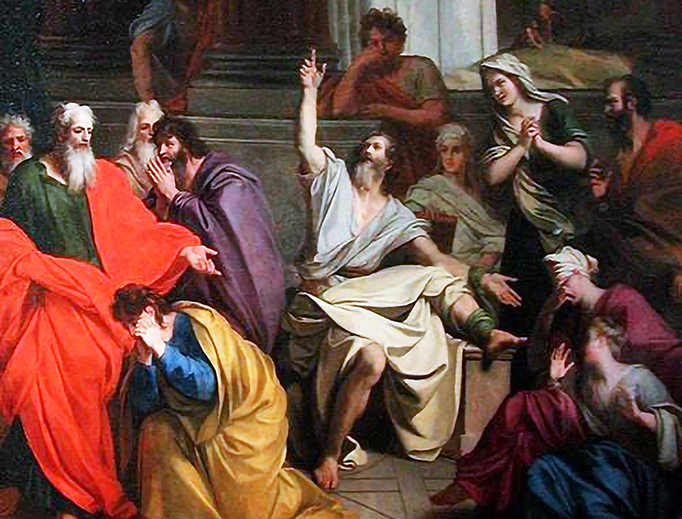
The Prophecy of Agabus, by Louis Chéron, 1687

After we had torn ourselves away from them, we put out to sea and sailed straight to Kos. The next day we went to Rhodes and from there to Patara. We found a ship crossing over to Phoenicia, went on board and set sail. After sighting Cyprus and passing to the south of it, we sailed on to Syria. We landed at Tyre, where our ship was to unload its cargo. 

We sought out the disciples there and stayed with them seven days. Through the Spirit they urged Paul not to go on to Jerusalem. When it was time to leave, we left and continued on our way. All of them, including wives and children, accompanied us out of the city, and there on the beach we knelt to pray. After saying goodbye to each other, we went aboard the ship, and they returned home.

We continued our voyage from Tyre and landed at Ptolemais, where we greeted the brothers and sisters and stayed with them for a day. Leaving the next day, we reached Caesarea and stayed at the house of Philip the evangelist, one of the Seven. He had four unmarried daughters who prophesied.

After we had been there a number of days, a prophet named Agabus came down from Judea. Coming over to us, he took Paul’s belt, tied his own hands and feet with it and said, “The Holy Spirit says, ‘In this way the Jewish leaders in Jerusalem will bind the owner of this belt and will hand him over to the Gentiles.’”

When we heard this, we and the people there pleaded with Paul not to go up to Jerusalem. Then Paul answered, “Why are you weeping and breaking my heart? I am ready not only to be bound, but also to die in Jerusalem for the name of the Lord Jesus.” When he would not be dissuaded, we gave up and said, “The Lord’s will be done.”

After this, we started on our way up to Jerusalem. Some of the disciples from Caesarea accompanied us and brought us to the home of Mnason, where we were to stay. He was a man from Cyprus and one of the early disciples. (New International Version)

The Apostle Paul was on his farewell tour, visiting the believers in churches he planted during his missionary journeys.

The visit to Ephesus was especially heart wrenching; everyone knew this was the last time they would see each other. Paul had spent considerable time in Ephesus establishing the church, and went through a lot with the people. They cared for one another deeply, which is seen in their praying meeting on the beach.

Paul was determined to get back to Jerusalem. Everyone knew that Paul would likely be imprisoned or killed or both by returning there. After the tears were shed, Paul and his coterie of people got on a ship and sailed toward Judea.

Once in Judea, Paul and his companions encountered some characters in the city of Caesarea, including four sisters who had the gift of prophecy, and a man named Agabus who was also a prophet.

The Apostle had been warned several times about going back to Jerusalem. Agabus joined the voices by giving a word by means of the Holy Spirit that Paul would meet persecution if he continued on his journey.

Agabus did some rather dramatic Old Testament prophetic type stuff with Paul. Although others interpreted the message of Agabus as a warning to not go into the lion’s den of inevitable persecution, the prophecy itself is only descriptive of what will happen, and not prescriptive of what should be done.

It’s important to distinguish what the Holy Spirit reveals and commands. We ought only to smush the revelation and the commands together when the Spirit does that. In the case of Agabus and Paul, it was only a revelation. And Paul picked up on that immediately. He knew what he was in for, and was okay with it.

The bottom line for the Apostle Paul was that he felt compelled to head for Jerusalem and face whatever he needed to face there. He was determined to personally bring both spiritual encouragement and economic relief for the people in Judea.

It seems that nobody wanted to see Paul get hurt, arrested, killed, or all three; and that’s more than understandable. Yet, the Apostle himself was convinced of what he should do; and no amount of trying to persuade him otherwise was going to work. So, Paul continued his journey.

The believers came around to saying, “The Lord’s will be done.” And that’s really what we all eventually must come to accept – that participation with what God is doing in the world, in a place, and with us personally, is the thing that counts.

Even Jesus needed to get to that point, so maybe we ought to cut others (and ourselves) some slack when it comes to accepting the situation we are called to be in.

 “Father, if you are willing, take this cup from me; yet not my will, but yours be done.”

Jesus (Luke 22:42, NIV)

No one, especially me, is saying that it’s easy to face adversity and hardship for a certain time and place in your life (or the life of someone you love). In fact, much like Jesus in the garden, it is often agonizing. But moving ahead and doing it we shall, if the Lord’s will is plain to us.

One of the reasons why Paul could be so resolute, and do what he did, was because of the support he continually had around him with his traveling companions.

I often ask people if they are part of a church. Some folks take this as a rebuke and instantly feel guilty that they haven’t attended a worship service for a long while. But the reason I ask is that I’m wondering about their sources of support.

Whenever people are going through hard times, its very helpful to have a faith community who they can rely upon and lean into. Since Paul was rarely alone, he had a consistent supportive presence of people who knew him well, and the circumstance he was enduring.

And I’m hoping that same thing for you – to have a good support system in place for help in following through with the will of God, as you understand it. Because if you are convinced of what you must do, and have people to support you in doing it, no matter what happens, then you can endure a lot, as well as learn a lot.

Lord God almighty, help me grow in discernment and making decisions. Jesus, you know the intensity of our struggle when God’s will conflicts with our desires. Equip and enable me to do your revealed will with a glad and sincere heart. May your will be done, in the power of the Holy Spirit. Amen.

Who Do You Look To When Things Are Tough? (1 Samuel 9:1-14)

There was a Benjamite, a man of standing, whose name was Kish son of Abiel, the son of Zeror, the son of Bekorath, the son of Aphiah of Benjamin. Kish had a son named Saul, as handsome a young man as could be found anywhere in Israel, and he was a head taller than anyone else.

Now the donkeys belonging to Saul’s father Kish were lost, and Kish said to his son Saul, “Take one of the servants with you and go and look for the donkeys.” So he passed through the hill country of Ephraim and through the area around Shalisha, but they did not find them. They went on into the district of Shaalim, but the donkeys were not there. Then he passed through the territory of Benjamin, but they did not find them.

When they reached the district of Zuph, Saul said to the servant who was with him, “Come, let’s go back, or my father will stop thinking about the donkeys and start worrying about us.”

But the servant replied, “Look, in this town there is a man of God; he is highly respected, and everything he says comes true. Let’s go there now. Perhaps he will tell us what way to take.”

Saul said to his servant, “If we go, what can we give the man? The food in our sacks is gone. We have no gift to take to the man of God. What do we have?”

The servant answered him again. “Look,” he said, “I have a quarter of a shekel of silver. I will give it to the man of God so that he will tell us what way to take.” (Formerly in Israel, if someone went to inquire of God, they would say, “Come, let us go to the seer,” because the prophet of today used to be called a seer.)

“Good,” Saul said to his servant. “Come, let’s go.” So they set out for the town where the man of God was.

As they were going up the hill to the town, they met some young women coming out to draw water, and they asked them, “Is the seer here?”

“He is,” they answered. “He’s ahead of you. Hurry now; he has just come to our town today, for the people have a sacrifice at the high place. As soon as you enter the town, you will find him before he goes up to the high place to eat. The people will not begin eating until he comes, because he must bless the sacrifice; afterward, those who are invited will eat. Go up now; you should find him about this time.”

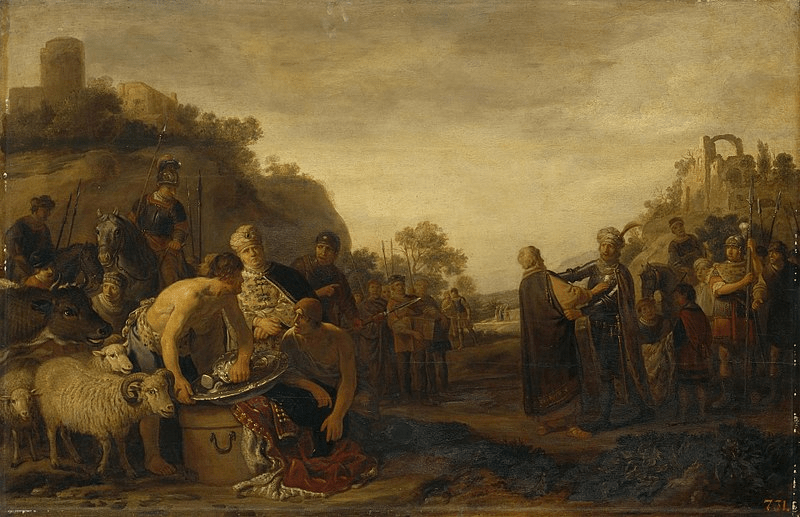
They went up to the town, and as they were entering it, there was Samuel, coming toward them on his way up to the high place. (New International Version)

“He who seeking asses, found a kingdom.”

John Milton, Paradise Regained

We are introduced to Saul, who eventually became the infamous first king of Israel. And he is described in almost a kingly sort of tone; his stature and pedigree are impressive. Saul looks the part of someone who could be important, do things, and go places.

Samuel and Saul, by Dutch painter Claes Moeyaert (1592-1655)

In today’s story, we find Saul to be an obedient and responsible son, going out to find some lost donkeys. By all appearances, Saul was an upright, law-abiding, faithful Jew from the tribe of Benjamin. However, appearances can be rather deceitful. The outward presentation of someone is not always congruent with what is on the inside; and vice versa.

These were the days when Samuel the priest would make a circuit through the country. He made regular rounds as Israel’s judge. Saul and Samuel would encounter each other in a divine appointment. The contrast between the two of them would become ever more pronounced and obvious. But to the point at hand, Saul was simply out looking for some lost animals.

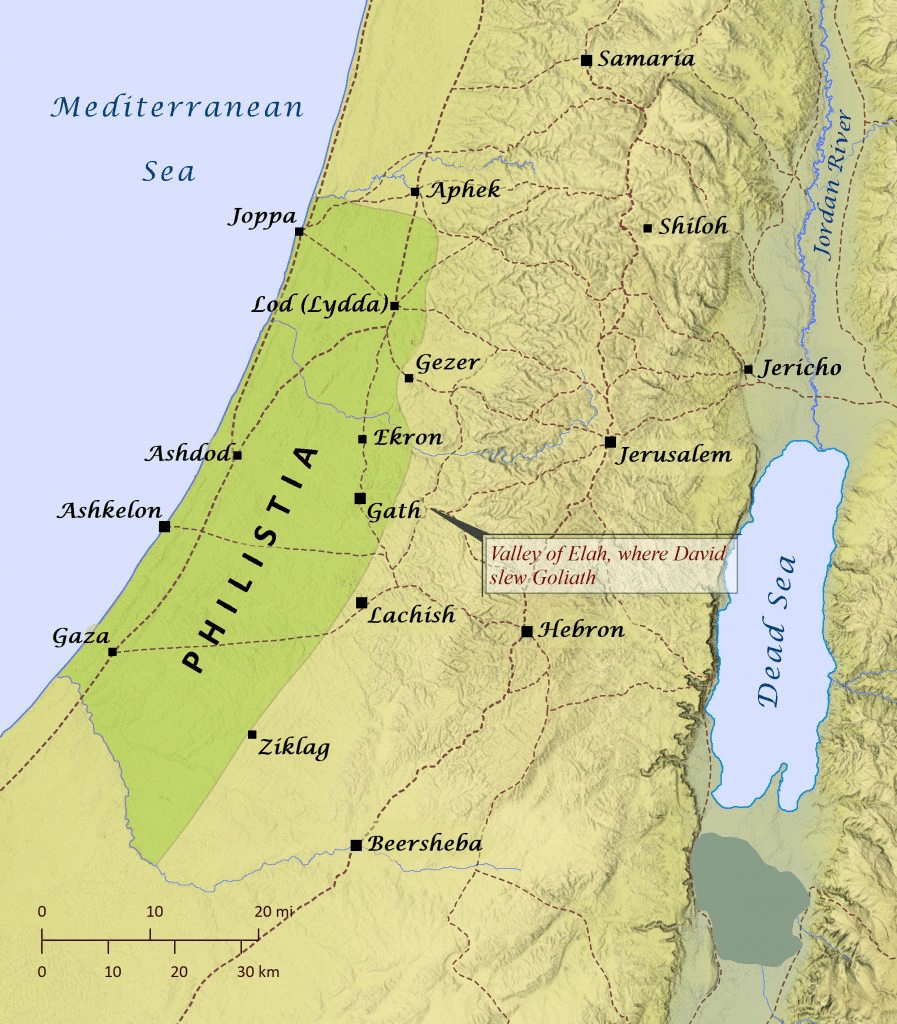
At that time, Israel was facing yet another Philistine military threat. The Philistines were not indigenous to Palestine. The Egyptians referred to them as “sea people;” they originally came from somewhere around the Aegean Sea area and settled in Canaan along the coastal plain between Gaza and Jaffa.

The Philistines expanded their territory, which continually put them at odds with Israel their neighbor. Militarily, the Israelites looked like bumpkins compared to the Philistines – who were skilled warriors with state of the art weapons.

Israel had no king. Instead, they were led by a series of judges who gave rulings throughout the land. Samuel was the last of them because the Israelite tribes determined and demanded that they must have a king in order to face the Philistine threat. (1 Samuel 8:1-21)

Samuel wisely perceived that asking for a king was not going to go well for the people. And he had warned them appropriately. Yet, Israel persisted in wanting to be like all the other nations in having a king to lead an army and fight Israel’s battles.

Although the people loved and appreciated the priest and prophet Samuel, his leadership was regarded as insufficient for the constant anxiety of dealing with the Philistines. It seems the people did not realize or consider what they were asking for, because they got it, and it wasn’t always victory and celebration.

If Israel wanted a king – and someone who looked the part – then that is exactly what they would receive. Saul was tall, strong, and seemed qualified to wage war on the pesky Philistines. Frankly, Saul was a putz who lacked the internal character needed to govern God’s people and ensure God’s will would be done in Israel.

But, again, I get ahead of myself. Reading the account of Saul for the first time, it’s easy for one to not see the signs of a coming personal implosion of the soul.

Sometimes whenever circumstances have been challenging for so long, and difficulty just keeps showing up, we begin to lose our good judgment and start wanting easy solutions for complex problems. And that is what I believe happened to Israel.

The Israelites got tired of the constant Philistine threat – to the point of believing that the grass is greener on the other side of the fence. They thought they needed a king and that everything would be better. And initially it was. But, over the long haul, it proved to be fatal.

For us today, it is good to remember that sound self-discipline through proven spiritual practices, and development of the soul by means of humility, patience, and wisdom, accomplish what is most needed in life.

Becoming weary and tired, we may slowly lose faith. Yet, the ability to persevere, stay the course, and listen well to wise people, can begin to erode and decay through the discouragement of constant adversity.

There is, however, a way to keep going when things are hard. Encourage one another daily. Avoid a critical spirit which drains the energy from others. Be careful who you listen to and take advice from. Become ever more familiar with Holy Scripture and that which is right, just, and good. Rely upon the Lord.

Living a faithful and devoted life to the divine covenant, instead succumbing to human culture, may not be easy; but it will serve us well in the long run.

Father of mercy, alone we have no power in ourselves to help ourselves. When we are discouraged by our weakness, strengthen us to follow Christ, our pattern and our hope; who lives and reigns with you and the Holy Spirit, one God, now and forever. Amen.

Misunderstanding Jesus (Mark 3:20-35)

By Jorge Cocco Santángelo

Then he went home, and the crowd came together again, so that they could not even eat. When his family heard it, they went out to restrain him, for people were saying, “He has gone out of his mind.” And the scribes who came down from Jerusalem said, “He has Beelzebul, and by the ruler of the demons he casts out demons.” 

And he called them to him and spoke to them in parables, “How can Satan cast out Satan? If a kingdom is divided against itself, that kingdom cannot stand. And if a house is divided against itself, that house will not be able to stand. And if Satan has risen up against himself and is divided, he cannot stand, but his end has come. But no one can enter a strong man’s house and plunder his property without first tying up the strong man; then indeed the house can be plundered.

“Truly I tell you, people will be forgiven for their sins and whatever blasphemies they utter, but whoever blasphemes against the Holy Spirit can never have forgiveness but is guilty of an eternal sin”—for they had said, “He has an unclean spirit.”

Then his mother and his brothers came, and standing outside they sent to him and called him. A crowd was sitting around him, and they said to him, “Your mother and your brothers are outside asking for you.” And he replied, “Who are my mother and my brothers?” And looking at those who sat around him, he said, “Here are my mother and my brothers! Whoever does the will of God is my brother and sister and mother.” (New Revised Standard Version)

Who exactly is Jesus? That’s a question which has been bantered around by people for the past two millennia. I suppose that is to be expected, since people contemporary to Christ misunderstood him, including his own family.

There were a couple of related charges against Jesus by the religious authorities of his day: he has a demon; and by the prince of demons he casts out demons. There was also a charge against Jesus from members of his family: he is out of his mind. All the accusations and misinterpretations were in response to the crowds Jesus was attracting.

Sometimes one’s own relatives will think one is crazy, just for doing God’s will. Yet, the good news is that the misunderstood and the misinterpreted folks can find a family within Christian community. Jesus stated that his family are not those who are related by blood, but those who share his purpose of doing the will of God.

Jesus teaching, by James Tissot (1836-1902)

When it came to the religious leaders accusations, they were essentially saying that Jesus was using dark magic and not God’s power. They thought of Jesus as having gained control of certain spirits to do his bidding, as if he were casting spells on people and making them do what he wanted.

Yet, it is illogical, as Christ pointed out, that Satan would cast out his own demons, thus undermining his own sinister work. It’s much more logical to discern Christ’s work as the power of God and the work of the Holy Spirit. To miss this completely, and accuse otherwise, is to commit an unpardonable sin.

The controversy and charges in this story are about who is truly in and who is really out. Because, in reality, the insiders are out and the outsiders are in. And it isn’t so clear cut as everyone seems to think.

Jesus was drawing in the crowd of people, while family members were becoming outsiders. Those on the inside are given insight and understanding about God’s kingdom, whereas those on the outside are scratching their heads, not knowing what Jesus is doing or talking about.

Since the family was mystified by their own relative, they misinterpreted Jesus as being off his rocker. And since the religious leaders were clueless to the parables and actions of Jesus, they misunderstood the source of his power as demonic.

To mistake the work and power of the Holy Spirit as satanic is to be guilty of an unforgivable sin, simply because the ones mistaking, misunderstanding, and misinterpreting never see a need for repentance and forgiveness. They believe they’re okay, and that Jesus is not.

You cannot be forgiven if you always think you’re right.

The bottom line for both the family and the religious leaders is that Jesus didn’t meet their expectations and act as they all think he should; so they make completely misguided conclusions about him.

But, in truth, all they’re actually doing is projecting their own stuff onto Jesus. The family is out of their mind for not recognizing who is actually in front of their face. And the religious authorities blasphemed God by saying hard things about the Lord of life, of whom they were observing.

If that’s how others are going to treat Jesus, then they’re going to be on the outside of God’s kingdom. It’s their own fault, because of their own chosen lack of awareness, and their refusal to take a good hard look at who Jesus is.

For myself, I want to investigate Jesus so closely that I’m like the crowd pressing in to see him and touch the hem of his garment – believing that my desperate desire can be fully met in him. And I want the continued assurance that I am claimed by Christ as his brother.

I am grateful that I no longer have to be an outsider looking in; but instead have become a keeper of kingdom truth because I am drawn into the mystery of God’s love in Jesus Christ through the enablement of the Holy Spirit. To which I say with flavor, “amen” and “amen.”