A Psalm of Lament For the Government of the United States of America

Many, if not most, people fail to acknowledge their grief, and therefore fail to lament their significant changes and losses in life.

What’s more, many, if not most, Christians do the same thing because they focus too much upon triumphalism to the exclusion of dealing with suffering. “Just get over it!” is the mantra to themselves and others.

But that is not a biblical approach to change and loss. 62 out of the 150 Psalms in the Old Testament are laments; some are communal, and others are individual expressions of grief.

Even God laments. We must never forget that a major role of God in our own loss is that the Lord grieves and laments along with us.

Keep in mind that grief can attach itself to any significant change or loss; it is the normal emotional, spiritual, physical, and relational reaction to that loss.

Lament is an intentional process of letting go of relationships and dreams, and living into a new identity after the loss or change.

Please know that everyone’s grief is personal; there is no one-size-fits-all. Thus, the following psalm of lament is my own. It is not meant to be a dig on someone else who rejoices in what I happen to lament. It’s just simply my own sadness over the state of affairs in my beloved nation…

O Lord, I’ll get right down to it: Help!

          I have always taken my refuge in You.

Rescue us, the American people;

          free us from the injustice and unrighteousness rampant in our government.

Be a strong rock to which the oppressed may rely upon;

be a place where I may always go.

You, O God, have saved us many times in the past,

          and Your divine providence has guided us, despite our past and many sins.

My God, free the innocent and the poor from the hands of wicked persons,
         from the grasp of the cruel and unjust President of the United States.

For decades, members of both political parties agreed to safely regulate business;

they’ve decided to provide a social safety net, promote infrastructure, and protect civil rights.

Ideally, the U.S. government has sought to protect every American,

by access to education, healthcare, transportation, communication, employment, and resources.

And elected officials thought primarily of the common good,

so that every American could work hard and prosper.

But what is happening today in the United States,

is the same thing which occurred so long ago in ancient times.

We are in similar situations when the Old Testament prophets called out greed,

          injustice, and abuse in Israel and Judah.

Hear this word that I take up over you in lamentation, O house of Israel…  

They [the rich and powerful] hate the one who reproves in the gate,
    and they abhor the one who speaks the truth.
Therefore because you trample on the poor
    and take from them levies of grain,
you have built houses of hewn stone,
    but you shall not live in them;
you have planted pleasant vineyards,
    but you shall not drink their wine.
For I know how many are your transgressions
    and how great are your sins—
you who afflict the righteous, who take a bribe
    and push aside the needy in the gate.

Hate evil and love good,
    and establish justice in the gate. (Amos 5:1, 10-12, 15a, NRSV)

Perhaps because so few persons even read the prophetic books anymore,

our ignorance has allowed evil means and ways to take over the government.

We are in a nation and in a world full of oligarchs,

who care only for their exorbitant wealth, abuse of power, and self-interest.

As for me, I will not amble down the path of injustice,

          but walk the path of light and life.

I will embrace truth and harmony,

          unlike so many Republican politicians and their lackeys.

They say one thing and then do another;

          lies and corruption are on their lips.

If we say we are in harmony with him [God] yet walk a path of darkness,
we are living a lie and not following the truth…
If we say that we have no broken ways,
we are lying to ourselves,
and the truth is not alive in us.

(1 John 1:6, 8, First Nations Version)

I must, I will, view our problems differently,

because You are my hope, O Almighty Lord.

You have been my confidence ever since I was young;
          I depended on You through many hard times.

My songs of praise constantly speak about You,

for You are my strong refuge,

the Rock I have built my life upon.

Therefore, my mouth is filled with your praise,

and with your glory all day long.

I make my appeal to You, merciful God;

          I ask for divine intervention and deliverance,

          from the ignorant and sinister machinations of the U.S. President.

Do not reject us forever, O Lord,

or abandon us whenever we are too weak to carry on.

My political (and spiritual) enemies talk about me behind my back,

and plot their evil schemes to silence the truth.

They say, “God is not with him and his nonsense;

          put him in his place because no one will help him.”

O God, be close to me, and to all who love the truth;

          O Lord, come quickly to my aid.

Let those who traffic in lies come to a shameful end;

          let them be covered with disgrace and humiliation.

As for me, I will always have hope,

          because You are the God of all hope.

I vow to testify when Your righteousness wins the Day;

          I will never cease to praise Your sacred way of life.

Even when I am old and my mind is no longer clear,

          do not abandon me, O God.

Let me continue to tell the people of this age

what Your divine strength has accomplished,

to someday tell about how Your power delivered us from evil leadership.

Your righteousness and justice reaches to the heavens, O God;

You have done great things.

O Lord, who is like You?

          saving the poor from injustice,

          and delivering the oppressed from evil.

We, indeed, are enduring many terrible troubles;

          yet You, God, are expert at restoration, right relations, and harmonious ways.

You are the One who comforts the afflicted,

and the One who afflicts the comfortable.

Because of your faithful and steadfast love, O God,

          I will give thanks to You as long as I live.

As long as I have a mouth to speak,

          I will tell about your righteousness all day long.

Evil will not prevail;

          ungodly leadership shall not endure.

May Your divine and loving ways come to this country, O God,

          and may your moral will be done,

          on this earth, as it is always done in Your heaven. Amen.

You Live For Whatever You Love (Luke 16:14-18)

The Pharisees, who loved money, heard all this and were sneering at Jesus. He said to them, “You are the ones who justify yourselves in the eyes of others, but God knows your hearts. What people value highly is detestable in God’s sight.

“The Law and the Prophets were proclaimed until John. Since that time, the good news of the kingdom of God is being preached, and everyone is forcing their way into it. It is easier for heaven and earth to disappear than for the least stroke of a pen to drop out of the Law.

“Anyone who divorces his wife and marries another woman commits adultery, and the man who marries a divorced woman commits adultery. (New International Version)

No one can serve two masters. Everyone is committed to something, based upon who or what they are truly serving. Everybody has a master which informs them of ultimate values in life.

In other words, we live for what or whom we love.

Money

The Gospel writer Luke flatly and unequivocally mentioned the Pharisees as loving money. They lived for it. Money was their ultimate value.

With money as master, God is not.

If one’s thoughts, desires, and motives are fueled by Master Money, then that person can say they love and serve God, but they would be lying through their teeth.

If one’s activities are dominated by investments, buying and selling, and conversations with financial planners, then it isn’t God to whom they are praying; Mammon is their God.

The servants of Master Money may attempt to justify themselves, and rationalize their service to Mammon. They might talk about how much they give to charitable organizations, support their local church with monetary gifts, and underwrite a community building project. Yet, the real muster of benevolence is to whom all the money is truly being directed.

Money itself is not the problem; it’s the love of money that’s the issue (1 Timothy 6:10). Such a love of money had taken root into the Pharisee’s heart. They were offended by the words of Jesus, who exposed their true master.

Kingdom

The religious leaders claimed to be all about the Mosaic Law – which is why Jesus addressed this. In Christ’s view, the law and the prophets were until John the Baptist. John’s ministry caused a kerfuffle, because he was the forerunner of Messiah. He pointed to Jesus as the hoped for Savior.

The kingdom of God was at hand. But the religious establishment was too rooted in money as their ultimate deliverer.

Jesus is the Son over God’s house, and the Ruler of God’s empire. Christ is the kingdom. Since the time of John, the kingdom of God has been proclaimed, and everyone is pressing into it.

Multitudes of people flocked and followed Jesus in his earthly ministry. They listened to him talk of God’s kingdom being near. They seized hold of it, striving and pressing to get in.

There were folks who dropped everything, gave up everything, and forsook everything, just to pursue the kingdom of God. Their press toward the kingdom was a reflection of their values. And money had nothing to do with it.

Those who are Christians, in name only, may know something of Jesus and might talk a good line of theology, but they are far from the kingdom of God. They talk, but they don’t press. Someone who presses cries out with the psalmist:

How lovely is your dwelling place,
    Lord Almighty!
My soul yearns, even faints,
    for the courts of the Lord;
my heart and my flesh cry out
    for the living God. (Psalm 84:1-2, NIV)

Someone who presses is ready and willing to do some heavy spiritual lifting. They’ll put in the time and the effort toward the kingdom of God. It’s Jesus they think about, not money.

Law

Believers and followers of Jesus are concerned for what God cares about. And Jesus was concerned about Holy Scripture. He intended on keeping every jot and tittle of the Torah, the Law.

Although we have many differing interpretations of varying passages in the Bible, Jesus is still concerned for the fulfillment of all God’s good promises. Our own angst about upholding the Bible isn’t shared by Christ. Our arguments and divisions don’t sway Jesus into our anxiety.

Christ knows that every word of God shall not fail. It would be easier for the world to spontaneously blow up than for any one word of God to fall away unfulfilled. Money and stuff will pass away, but not God’s Word.

The basic moral and ethical will and law of God hasn’t gone anywhere. Just because the Ten Commandments are not posted publicly anywhere, doesn’t mean they have disappeared.

God’s holy law is like a mirror in front of us, showing us how we are to judge ourselves. The Apostle Paul likened the law to a schoolmaster that drives us to Christ (Galatians 3:24-27).

Furthermore, the law acts as a restraint to evil in the world. It has the value of revealing to us what is not pleasing to God. And if I am pressing into the kingdom of God, I want to know what God loves and hates.

The Pharisees were supposedly the experts in God’s law. Some folks are quite hard on the Pharisees. Yet, rather than bashing on them as a group of people, we need to let the law be our own mirror; we must be concerned with our own righteousness, or lack thereof.

It’s easy for us, along with the old Pharisees, to be legalists – adding principles and traditions to the law that are not the law itself. Holding to these traditions can become as important, or more, as the actual law. They can end up becoming the standard we judge everything by, instead of the actual law, as it is.

Divorce

The morass of traditions surrounding the law is what Jesus was referring to in speaking about divorce. Christ had no use for a husband who could divorce his wife for various incidents, including not being pretty anymore, breaking a dish, or burning the toast.

All of that rigmarole was why Jesus came back to affirming the sanctity of marriage. He pointed out that divorce under conditions of tradition, not law, were tantamount to adultery. Christ was thinking of women’s rights.

In a society in which women were dependent upon men for having their needs met, Jesus did not want women to experience injustice from men. In God’s economy, men are neither free to do whatever they want with women, nor with marriage. Their money needs to be used for wife and family, and not in cleverly contrived ways to get around the law.

We live for what we love. If someone loves money, it will not end well for them. If someone loves God and doing God’s will, then there is life and peace.

Let’s just make sure that we are truly doing God’s will, and not our own secret or unconscious intentions. Because no one can serve two masters.

Blessed God, help me to do Your revealed will fully, gladly, and immediately; and to love You with all my heart, soul, mind, and strength. Enable us all to love our neighbors as ourselves; and to seek the good of people from everywhere. Save us from being unhappy Christians. Deliver us from the sinful habit of complaint. May we rejoice in You, be constant in prayer, and give thanks in all circumstances; through Jesus Christ our Lord, in the strength of the Holy Spirit. Amen.

Divine Sovereignty and Human Responsibility (2 Samuel 8:1-18)

In the course of time, David defeated the Philistines and subdued them, and he took Metheg Ammah from the control of the Philistines.

David also defeated the Moabites. He made them lie down on the ground and measured them off with a length of cord. Every two lengths of them were put to death, and the third length was allowed to live. So the Moabites became subject to David and brought him tribute.

Moreover, David defeated Hadadezer son of Rehob, king of Zobah, when he went to restore his monument at the Euphrates River. David captured a thousand of his chariots, seven thousand charioteers and twenty thousand foot soldiers. He hamstrung all but a hundred of the chariot horses.

When the Arameans of Damascus came to help Hadadezer king of Zobah, David struck down twenty-two thousand of them. He put garrisons in the Aramean kingdom of Damascus, and the Arameans became subject to him and brought tribute. The Lord gave David victory wherever he went.

David took the gold shields that belonged to the officers of Hadadezer and brought them to Jerusalem. From Tebah and Berothai, towns that belonged to Hadadezer, King David took a great quantity of bronze.

When Tou king of Hamath heard that David had defeated the entire army of Hadadezer, he sent his son Joram to King David to greet him and congratulate him on his victory in battle over Hadadezer, who had been at war with Tou. Joram brought with him articles of silver, of gold and of bronze.

King David dedicated these articles to the Lord, as he had done with the silver and gold from all the nations he had subdued:Edom and Moab, the Ammonites and the Philistines, and Amalek. He also dedicated the plunder taken from Hadadezer son of Rehob, king of Zobah.

And David became famous after he returned from striking down eighteen thousand Edomites in the Valley of Salt.

He put garrisons throughout Edom, and all the Edomites became subject to David. The Lord gave David victory wherever he went.

David reigned over all Israel, doing what was just and right for all his people. Joab son of Zeruiah was over the army; Jehoshaphat son of Ahilud was recorder; Zadok son of Ahitub and Ahimelek son of Abiathar were priests; Seraiah was secretary; Benaiah son of Jehoiada was over the Kerethites and Pelethites; and David’s sons were priests.(New International Version)

“God’s sovereignty does not negate our responsibility; it empowers us to live out God’s purposes.”

D. A. Carson

In every biblical story, the real hero is God. That’s because, in each scriptural narrative, God’s sovereignty, power, and authority works on behalf of the people. The secondary characters – if they are good people – take up their mantle of responsibility by working for the people in fulfillment of God’s good promises to them.

Divine sovereignty and human responsibility work together. When that happens, it doesn’t matter what the odds of a situation are, because God’s people will emerge as recipients of God’s gracious promises.

It’s good to always keep in mind that God is working – albeit, mostly behind the scenes where we never see it – and that therefore we must remember to be ourselves continually responsible for acting consistent with God’s revealed will to us.

Up to this point in today’s story, the Ark of the Covenant has been brought to the new national capitol of Jerusalem. The Ark signifies the presence of God, and it’s central placement in the life of the Jewish nation, signifies King David’s desire to be responsible in working on God’s behalf.

So, this is why we have a litany of David’s successes, in order to show us the connection between God’s presence and the national advancement of Israel’s people in the region. King David was able to defeat Jewish enemies in all the geographic places around Israel and Judah.

King David’s Jerusalem, by Julia Goddard

All of the areas mentioned in today’s text fit the boundary promises given to the original Jewish ancestor Abraham, centuries earlier. (Genesis 15:18-21)

David defeated Judah’s main enemy in the West, the Philistines, by capturing their main city, and thus, controlling their entire territory. Philistia had been the major thorn in Judah’s side for a very long time. After David’s victory over them, the Philistines never regained their power again.

David defeated Israel and Judah’s enemies in the East. The Moabites were ancient foes, having tried to put a curse on Israel so that they could enter the Promised Land (Numbers 24:17). But the curse backfired. King David was perhaps merciful to them by not wiping out Moab altogether, but only humbling them with limited violence.

David defeated Israel’s enemies in the North by achieving an overwhelming decisive victory against the Arameans and the city of Damascus, despite insurmountable odds. Yahweh, Israel’s God, clearly outdid Aram’s storm god Hadad – proving to the people once and for all that the Lord is not limited to the geography of Israel.

David defeated Judah’s enemies in the South. The Edomites were always looking to take advantage of their brother Jews, constantly playing out the ancient rivalry between Esau and Jacob. Overcoming the nation of Edom, along with the other surrounding nations, allowed David’s kingdom to more than double in size.

The hallmark description of any good and godly leader is that they do what is right and just for all the people – which is precisely what King David sought to do, and did. And he didn’t do it alone, but had a solid group of good and godly people helping him in his royal administration.

King David acted according to his understanding of God’s will for the Jewish nation, which meant decisively handling the ancient enemies which previous leaders either could not or would not take on. David moved with confidence, believing that God was with him in all his endeavors, based upon divine promises from God’s covenant with Israel.

The God of David is still watching over the nations, and still yet remains sovereign. People are still responsible to act according to their understanding of God’s will – not confusing that responsibility with Israel’s, but knowing what their place is in the kingdom of God with King Jesus as the ultimate Sovereign.

Today, I believe that two significant problems plague us: 1) A lack of knowing God and God’s will for us; and 2) An unwillingness to act confidently in faith and take a risk based on a solid understanding of God. The result of these two problems is pervasive spiritual immaturity and mediocrity.

We have a lot of work to do. And it’s high time we roll up our sleeves and deal with the primary problems in front of us – not with military weapons and shedding blood – but by the means of knowledgeable prayer and loving actions.

May it be so, to the glory of God and for the blessing of the nations. Amen.

There Is Hope (Psalm 89:20-37)

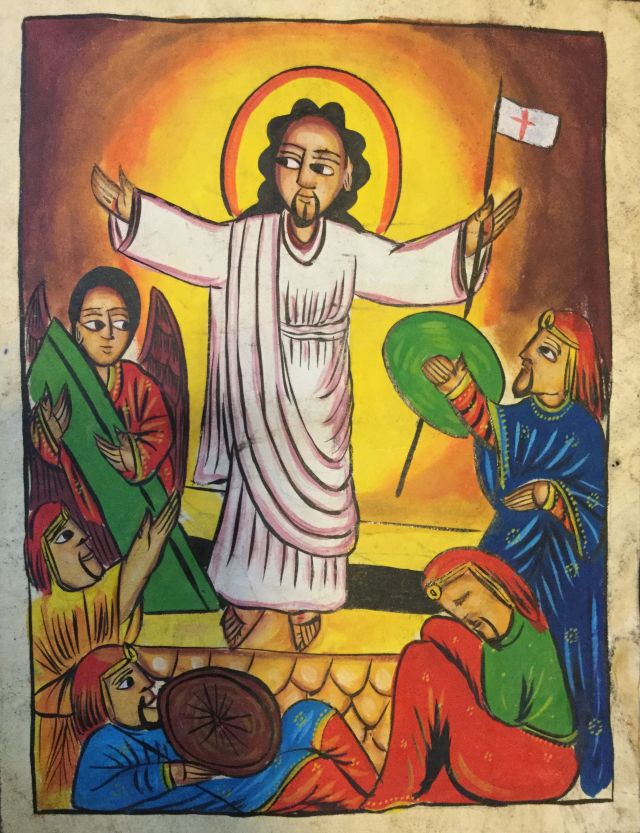
Ethiopian Orthodox depiction of Jesus

“I have found my servant David;
    with my holy oil I have anointed him;
my hand shall always remain with him;
    my arm also shall strengthen him.
The enemy shall not outwit him;
    the wicked shall not humble him.
I will crush his foes before him
    and strike down those who hate him.
My faithfulness and steadfast love shall be with him,
    and in my name his horn shall be exalted.
I will set his hand on the sea
    and his right hand on the rivers.
He shall cry to me, ‘You are my Father,
    my God, and the Rock of my salvation!’
I will make him the firstborn,
    the highest of the kings of the earth.
Forever I will keep my steadfast love for him,
    and my covenant with him will stand firm.
I will establish his line forever
    and his throne as long as the heavens endure.
If his children forsake my law
    and do not walk according to my ordinances,
if they violate my statutes
    and do not keep my commandments,
then I will punish their transgression with the rod
    and their iniquity with scourges,
but I will not remove from him my steadfast love
    or be false to my faithfulness.
I will not violate my covenant
    or alter the word that went forth from my lips.
Once and for all I have sworn by my holiness;
    I will not lie to David.
His line shall continue forever,
    and his throne endure before me like the sun.
It shall be established forever like the moon,
    an enduring witness in the skies.” (New Revised Standard Version)

Back when today’s psalm was originally crafted, there was a lot of stress for the Jews in Jerusalem. The city was in ruins, the land without their king, and the people were experiencing divine judgment from their God.

Into this situation, the psalmist brought some light from darkness; and hope for the survivors, that blessings lay in the future. The psalm is a song of prayer, speaking of the Lord’s faithfulness and steadfast love because of the promises made to the people’s ancient ancestor, King David.

The covenant between God and the people, made so many centuries ago, will never be broken. Why? Because fidelity to that covenant doesn’t depend on the people, but on the faithfulness of God and God’s timeless moral law.

The Lord God, the Almighty, did not forsake nor forget the people. The Lord’s mercies are new every morning; and God’s faithful love is forever.

Renewal and restoration are very real possibilities, despite the dire circumstances, and the people’s spiritual infidelity. Once again in history, one worthy of the throne of David will sit to judge the people with equity and grace.

The Son of David will be the custodian of God’s covenant promises. Evil shall be defeated. Authority to forgive sins, and to grant eternal life, will be established on earth. Indeed, the Lord’s enduring words and ways will be accomplished on this earth, as they are always done in God’s heaven.

The divine covenant will find its ultimate fulfillment in One whose throne is established for all eternity. The anointed one, the God-Man, will carry the burden of government on his shoulders; his rule and authority shall extend over the whole earth. (Isaiah 9:7)

Acting with the power of God, this Ruler is the visible image of the invisible God – the Mighty God, Eternal Father, Prince of Peace. For the Christian, these qualifications and descriptions are all met in the person of Jesus the Christ.

In a thoroughly and unabashed Christo-centric reading of the psalm, Jesus is the ultimate Messiah and High Priest who offered himself as the faultless, acceptable, eternal, and final sacrifice on behalf of the whole world. (Isaiah 53)

Therefore, since we are justified by faith, we have peace with God through our Lord Jesus Christ, through whom we have obtained access to this grace in which we stand, and we boast in our hope of sharing the glory of God. (Romans 5:1-2, NRSV)

Through Jesus, the New Testament perspective is that the old Mosaic Covenant became obsolete, and the New Covenant – promised by the prophets Jeremiah and Ezekiel – took its place. (Jeremiah 31:31-34; Ezekiel 36:25-27; Hebrews 8:13)

Although this High Priest died, he also was raised to life, and ascended to heaven – where he continues to intercede for God’s people.

He holds his priesthood permanently because he continues forever. Consequently, he is able for all time to save those who approach God through him, since he always lives to make intercession for them. (Hebrews 7:24-25, NRSV)

Before David was anointed king, Saul and his enemies hunted him and tried to kill him. Yet, through all of those twists and turns of harrowing circumstances, David trusted in the Lord and patiently waited for God to ensconce him as king. In time, that is precisely what happened. And David became the greatest king Israel ever had.

In much the same way, that fox King Herod tried to kill Jesus. Then later, Herod’s son, along with the religious establishment, sought to kill Jesus, as well. Behind the murderous intent, and every intent of doing away with the innocent, are the dark evil forces of this world.

The Accuser, Satan, the devil, tried to tempt the Christ and subvert the will of God, thus making the New Covenant something that would never happen. But Jesus was obedient to the Father – obedient even to death. (Philippians 2:8)

Christ Jesus offered himself willingly. His death may have been orchestrated by the existence of evil on this earth, yet it was God who allowed it all to occur, so that evil’s murderous tool, death, would become impotent.

The power of sin, death, and hell has been broken; but it will take awhile before the kingdom of God is established in all its grace and glory, and David’s fallen Tabernacle restored.

No matter how difficult, chaotic, and frustrating our current earthly situation may be, God will still establish the king; the good work begun and effected shall ultimately be thoroughly fulfilled. Jesus is coming again.

Until then, the good news is proclaimed that the kingdom of God is near. There is grace and forgiveness in the name of Jesus. Peace is no longer a pipe dream. Hope is real.

O Lord, when evil darkens our world, give us light. When despair numbs our souls, give us hope. When we stumble and fall, lift us up. When doubts assail us, give us faith. When nothing seems sure, give us trust. When ideals fade, give us vision. When we lose our way, be our guide, so that we may find serenity in Your presence, and purpose in doing Your will. Amen.