Divine Sovereignty and Human Responsibility (2 Samuel 8:1-18)

In the course of time, David defeated the Philistines and subdued them, and he took Metheg Ammah from the control of the Philistines.

David also defeated the Moabites. He made them lie down on the ground and measured them off with a length of cord. Every two lengths of them were put to death, and the third length was allowed to live. So the Moabites became subject to David and brought him tribute.

Moreover, David defeated Hadadezer son of Rehob, king of Zobah, when he went to restore his monument at the Euphrates River. David captured a thousand of his chariots, seven thousand charioteers and twenty thousand foot soldiers. He hamstrung all but a hundred of the chariot horses.

When the Arameans of Damascus came to help Hadadezer king of Zobah, David struck down twenty-two thousand of them. He put garrisons in the Aramean kingdom of Damascus, and the Arameans became subject to him and brought tribute. The Lord gave David victory wherever he went.

David took the gold shields that belonged to the officers of Hadadezer and brought them to Jerusalem. From Tebah and Berothai, towns that belonged to Hadadezer, King David took a great quantity of bronze.

When Tou king of Hamath heard that David had defeated the entire army of Hadadezer, he sent his son Joram to King David to greet him and congratulate him on his victory in battle over Hadadezer, who had been at war with Tou. Joram brought with him articles of silver, of gold and of bronze.

King David dedicated these articles to the Lord, as he had done with the silver and gold from all the nations he had subdued:Edom and Moab, the Ammonites and the Philistines, and Amalek. He also dedicated the plunder taken from Hadadezer son of Rehob, king of Zobah.

And David became famous after he returned from striking down eighteen thousand Edomites in the Valley of Salt.

He put garrisons throughout Edom, and all the Edomites became subject to David. The Lord gave David victory wherever he went.

David reigned over all Israel, doing what was just and right for all his people. Joab son of Zeruiah was over the army; Jehoshaphat son of Ahilud was recorder; Zadok son of Ahitub and Ahimelek son of Abiathar were priests; Seraiah was secretary; Benaiah son of Jehoiada was over the Kerethites and Pelethites; and David’s sons were priests.(New International Version)

“God’s sovereignty does not negate our responsibility; it empowers us to live out God’s purposes.”

D. A. Carson

In every biblical story, the real hero is God. That’s because, in each scriptural narrative, God’s sovereignty, power, and authority works on behalf of the people. The secondary characters – if they are good people – take up their mantle of responsibility by working for the people in fulfillment of God’s good promises to them.

Divine sovereignty and human responsibility work together. When that happens, it doesn’t matter what the odds of a situation are, because God’s people will emerge as recipients of God’s gracious promises.

It’s good to always keep in mind that God is working – albeit, mostly behind the scenes where we never see it – and that therefore we must remember to be ourselves continually responsible for acting consistent with God’s revealed will to us.

Up to this point in today’s story, the Ark of the Covenant has been brought to the new national capitol of Jerusalem. The Ark signifies the presence of God, and it’s central placement in the life of the Jewish nation, signifies King David’s desire to be responsible in working on God’s behalf.

So, this is why we have a litany of David’s successes, in order to show us the connection between God’s presence and the national advancement of Israel’s people in the region. King David was able to defeat Jewish enemies in all the geographic places around Israel and Judah.

King David’s Jerusalem, by Julia Goddard

All of the areas mentioned in today’s text fit the boundary promises given to the original Jewish ancestor Abraham, centuries earlier. (Genesis 15:18-21)

David defeated Judah’s main enemy in the West, the Philistines, by capturing their main city, and thus, controlling their entire territory. Philistia had been the major thorn in Judah’s side for a very long time. After David’s victory over them, the Philistines never regained their power again.

David defeated Israel and Judah’s enemies in the East. The Moabites were ancient foes, having tried to put a curse on Israel so that they could enter the Promised Land (Numbers 24:17). But the curse backfired. King David was perhaps merciful to them by not wiping out Moab altogether, but only humbling them with limited violence.

David defeated Israel’s enemies in the North by achieving an overwhelming decisive victory against the Arameans and the city of Damascus, despite insurmountable odds. Yahweh, Israel’s God, clearly outdid Aram’s storm god Hadad – proving to the people once and for all that the Lord is not limited to the geography of Israel.

David defeated Judah’s enemies in the South. The Edomites were always looking to take advantage of their brother Jews, constantly playing out the ancient rivalry between Esau and Jacob. Overcoming the nation of Edom, along with the other surrounding nations, allowed David’s kingdom to more than double in size.

The hallmark description of any good and godly leader is that they do what is right and just for all the people – which is precisely what King David sought to do, and did. And he didn’t do it alone, but had a solid group of good and godly people helping him in his royal administration.

King David acted according to his understanding of God’s will for the Jewish nation, which meant decisively handling the ancient enemies which previous leaders either could not or would not take on. David moved with confidence, believing that God was with him in all his endeavors, based upon divine promises from God’s covenant with Israel.

The God of David is still watching over the nations, and still yet remains sovereign. People are still responsible to act according to their understanding of God’s will – not confusing that responsibility with Israel’s, but knowing what their place is in the kingdom of God with King Jesus as the ultimate Sovereign.

Today, I believe that two significant problems plague us: 1) A lack of knowing God and God’s will for us; and 2) An unwillingness to act confidently in faith and take a risk based on a solid understanding of God. The result of these two problems is pervasive spiritual immaturity and mediocrity.

We have a lot of work to do. And it’s high time we roll up our sleeves and deal with the primary problems in front of us – not with military weapons and shedding blood – but by the means of knowledgeable prayer and loving actions.

May it be so, to the glory of God and for the blessing of the nations. Amen.

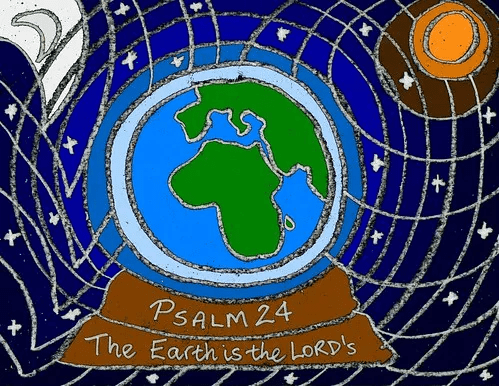
Everything Belongs to God (Psalm 24)

By Stushie Art

The earth is the Lord’s and all that is in it,
    the world, and those who live in it,
for he has founded it on the seas
    and established it on the rivers.

Who shall ascend the hill of the Lord?
    And who shall stand in his holy place?
Those who have clean hands and pure hearts,
    who do not lift up their souls to what is false
    and do not swear deceitfully.
They will receive blessing from the Lord
    and vindication from the God of their salvation.
Such is the company of those who seek him,
    who seek the face of the God of Jacob.

Lift up your heads, O gate
    and be lifted up, O ancient doors,
    that the King of glory may come in!
Who is the King of glory?
    The Lord, strong and mighty,
    the Lord, mighty in battle.
Lift up your heads, O gates!
    and be lifted up, O ancient doors,
    that the King of glory may come in!
Who is this King of glory?
    The Lord of hosts,
    he is the King of glory. (New Revised Standard Version)

The world belongs to God; and so do we. People have a simple, yet profound, task in this life: To confess the Lord’s great and sovereign ownership of everything, including themselves; and to therefore live a good and holy life because of that theological understanding.

“There is not a square inch in the whole domain of our human existence over which Christ, who is Sovereign over all, does not cry, Mine!”

Abraham Kuyper

Abraham Kuyper (1837-1920) was born in the Netherlands. He was a church minister, university professor, and politician – having established a Christian university, as well as served in the Dutch parliament and as Prime Minister of the Netherlands.

Kuyper labored throughout his life to flesh-out the theological implications of a sovereign God. He consistently insisted that all we do as humans is to be integrated and brought under the lordship of Jesus Christ.

He firmly believed that all things belong to God in Christ; thus, all the fragments of our lives are to be oriented and integrated around our Creator’s great claim upon us as creatures. Whether a pastor, teacher, or politician – every vocation, each activity, and all thoughts and intents rightly belong to God.

By Stushie Art

This means that religion and spirituality cannot be kept within superimposed limits. There is no separation of any one domain of human thought from the rest, no isolation of any one domain of human life from another or from Christ.

The spiritual life is not limited to merely the ethereal. It is both celestial and terrestrial – heavenly and earthly – concerned for the immaterial and the material. God cares about it all, because it all belongs to God.

God owns the world. So, the implications of this for us is huge. It means we don’t really own anything. We are simply stewarding all that God has given us – including our very lives.

The chaos of this world, from a biblical perspective, comes from creatures attempting to assert their own sovereignty and to control things. Since we were not created to be little gods roaming about doing our own thing, the inevitable result is a topsy-turvy messed-up world.

God’s divine claim and ownership of the world means that absolute authority does not rest with nations, states, or leaders. Everything we see, as well as what we don’t see, belongs to the Lord.

A significant task of believers is to confess and bear witness to God’s rightful and benevolent rule in this world. In fact, Christians everywhere pray toward this end every week:

“Your kingdom come, your will be done, on earth, as it is in heaven.” (Matthew 6:10)

The circle of life, within Holy Scripture, is the Creator God bestowing life and relationship to created humans, who then respond by practicing just and righteous living – thereby receiving renewal from the Lord and life anew. Theoretically, this movement can go unbroken. It can be a regular celebration in consistent rhythms of worship and adoration of God.

When we are able to get into the intended divine groove of faith, life, and worship, we will discover our meaning and purpose in the world.

By rightly ordering our lives, centering and grounding them in the gracious and loving relationship of Creator and creature, then we find true blessing – because it enjoys an intuited stamp of approval by the God who makes life possible.

In the Christian tradition, Jesus is the Victor, the King of Glory. All the promises and hopes of people are found and focused, in Christ. We enter through Jesus, the door of life, into deliverance from death and everything which separates us from God, others, and self.

Jesus comes to bring blessing, justice, righteousness, mercy, purity, and peace. For this is how the world was meant to operate from the beginning. We are to open the ancient door of faith, especially when the Lord comes knocking:

Listen! I am standing and knocking at your door. If you hear my voice and open the door, I will come in and we will eat together. Everyone who wins the victory will sit with me on my throne, just as I won the victory and sat with my Father on his throne. If you have ears, listen to what the Spirit says to the churches. (Revelation 3:20-22, CEV)

Old Abraham Kuyper is long dead, and yet he got it right, if we are able to hear him:

“Whatever people may do, to whatever they may apply their hands – in agriculture, in commerce, and in industry, or in mind, in the world of art, and science – they are, in whatsoever it may be, constantly standing before the face of God. They are employed in the service of God. They have strictly to obey God. And above all, they must aim at the glory of God.”

Blessed Lord, Creator of heaven and earth, though I am quite capable of fretting, complaining, and lamenting about how out of control things seem, the truth is that nothing is outside your grip. I may not always see your hand, discern your heart, or like your ways, but you are God and there is no other. 

So, continue to renew my thinking, gentle my heart, and deepen my worship. I humbly and gladly affirm that you are God, and I am not, through Jesus Christ, my Lord, who with you and the Holy Spirit reign sovereign as one God, now and forever. Amen.

The Grace of Redemption and Gratitude (Exodus 37:1-16)

Bezalel made the ark of acacia wood—two and a half cubits long, a cubit and a half wide, and a cubit and a half high. He overlaid it with pure gold, both inside and out, and made a gold molding around it. He cast four gold rings for it and fastened them to its four feet, with two rings on one side and two rings on the other. Then he made poles of acacia wood and overlaid them with gold. And he inserted the poles into the rings on the sides of the ark to carry it.

He made the atonement cover of pure gold—two and a half cubits long and a cubit and a half wide. Then he made two cherubim out of hammered gold at the ends of the cover. He made one cherub on one end and the second cherub on the other; at the two ends he made them of one piece with the cover. The cherubim had their wings spread upward, overshadowing the cover with them. The cherubim faced each other, looking toward the cover.

They made the table of acacia wood—two cubits long, a cubit wide and a cubit and a half high. Then they overlaid it with pure gold and made a gold molding around it. They also made around it a rim a handbreadth wide and put a gold molding on the rim. They cast four gold rings for the table and fastened them to the four corners, where the four legs were. The rings were put close to the rim to hold the poles used in carrying the table. The poles for carrying the table were made of acacia wood and were overlaid with gold. And they made from pure gold the articles for the table—its plates and dishes and bowls and its pitchers for the pouring out of drink offerings. (New International Version)

This section is, for the most part, a mirror image of Exodus 25:23-40 – which provides meticulous instructions from God on how to build the Ark of the Covenant and the Table that goes with it.

The purpose of this section in Holy Scripture is to give a detailed report that everything the Lord instructed Moses to do, was obediently done, down to every last detail.

This was of upmost importance to the biblical writer, because half-obedience is really not obedience, at all. And there needs to be obedience in order to realize blessing.

God had a purpose with ancient Israel to establish them as God’s people, with God dwelling amongst them. The way this would happen was by means of all the specific prescriptions for the Tabernacle with its worship implements.

Foremost amongst those worship implements was the Ark and the Table, simply because that was the place of meeting with God – and even more specifically – the place of redemption.

The Tabernacle was built, then erected and put into place, just as it was described by God to Moses. And that is the point. The Lord does not change. There was no Plan B or altering the agenda as things went along, because human sin and people’s foibles mucked up everything. No, that’s not how it went down.

Nothing detracts or sidelines God from accomplishing divine purposes – especially when it comes to redeeming people and coming alongside them.

Just because the Israelites disastrously made an idol in the form of a golden calf, and worshiped it as if it were God, did not mean God’s plan failed.

In fact, the Lord made the plan even better by showing exceeding grace in not wiping out the entire lot of them – but instead used the situation to demonstrate steadfast love and accomplish the divine purpose of redemption.

No matter how you slice or dice it, it always comes out as grace.

My hope is that you can see that through all of the details of worship implements and Tabernacle protocol, God bent over backwards to be with the people.

God is holy. God is absolute purity and light. That holiness and purity would incinerate us in a nanosecond if we didn’t have things in place to help us be with God. That was what the Ark and the Table helped to do for Israel.

There are times in Holy Scripture when things get repeated. Repetition, according to many scholars, communicates emphasis. The repeated details of the Ark and the Table, as well as all the other articles associated with worship, communicate the heart of God in wanting us to have access to the divine. In other words, its repeated because it’s important.

Access, redemption, worship, and mercy are all important for the believer. We learn from today’s seemingly mundane verses that:

  • Sin must be addressed in order to have access to God
  • A way has been made for us to be with God
  • We are enabled and empowered to approach God
  • We have received the mercy of redemption from God
  • We are to therefore give mercy to others through table fellowship and forgiveness
  • And we are to give thanks and have gratitude in our hearts to God

Listening to the instructions of God, obeying them, and enjoying them is at the heart of good religion. May it be so, to the glory of God.

Accept, O Lord, our thanks and praise for all that you have
done for us. We thank you for the splendor of the whole
creation, for the beauty of this world, for the wonder of life,
and for the mystery of love.

We thank you for the blessing of family and friends, and for
the loving care which surrounds us on every side.

We thank you for setting us at tasks which demand our best
efforts, and for leading us to accomplishments which satisfy
and delight us.

We thank you also for those disappointments and failures
that lead us to acknowledge our dependence on you alone.

Above all, we thank you for your Son Jesus Christ; for the
truth of his Word and the example of his life; for his steadfast
obedience, by which he overcame temptation; for his dying,
through which he overcame death; and for his rising to life
again, in which we are raised to the life of your kingdom.

Grant us the gift of your Spirit, that we may know him and
make him known; and through him, at all times and in all
places, may give thanks to you in all things. Amen.

The Parable of the Sower (Mark 4:1-20)

The Sower, by Mike Moyers

Again Jesus began to teach by the lake. The crowd that gathered around him was so large that he got into a boat and sat in it out on the lake, while all the people were along the shore at the water’s edge. He taught them many things by parables, and in his teaching said:

“Listen! A farmer went out to sow his seed. As he was scattering the seed, some fell along the path, and the birds came and ate it up. Some fell on rocky places, where it did not have much soil. It sprang up quickly because the soil was shallow. But when the sun came up, the plants were scorched, and they withered because they had no root. Other seed fell among thorns, which grew up and choked the plants, so that they did not bear grain. Still other seed fell on good soil. It came up, grew and produced a crop, some multiplying thirty, some sixty, some a hundred times.”

Then Jesus said, “Whoever has ears to hear, let them hear.”

When he was alone, the Twelve and the others around him asked him about the parables. He told them, “The secret of the kingdom of God has been given to you. But to those on the outside everything is said in parables so that,

“‘they may be ever seeing but never perceiving,
    and ever hearing but never understanding;
otherwise they might turn and be forgiven!’”

Then Jesus said to them, “Don’t you understand this parable? How then will you understand any parable? The farmer sows the word. Some people are like seeds along the path, where the word is sown. As soon as they hear it, Satan comes and takes away the word that was sown in them. Others, like seed sown on rocky places, hear the word and at once receive it with joy. But since they have no root, they last only a short time. When trouble or persecution comes because of the word, they quickly fall away. Still others, like seed sown among thorns, hear the word; but the worries of this life, the deceitfulness of wealth and the desires for other things come in and choke the word, making it unfruitful. Others, like seed sown on good soil, hear the word, accept it, and produce a crop—some thirty, some sixty, some a hundred times what was sown.” (New International Version)

The Sower, by Johne Richardson

All four of the New Testament Gospels have their own particular angle and focus upon the life of Jesus Christ. For Mark, he wrote to demonstrate and prove the established authority of Christ over everything.

God’s power is expressed in and through Christ. So, when Mark tells a story, he is concerned to communicate that God’s kingdom – God’s rule and reign on this earth – comes through Jesus as the Sovereign over this realm of the universe and our world.

By means of a parable – a farmer going out and scattering seeds – Jesus was making some points about the kingdom of God: it will be successful; it is thoroughly under divine control; and it’s inclusive.

God’s Reign Will Succeed

History is inexorably moving toward a climax. God’s sovereign rule has broken into human history. Christ’s authoritative rule is taking root, growing, and shall eventually envelope all the world.

It may not presently seem as if that’s going to happen. But appearances can be deceiving. Although much, if not most, of the good gospel seeds spread about this earth never produce a harvest of righteousness, there is enough good soil for those seeds to succeed.

Even though there is a lot of unproductive and ineffective soil in this world, good seeds in good soil will germinate and take root. They will grow, develop, mature, and ripen. An abundant yield of crops will more than satisfy the needs of the earth. And it will blow the imagination of even the wisest and best farmer.

One person, having realized the incredible fruit of the Spirit, makes a broad, deep, and expansive impact on dozens, hundreds, thousands, tens of thousands, and even millions of people. It certainly doesn’t happen overnight; but goodness, truth, beauty, and righteousness are making their way slowly – and will overtake and overwhelm all evil.

If you make disciples who make more disciples, that is multiplication. Jesus made disciples, and called his followers to do the same. He spent three years training twelve men; and then commissioned them to go out and reproduce the process with others. (Matthew 28:18-20)

Beginning in Jerusalem, the earliest disciples of Jesus began making more disciples, following Christ’s ascension, and that movement has never stopped. Jesus started a movement of a few seeds multiplying into many seeds, so that the Church would grow exponentially. Not even the gates of hell can stop the process from happening. (Acts 1:1-8; Matthew 16:17-19)

God’s Reign Is Ruled by God

That may seem like a ridiculously obvious statement, yet it still needs to be said. God is authoritatively in control, not only of God’s own kingdom, but of all things. This means that God’s rule and reign is the result of God’s action, not ours. The only thing we need to do is scatter the seed and be a simple farmer. Everything else is up to God.

Our ability to do anything is animated by God’s gracious work in our lives. The power to effect making disciples comes from the Lord. Since we are dependent upon God for our next breath, we are also completely under the authority and sustaining presence of God for everything in life.

Both the subject and object of every biblical story is God. In this unfolding drama of redemptive history that we are experiencing, God is the writer, producer, director, and lead actor; we only have some bit parts in the whole thing. It’s our job to respond – and not to try and take over the show.

God’s Reign Is Inclusive

When gospel seeds are established in good soil, eventually producing an abundant harvest, it will feed the entire world. It will include all kinds of people. The produce which is available is not limited to a particular group of people. God’s grace and goodness are shown to people without prejudice or favoritism.

The best things in life begin as small as a mustard seed. That’s because every good thing we have is a result of humility. And from that place – the hummus of the earth – God creates life, gives new life, and does the improbable and the impossible of transforming a tiny little seed into a tall expansive plant which blesses many.

Conclusion

As simple humble farmers of faith, we need to pay attention to what we have, so that we don’t become complacent. The forces of evil – the spiritual tornados and tsunamis – are still very much active on this earth. Those powers temporarily oppose the good power and authority of Christ.

The good word spread to us can be snatched and taken away by the ravens of Satan. Although other good words make some effective headway, all the weeds around them can choke the plants until they wither and die. All sorts of existential conditions surrounding the plants can cause a failure to thrive.

Whenever Christians face opposition – or when they observe young believers lost to those surrounding forces – they need not become discouraged. Why? Because this is all a part of the ministry to which every follower of Jesus is called. Our part is to keep sowing and planting. The rest is up to God.

Sovereign and almighty God:
Give me strength to live faithfully this day;
Let me not turn coward because of difficulties, or become irresponsible to my duties;
Let me not lose faith in other people;
Keep me sweet and sound of heart, in spite of ingratitude, treachery or meanness;
Preserve me from minding little stings or giving them;
Help me to keep my heart clean and to live so honestly and fearlessly that no outward failure can dishearten me or take away the joy of conscious integrity;
Open wide the eyes of my soul that I may see good in all things;
Grant me this day some new vision of your truth;
Inspire me with the spirit of joy and gladness, and make me the fertilizer to suffering souls; in the name of the strong Deliverer, our only Lord and Savior, Jesus Christ. Amen.