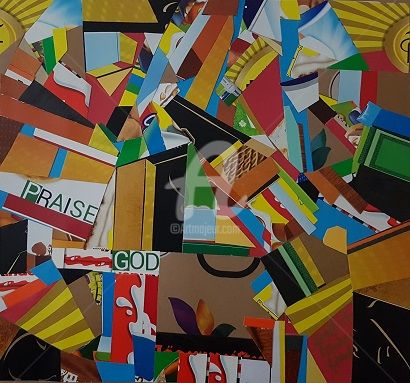
Psalm 113 – Shout Praises

“From Sunrise to Sunset Praise God” by Muha Rukab

Shout praises to the Lord!
Everyone who serves him,
    come and praise his name.

Let the name of the Lord
    be praised now and forever.
From dawn until sunset
    the name of the Lord
    deserves to be praised.
The Lord is far above
    all of the nations;
    he is more glorious
    than the heavens.

No one can compare
    with the Lord our God.
His throne is high above,
    and he looks down to see
    the heavens and the earth.
God lifts the poor and needy
    from dust and ashes,
    and he lets them take part
    in ruling his people.
When a wife has no children,
    he blesses her with some,
and she is happy.
    Shout praises to the Lord! (Contemporary English Version)

When my firstborn daughter was an infant, I was a busy seminarian as well as working a job. I had very little discretionary time on my hands. Yet, I could stand over the crib of my beautiful little bundle of a girl for long stretches of time without ever thinking about all my responsibilities. Whenever she awoke I spoke to her in that kind of baby talk that only a doting father can do. 

I imagine God looks at us in much the same way, as well as speaking and acting toward us in ways we can understand. Just as parents (hopefully) communicate on a level their kids can understand, so G-d condescends and stoops to our level in order to help us. 

The Lord is seated on high, looking down on the heavens and the earth. G-d looks at us with lovingkindness and seeks our best interests. The Lord notices the poor and acts justly on their behalf. G-d observes the needy and lifts them from their want to a place where they can thrive. The divine condescension of God is a beautiful thing because without it we would be like a helpless baby.

G-d, while being unknowable and unreachable in so many ways, has nevertheless communicated with humanity in a way people can understand and to which they can respond. The Lord has accommodated, or made allowance for, our language and general level of understanding.

The Lord, sovereign and high above us all, has chosen to stoop and coo over us here on earth. G-d’s love affectionately delights in us. The psalmist’s portrayal of G-d is not of some aloof Being who is bothered with humanity’s pestering. Rather, G-d sees, notices, and cares. We don’t need to do some sort of spiritual back flips to gain G-d’s attention. We already have it.

This psalm of praise to G-d celebrates how the Sovereign of the universe notices and acts. We are meant to remember the great deeds of G-d – both those things done in history, and the things done for us, personally. 

“Despite our earnest efforts, we couldn’t climb all the way up to God. So what did God do? In an amazing act of condescension, God climbed down to us and became one with us.”

Will Willimon

In Christianity, the concept of divine condescension and accommodation is given its supreme form in the person and work of Jesus Christ. By becoming human, Jesus accommodates himself to the human condition. Through his life, teaching, and ministry, Christ speaks as G-d, communicating sufficiently and effectively to humanity.

The redemptive events of Christ – his incarnation, holy life, death, resurrection, ascension, and glorification – are divine acts of grace, mercy, and love to all humanity. Praise and thanksgiving are the appropriate responses to such events done on our behalf.

This is one reason why the spiritual practice of journaling is such a good personal discipline because we then have a record of the ways in which G-d has acted on our behalf. When we look back and remember, we can praise the Lord all over again for lifting us from the ash heap. And this will fortify our spiritual mettle for the times when we need encouragement.

Keeping a gratitude journal and writing each day about at least one way the Lord has acted on your behalf, can bring encouragement, transformation, and joy to your life. I suggest you write for your own eyes only. This is between you and G-d. Therefore, you need not be concerned for correct spelling and grammar. It doesn’t even need to be legible, as long as you can read your own writing!

“Praise is the rehearsal of our eternal song. By grace we learn to sing, and in glory we continue to sing. What will some of you do when you get to heaven, if you go on grumbling all the way? Do not hope to get to heaven in that style. But now begin to bless the name of the Lord.”

Charles Spurgeon

What’s more, shouting our praises is not only appropriate but encouraged – even commanded. Shouting is both cathartic and fun. It builds emotional resilience and spiritual strength. Coupled with writing, shouting our praises has the effect of bringing spiritual growth and maturity to our lives.

We, of course, want to avoid shouting at others. Yet, we can take advantage of shouting while driving alone, out in the woods by ourselves, or even into a pillow. This isn’t weird. Shouting goes appropriately with praise and celebration.

In fact, it would be weird if there were no shouting. Try telling a sports fan watching their favorite team that they aren’t supposed to shout. Or just see what happens when a woman longing for children becomes pregnant for the first time.

Emotional expressions are expected whenever G-d shows up and accomplishes great deeds for us. To not do so is a sign of having spiders in your heart and garlic in your soul. It’s not right.

What are you thankful for today? Is there something in this day for which to praise the Lord, whether big or small? Will you give yourself permission to shout?

Accept, O Lord, our thanks and praise for all you have done for us. We thank you for the splendor of the whole creation, the beauty of this world, the wonder of life, and the mystery of love. We thank you for the blessing of family and friends, and the loving care which surrounds us on every side. We thank you for setting us at tasks which demand our best efforts and leading us to accomplishments which satisfy and delight us. We thank you also for those disappointments and failures that lead us to acknowledge our dependence on your mercy and grace.

Above all, we thank you for your Son, our Lord, Jesus Christ, the truth of his Word, the example of his life; his steadfast obedience, by which he overcame temptation; his dying, through which he overcame death; and his rising to life again, in which we are raised to new life. Grant us the gift of your Spirit so that we may know Christ and make him known; and through him, at all times and in all places, we may give thanks to you in and for all things. Amen.

Proverbs 30:1-10 – Live Wisely and without Envy

These are the solemn words of Agur son of Jakeh:

    “God is not with me, God is not with me,
    and I am helpless.
I am more like an animal than a human being;
    I do not have the sense we humans should have.
I have never learned any wisdom,
    and I know nothing at all about God.
Have any ever mastered heavenly knowledge?
    Have any ever caught the wind in their hands?
    Or wrapped up water in a piece of cloth?
    Or fixed the boundaries of the earth?
Who are they, if you know? Who are their children?

“God keeps every promise he makes. He is like a shield for all who seek his protection. If you claim that he said something that he never said, he will reprimand you and show that you are a liar.”

I ask you, God, to let me have two things before I die: keep me from lying and let me be neither rich nor poor. So, give me only as much food as I need. If I have more, I might say that I do not need you. But if I am poor, I might steal and bring disgrace on my God.

Never criticize servants to their master. You will be cursed and suffer for it. (Good News Translation)

These are the raw expressions of a man who has awareness of his own envious nature. He realizes his profound lack of wisdom. The man, Agur, discerns how helpless and pathetic he really is, apart from wise living.

The wise person knows that a heart at peace gives life to the body, but envy rots the bones. Possessing too much or too little tends to awaken the eye of envy within us. Agur wants to avoid thinking that people, even God, owes him. He is concerned he might slip into the disposition of what the Lord and others can do for him, rather than vice versa.

“The secret of success is that it is not the absence of failure, but the absence of envy.”

Herodotus

Today, envy manifests itself in moving-on to another church, or friendship, or marriage, or job when perceived needs and wants are not met. Certainly, ties need to be severed in the case of abusive treatment. Yet, when we simply do not like something, and aspire to more and more hoarding of emotional and spiritual resources, there is little to no awareness of the shadowy places in our hearts.

Perhaps, through the difficulty, the Lord was attempting to reveal something important to us or working to bring about positive transformation. However, we bailed from the situation too quickly, not wanting to deal with the pain or inconvenience of it all. And, all the while, our real motivations remain hidden and unaddressed.

It is necessary to see envy for what it is – not just a common predilection everyone has – but a malady of believing I deserve things no one is giving me. It’s the age old endemic problem, much like Adam and Eve’s original sin, of grabbing a forbidden fruit in the belief G-d is not providing everything I need. And we then cannot, or will not, see all the vast resources and blessings already possessed.

Gratitude is a spiritual practice, when engrafted into a daily spiritual walk, provides a strong antidote to keeping envy at bay. Instead of wondering why G-d is not blessing my life and work in ways I think it should happen, perhaps we ought to identify and count the blessings we already possess and enjoy. 

Some of the greatest joys around us are the simple pleasures of everyday life – holding and sipping a hot cup of coffee; a quick kiss good-bye to my spouse on the way out the door; the opportunity to curl up with a good book on a rainy day; these and many more are blessings given to us by a heavenly Father who cares for us deeply.

“Gratitude turns what we have into enough.”

Aesop

It might be a good thing to spend some intentional time saying and/or writing out many of the blessings currently existing in your life. 

For example, rather than wishing a loved one would not have to endure disease or surgery and envying healthy people, rejoice that he/she is with you, that you enjoy one another’s love and companionship, whether it is in times of health or in seasons of illness.

And instead of envying the rich or worrying about becoming poor, give thanks for this current place in your life. Simple thanksgiving to G-d for every meal, each possession obtained, and even all things lost forever, fortifies the spirit for resilience over the long haul of life.

Much of our life on this earth comes down to mystery. We simply do not know, and are not privy, to the myriad ways G-d is working in the world. We may never know why we must face and deal with our particular and personal pains, disappointments, and sorrows.

So, when we pray, much like Agur, it might be wise to ask for continual help with never-ending problems, rather than constantly praying for deliverance from unwanted situations. It is best we pray as Jesus taught us saying, “Give us this day our daily bread.” (Matthew 6:11)

“I’ve learned by now to be quite content whatever my circumstances. I’m just as happy with little as with much, with much as with little. I’ve found the recipe for being happy whether full or hungry, hands full or hands empty. Whatever I have, wherever I am, I can make it through anything in the One who makes me who I am.”

The Apostle Paul (Philippians 4:11-13, MSG)

Wise persons know the frailty of their own hearts. Prayer, for them, is an organic practice arising from vulnerable and forthright discussions with G-d about doubt and disbelief. Indeed, people come to know the Lord not through speculating or imposing their own personality on G-d but by daily calling upon the Divine Being for practical help at the neediest points of life.

Blessed Lord, take me to the place where I am saved from my pride and arrogance and humility takes center stage, where I’m lifting up clean hands and a pure heart to you. Take me to the place where I’m no longer looking at the mountains I face but looking down upon them, where I can clearly see, and my decisions are flooded with your light, truth and justice. I bend my knee and receive your truth. I open my ears to receive your counsel. I open my heart to receive your eternal wisdom. Amen.

Psalm 57 – Prayer and Praise in the Middle of Trouble

Above the Heavens by painter Melani Pyke

Be merciful to me, O God, be merciful to me,
    for in you my soul takes refuge;
in the shadow of your wings I will take refuge,
    until the destroying storms pass by.
I cry to God Most High,
    to God who fulfills his purpose for me.
He will send from heaven and save me,
    he will put to shame those who trample on me.
God will send forth his steadfast love and his faithfulness.

I lie down among lions
    that greedily devour human prey;
their teeth are spears and arrows,
    their tongues sharp swords.

Be exalted, O God, above the heavens.
    Let your glory be over all the earth.

They set a net for my steps;
    my soul was bowed down.
They dug a pit in my path,
    but they have fallen into it themselves.
My heart is steadfast, O God,
    my heart is steadfast.
I will sing and make melody.
    Awake, my soul!
Awake, O harp and lyre!
    I will awake the dawn.
I will give thanks to you, O Lord, among the peoples;
    I will sing praises to you among the nations.
For your steadfast love is as high as the heavens;
    your faithfulness extends to the clouds.

Be exalted, O God, above the heavens.
    Let your glory be over all the earth. (New Revised Standard Version)

One thing we all share about the human experience is that, sooner or later, someone or a group of people will let us down. 

On top of that, many have experienced, or will experience, some sort of abuse and victimization from another person or group – leaving one scarred by trauma. What’s more, there are those who have even had their very lives at risk because someone intentionally sought to actually kill them. That is the company David found himself in when King Saul, and when his son Absalom, sought to do away with his life.

To David’s credit, he never retaliated and did not try and turn the tables by putting a hit out on either Saul or Absalom. Instead, David cried out to God. And we get to listen in on the prayer. Today’s psalm is David’s prayerful reliance upon the God in whom he put all his trust and praise. 

The entire basis of prayer is to let God be God. So, how do we exactly do that?

When the storms of life assail us, calloused persons trample on us with impunity, devious individuals set traps for us, and greedy organizations prey upon us, we refuse to respond in kind. Instead, we deliberately praise God and rely on divine protection, praying to the Lord and steadfastly holding to our confidence that if God is for us, nothing can be against us.

That advice may seem like some sort of pie-in-the-sky rot of ginning up positive thoughts when there is nothing positive to be seen in the experience. Indeed, we must never, and I repeat, never invalidate another’s experience nor our own, when those experiences are hellish.

Yet, there is also always hope. There are two unshakable truths which are constant and never diminished by any adverse circumstance: God is present. And God loves.

If we know nothing else, and all else seems to be descending into the abyss of tragedy, the twin towers of divine presence and attention stand tall as the strongest sentinels over our dilapidated situation and struggling faith.

Letting God be God means not trying to exercise control over things we have no control over – but affirming that the Lord is willing and capable of handling our worst. It could be that we are stuck in the belly of whale because, without our knowing, there are sharks surrounding us who cannot get to us.

Our perspective of matters is, at best, severely limited. It is much better to place faith in the God who sees it all with an expansive eye which misses nothing.

One of the best things about the psalms is that they are a wonderful collection of prayers we can adopt for our own. Not only can we use them for ourselves, but we are also obliged to do so. If anyone has been in an adverse situation so deep that it feels like having ambled into a pride of lions, it is quite likely that the experience leaves one with no adequate words to say. It’s as if you are paralyzed with fear. 

So, let the psalm say for you what you cannot even begin to utter yourself. The Word of God is not meant to sit on a coffee table or rest on a shelf; it is meant to be opened and used for prayer. Allow it to do its intended purpose.

Who knows? Perhaps your faith in the mercy of God and your praises lifted to God will give rise to settled confidence and peace so that you can rest secure even when all around you is going to hell.

Be merciful to me, O God, for in you my soul takes refuge.  Even though I feel the slash of people with tongues as swords, my heart is steadfast and will exalt your name above the heavens.  Let your glory be over all the earth!  Amen.

Psalm 37:12-22 – Get Some Perspective

Merciless people make plots
against good people
    and snarl like animals,
but the Lord laughs and knows
    their time is coming soon.
The wicked kill with swords
and shoot arrows
to murder
    the poor and the needy
    and all who do right.
But they will be killed
    by their own swords,
    and their arrows
    will be broken.

It is better to live right
and be poor
    than to be sinful and rich.
The wicked will lose all
    of their power,
but the Lord gives strength
    to everyone who is good.

Those who obey the Lord
    are daily in his care,
    and what he has given them
    will be theirs forever.
They won’t be in trouble
    when times are bad,
    and they will have plenty
    when food is scarce.

Wicked people are enemies
    of the Lord
    and will vanish like smoke
    from a field on fire.

An evil person borrows
    and never pays back;
    a good person is generous
    and never stops giving.
Everyone the Lord blesses
    will receive the land;
    everyone the Lord curses
    will be destroyed.
(Contemporary English Version)

The angle from which we view things is really important.

Perspective is everything. 

Whenever some ornery cuss swears at us, or a group of people think the worst of us, or an organization takes advantage of us, we might feel like crumbling underneath the weight of stress.

Throw into the mix the state of world affairs: pandemic, natural disasters, war, poverty, human trafficking, and a legion of unjust victimization and oppression around the globe.

And add our own personal issues, whatever they are, of dealing with mental and physical health, and/or difficult relationships with family, co-workers, or neighbors.

Put it all together and it would be rather easy to believe evil is winning. Can we even begin to make a dent in the wickedness of injustice, abuse, and maltreatment?

When we infuse God to the menacing challenges of our world, it changes everything.

Don’t you know? Haven’t you heard?
    The Lord is the everlasting God,
    the creator of the ends of the earth.
    He doesn’t grow tired or weary.
His understanding is beyond human reach.

Isaiah 40:28, CEB

The vantage of the psalmist is that all this immense malevolent plotting which exists cannot even begin to stand up to the even larger sovereign and benevolent God. 

It’s almost as if the Lord looks down from heaven at wicked people and says, “Well, now, isn’t that something, those tiny little yippee dogs thinking they can take on the big dog!” Truth is, the Lord laughs at the wicked, for God sees that their day is coming – and it won’t be pretty for them. 

Or we might picture some puny bugs on the ground making nefarious plans, completely oblivious to the hugeness of God that towers over them. They are about to be squished but are too busy going about their pathetic business to look up and see what is coming. The bugs are totally powerless in the face of such an awesome presence.

So cut away the thick calluses from your heart and stop being so willfully hardheaded. God, your God, is the God of all gods, he’s the Master of all masters, a God immense and powerful and awesome. He doesn’t play favorites, takes no bribes, makes sure orphans and widows are treated fairly, takes loving care of foreigners by seeing that they get food and clothing. (Deuteronomy 10:17-18, MSG)

We humans who try our best to be good, do right, and live a spiritual life can become much too discouraged, far too easily. 

The remedy to the malady of such disillusionment is to be filled with a robust theology which wisely discerns God as far above all our problems and situations. 

“I am the Lord, the God of all people. Nothing is too difficult for me.”

Jeremiah 32:27, GNT

No matter how ominous the machinations of malicious corruption array against us, the spiritual believer is assured that God is in control, and, in the end, the wicked will get their comeuppance. 

And if we will have the spiritual eyes to see, that fearsome lion who scares the baloney out of us with his loud roar, is really an old toothless cat with no bite. Malicious and malevolent people typically make all kinds of noise and talk a big line, but all they really have is their belligerent bullying and ballyhoo.

No earthly power, no clever person, no loudmouth tormentor, and no human organization can ever go toe to toe with the gargantuan God we serve. 

Put all your circumstances beside this God and see if it changes your perspective.

Mighty God, you bless those who are dedicated to you, and you put down those who rage against you.  Fortify my spirit and let me see just the train of your robe, and I will glimpse the large grandeur of your glory.  Let me know Jesus Christ risen and ascended far above all principalities and powers of this earth.  Amen.