Why Are We Here? (Matthew 9:2-13)

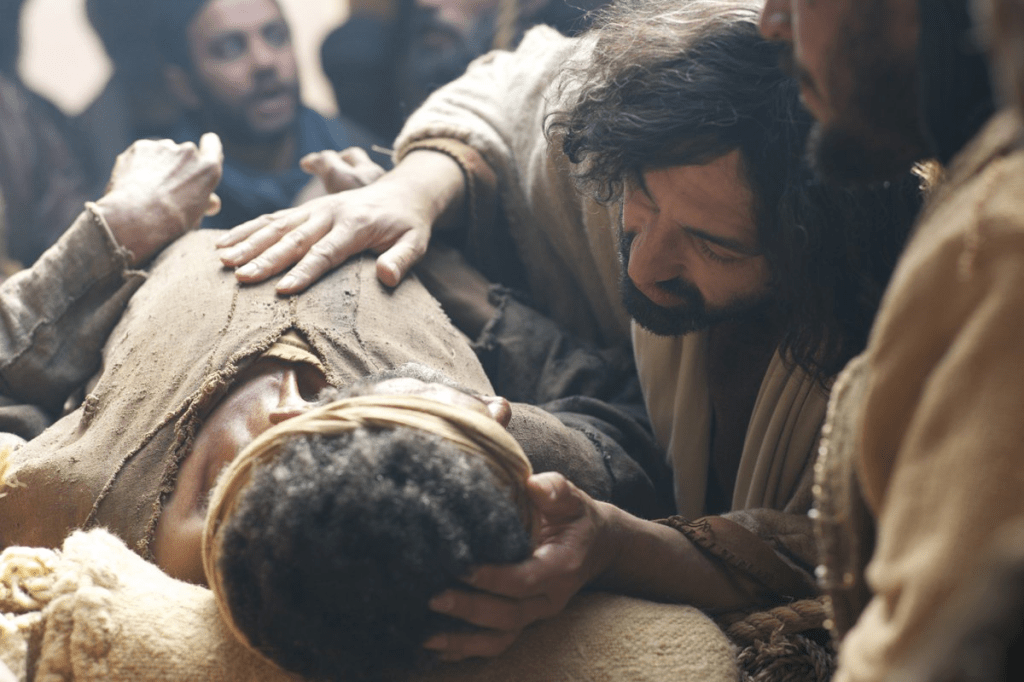
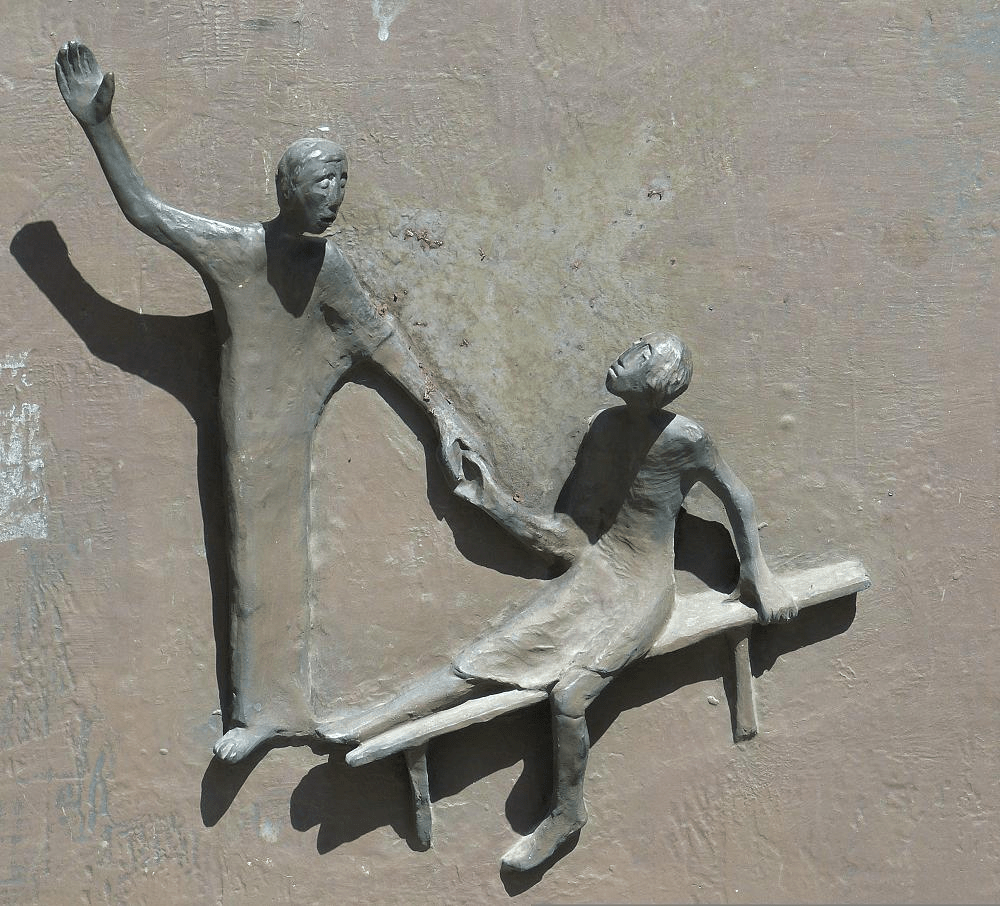
Jesus heals and forgives a paralyzed man

Some men brought to him a paralyzed man, lying on a mat. When Jesus saw their faith, he said to the man, “Take heart, son; your sins are forgiven.”

At this, some of the teachers of the law said to themselves, “This fellow is blaspheming!”

Knowing their thoughts, Jesus said, “Why do you entertain evil thoughts in your hearts? Which is easier: to say, ‘Your sins are forgiven,’ or to say, ‘Get up and walk’? But I want you to know that the Son of Man has authority on earth to forgive sins.” So he said to the paralyzed man, “Get up, take your mat and go home.” Then the man got up and went home. When the crowd saw this, they were filled with awe; and they praised God, who had given such authority to man.

As Jesus went on from there, he saw a man named Matthew sitting at the tax collector’s booth. “Follow me,” he told him, and Matthew got up and followed him.

While Jesus was having dinner at Matthew’s house, many tax collectors and sinners came and ate with him and his disciples. When the Pharisees saw this, they asked his disciples, “Why does your teacher eat with tax collectors and sinners?”

On hearing this, Jesus said, “It is not the healthy who need a doctor, but the sick. But go and learn what this means: ‘I desire mercy, not sacrifice.’ For I have not come to call the righteous, but sinners.” (New International Version)

“The church is a hospital for sinners, not a museum of saints.”

Abigail Van Buren (“Dear Abby”)

Why does the Church exist? Why did Jesus come to this earth? What are we supposed to be doing? Does Christianity make any difference in this world? Why are we here?

The Church is not on this earth solely for the benefit of Christians, any more than a hospital exists for the benefit of the doctors or insurance companies.

Rather, the Church is designed to extend the mission of Jesus through proclamation of good news with the restorative touch of grace. The Church is the community of the redeemed, gathered together for worship and encouragement, and then sent into the world to be the continuing presence of Jesus on this earth.

This mean that the Church’s calling is not to find others who can help them with their tithing and budget, or to keep the pews warm with fresh bottoms.

Some folks are not healthy. Some are sick physically, and others spiritually. Even more are emotionally brokenhearted. And then there are those who are sick-and-tired of being sick-and-tired.

Please know that Jesus came neither to condemn nor heap a pile of unrealistic expectations on us. Christ points us to the source of healing and transformation, and invites us to come to him. 

Conversely, there are many other people today who are healthy, spiritually alive, and have a good well-being. And they possess the opportunity to participate in ways that bring holistic healing to the world as Christians. The mission of Jesus is our mission, as well.

Jesus came to bring forgiveness and transformation. In today’s Gospel healing, it was a case where the person’s paralysis was both physical and spiritual. The paralytic found in Jesus healing of both body and soul.

The religious insiders observed the healing of the paralytic. Yet, they didn’t rejoice over it. Instead, they were hung up on Jesus claiming to be God. Although this may have been a hard truth to accept, Jesus labeled their response as evil – because of an inability to perceive the situation as a divine intervention. Since the religious insiders wrongly discerned who Jesus is, they wrongly interpreted the situation. 

It’s important to see Jesus as the Human One who extends compassion and forgiveness. If we fail to see this about Christ, we will get caught up in all kinds of silly matters concerning personal preferences and power plays, based in how we think things should go, rather than how God is shaking out things.

Jesus came to forgive our guilt and shame. Healing the body is good, but it’s not enough. Christ came to heal both the body and the spirit. At the heart of the human condition is spiritual brokenness, and Jesus wants to remove the obstacle of sin and create a new healthy society. This is a radical vision which seeks to encompass all persons – which means Jesus touched many people overlooked by others.

Jesus came to call the despised people of society, the “sinners.” He called Matthew, a tax collector. Tax collectors were hated. They were corrupt characters who extorted money from innocent people. And furthermore, Jesus had dinner with Matthew, along with all of his unsavory buddies. This kind of behavior by Jesus was deeply offensive to upstanding citizens.

However, Jesus did not back down, saying that it’s not the healthy who need a doctor, but the sick. And he backed up his social actions with Scripture by encouraging offended folks to meditate on what the biblical phrase, “I desire mercy, not sacrifice.” (Hosea 6:6)

It is possible to engage in outward rituals of worship, do all the right things, fulfill duty, yet still miss the heart of what God wants for humanity. Mercy is what God wants. Jesus knew this. So, Christ entangled himself with sinners to bring spiritual healing and restoration.

If we want to see God deliver people from their unhealthy situations, we must entangle ourselves with them, into complicated lives that are not pretty, with persons who have been tainted by sin. 

Lots of people are in awful predicaments. Christians, like their Lord, will need to get their hands dirty and their feet wet to extend Christ’s ministry of mercy and forgiveness.

The gospel was never intended to be proclaimed from afar, but up close and personal. The merciful mission of Jesus requires the following three activities:

  1. Intimacy with Jesus. Engaging in the spiritual disciplines of prayer, giving, fasting, reading, and meditating on Scripture. These practices help us to know Christ better and how to respond with mercy.
  2. Intimacy with fellow believers. We are hard-wired by God for community. Superficial relationships only provide superficial community. Christians need to help one another with spiritual growth, and to hold one another accountable for the mission of Christ.
  3. Intimacy with “sinners.” This world is filled with sick, needy, hurting, and lonely people who are locked in unhealthy patterns of living. They need a merciful change of life that comes from the merciful Jesus acting through merciful Christians. 

Mercy, not judgment, is at the heart of all change. For things to be different, we must be acquainted with mercy.

Most merciful God, we confess we have sinned against you in thought, word, deed, and neglect. We have not held fast to your commandments and have strayed from your teachings. We turn away from self-centered actions and pride. For the sake of your Son, Jesus, have mercy on us and forgive us so that we are released from all sinful obstacles. Empower us with your wisdom, revelation, and discernment so that we might be your merciful hands, feet, and words to one another and those who do not yet know you. Amen.

Donkey Talk (Numbers 22:22-28)

The angel of the Lord meets Balaam with a sword, from “Bible Pictures and What They Teach Us” by Charles Foster, 1897

Balaam was riding his donkey to Moab, and two of his servants were with him. But God was angry that Balaam had gone, so one of the Lord’s angels stood in the road to stop him. When Balaam’s donkey saw the angel standing here with a sword, it walked off the road and into an open field. Balaam had to beat the donkey to get it back on the road.

Then the angel stood between two vineyards, in a narrow path with a stone wall on each side. When the donkey saw the angel, it walked so close to one of the walls that Balaam’s foot scraped against the wall. Balaam beat the donkey again.

The angel moved once more and stood in a spot so narrow that there was no room for the donkey to go around. So it just lay down. Balaam lost his temper, then picked up a stick and whacked the donkey.

When that happened, the Lord told the donkey to speak, and it asked Balaam, “What have I done that made you beat me three times?” (Contemporary English Version)

This is one of those stories which speaks for itself. It’s clear to see that the diviner Balaam made a jackass of himself. A dumb donkey could see things better than a famous seer.

The nation of Moab was afraid of Israel. Balak the Moabite got in touch with Balaam the diviner in order for him to put a curse on Israel. Even though Balaam had the sense to know that he could only speak what God told him, he was influenced by Balak through vanity, and enticed with a small fortune. So, off he went to Moab.

But God was angry with Balaam. Three times the angel of the Lord stood in the road to oppose Balaam. The donkey knew what was up, but Balaam was too dense – stubborn as a jackass – to what was going on. It took God talking through the donkey before Balaam could finally see the angel.

When God wants to speak and accomplish a divine purpose, the Lord can use anything or anybody to achieve it – even by means of a talking donkey.

In fact, throughout Holy Scripture, God oftentimes uses the weak to further the divine agenda. Whenever God determines something, it will happen, usually by means nobody ever expects.

Look at your situation when you were called, brothers and sisters! By ordinary human standards not many were wise, not many were powerful, not many were from the upper class. But God chose what the world considers foolish to shame the wise. God chose what the world considers weak to shame the strong. And God chose what the world considers low-class and low-life—what is considered to be nothing—to reduce what is considered to be something to nothing. (1 Corinthians 1:26-28, CEB)

If God can use a donkey as a teacher, then none of us need ever be discouraged. The Lord can and will use us to make a difference in this world. God takes special delight in choosing and using the nobodies of this world to fulfill divine purposes and to communicate important messages.

This is why we can always bank of the promises of God – because nothing and nobody can ever stand in the way of the Lord’s will. God is creative and determined, using whatever means and whomever God wants, in order to bring about the good and the right and the just, in this old fallen world.

Most of us don’t have to worry about having a big head or a vain spirit or being a famous prophet like Balaam. The majority of us struggle more with having a lower view of ourselves than we actually are.

God created us according to the divine will and in divine wisdom. The Lord has equipped you with your particular DNA both biologically and spiritually. And, most of all, each one of us has been stamped with the divine image and likeness of God. We carry within our very being the stuff of our Creator.

So, I hope it won’t take some donkey talk to help you see and understand who you are and what your purpose on this earth is for. And there is no need to consult a dubious diviner to try and obtain something that you already possess. Not even a jackass does that.

Our Father in heaven,
Reveal who you are.
Set the world right;
Do what’s best—
    as above, so below.
Keep us alive with three square meals.
Keep us forgiven with you and forgiving others.
Keep us safe from ourselves and the Devil.
You’re in charge!
You can do anything you want!
You’re ablaze in beauty!
    Yes. Yes. Yes. Amen. (Matthew 6:9-13, MSG)

Set Apart for a Purpose (Exodus 30:22-38)

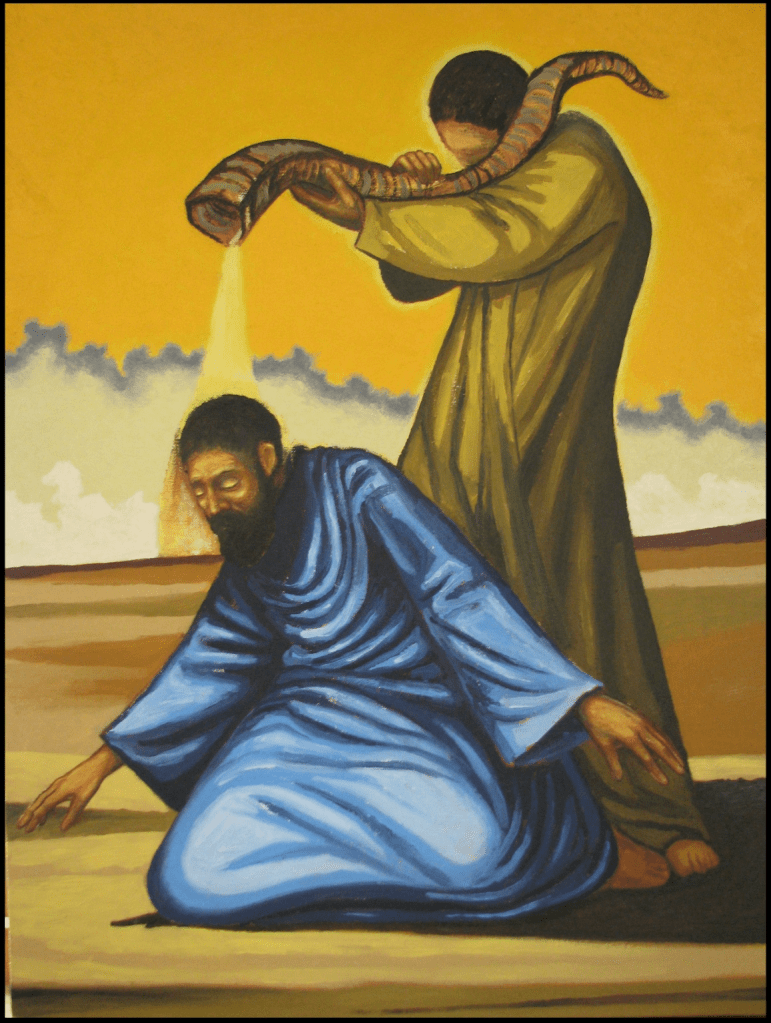
Aaron is anointed by Moses, by Jack Baumgartner

Then the Lord said to Moses, “Collect choice spices—12 1⁄2 pounds of pure myrrh, 6 1⁄4 pounds of fragrant cinnamon, 6 1⁄4 pounds of fragrant calamus, and 12 1⁄2 pounds of cassia—as measured by the weight of the sanctuary shekel. Also get one gallon of olive oil.

Like a skilled incense maker, blend these ingredients to make a holy anointing oil. Use this sacred oil to anoint the Tabernacle, the Ark of the Covenant, the table and all its utensils, the lampstand and all its accessories, the incense altar, the altar of burnt offering and all its utensils, and the washbasin with its stand. Consecrate them to make them absolutely holy. After this, whatever touches them will also become holy.

“Anoint Aaron and his sons also, consecrating them to serve me as priests. And say to the people of Israel, ‘This holy anointing oil is reserved for me from generation to generation. It must never be used to anoint anyone else, and you must never make any blend like it for yourselves. It is holy, and you must treat it as holy. Anyone who makes a blend like it or anoints someone other than a priest will be cut off from the community.’”

Then the Lord said to Moses, “Gather fragrant spices—resin droplets, mollusk shell, and galbanum—and mix these fragrant spices with pure frankincense, weighed out in equal amounts. Using the usual techniques of the incense maker, blend the spices together and sprinkle them with salt to produce a pure and holy incense. Grind some of the mixture into a very fine powder and put it in front of the Ark of the Covenant, where I will meet with you in the Tabernacle.

You must treat this incense as most holy. Never use this formula to make this incense for yourselves. It is reserved for the Lord, and you must treat it as holy. Anyone who makes incense like this for personal use will be cut off from the community.” (New Living Translation)

It’s not everyday that you get a scripture text like this one to reflect upon. Yet, since all of Holy Scripture is given to us and for us, it’s good to occasionally have to work through the place and purpose of seemingly mundane passages within the Bible.

The ancient world of the Israelites had a relationship with their God in which everything and every part of their lives were to be holy – both worship and daily life were infused with reminders that they were set apart entirely to God and for God.

Therefore, what the people wore, what they ate, and how they went about daily tasks of living and worshiping was dictated to them from the Lord. The purpose of all the detailed instructions was to reinforce the importance of being a holy people, a kingdom of priests, who could show the world how a community of persons devoted to Yahweh lived, talked, and acted.

Concerning the people’s worship of God, chapters 25-31 of Exodus provide detailed plans for the sacred space and symbols which were to be used in that worship. Elaborate specifications were given for their construction and placement.

Today’s Old Testament lesson deals with the special formula for anointing oil. In keeping with the holiness which is to be pervasive throughout all of Israelite life, this particular oil has a specific use, and is never to be used outside of that ordained purpose.

The sanctity of the oil is communicated in the strongest of terms; profane use of it is strictly forbidden. And all of the work is to be done during six days of the week, because the Sabbath is a day set apart as different, with an abundant rest from labor.

The anointing oil is used for symbolic marking in the service of God. The priests (the Levites Aaron and his sons) were to use the oil, since they were the only ones set apart to do the priestly work. The articles used for worship were also marked with the anointing oil. (Exodus 29:4-7)

None of this liturgical action was in any sort of way magical; it communicated the important theological concept that God is holy, and therefore, holiness is to be woven into every facet of Israelite life. The anointing oil was a sign of God’s acknowledgement and approval that the objects and the people being anointed were to be exclusively used for worship.

Holiness and being set apart aren’t only ancient ideas and practices; it’s also an important part of the New Testament and the way we are to live today. That’s because holiness isn’t merely something God does; it is inherent to God’s very nature. Therefore, as people created in God’s image and likeness, we too, are to live sanctified lives, set apart to live as humans are designed to live.

“You must be holy because I, the Lord your God, am holy.” (Leviticus 19:2, NLT)

“You must be holy because I, the Lord, am holy. I have set you apart from all other people to be my very own.” (Leviticus 20:26, NLT)

But now you must be holy in everything you do, just as God who chose you is holy. For the Scriptures say, “You must be holy because I am holy.”

1 Peter 1:15-16, NLT

Followers of Christ are set apart for a purpose – to be holy and sanctified in all they say and do. And, much like the ancient followers of God, Christians are to worship the Lord alone, living differently than the rest of the world.

It is God’s will that you should be sanctified. (1 Thessalonians 4:3a, NIV)

You are a chosen people, a royal priesthood, a holy nation, God’s special possession, that you may declare the praises of him who called you out of darkness into his wonderful light. Once you were not a people, but now you are the people of God; once you had not received mercy, but now you have received mercy. (1 Peter 2:9-10, NIV)

We have an opportunity, as people anointed and set apart for God’s good purposes, to bring mercy as we have received mercy, love as we ourselves have received love; and to maintain the integrity of holiness everywhere we go.

In today’s mass produced factory products, consumers only see the end results; they are ignorant of the person and process that made the product. Most things we buy and use come to us without any history of how they were made and who made them.

Yet, the people and the processes used in making anything is significant because holiness cannot be factory-made. There is always a connection between the person, the process, and what is being produced for the end product.

In God’s economy, it isn’t enough just to have anointing oil composed of the right ingredients; the individual and the craft employed are what make it truly an oil for anointing the holy.

People, in truth, are neither interchangeable on a factory floor assembly line, nor with the worship of God. The individual person offering their process will always have a particular outcome unique to that mix of person, process, and product. The belief that singing, praying, serving, and whatever else happens in worship is to be done with consistency – no matter who does it – is both impossible and not expected by God.

Though the ingredients of a particular spiritual experience always remain the same, Holy Scripture suggests that the subtle differences each individual brings to the craft of worship is good and necessary; without that uniqueness, there cannot be holiness.

Sanctify your church by the truth, O Lord; your word is truth.

Sanctify us by the truth, O Lord; your word is truth.

Sanctify me by the truth, O Lord; your word is truth. Amen.

See the Big Picture (Genesis 41:37-57)

The proposal pleased Pharaoh and all his servants. Pharaoh said to his servants, “Can we find anyone else like this, one in whom is the spirit of God?” So Pharaoh said to Joseph, “Since God has shown you all this, there is no one so discerning and wise as you. You shall be over my house, and all my people shall order themselves as you command; only with regard to the throne will I be greater than you.” And Pharaoh said to Joseph, “See, I have set you over all the land of Egypt.” 

Removing his signet ring from his hand, Pharaoh put it on Joseph’s hand; he arrayed him in garments of fine linen and put a gold chain around his neck. He had him ride in the chariot of his second-in-command, and they cried out in front of him, “Bow the knee!” Thus he set him over all the land of Egypt. 

Moreover, Pharaoh said to Joseph, “I am Pharaoh, and without your consent no one shall lift up hand or foot in all the land of Egypt.” Pharaoh gave Joseph the name Zaphenath-paneah, and he gave him Asenath daughter of Potiphera, priest of On, as his wife. Thus Joseph gained authority over the land of Egypt.

Joseph was thirty years old when he entered the service of Pharaoh king of Egypt. And Joseph went out from the presence of Pharaoh and went through all the land of Egypt. During the seven plenteous years the earth produced abundantly. He gathered up all the food of the seven years when there was plenty in the land of Egypt and stored up food in the cities; he stored up in every city the food from the fields around it. So Joseph stored up grain in such abundance—like the sand of the sea—that he stopped measuring it; it was beyond measure.

Before the years of famine came, Joseph had two sons, whom Asenath daughter of Potiphera, priest of On, bore to him. Joseph named the firstborn Manasseh, “For,” he said, “God has made me forget all my hardship and all my father’s house.” The second he named Ephraim, “For God has made me fruitful in the land of my misfortunes.”

The seven years of plenty that prevailed in the land of Egypt came to an end, and the seven years of famine began to come, just as Joseph had said. There was famine in every country, but throughout the land of Egypt there was bread. 

When all the land of Egypt was famished, the people cried to Pharaoh for bread. Pharaoh said to all the Egyptians, “Go to Joseph; what he says to you, do.” And since the famine had spread over all the land, Joseph opened all the storehouses and sold to the Egyptians, for the famine was severe in the land of Egypt. 

Moreover, all the world came to Joseph in Egypt to buy grain, because the famine became severe throughout the world. (New Revised Standard Version)

Mosaic of Joseph overseeing the gathering of grain during the seven years of plenty, c.1275 C.E., St. Mark’s Basilica, Venice, Italy

It’s easy to get lost and miss the forest for the trees; we may become too involved in the details of a problem to look at the situation as a whole. Whenever we are in the middle of hard times, it can be difficult to see the big picture of what’s really going on.

Joseph had been in a peck of trouble. He literally found himself deep in trouble by being tossed into a dark hole of a well by his jealous brothers. Then, the same brothers turned around and pulled him up, only to sell him in slavery to a caravan heading for Egypt. (Genesis 37)

While in Egypt, Joseph became the head servant in the household of Potiphar, the captain of the guard for Pharaoh. But again, trouble found Joseph, even though the guy was diligent and squeaky clean in his moral living. Mrs. Potiphar had eyes for Joseph – who did not reciprocate her advances. There’s no wrath quite like a woman’s scorn, and off to jail Joseph went. (Genesis 39)

In prison Joseph waited… and waited. It seemed as though he had been forgotten. And although he had come to be in charge of his fellow inmates because the jail keeper trusted him so much, Joseph was still in the place of bondage. (Genesis 40) So, what would you do if you were in similar circumstances?

Blame others. Bellyache. Bully your way around with a chip on your shoulder. Become bitter about the ways you’ve been shafted and the brunt of injustice. Those are things that many of us might do in the throes of one injustice after another. But not Joseph.

Holy Scripture has no record of Joseph responding with complaint nor discouragement. Joseph seemed to have a sense that there were larger forces at work behind the scenes – that God could be trusted to work out the adverse situations for divine purposes.

So, when Joseph went from the bottom slug in a prison to the top dog in Egypt, the big picture became much more clear. From age 17 to age 30, Joseph labored as the right hand servant in charge of Potiphar’s household, and then as the right hand man to the jail keeper in prison. Now, Joseph becomes the right hand to Pharaoh, the administrator over all of Egypt.

All along, the Lord was getting Joseph ready for something supremely large – life and death sort of stuff. It turns out that, with Joseph in charge, tens of thousands of lives may have been spared because of his insight, foresight, and hindsight.

Joseph had divine insight as an interpreter of dreams – a gift which he acknowledged was given to him by God. He had the foresight and wisdom to take that insight and turn it into a solid administrative plan for saving many lives from a terrible famine. And Joseph continually had the benefit of hindsight in knowing who he was and where he came from – believing that he was part of a specially called family whom the Lord had a divine hand upon.

Every experience, each event, and the myriad mundane tasks which Joseph had to endure for 13 long years were like individual bricks being mortared together into a building which would eventually house enough life-learning to accomplish a life-saving governmental administration which kept food on the table for thousands of people.

Perhaps you and I don’t always get to see what’s going on above us, what is truly being worked out to bring help and justice to the world. Yet, we can rest assure that there is a God in heaven who sees, cares, and is planning salvation for people. And we are part of that large divine plan, if we have the faith to understand there is more going on than our present circumstances and physical eyes can see.

Righteous God and Father of all: Raise up among us people who keep faith alive, hope awakened, and love abundant. Guard our daily vocations and set them apart for your good purposes. Grant us the privilege of seeing our daily work accomplish the saving and blessing of many lives. Renew us in your mercy, sanctify us with your Spirit, and redeem our time so that we may serve you and steward well our lives, through Jesus Christ our Lord. Amen.