Isaiah 41:14-20 – For Such a Worm as I

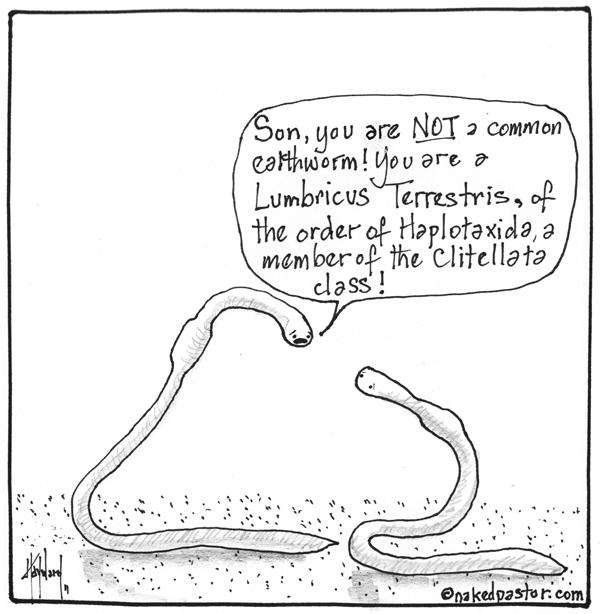
Do not fear, you worm Jacob,
    you insect Israel!
I will help you, says the Lord;
    your Redeemer is the Holy One of Israel.
Now, I will make of you a threshing sledge,
    sharp, new, and having teeth;
you shall thresh the mountains and crush them,
    and you shall make the hills like chaff.
You shall winnow them and the wind shall carry them away,
    and the tempest shall scatter them.
Then you shall rejoice in the Lord;
    in the Holy One of Israel you shall glory.

When the poor and needy seek water,
    and there is none,
    and their tongue is parched with thirst,
I the Lord will answer them,
    I the God of Israel will not forsake them.
I will open rivers on the bare heights,
    and fountains in the midst of the valleys;
I will make the wilderness a pool of water,
    and the dry land springs of water.
I will put in the wilderness the cedar,
    the acacia, the myrtle, and the olive;
I will set in the desert the cypress,
    the plane and the pine together,
so that all may see and know,
    all may consider and understand,
that the hand of the Lord has done this,
    the Holy One of Israel has created it. (NRSV)

Each morning I rise and read God’s Holy Word. It is a discipline I have been doing for over forty years. In the past few years, I have begun reading more slowly and with greater contemplation – because the goal is not to check off having read some verses on a Bible reading plan. The aim is to connect meaningfully with God. The desired result is to hear the voice of the Lord, and to let the Scriptures do their incredible work in our hearts.

One of the ways I connect with Scripture, after having read the verses for the day several times, is to write it in my own words…

“My dear servant, there is no need whatsoever to worry yourself,

though others say about you,

            ‘That guy is nothing, only a wormy maggot!’

I am your holy God,

            who saves and protects you.

I’ll let you be like a big ol’ log

            covered with sharp spikes.

You will grind and crush

every mountain and hill in front of you

            until they turn to dust.

A strong wind will scatter the dust of unholy jerks

            in all directions.

Then you will celebrate

and praise me, your Lord,

            the holy God who watches your life.

When your financial budget no longer budges

and your bank accounts lie empty

            and you have no idea where to turn,

I, your Lord, and your God

will come to your rescue.

            I will not forget you.

I will make rivers of abundance flow

            on the desolate mountain peaks of your life.

I will send streams of life

to fill your empty valley of life’s tribulations.

Dry and barren places in your life

will flow with springs

            and become a lake of grace and goodness.

I will fill the parched desert areas of your needy life

            with all kinds of fruitful trees –

apple trees, olive trees, fig trees,

oak and walnut, elm and maple, fir, and pine,

like in the original garden,

all your needs will be met in and through me, your God.

Everyone will see this

            and know that I,

the holy Yahweh God whom you love and serve,

            created every bit of it.”
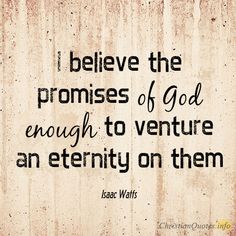
Whichever way we choose to view ourselves, as worm and insect, or as majestic person in the image of God, the spiritual reality continually before us is that the Lord will provide, bless, and care for us. We are the recipients of God’s gracious salvation. Although many modern hymnals do not include Isaac Watt’s, At the Cross, and if they do, the original words have been changed – it matters little. Because the action of deliverance belongs to God, and neither to you nor me. And even though we seem but lowly worms next to God, the Lord chooses to treat us with deference, accommodation, and care. Any low view of self is quickly eradicated in the face of such divine love.

Stanza 1:

Alas! and did my Savior bleed?

And did my Sov’reign die?

Would He devote that sacred head

For such a worm as I? 

Chorus:

At the cross, at the cross,

Where I first saw the light,

And the burden of my heart rolled away –

It was there by faith I received my sight,

And now I am happy all the day. 

By Isaac Watts (1674-1748) and published in 1707.

Psalm 29 – The Voice of the Lord and the Power of Words

Welcome, friends! Click the video below and hear a message from God’s Word…

Psalm 29

The words of Psalm 29 spoken by children…

A song inspired by the words of Psalm 29…

May God’s peace, which goes beyond anything we can imagine, guard your thoughts and emotions through Christ Jesus. Amen.

Psalm 125 – She Rocks!

The God Who Surrounds Us by Irv Davis

The people who trust in the Lord
    are like Mount Zion:
    never shaken, lasting forever.
Mountains surround Jerusalem.
    That’s how the Lord surrounds his people
    from now until forever from now!
The wicked rod won’t remain
in the land given to the righteous
    so that they don’t use their hands to do anything wrong.
Lord, do good to people who are good,
    to people whose hearts are right.
But as for those people who turn to their own twisted ways—
    may the Lord march them off with other evildoers!

Peace be on Israel! (CEB)

Psalms 120-134 comprise a collection of short songs of ascent meant to guide Jewish pilgrims in their communal trek up to the city of Jerusalem, and ultimately to the temple mount.  The rhythm of the pious ancient Israelites centered round particular festivals, seasons, and Sabbath. 

Taking the annual pilgrimage to the Holy City was an especially anticipated time of year.  This yearly cycle bolstered their faith and gave the people some needed spiritual stability. The sameness of the routine and the ritual helped to remind the faithful of the solid theology that God cannot be moved and will always be there.

One of the most fundamental of all truths about God is divine consistency and constancy, that the Lord is forever present with God’s people. If God seems or feels distant or inattentive, it comes not from a place of uncaring. as though absent, aloof, or not listening.  It simply means the Lord self-reveals on a divine timetable, not a human one. Our responsibility in the entire affair is to engage in consistent rhythms of spirituality that place us in a position to receive grace when God decides to give it.

Therefore, we must not despair but anticipate meeting with God, just as the Israelites of old looked forward and upward to their annual worship at the top of the mountain. 

God continually surrounds people, even when we do not always perceive it to be so. 

Basic sound theology, as we possess abundantly in the psalms, is neither gender specific nor gender neutral. To have a full orbed understanding of the God of the psalms means we use both male and female pronouns in our descriptions.

To limit God as an old white guy, or only as male, truncates a strong view of true divinity.

What I am suggesting here is that we avail ourselves of the full compliment of metaphors to present a more complete picture of God. Language is our vehicle in communication about the Lord, so let us use it to its entire extent to present the Lord in all his/her grandeur, majesty, holiness, and strength.

For example, as the psalmist likens God to a mountain chain surrounding Jerusalem, if we only picture this in our imaginations as a man, we have not quite got an integral picture. Although a muscular Christianity might provide us with an understanding of God’s sheer brute power, a maternal Christianity gives us a strength of provision, care, and protection from a different angle.

When Jesus came to Jerusalem, the city surrounded by mountains, he did not use a masculine metaphor to communicate to the people; he used a maternal one:

“O Jerusalem, Jerusalem, the city that kills the prophets and stones God’s messengers! How often I have wanted to gather your children together as a hen protects her chicks beneath her wings, but you wouldn’t let me.” (Matthew 23:37, NLT)

When the Apostle Paul wanted to communicate to the Thessalonian Church his deep concern for them, he went for the maternal metaphor:

We could have thrown our weight around as Christ’s apostles (like a man). Instead, we were gentle with you like a nursing mother caring for her own children (like a woman). We were glad to share not only God’s good news with you but also our very lives because we cared for you so much. (1 Thessalonians 2:7-8, CEB)

Indeed, in my culture when we want to convey the ultimate protective behavior of another, we describe them as a “mother bear.”

The gist of theology is this: God cannot be tied down or limited to gender, race, ethnicity, class, etc. The Lord is God, and we are not. Therefore, it is perfectly appropriate, and I daresay necessary, to use both male and female pronouns and metaphors in describing God because the Lord of the universe created both male and female in his/her image. (Genesis 1:26-27)

This is neither taking liberal license of the psalms nor emasculating them; it is merely pointing out that God is Spirit, and we worship her/him in spirit and in truth. And the truth is that he is the mountains surrounding us as a manly sentinel over our lives; and she is the mountain chain encircling us with protective care for whom nobody better mess with us.

May the Lord do good to us, as the manly Rock of our salvation as well as the feminine Fortress of our souls, protecting us with the care of both a father and a mother.

Ever-present God, there is no place where I can go where you are not.  Help me to so intuit your divine presence that it bolsters my faith and resilience for daily life in Jesus Christ.  Amen.

1 Kings 18:1-18 – Faith at Work

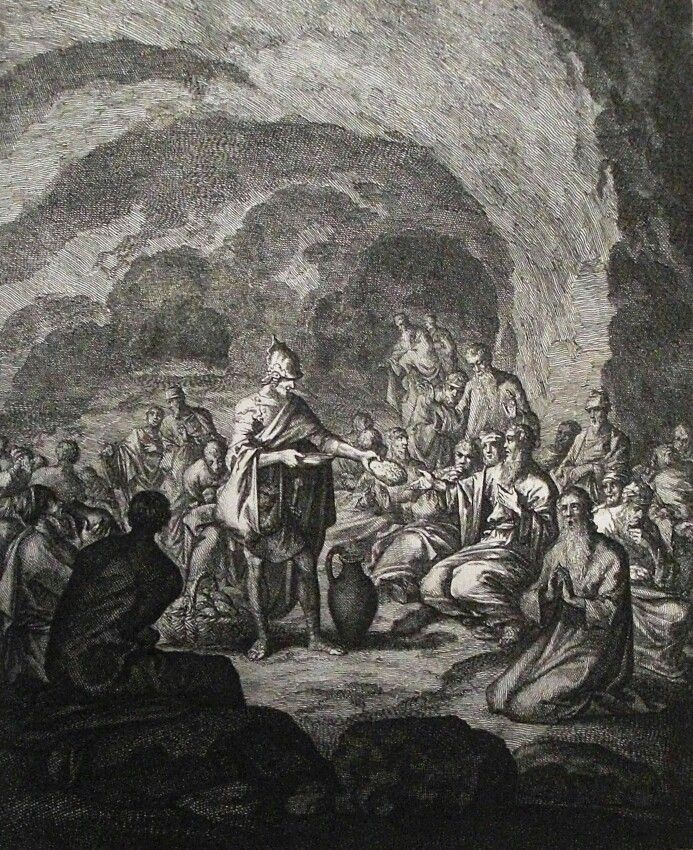
Obadiah Takes the Prophets to a Cave by Dutch engraver, Caspar Luyken (1672-1708)

For three years no rain fell in Samaria, and there was almost nothing to eat anywhere. The Lord said to Elijah, “Go and meet with King Ahab. I will soon make it rain.” So, Elijah went to see Ahab.

At that time Obadiah oversaw Ahab’s palace, but he faithfully worshiped the Lord. In fact, when Jezebel was trying to kill the Lord’s prophets, Obadiah hid one hundred of them in two caves and gave them food and water.

Ahab sent for Obadiah and said, “We have to find something for our horses and mules to eat. If we don’t, we will have to kill them. Let’s look around every creek and spring in the country for some grass. You go one way, and I’ll go the other.” Then they left in separate directions.

As Obadiah was walking along, he met Elijah. Obadiah recognized him, bowed down, and asked, “Elijah, is it really you?”

“Yes. Go tell Ahab I’m here.”

Obadiah replied:King Ahab would kill me if I told him that. And I haven’t even done anything wrong. I swear to you in the name of the living Lord your God that the king has looked everywhere for you. He sent people to look in every country, and when they couldn’t find you, he made the leader of each country swear that you were not in that country. Do you really want me to tell him you’re here?

What if the Lord’s Spirit takes you away as soon as I leave? When Ahab comes to get you, he won’t find you. Then he will surely kill me.

I have worshiped the Lord since I was a boy. I even hid one hundred of the Lord’s prophets in caves when Jezebel was trying to kill them. I also gave them food and water. Do you really want me to tell Ahab you’re here? He will kill me!

Elijah said, “I’m a servant of the living Lord All-Powerful, and I swear in his name that I will meet with Ahab today.”

Obadiah left and told Ahab where to find Elijah.

Ahab went to meet Elijah, and when he saw him, Ahab shouted, “There you are, the biggest troublemaker in Israel!”

Elijah answered:You’re the troublemaker—not me! You and your family have disobeyed the Lord’s commands by worshiping Baal.” (CEV)

Obadiah was the overseer in charge of King Ahab’s palace in Samaria of ancient Israel. To put it mildly, Ahab was a rascal. Old Testament stories frequently and purposefully contrast characters so that we will easily discern ethical differences between good and evil. Here we have a clear contrast between the godly and faithful Obadiah and the downright wicked royal couple of Ahab and Jezebel.

Whereas Obadiah was trying to preserve life and went to great lengths to do so, Ahab and Jezebel were doing everything in their sinister power to destroy life. The entire drama plays out like an episode of House of Cards. Ahab and Jezebel were a real king and queen who were thoroughly selfish and evil in all their dealings. Ahab, enabled and emboldened by his pagan wife, did away with the true worship of God and established the worship of Baal in the land of Israel. 

This did not mean, however, that God was absent or inactive. Rather, the Lord was working behind the scenes to undermine the systemic evil in the kingdom through his servant, Obadiah, who was devoted to God. Obadiah was neither a prophet nor a priest. He was simply a man working in an ungodly kingdom, doing the best he could to serve the Lord. 

Elijah may have had the prophetic voice and power, but Obadiah was the backstage administrator, daily cobbling together a living for hundreds of people without any support from the royal pain-in-the-butts.

Our ordinary everyday vocations and jobs have been ordained by God to use us where we are. Instead of lamenting our limitations or wishing the situation were different, we all have an opportunity for God to work through us in our current positions and stations in life. 

Every one of us has the daily opportunity to integrate our faith and our work through connecting biblical ethics to concrete applications at our jobs; seeing our workplaces as mission fields; interpreting our work through a Christian worldview; discerning our vocation as a calling from God; and, knowing our work is a means for God to transform and sanctify us.

So, how do you view your job?  How might you connect your faith and your work?  How does what you do reflect the nature and character of God?  In what ways do you think God wants to use you in your workplace?

Sovereign God, you cause nations and institutions to rise and fall; you set up leaders to rule and put them down.  Take my life and my work and use it in redemptive ways that glorify the name of Jesus and exemplify the power of the Holy Spirit.  Amen.