Restoration (Jeremiah 30:1-11a)

This is the word that came to Jeremiah from the Lord: “This is what the Lord, the God of Israel, says: ‘Write in a book all the words I have spoken to you. The days are coming,’ declares the Lord, ‘when I will bring my people Israel and Judah back from captivity and restore them to the land I gave their ancestors to possess,’ says the Lord.”

These are the words the Lord spoke concerning Israel and Judah: 

“This is what the Lord says:

“‘Cries of fear are heard—
    terror, not peace.
Ask and see:
    Can a man bear children?
Then why do I see every strong man
    with his hands on his stomach like a woman in labor,
    every face turned deathly pale?
How awful that day will be!
    No other will be like it.
It will be a time of trouble for Jacob,
    but he will be saved out of it.

“‘In that day,’ declares the Lord Almighty,
    ‘I will break the yoke off their necks
and will tear off their bonds;
    no longer will foreigners enslave them.
Instead, they will serve the Lord their God
    and David their king,
    whom I will raise up for them.

“‘So do not be afraid, Jacob my servant;
    do not be dismayed, Israel,’
declares the Lord.
‘I will surely save you out of a distant place,
    your descendants from the land of their exile.
Jacob will again have peace and security,
    and no one will make him afraid.
I am with you and will save you,’
    declares the Lord.” (New International Version)

The cry of Jeremiah the prophet, by Slovakian artist, 1937

To be restored is a beautiful thing, namely because it presupposes that someone or a group of people were dilapidated and in need of healing. Restoration implies that something was lost, but now is found.

If you have lost things like finances, a home, a car, precious memorial items, a job; or relationships such as a marriage, a friendship, estrangement from family members; or your health to disease or disaster; or even lost your mind or your soul – you can completely understand the longing for restoration and wholeness.

The Jews lost their homeland, their property, their temple, and their dignity to the invading Babylonians. Babylon took everything from Judea. The people became exiled in a strange land. Only some poor folk were left behind in a land that was ravaged.

This was the place that was once referred to as a land of milk and honey, a good home of abundance and blessing. But in the prophet Jeremiah’s day, it was becoming a thing of the past. Would the people ever recover what they had lost? Is restoration even a possibility? Could they learn to hope again?

Into a time of distress and despair, God spoke, and said that yes, it is possible; yes, restoration can and will happen. The people will not be in captivity forever.

Things can get so bad that you become physically sick, emotionally spent, mentally fearful, and spiritually disheartened – as if your life has been ripped from you without mercy and with malice. Yet, what is true of us today is not necessarily going to be true of us tomorrow.

Oppression is a terrible thing. To be constantly harassed by others or by chronic pain or by adverse situations is draining; it sucks the life out of us. Into these sorts of circumstances, God says to us, “I am with you, and I will save you.”

Perhaps tomorrow comes and nothing changes. The pain is still there. The mean-spirited people haven’t gone anywhere. The lost things are not found. And yet, there is something primal and universal which has always been here and shall never go away, no matter the circumstances: God is with us, and God loves us.

If we have the spiritual eyes to see, we will notice that God is alongside us, weeping with us. God knows a thing or two about the sort of suffering and pain that is unimaginable.

“Why does not God do something sooner, if God is so loving and powerful?” you may ask. If you are a parent, you have likely had a child ask you why you are doing something to them that feels awful. You know that emotion of feeling hurt alongside them. You also know that there is sometimes no way you can adequately explain to them what’s going on.

You commit yourself to being there, being present, and assuring the child that you aren’t going anywhere. So, when it comes to us, why is it so hard to understand that God is not a divine Santa or a cosmic Genie granting our every wish? If we want kids to understand, then perhaps we ought to first understand our own relationship as God’s children.

There will be times of trial and tribulation, even divine judgment. Yet there shall also be deliverance from evil, and salvation from sin, death, and hell. The yoke of oppression won’t last because there is the promise of restoration.

No matter how nasty, misguided, or sinful the political leadership and governmental system, none of those rulers or politicians have the last word – God does, not them. Grace has the final say, utilizing a restorative mercy which cannot be undone.

The days are coming when there will be a new future, based in the resolve of God to accomplish it. Fortunes shall be restored. Rehabilitation and renewal are ahead for the faithful. Healing will happen, whether it be in this life, or the next.

Things may seem impossibly hopeless now, but God can and will overrule the present evil machinations of oppressive rulers. Terror may be on every side, yet the Lord will break the bonds of oppression; God will burst the unjust practices. Indeed, God will save.

Therefore, we need not fear, for God is with us; and divine intervention is nearly here.

O God of heavenly powers, by your holy might, be present to us in your goodness and grace; banish all injustice and unrighteousness and restore your people in the strength of faith. Amen.

Spiritual Blessings (Ephesians 1:7-14)

The Trinity, by Ukrainian artist Feodosiy Humeniuk, 1981

In him we have redemption through his blood, the forgiveness of our offenses, according to the riches of his grace that he lavished on us in all wisdom and insight.He did this when he revealed to us the mystery of his will, according to his good pleasure that he set forth in Christ, toward the administration of the fullness of the times, to head up all things in Christ—the things in heaven and the things on earth.

In Christ we too have been claimed as God’s own possession, since we were predestined according to the purpose of him who accomplishes all things according to the counsel of his will so that we, who were the first to set our hope on Christ, would be to the praise of his glory. And when you heard the word of truth (the gospel of your salvation)—when you believed in Christ—you were marked with the seal of the promised Holy Spirit, who is the down payment of our inheritance, until the redemption of God’s own possession, to the praise of his glory. (New English Translation)

The Apostle Paul wrote this letter to the Church at Ephesus. Believe it or not, the first chapter of Ephesians  comprises only two sentences in the Greek language for which he originally wrote. Ephesians 1:3-14 are one sentence, and Ephesians 1:15-23 is the other sentence. Thankfully, understandably, and mercifully, English translators have created multiple sentences for us so that we can better make sense of the text. 

It’s almost as if Paul was so excited to talk with the Ephesian believers about who they are in Jesus Christ and what they possess in him that he blurted out in writing with a flurry of enthusiasm and excited fervor without stopping to take a breath or a break.

Paul stacked word after significant word, on top of each other, in order to communicate the spiritual blessings that believers in Christ enjoy. Redemption, forgiveness, grace, wisdom, insight, predestination, faith, inheritance, and salvation are just some of the blessings given to those in union with Jesus Christ.

And, if that wasn’t enough, God has also graciously given us the Holy Spirit, the Paraclete, the one who comes alongside and helps us to live into the blessings we possess. Because God the Father predestined and elected us, God the Son redeemed us, and God the Spirit took possession of us, we are delivered from sin, death, and hell.

It’s as if we came to Christmas day expecting a package of underwear, and found instead a bunch of big boxes with some of the most lavish and expensive gifts we’ve ever seen!  This says much more about the giver than it says about us.

It was according to God’s good pleasure in Christ through the Spirit that believers in Jesus have such privileges.  Like the parent who sits back and watches the unpackaging of presents happen with great joy, so God delights and is pleased with the gifts given to us. The Lord absolutely delights in watching us unpack them and use them in this life.

These gifts, these blessings, are all lavishly provided because they are extensions of God, as if the Lord meticulously handmade each present with us in mind.

Throughout the entirety of Holy Scripture, all the stories and narratives, teachings and writings, are about God. The Lord of all creation is both the subject and object of each book of the Bible. Every good thing we have in this life is because of God’s gracious presence and power in this world.

Each positive experience we have is a direct result of God’s steadfast love toward people. All good gifts come from a good God who is delighted and pleased to give them.

Not a one of us purchased our own gifts and stuck them under the tree. God bought them all with the precious blood of Jesus and sent the Spirit to deliver them to us. 

Consider setting aside time today or tomorrow in a quiet place, and reflect on just one of the words in today’s New Testament lesson. Think about redemption or forgiveness, salvation, or grace, or any of the words which grab you.

Say the word repeatedly and meditatively, quietly and loudly, thoughtfully and with flavor. Consider what God did to bring you that gift. Contemplate the way(s) in which you have received the gift. 

Plan one way in which you might share your gift with another person. And make sure to give glory and praise to God for the grace lavishly given to you.

May your meditation lead to a deeper appreciation of what God has done for you; and may that revelation result in praise, honor, and glory to the One who accomplished so much on our behalf.

Gracious God, you have revealed and made known the way of deliverance from the power of darkness and brought me into your marvelous light. Help me to better understand all the ways you have acted on my behalf so that my life might reflect your grace and steadfast love to the world, through Jesus Christ, my Savior, in the enablement of the Holy Spirit. Amen.

True Faith (Hebrews 11:1-3, 13-19)

Now faith is confidence in what we hope for and assurance about what we do not see. This is what the ancients were commended for.

By faith we understand that the universe was formed at God’s command, so that what is seen was not made out of what was visible….

All these people were still living by faith when they died. They did not receive the things promised; they only saw them and welcomed them from a distance, admitting that they were foreigners and strangers on earth. People who say such things show that they are looking for a country of their own. If they had been thinking of the country they had left, they would have had opportunity to return. Instead, they were longing for a better country—a heavenly one. Therefore God is not ashamed to be called their God, for he has prepared a city for them.

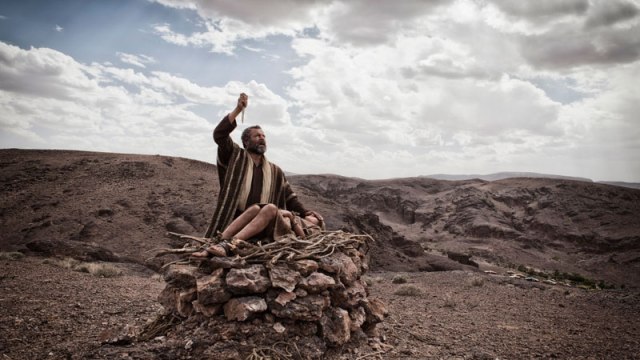
By faith Abraham, when God tested him, offered Isaac as a sacrifice. He who had embraced the promises was about to sacrifice his one and only son, even though God had said to him, “It is through Isaac that your offspring will be reckoned.” Abraham reasoned that God could even raise the dead, and so in a manner of speaking he did receive Isaac back from death. (New International Version)

Faith is important. It’s part of us. We are all people of faith – maybe not sharing the same faith – but it is faith, none-the-less.

Belief transcends time. Faith is rooted in the past, experienced in the present, and future-oriented. In Christianity, faith is historically moored to the redemptive events of Christ’s incarnation, life, death, resurrection, and ascension.

This historic faith has continuing ramifications into the present time. And it is a faith which believes Christ is coming again to judge the living and the dead.

People of faith allow their belief in what is coming to shape how they live now in daily life.

The biblical character of Abraham is synonymous with faith. And for good reason. God had told Abraham he would have a son with his wife Sarah. This would not be unusual except for the fact the couple were well advanced in age, and Sarah was incapable of having children.

Yet, despite the overwhelming odds, Abraham believed God. Years later and with a mix of patience and impatience from the would-be parents, the promise from God was realized. Abraham and Sarah had a son, Isaac.

But true faith never comes without anguish…

Isaac was known as the child of the promise. So that’s why this command of God was so perplexing: Take your son, this child of the promise, and go to the mountain and sacrifice him there. (Genesis 22:2)

Huh? What the #&%!  But it only seems strange and super-weird to us. There was no reaction from Abraham, no questioning, no talk back. He simply went about the business of saddling up the donkey, chopping some wood for the sacrifice, and took his only son with him on the journey to the mountain. (Genesis 22:3-5)

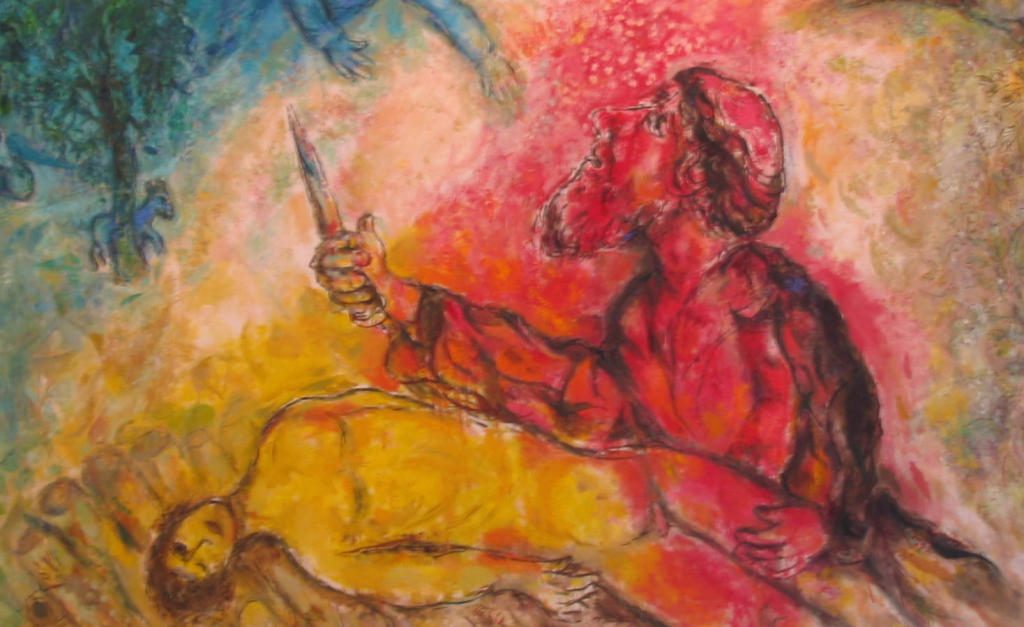
The Sacrifice of Isaac, by Marc Chagall, 1966

We might wonder what was going through Abraham’s mind through all of this. While you and I might try and figure out if we really heard God or not, Abraham had a history of talking with God. He knew God’s voice as well as he knew his own.

Abraham was well down the road of relationship with the God he served. We gain the insight from the author of Hebrews into Abraham’s thought process, a line of thinking consistent with a person who has a regular habit of talking with God.

The promise was given to Abraham that it would be Isaac who receives the family blessing. So, when Abraham’s faith underwent a maximum test, he was willing to sacrifice Isaac. He reasoned and believed that God could raise people to life. Abraham simply thought he would get Isaac back from death.

Abraham did not try and figure out God’s mind. He didn’t get into a debate with God about the contradiction of ethics he was being asked to do. He just obeyed. Abraham knew that it didn’t matter if Isaac were killed because God would raise him from death.

This, of course, is not what happened. It was all a test of faith. Abraham knew beyond a shadow of a doubt that God is the Lord who provides. (Genesis 22:9-14)

You and I, along with all the faithful believers who have gone before us, rarely know why we are facing the unwanted and unasked for circumstances we are enduring. We don’t always know what in the world God is thinking.

Yet, like Abraham, if we have a spiritual history of walking with God and hearing the Lord’s voice, we don’t hesitate to respond. We are convinced God will provide. Obedience for the follower of Christ is not a burden but a privilege, even when we are being tested beyond our seeming emotional ability to do it.

True biblical faith is neither an existential leap into darkness, nor a simple recognition of certain facts. Rather, Christian faith is a reliance upon and commitment to the promises of God that results in taking a risk. 

Sovereign Lord, your ways are sometimes strange and confusing. Yet, I know that everything you do is always right, just, and good. It is to your gracious and merciful character that I know you will provide. My allegiance is to you, in the Name of Jesus Christ, through the power of the Holy Spirit. Amen.

Recall the Faithfulness of God (Psalm 105:1-11, 37-45)

The Delivery of Israel out of Egypt, by Francis Danby, 1825

O give thanks to the Lord; call on his name;
    make known his deeds among the peoples.
Sing to him, sing praises to him;
    tell of all his wonderful works.
Glory in his holy name;
    let the hearts of those who seek the Lord rejoice.
Seek the Lord and his strength;
    seek his presence continually.
Remember the wonderful works he has done,
    his miracles and the judgments he has uttered,
O offspring of his servant Abraham,
    children of Jacob, his chosen ones.

He is the Lord our God;
    his judgments are in all the earth.
He is mindful of his covenant forever,
    of the word that he commanded for a thousand generations,
the covenant that he made with Abraham,
    his sworn promise to Isaac,
which he confirmed to Jacob as a statute,
    to Israel as an everlasting covenant,
saying, “To you I will give the land of Canaan
    as your portion for an inheritance….

Then he brought Israel out with silver and gold,
    and there was no one among their tribes who stumbled.
Egypt was glad when they departed,
    for dread of them had fallen upon it.
He spread a cloud for a covering
    and fire to give light by night.
They asked, and he brought quails
    and gave them food from heaven in abundance.
He opened the rock, and water gushed out;
    it flowed through the desert like a river.
For he remembered his holy promise
    and Abraham, his servant.

So he brought his people out with joy,
    his chosen ones with singing.
He gave them the lands of the nations,
    and they took possession of the wealth of the peoples,
that they might keep his statutes
    and observe his laws.
Praise the Lord! (New Revised Standard Version)

Some stories are worth repeating over and over again. For example, on the birthday of each of my children (and now grandchildren) I recount and remember their birth story; on Christmas, I read the first chapter of Luke’s Gospel to the family in order to recall and remember the birth of Jesus.

Psalm 105 is a remembering and retelling of the ancient Israelites’ exodus event, their deliverance from Egyptian slavery. That event permeates much of the Old Testament, and rightly so. God’s faithfulness, grace, and steadfast love dominates the psalm, namely because the Lord’s majesty, power, and sovereignty was overwhelmingly evident through the deliverance from Egypt.

And so, it is appropriate for the psalmist to express gratitude and praise to God in remembering that deliverance. It only makes sense, in such a retelling, that we are encouraged to continually seek the Lord. Seeking the Lord is a common biblical admonition, and is linked to memories of what God has done in the past.

Glory in his holy name;
    let the hearts of those who seek the Lord rejoice.
Seek the Lord and his strength;
    seek his presence continually.
Remember the wonderful works he has done,
    his miracles and the judgments he uttered. (1 Chronicles 16:10-12, NRSV)

God graciously works in history by choosing a people and making a covenant with them. The Lord is faithful to that arrangement by giving them everything they need to maintain obedience on their end of the covenant. For God doesn’t merely call persons who are already equipped and ready for high level spiritual service. Rather, the Lord equips those who are called.

Abraham was called by God, not because he had some sort of superior spirituality or inclination toward the divine, but only because God chose him, period. And once he was called, Abraham doggedly and faithfully sought the Lord.

God brought the Israelites out of Egypt because of the covenant made to Abraham. The Lord promised him and his descendants a people and a land. It may have seemed that becoming enslaved in Egypt would negate the promise. But not so. The exodus happened.

Being freed from slavery, the people could seek the Lord and pursue knowing God without any hindrance or obstacle. From that point on, the people were expected to utilize their memory of God’s saving actions to seek God with all their heart, soul, and mind.

The entire aim of recounting God’s covenant and the exodus event is to remind the people to observe God’s commands. Since a powerfully good God has acted in history, then we are to keep the faith by embracing the powerfully good words of God and following them with the utmost commitment.

Remembering that we belong to God, enables us to keep on seeking the Lord throughout all of life, for the rest of our lives. The consistent retelling of deliverance stories can strengthen our faith and equip us for what is ahead.

When times are tough, it is good and helpful to recall the divine deliverance that has already happened. Our memory can then serve us well, by renewing our minds and energizing us to persevere in the spiritual life.

O Lord our God, we pray that your Spirit would guide and inspire our life and worship, our contemplation and our action. Open our mouths to sing and speak your praise, our ears to hear your Word, our eyes to see to you at work among us, and our hearts to receive your divine love. Help us to remember your goodness, seek your face continually, and serve you always. Amen.