Psalm 130 – Believe, Hope, and Love

I cry out to you from the depths, Lord—

my Lord, listen to my voice!
    Let your ears pay close attention to my request for mercy!
If you kept track of sins, Lord—
    my Lord, who would stand a chance?
But forgiveness is with you—
    that’s why you are honored.

I hope, Lord.
My whole being hopes,
    and I wait for God’s promise.
My whole being waits for my Lord—
    more than the night watch waits for morning;
    yes, more than the night watch waits for morning!

Israel, wait for the Lord!
    Because faithful love is with the Lord;
    because great redemption is with our God!
He is the one who will redeem Israel
    from all its sin.
(Common English Bible)

Throughout church history, the book of Psalms has been used and understood as the Church’s prayer book.  Indeed, the psalms are much more than a collection of beautiful poems, words of assurance, and songs of praise – they are designed and meant to have regular and ongoing use as prayers. And I’m not just talking about the psalms being somebody else’s prayers; they are my prayers and your prayers. 

There are times when words fail us – where we find ourselves between a rock and a hard place and want to pray. Our stress and/or anxiety is so high, we can neither think straight, nor form anything coherent with our mouths. It’s in such times that the psalms present themselves to us as the path forward. 

What’s more, psalms are meant to be spoken out loud and more than once. And I’m not talking about saying them with a quiet mumble or a flat monotone.  No! These precious prayers of Holy Scripture are meant to be declared with full voice and a large amount of flavor!  They are to repeatedly roll off our lips with all the emotional and spiritual gusto which resides within us!  Tears and yelling are both appropriate and encouraged. 

For we do not possess a mere heady faith of thoughts and ideas; we also possess a faith that is robustly heartfelt, and dwells down deep in the gut where our bowels of compassion have their abode. 

Even with a cursory reading of today’s psalm, we can easily observe there’s more going on here than beliefs of faith, hope, and love. 

The psalmist is expressive, clinging to faith with a patient longing for God to make good on divine promises. It is chocked full of emotion, a prayer coming from the depths of the gut. The whole being is involved, and rightly so, because our faith affects the entirety of a person and everyone in the community of the redeemed.

If this psalm resonates with you in any way, let your proclamation of it be with the expanse of feeling inside you. After all, as people created in the image of God, we share God’s own deep sense of love – and love is genuinely love when it is outwardly expressed with a sacred combination of words, actions, and feelings.

Waiting, watching, hoping. We as humans do a lot of that. While we anticipate God’s response, we keep up the praying. We keep reminding God to be God. We encourage others to watch and wait and hope, all the while encouraging ourselves, as well.

Whenever we are stressed, more often than not, we thrash about, like a desperate swimmer in the middle of a lake, just trying to keep his head above water. Yet, the psalm tells us to do the counterintuitive: Don’t do something. Just stay there and relax. Why, in heaven’s name, should I do nothing?

Because the Lord will act.

And that action of God will redeem, renew, refresh, and revitalize. It will be new, like the morning dawn. A fresh day, that will not be like any other day before it.

God does his best saving work in the worst and most impossible of circumstances. We need not fear the overwhelming depths of difficulty and trouble. We can trust the Lord.

Perhaps the most awful of deep holes are emotional – deep depression and/or anxiety – a lostness inside oneself because of mental disorder. In such a dark oblivion, and terrible morass, one tries to survive into another hour, not just another day. Like a watchman waiting for the night to dissipate and dawn to break, there is a longing for God.

Deliverance and rescue seem slim. Hopelessness begins to calcify the spirit. Only love can release the hardening situation; the steadfast love of God is a gentle hammer, picking away at the grief.

This is a love which never gives up.

Today’s psalm begins as a desperate cry for help. It ends with an awareness of the need to trust, hope, and wait….

Blessed Jesus, in the comfort of your love, I lay before you the memories that haunt me, the anxieties that perplex me, the despair that frightens me, and my frustration at my inability to think clearly. Help me to discover your forgiveness in my memories and know your peace in my distress. Touch me, O Lord, and fill me with your light and your hope. Amen.

*Above painting of Psalm 130 by Virginia Wieringa

Psalm 9:9-20 – Assertive Anger and Confident Trust

The poor can run to you
    because you are a fortress
    in times of trouble.
Everyone who honors your name
    can trust you,
    because you are faithful
    to all who depend on you.

You rule from Zion, Lord,
    and we sing about you
    to let the nations know
    everything you have done.
You did not forget
    to punish the guilty
    or listen to the cries
    of those in need.

Please have mercy, Lord!
    My enemies mistreat me.
Keep me from the gates
    that lead to death,
    and I will sing about you
    at the gate to Zion.
I will be happy there
    because you rescued me.

Our Lord, the nations fell
    into their own pits,
    and their feet were caught
    in their own traps.
You showed what you are like,
and you made certain
    that justice is done,
    but evil people are trapped
    by their own evil deeds.
The wicked will go down
    to the world of the dead
    to be with those nations
    that forgot about you.

The poor and the homeless
won’t always be forgotten
    and without hope.

Do something, Lord!
    Don’t let the nations win.
    Make them stand trial
    in your court of law.
Make the nations afraid
and let them all discover
    just how weak they are.
(Contemporary English Version)

Everyone gets angry. Every single person on planet earth knows what anger feels like. And, to me, it makes sense that people get angry. After all, God gets angry. As people created in God’s image, we share God’s sense of justice and injustice.

That’s really what anger is: an emotional response to injustice. Whenever we are wronged or treated unfairly – or observe another person or group of people experiencing injustice – it stirs up our anger.

So, anger, in and of itself, is neither good nor bad. It just is. It’s what we do with our anger that gets dicey. A lot of human anger gets expressed in unhealthy ways by either passively stuffing it down into the soul and ignoring it; aggressively lashing out with verbal or physical violence; or passive-aggressively doing indirect jabs at the object of our anger.

The psalmist, however, takes another way of expressing anger. He is assertive, straightforward, and addressed God with his observations and feelings, as well as affirming that the Lord is the One who administers justice with fairness and equity.

When the poor are overlooked or oppressed by the rich, it is unjust. It creates anger, both human and divine. In their misery and hardship, they can flee to God, who is faithful to care for them and treat them with respect and dignity, as people carrying the divine image, like everyone else.

The nations of the earth are not all attentive to the needy. They don’t all serve their citizens and try to do right by them. Unfortunately, many people throughout the world groan under national leadership which is enamored with power and privilege – and forget those who are powerless, unable to lift themselves by their bootstraps.

Because of this reality, the psalmist petitions God. He asks, even insists, that God step in and act as judge and jury. It is an assertive use of anger that goes to the source of true help, to the Lord, who possesses both the will and the ability to overturn injustice and establish a right use of power.

Holy Scripture is consistent in its insistence on paying attention to those outside the halls of power. The prophets directed their message to issues of justice:

Learn to live right. See that justice is done. Defend widows and orphans and help those in need. (Isaiah 1:17, CEV)

Just look at those lawmakers who write evil laws and make life hard for the people. They are not fair to the poor. They take away the rights of the poor and allow people to steal from widows and orphans. (Isaiah 10:1-2, ERV)

He has told you, human one, what is good and what the Lord requires from you: to do justice, embrace faithful love, and walk humbly with your God. (Micah 6:8, CEB)

Do you know what I want? I want justice—oceans of it. I want fairness—rivers of it. That’s what I want. That’s all I want. (Amos 5:24, MSG)

Doing justice is taking up the cause of the powerless, the oppressed, and the needy among us in society. Because God cares, we care. To ignore the poor is to ignore God. To treat them unfairly is to flip the middle finger at God.

The Lord, thankfully, is a strong fortress for the oppressed and a protective force in times of trouble.

God remembers the prayers of the down-and-out.

Sooner, or later, those who are wicked in their dealings through exploitation of the powerless, will know firsthand, they are puny humans, and that God is immensely big.

Today’s psalm is both an angry petition, as well as an affirmation of faith. May it serve as a model for using our anger assertively, ordering our love rightly, and trusting our God confidently.

God almighty, you have given all peoples one common origin. It is your will they be gathered together as one family in yourself. Fill the hearts of humanity with the fire of your love and with the desire to ensure justice for all. By sharing the good you give us, may we ensure equity for all our brothers and sisters throughout the world. May there be an end to division, strife and war. May there be a dawning of a truly human society built on love and peace, through Jesus Christ, our Lord. Amen.

**Above image: The Kveshi Fortress in the nation of Georgia.

1 Samuel 16:14-23 – The Work of God

Now the Lord’s spirit had departed from Saul, and an evil spirit from the Lord tormented him. Saul’s servants said to him, “Look, an evil spirit from God is tormenting you. If our master just says the word, your servants will search for someone who knows how to play the lyre. The musician can play whenever the evil spirit from God is affecting you, and then you’ll feel better.”

Saul said to his servants, “Find me a good musician and bring him to me.”

One of the servants responded, “I know that one of Jesse’s sons from Bethlehem is a good musician. He’s a strong man and heroic, a warrior who speaks well and is good-looking too. The Lord is with him.”

So, Saul sent messengers to Jesse to say, “Send me your son David, the one who keeps the sheep.”

Jesse then took a donkey and loaded it with a homer of bread, a jar of wine, and a young goat, and he sent it along with his son David to Saul. That is how David came to Saul and entered his service. Saul liked David very much, and David became his armor-bearer. Saul sent a message to Jesse: “Please allow David to remain in my service because I am pleased with him.” Whenever the evil spirit from God affected Saul, David would take the lyre and play it. Then Saul would relax and feel better, and the evil spirit would leave him alone. (Common English Bible)

In the realm of God, everything seems upside-down. Those who are first are last, and the last are first. The rich are really poor, and the poor are actually rich. People of low position are the highest in God’s realm, while those at the top are really at the bottom. The religious insiders, appearing close to God, are on the outside; and the outsiders, seemingly far from God, are really the insiders and close to the Lord.

If we judge circumstances according to human standards of fair-play and what seems right to us, God’s ethics might not make much sense. There are two extreme responses to this reality of God’s odd working in the world. 

One response is to try and nail down everything we don’t understand, to create a black and white world where every question has an answer, and all things are certain so that we know exactly how God works, all the time. 

The opposite response is to never try answering anything about the mysterious working of God, saying, “whatever will be, will be.” Somewhere in the middle of the extremes is probably a good place to be – working to know God better and how divinity operates in the world, while being comfortable with mystery and discerning we will never completely understand everything in this life.

There are times we feel confident of what God is doing. Other times, maybe most of the time, we are clueless as to how God is working. We do not have all the answers to God’s activity. Yet, there is still a lot we know about God. The Lord worked in quite different ways with Saul than with David.  

The difference in the two characters, Saul and David, hinges upon the presence and absence of God. God withdrew divine presence from Saul. King Saul’s deliberate and consistent disobedience of God’s direct commands led to the divine absence. Not only did God leave Saul, but an evil or bad spirit from the Lord tormented him. That reality might be something way off your understanding of how God works with people.  God departed from Saul and put him in a situation of inflicting pain.

Bear in mind, in a biblical worldview, there are not two equally opposing forces of God and Satan. Rather, Lucifer is a created being who aspired to be like God and fell from heaven. God stands alone as the one sovereign Being who controls all things in heaven and earth. 

Saul is not an isolated occurrence of experiencing a bad spirit. For example, God hardened the heart of Pharaoh so that he acted harshly against the people of Israel (Exodus 9:12; 10:20, 27; 11:10). From a strictly human perspective, it seemed God was kicking the can down the road, pushing off the people’s deliverance. Yet, the Lord was orchestrating deliverance from bondage, and a redemption far beyond what the Israelites could have ever imagined. 

Sometimes, we are privy to God’s working. For example, in the days of the Judges:

Abimelech ruled over Israel three years. But God sent an evil spirit between Abimelech and the lords of Shechem; and the lords of Shechem dealt treacherously with Abimelech. This happened so that the violence done to the seventy sons of Jerubbaal might be avenged and their blood be laid on their brother Abimelech, who killed them, and on the lords of Shechem, who strengthened his hands to kill his brothers. (Judges 9:22-24, NRSV)

In whatever way we understand an evil spirit from God in the life of Saul, the point to grasp is that God is aware and in control – whereas Saul is a disturbed man due to his own bad choices. Some ancient interpreters of the story view this as an act of mercy on God’s part, by not just eradicating Saul altogether, but, instead, giving Saul an opportunity to turn his life around and again experience the presence of God.

Keep in mind, just because someone experiences mental or emotional pain in the form of depression or anxiety or other disorder, does not necessarily mean there is a bad decision behind it. To go down that route is to take the extreme position of living in the black and white world of trying to be certain of everything. We only need consider the life of Job to know that pain, even extreme pain and horrible circumstances, does not necessarily mean sin is at the root of it all. (Job 2:7-10)

“People with absolute certainty are usually the misguided souls who confidently tell other people in terrible circumstances how God is either punishing them or that this will all work out in some fairy tale ending of the miraculous (which it rarely does).” 

Mit Tdrahrhe

On the other extreme, those embracing only mystery simply say to people in pain to trust God and accept your situation because God has a plan (not helpful, even hurtful). So, what is helpful?

The servants of Saul knew what was helpful. They asked the king to put out an ad for a music therapist. And the best one they could find was David. The problem of Saul’s anguish needed the answer of a good harpist. 

Saul got some relief from pain, got a chance to perhaps come back to God, and David (already the next anointed king) got to learn the job of leading first-hand from the bottom-up by being in Saul’s service.

David needed to learn lowly service before becoming an exalted king. God could have simply knocked Saul off the throne and did away with him (which would make sense to a lot of people). Instead, God graciously gave young David time to observe the duties of a king.

God isn’t off his rocker. God knows what he is doing. God knew both Saul and David, inside and out. And, the Lord intimately knows each person, family, faith community, nation, and people group. If anyone claims to know precisely what God is doing and should do, they are a spiritual huckster speaking from ignorant pride. Conversely, if anyone throws up their arms in exasperation, mumbling how nobody can know God’s working, they are spiritually immature and irresponsible.

How we act or not act, what we say and do not say, is all a function of our theology – our real view of God. So, what might we take away from this story?

  1. The mystery of God and the certainty of people do not mix well. Claiming to always know what God is doing is delusional and just doesn’t help anyone.
  2. The clarity of God through divine commands, and the apathy of people to them, is a bad situation.  Claiming to never know what God is doing is a cop-out (because God has spoken clearly about a lot of things, like the Ten Commandments).
  3. Unlike Saul, do the best you can in the circumstances before you. Many situations we cannot avoid. However, in every situation we can control our response.
  4. Like David, be an agent of comfort, healing, and blessing to others. Most of the psalms were written in times of doubt, distress, and disturbance. We can take those psalms and pray them directly to God in the midst of our own discomfort.

We are in God’s hands, all of time. There is never a time when we are outside of God’s sight or ability to work.  The Lord’s arm is not too short to accomplish good purposes. God is our strong tower and mighty fortress for every life circumstance.

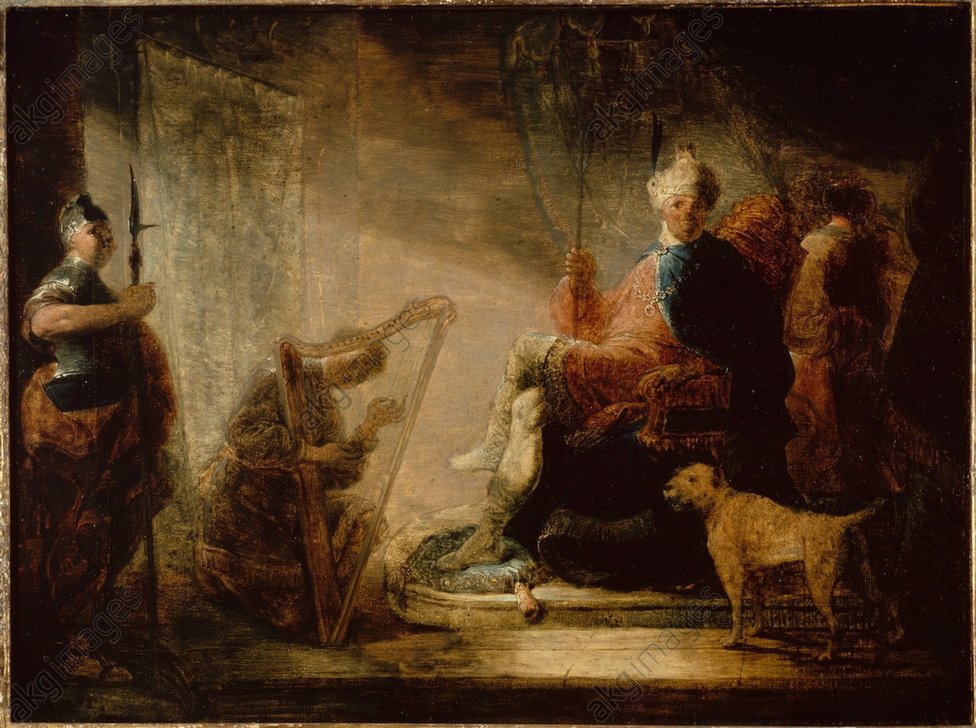
**Above painting: David playing the harp for King Saul, by German painter, Januarius Zick, 1750

Psalm 108 – My Heart Is Unwavering

My heart is unwavering, God.
    I will sing and make music—
    yes, with my whole being!
Wake up, harp and lyre!
    I will wake the dawn itself!
I will give thanks to you, Lord, among all the peoples;
    I will make music to you among the nations,
    because your faithful love is higher than heaven;
    your faithfulness reaches the clouds.
Exalt yourself, God, higher than heaven!
    Let your glory be over all the earth!
    Save me by your power and answer me
    so that the people you love might be rescued.

God has spoken in his sanctuary:
“I will celebrate as I divide up Shechem
    and portion out the Succoth Valley.
Gilead is mine, Manasseh is mine;
    Ephraim is my helmet, Judah is my scepter.
But Moab is my washbowl;
    I’ll throw my shoe at Edom.
    I shout in triumph over Philistia!
I wish someone would bring me to a fortified city!
    I wish someone would lead me to Edom!”

But you have rejected us, God, haven’t you?
    You, God, no longer accompany our armies.
Give us help against the enemy—
    human help is worthless.
With God we will triumph:
    God is the one who will trample our adversaries.
(Common English Bible)

“Our faith is not meant to get us out of a hard place or change our painful condition. Rather, it is meant to reveal God’s faithfulness to us in the midst of our dire situation.”

David Wilkerson

Little did my wife and I know when we were married decades ago that our vows to one another would be put to the test time and time again over the years: a commitment to be with each for better or for worse; to hang in there whether rich or poor; to persevere in sickness or in health till the very end. Through all the ups and the downs, I am tremendously thankful that we are close and together. We have truly taken the stance that, no matter the circumstance, we will face it together.

Just as in a marriage, where there are times that stretch the relationship and the couple must make choices for the benefit of each other, so the follower of God will face difficulty as a believer and must decide to remain faithful. 

The psalmist decided on a steadfast heart toward, a committed and faithful stance which would stick to the Lord, no matter the circumstances. The psalmist also recognized God is forever faithful, that steadfast love would continually mark the relationship toward humanity.

If we lived by the whims of our feelings, many of us would never get out of bed in the morning, and not even bother to put on pants when we do. Yet, many believers take such an approach in their relationship with God: praying whenever it might fancy them to do so; and praising the Lord only when things are going their way. 

Yet, the psalmist chose to give thanks because of who God is. David, the psalmist, made the daily decision of being faithful by choosing to look at the faithfulness of God. The truth is that God is with us, and the Lord longs for us to recognize and enjoy it because that is the nature of a committed relationship.

It makes sense to tether oneself wholly and completely to a God who is consistently faithful and loving. The vicissitudes of life are unrelenting, having us ride waves of ups and downs. No one living in 2019 saw a pandemic coming in 2020 with all the changes associated with it. And who knows what the rest of this year will be like? Or next year?

There are a great many things we do not know. Yet, there are two unchangeable truths for which we can anchor our souls: God loves us; and God is with us. When all else is going to hell around us, the rock of the Lord’s presence and mercy is unfazed and endures.

So, in those times, when we feel like giving up or giving in, we can come back to a psalm like today’s, and choose to give thanks, sing, pray, and affirm our vows to God.

Remember your baptism. Remember to whom you belong. Remember the steadfast love of God and allow such love to shape your life – even when every circumstance around you is off and awry. Our relationship with the Lord will be tested time and time again, yet God is steadfast and will not let go.

For you Jesus Christ came into the world; for you he died and for you he conquered death. All this he did for you. We love because God first loved us.

Gracious God, bless and strengthen your people daily with the gift of your Holy Spirit; unfold to us the riches of your love, deepen our faith, keep us from the power of evil and enable us to live a holy and blameless life until your kingdom comes. Amen.