There Is a Behemoth In the Room (Job 40:1-24)

And the Lord said to Job:

“Shall a faultfinder contend with the Almighty?
    Anyone who argues with God must respond.”

Then Job answered the Lord:

“See, I am of small account; what shall I answer you?
    I lay my hand on my mouth.
I have spoken once, and I will not answer,
    twice but will proceed no further.”

Then the Lord answered Job out of the whirlwind:

“Gird up your loins like a man;
    I will question you, and you declare to me.
Will you even put me in the wrong?
    Will you condemn me that you may be justified?
Have you an arm like God,
    and can you thunder with a voice like his?

“Deck yourself with majesty and dignity;
    clothe yourself with glory and splendor.
Pour out the overflowing of your anger,
    and look on all who are proud and humble them.
Look on all who are proud and bring them low;
    tread down the wicked where they stand.
Hide them all in the dust together;
    bind their faces in the world below.
Then I will also acknowledge to you
    that your own right hand can give you victory.

“Look at Behemoth,
    which I made just as I made you;
    it eats grass like an ox.
Its strength is in its loins
    and its power in the muscles of its belly.
It makes its tail stiff like a cedar;
    the sinews of its thighs are knit together.
Its bones are tubes of bronze,
    its limbs like bars of iron.

“It is the first of the great acts of God;
    only its Maker can approach it with the sword.
For the mountains yield food for it
    where all the wild animals play.
Under the lotus plants it lies,
    in the covert of the reeds and in the marsh.
The lotus trees cover it for shade;
    the willows of the wadi surround it.
Even if the river is turbulent, it is not frightened;
    it is confident though Jordan rushes against its mouth.
Can one take it with hooks
    or pierce its nose with a snare? (New Revised Standard Version)

At various times throughout my life, and the life of my dear family, we have been referred to by others as “the family of Job.” Believe me, it’s not really a moniker you’d like to have.

It can be good to know that there are others who see you and affirm your undeserved suffering. Yet, suffering is not something I have ever asked for or wanted.

Suffering is like an uninvited guest who crashes life’s party. And there is no bouncer I can turn to in order to get this unwanted behemoth out of my life.

Speaking of behemoths, it just so happens that “Behemoth” is mentioned by God in today’s Old Testament lesson.

The word “behemoth” is simply an English transliteration (bəhēmōṯ) of the Hebrew word (בְּהֵמוֹת). This is because nobody really knows what the Behemoth is, or was.

This, however, didn’t stop some English translations from interpreting Behemoth, e.g. “hippopotamus” in the Contemporary English Version; and, the Easy-to-Read Version uses “behemoth” but inserts the footnote that “This might be a hippopotamus, a rhinoceros, or possibly an elephant.”

Whatever Behemoth actually was, it was very big and strong. And the fact that God can have one as a pet is meant to speak of how immense and powerful God is.

A big old Behemoth is something we may be awe-inspired by, or even admire from afar. But I don’t think any of us would want one in our living room, especially if the Behemoth is bigger than the room.

But that’s exactly where I too often find myself. I come home, and there is this great big behemoth that I cannot get around nor ignore. I have to deal with it.

The Behemoth makes me realize that I am rather puny and weak; I am therefore very limited in how I can deal with it. Compared to this Behemoth, I am nothing. My human limitations come annoyingly to the forefront as a pathetic display of ineffectiveness.

And that is precisely what I don’t like. I absolutely despise being limited. I keep holding to the ridiculous notion that in any and every situation, I feel that I should be able to handle it. I should be the smartest person in the room. I ought to be the best person for the job. I should be up to whatever job is in front of me.

I can easily “should” myself to death, believing that because I look like Clark Kent, I am really Superman. But the truth is that I am vulnerable, limited, and don’t have all the answers.

I have no problem whatsoever affirming God’s power, size, and ability. I have plenty of faith to believe that God’s plans and purposes will be accomplished in this world. And I have all kinds of trust that God is good for divine promises made.

But I have some serious problems with my own limitations. I hate having a lack of knowledge, awareness, and strength. I despise not being able to help. I want nothing to do with what my late aged parents described as “being a burden to my family.”

Yet, here I am. A human, with all the weaknesses, limitations, and ignorance that goes with it.

And this is the core of my problem: I cannot help God, be more like Jesus, and have the strength of the Holy Spirit. In other words, I am not God. I’m about as close to being like God as both ends of the universe are.

As big as that huge Behemoth is in my life – which for me, is actually my insipid and frustrating limitations – God is infinitely bigger than the biggest Behemoth there ever was.

It turns out that my not wanting to submit to anything but God, is really a lack of submission to God. The Lord wants to use my wife, my children, my colleagues, my neighbors, and even people I don’t know and/or don’t like to help me in my limitations.

When God shows up, it usually isn’t in a dramatic whirlwind; God typically comes in the form of the person right in front of me.

Almighty God, the Creator and Sustainer of the universe, you have no limits. Yet, I am quite limited. My body cannot do everything. My mind cannot know all things. My ability to feel and express emotion is too often suppressed and purposely limited. And my spirit is too often limited to the three dimensions of my physical existence. Help, Lord; I need you.

May your divine grace and peace surround me and fill me, so that even when I am weak in body, I am strong in faith. Help me to accept my human limitations, as well as help from others; and to embrace and pursue my spiritual possibilities; through Jesus Christ my Lord. Amen.

Questions Without Answers (Job 38:1-7, 38-41)

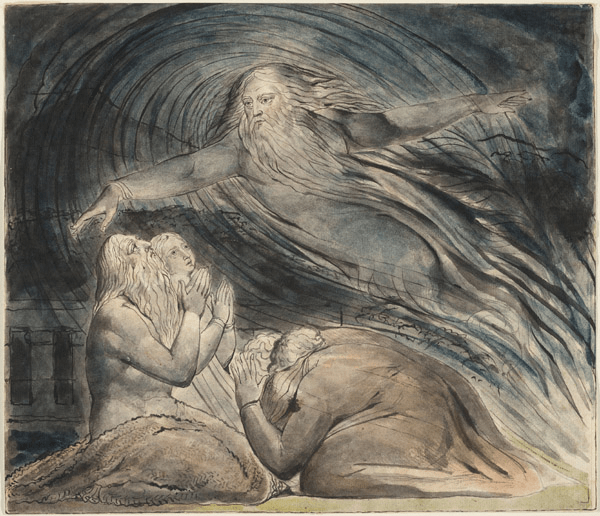
God Answers Job Out of the Whirlwind, by William Blake, 1805

Then the Lord answered Job out of the whirlwind:

“Who is this that darkens counsel by words without knowledge?
Gird up your loins like a man;
    I will question you, and you shall declare to me.

“Where were you when I laid the foundation of the earth?
    Tell me, if you have understanding.
Who determined its measurements—surely you know!
    Or who stretched the line upon it?
On what were its bases sunk,
    or who laid its cornerstone
when the morning stars sang together
    and all the heavenly beings shouted for joy?…

“Can you lift up your voice to the clouds,
    so that a flood of waters may cover you?
Can you send forth lightnings, so that they may go
    and say to you, ‘Here we are’?
Who has put wisdom in the inward parts
    or given understanding to the mind?
Who has the wisdom to number the clouds?
    Or who can tilt the waterskins of the heavens
when the dust runs into a mass
    and the clods cling together?

“Can you hunt the prey for the lion
    or satisfy the appetite of the young lions,
when they crouch in their dens
    or lie in wait in their covert?
Who provides for the raven its prey,
    when its young ones cry to God
    and wander about for lack of food? (New Revised Standard Version)

The Book of Job is rather long. After the initial two chapters which set the scene for Job’s awful suffering, we then get an extended and agonizing thirty-five chapters of speeches between Job and his companions. It’s a lot of words which generally go nowhere.

So, by the time we get to this point in chapter 38 of Job, we may likely say, “Finally, God speaks!” Indeed, this is the moment Job has anticipated.

Perhaps we are looking for something in Job’s story which may help us in our own story of suffering. Like Job, maybe we’re looking for vindication of our situation, a restoration to some semblance of life before the grief, or to have our reputation upheld.

But that is not what we get from God. For the next nearly four chapters, God only speaks in questions, and does not answer a single one of them.

If it’s answers to questions we’re searching for, it is unlikely you will get them, at least on this side of heaven. You are more likely to get even more questions than you started with. And then, imagine being questioned by God, and having no answers for God whatsoever.

Yet, that is the point. We humans know jack squat – absolutely nothing, in comparison to an omnipresent and omniscient God.

If it’s God’s voice you really want to hear, you may not know what you’re actually asking for. That was certainly true for Job and his friends. God’s questions are really rather rhetorical; there is no way any of us could really answer them with any sort of knowledge or understanding. It would be a bit like a parent asking their toddler to describe his own birth and how it happened.

God’s unanswerable questions revolve mostly around the workings of the universe. God is the Creator, and none of us were around when it all came into existence. So, of course, we have no answers.

Yet, with all of the questions, we quickly get the impression that humans have very little control over much of anything. And I think that perhaps God wants us to be aware of that reality.

It seems to me that with every question of God, we are led to believe that God is God, and is really big; and that we are not God, and are pretty dang small.

I don’t think any of this is meant to make us feel irrelevant or disposable. Rather, it gives us some needed perspective, that is, that our perspective on world issues, events, and problems is very narrow. But God sees the whole big picture and has a stellar full perspective of all things and all people.

The God in the Book of Job is no vending machine deity, in which we can pick-and-choose what we like and don’t like. There is no grand certainty that if we press the right buttons in prayer that we get what we want.

Therefore, God is not some automaton who predictably rewards the righteous, and punishes the wicked (according to our definitions of those terms). Yet this is the God that Job’s friends believed in – which is why they reflexively interpreted Job’s situation as Job himself being a sinful man.

Even Job believed in this sort of God, at least to some degree. Up to the point of his terrible trouble, he was good and righteous, and received due reward for his faithfulness. The divine system was serving Job well.

But then the system seems to have broken down. Job interpreted God as not doing the expected divine job of operating within the predictable divine structure.

Believers in every generation and era must come to grips with the reality that – although personal virtue and devotion are important – one’s piety does not necessarily lead to personal health nor wealth.

In other words, good guys don’t always win in this life, because having faith typically means we will actually suffer, rather than not.

This is, to me, good news. Why? Because it means, conversely, that persons victimized by violence, poverty, and loss are not necessarily to blame for their troubles. Frankly, there are times when bad things happen to us that are not our fault, and we don’t see any good reason for it happening.

Whenever God is silent, we might start to think that God is also absent. We may begin to entertain nihilist thoughts that nothing matters, that everything in this universe is just random chaos.

Yet, God’s response with all the questions lets us know that there is a solid structural foundation to this universe that we aren’t always aware of. In other words, there is meaning, purpose, and order to it all. We are not forgotten. God sees and remembers us.

I do believe there is a reason for everything. However, I do not believe that we are always privy to know what that purpose may be. Which means that oftentimes, like Job, we don’t have any answers to our existential questions of human tragedy and trouble. This line of thinking isn’t meant to be a cop out; it’s meant to help us accept that we are human.

Sometimes all we can do is affirm what we know to be true, and accept the limits of our own human understanding of things such as:

  • God is God. I am not.
  • God created the world. I didn’t.
  • God established order in the universe. I sometimes see order, and oftentimes see what looks like random chaos.
  • God is Love all the time. I love, but not always.
  • God is with us, even though I may not always sense or feel that divine presence.

Maybe what is most important is that we humans keep up our dialogue with God – our questions, musings, emotions, and expressions of faith and devotion. Because it is in the relationship that we discover the key to the universe.

O God, by whom the meek are guided in judgment, and light rises up in darkness: Grant us, in all our doubts and uncertainties, the grace to ask what you would have us to do, so that the Spirit of wisdom may save us from all false choices, and that in your light we may see light, and in your straight path may not stumble. Amen.

There Is a Larger Perspective (Psalm 73:1-20)

Psalm 73, by Keli Hogsett. The artist states, “This piece is made entirely of wood ‘ends.’ The wood colored ends represent nearness to God, where the darker pieces represent the opposite. The darker ends can attract and manipulate the wooden ends, but the darker they get, they turn downward and are swallowed by the wooden ends.

God is indeed good to Israel,
    to those who have pure hearts.
But I had nearly lost confidence;
    my faith was almost gone
because I was jealous of the proud
    when I saw that things go well for the wicked.

They do not suffer pain;
    they are strong and healthy.
They do not suffer as other people do;
    they do not have the troubles that others have.
And so they wear pride like a necklace
    and violence like a robe;
their hearts pour out evil,
    and their minds are busy with wicked schemes.
They laugh at other people and speak of evil things;
    they are proud and make plans to oppress others.
They speak evil of God in heaven
    and give arrogant orders to everyone on earth,
so that even God’s people turn to them
    and eagerly believe whatever they say.
They say, “God will not know;
    the Most High will not find out.”
That is what the wicked are like.
    They have plenty and are always getting more.

Is it for nothing, then, that I have kept myself pure
    and have not committed sin?
O God, you have made me suffer all day long;
    every morning you have punished me.

If I had said such things,
    I would not be acting as one of your people.
I tried to think this problem through,
    but it was too difficult for me
    until I went into your Temple.
Then I understood what will happen to the wicked.

You will put them in slippery places
    and make them fall to destruction!
They are instantly destroyed;
    they go down to a horrible end.
They are like a dream that goes away in the morning;
    when you rouse yourself, O Lord, they disappear. (Good News Translation)

The psalmist Asaph communicated his own experience, which is really the experience of all Israel, and of all who genuinely seek to follow God.

Everyone who is truly pure in heart will struggle, at times, to make sense of all the impurity and injustice in the world. Even a cursory observation of this old world clearly sees that it is a broken messed up place.

Those observations challenge the faithful with questions such as, “Is God really good?” and “Is maintaining my purity and faithfulness worth it?”

Most often, the response to those questions is “Yes, but…”

Arrogant people prosper. They get away with being jerks. And it isn’t fair. Good people continually face adversity and hardship. Nothing comes easy. And it doesn’t make sense.

Contemplating this reality for too long can lead to a spiritual crisis of faith. It can produce doubt. It is likely to either morph into anger and bitterness, or a passive “meh” to most things in life.

However, observational appearances can be deceiving. There is much more to seeing than with our two physical eyes. There is the kind of sight which God has:

“I do not judge as people judge. They look at the outward appearance, but I look at the heart.”

1 Samuel 16:7

In truth, the real and actual power of arrogantly wicked people is their ability to create envy and jealousy in the righteous persons.

We need a different way of seeing, a reorientation of our limited understanding of life. Look at the world, containing both the wicked and the righteous, from an angle you haven’t seen before.

For Asaph, this breakthrough perspective happened in the sanctuary of his God. The psalmist began to see that the seeming wealth, health, and invincibility of the arrogant is merely a façade. Their true future is anything but prosperous.

Asaph also had a reorientation of himself. He began to understand and accept that his own heart had the shadows of bitterness and ignorance. He himself had too much vice hiding in his heart.

With the spiritual eyes of the heart, we can focus in on the presence of God. The Lord’s guidance is constant, even when it doesn’t seem like it. God’s handle on the future is secure.

The arrogant and the wicked will not last. There is a day coming when they will not rule over anything. Their end is a sure thing.

The wise heart discerns that not everything I see today will be the same tomorrow. Therefore, I can plan wisely for the future, and be patient that the goodness of God will ultimately prevail over it all. This orientation to life brings confidence and hope.

Wisdom also directs us to discern that our hope and confidence can wax and wane. Just because we may be full of faith, hope, and love today, does not mean that from here-on-out we will never have to struggle with these feelings of jealousy, envy, disappointment, and anger.

Far too often we think emotions can be easily replaced, the negative ones for the positive, envy for happiness, or jealousy for satisfaction.

However, we are more complex creatures than that, having the capacity to hold multiple emotions at the same time. Sometimes, the best thing is to recognize that I can be happy, even though I am sad, without ignoring or stuffing the sadness.

Consider this: At the same time, all the time, God is both terribly sad, as well as quite exuberant. The Lord both grieves and celebrates continually. That’s because God sees it all.

And if I were to see the entire scope of your life, I am sure there are aspects of that life which are joyous, and elements which are despondent, with great longing for change.

Asaph got a much fuller picture of how things actually are in this world. And with that more expansive perspective he discovered a sense of settled hope, despite the fact that nothing in his world had changed at all.

Indeed, I myself am to be the change that I long for in this world. And it starts with gaining a perspective of wisdom, and seeing the angle of immateriality.

Arrogant pride, hoarding of wealth, and injustice will not last forever. They are temporary. But there are permanent things in this universe, and none of them have to do with money or stuff.

When all is said and done, Love survives and thrives. God hasn’t gone anywhere. Jesus Christ is the same yesterday, today, and forever. The Spirit is still alongside us.

And the wicked are no more.

So, may righteousness, justice, and peace surround you today and everyday like a warm security blanket of hope. And may you know that you are seen and loved by a God who cares. Amen.

Lady Wisdom Is Speaking (Proverbs 8:1-31)

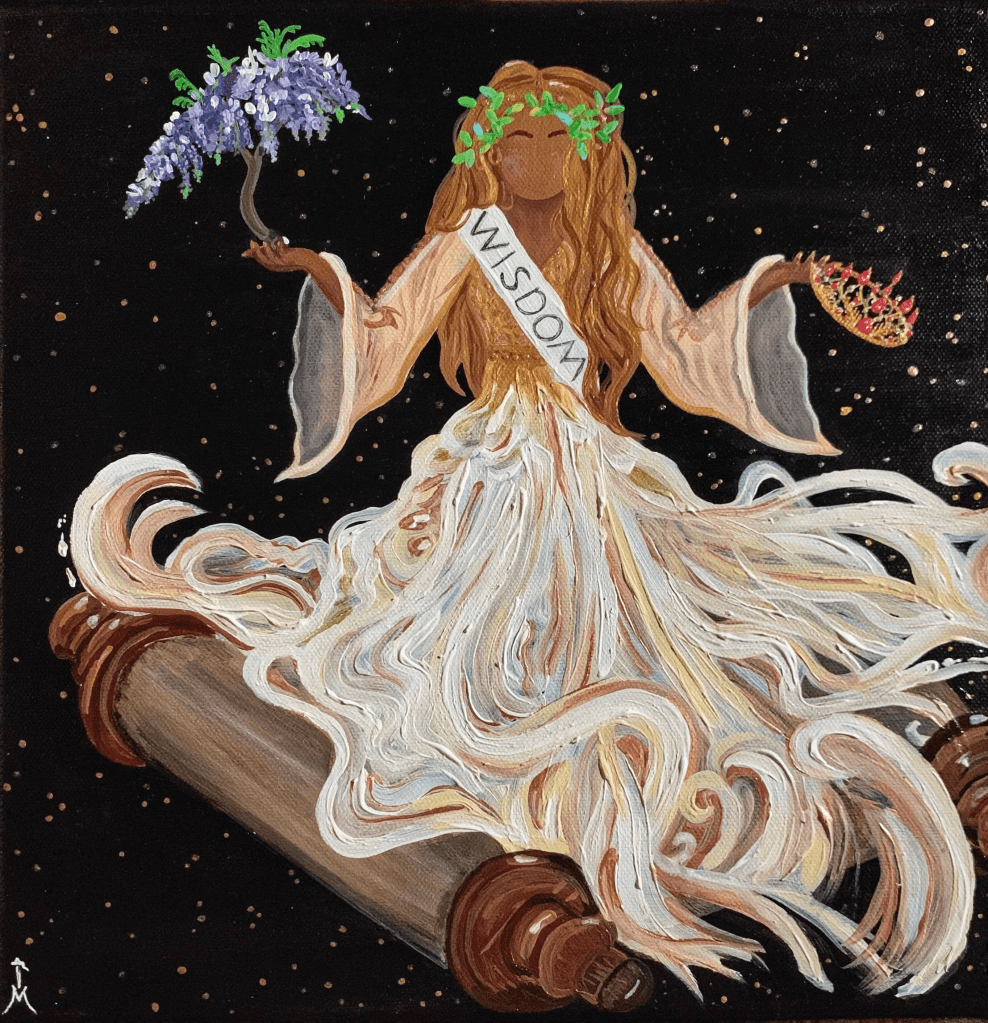
Lady Wisdom, by Mikayla Ragsdale

Doesn’t Wisdom cry out
    and Understanding shout?
Atop the heights along the path,
    at the crossroads she takes her stand.
By the gate before the city,
    at the entrances she shouts:

I cry out to you, people;
    my voice goes out to all of humanity.
Understand skill, you who are naive.
    Take this to heart, you fools.
Listen, for I speak things that are correct;
    from my lips comes what is right.
My mouth utters the truth;
    my lips despise wickedness.
All the words of my mouth are righteous;
    nothing in them is twisted or crooked.
All of them are straightforward to those who understand,
    and upright for the knowledgeable.
Take my instruction rather than silver,
    knowledge rather than choice gold.
Wisdom is better than pearls;
    nothing is more delightful than she.

I, Wisdom, dwell with prudence;
    I have found knowledge and discretion.
To fear the Lord is to hate evil.
    I hate pride and arrogance,
        the path of evil and corrupt speech.
I have advice and ability,
    as well as understanding and strength.
By me kings rule,
    and princes issue righteous decrees.
By me rulers govern,
    and officials judge righteously.
I love those who love me;
    those who seek me will find me.
Riches and honor are with me,
    as well as enduring wealth and righteousness.
My fruit is better than gold, even fine gold;
    my crops are better than choice silver.
I walk on the way of righteousness,
    on the paths of justice,
    to provide for those who love me
        and to fill up their treasuries.

The Lord created me at the beginning of his way,
    before his deeds long in the past.
I was formed in ancient times,
    at the beginning, before the earth was.
When there were no watery depths, I was brought forth,
    when there were no springs flowing with water.
Before the mountains were settled,
    before the hills, I was brought forth;
    before God made the earth and the fields
    or the first of the dry land.
I was there when he established the heavens,
    when he marked out the horizon on the deep sea,
    when he thickened the clouds above,
    when he secured the fountains of the deep,
    when he set a limit for the sea,
        so the water couldn’t go beyond his command,
    when he marked out the earth’s foundations.
I was beside him as a master of crafts.
    I was having fun,
    smiling before him all the time,
    frolicking with his inhabited earth
    and delighting in the human race. (Common English Bible)

Statue of Sophia (Wisdom), Sofia, Bulgaria

Wisdom is available. Wisdom is speaking to us. Wisdom lives with prudence. Wisdom enjoys God. And wisdom is personified as a woman (think about that before you have a round table discussion with all men).

To seek, cultivate, and teach wisdom is a worthy pursuit, in and of itself. The benefits of wisdom are great and profound, better than any earthly material thing, like silver or gold.

Actually, wisdom is quite an abstract ideal to pursue, which is likely why it helps to have it presented as a beautiful woman.

Proverbs are wise sayings; they are short pithy statements of experiential truth. This means that wisdom is less universal than it is situational. In other words, the Book of Proverbs is not a textbook or a manual on wisdom; it is rather something to be familiar with when we are facing difficult situations and thorny problems.

If there is a constant universal to all of the wisdom, it is to acknowledge and respect the presence of God in the world. All things change, except God. The Lord is the ever-present Being who is consistently right, just, and good all the time.

This may be why wisdom seems elusive. We can get to know God better and better for an eternity, and yet never exhaust getting to know God completely or fully.

Wisdom is like that. It’s too big, too variegated. There is no such thing as “Wisdom For Dummies,” that is distilled into a neatly bound book.

Truly, wisdom is rather slippery. It is not something to be mastered, but a grand sage presence to be mastered by. We must let Lady Wisdom have her way in our lives.

Lady Wisdom is in opposition to the temptress, the foolish one, who lures people into evil, and young men into the trap of misconduct that will alter their lives forever.

Just because Lady Wisdom has been around a long time – as old as the world – her beauty only increases over time; and her compelling message winsome.

The wise Lady still maintains a childlike wonder amongst God’s creative work. She revels in this world of delight and discovery. It’s fun to be alongside God and enjoy such a large and expansive playground of wonder.

Joy and levity are just as much at the heart of wisdom as brevity and seriousness. If Lady Wisdom can delight in the humans God has created, then we have much to learn from her in discovering how to frolic and play with our fellow creatures in good and wholesome ways.

The metaphorical image of wisdom as a beautiful woman who beckons us, is in competition with other voices that tempt us with quick and tidy happiness. Those other voices, however, never get around to mentioning the cost of their so-called solutions.

To court with foolishness is to make the devil’s bargain. It will only result in regret.

The best and straightest road to wisdom is by loving God and honoring God’s instructions. We get some help in this worthy endeavor through the wise sayings of Proverbs, and by means of Lady Wisdom’s sound advice.

We are called to keep up a pursuit of wisdom throughout the duration of our earthly lives – which means there is a lot of mystery to Lady Wisdom yet to discover; and there is much more to know about her.

Blessed God, help me to pay attention to your good friend, Lady Wisdom, so that in all my words and ways I may live into mercy, purity, and peace; and so, glorify You and enjoy this life you have given me. Amen.