A View of Suffering (Job 36:1-23)

The Wrath of Elihu,” by William Blake (1757-1827)

Elihu continued:

“Bear with me a little longer and I will show you
    that there is more to be said in God’s behalf.
I get my knowledge from afar;
    I will ascribe justice to my Maker.
Be assured that my words are not false;
    one who has perfect knowledge is with you.

“God is mighty, but despises no one;
    he is mighty, and firm in his purpose.
He does not keep the wicked alive
    but gives the afflicted their rights.
He does not take his eyes off the righteous;
    he enthrones them with kings
    and exalts them forever.
But if people are bound in chains,
    held fast by cords of affliction,
he tells them what they have done—
    that they have sinned arrogantly.
He makes them listen to correction
    and commands them to repent of their evil.
If they obey and serve him,
    they will spend the rest of their days in prosperity
    and their years in contentment.
But if they do not listen,
    they will perish by the sword

    and die without knowledge.

“The godless in heart harbor resentment;
    even when he fetters them, they do not cry for help.
They die in their youth,
    among male prostitutes of the shrines.
But those who suffer he delivers in their suffering;
    he speaks to them in their affliction.

“He is wooing you from the jaws of distress
    to a spacious place free from restriction,
    to the comfort of your table laden with choice food.
But now you are laden with the judgment due the wicked;
    judgment and justice have taken hold of you.
Be careful that no one entices you by riches;
    do not let a large bribe turn you aside.
Would your wealth or even all your mighty efforts
    sustain you so you would not be in distress?
Do not long for the night,
    to drag people away from their homes.
Beware of turning to evil,
    which you seem to prefer to affliction.

“God is exalted in his power.
    Who is a teacher like him?
Who has prescribed his ways for him,
    or said to him, ‘You have done wrong’? (New International Version)
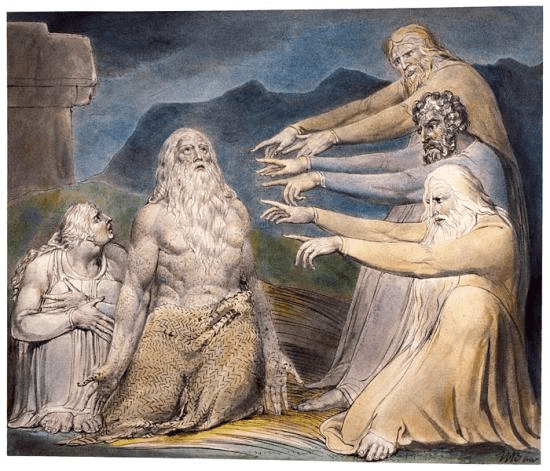
Job’s “friends” scorn him, painting by William Blake

I’m just going to go ahead and say it: Elihu was a jerk. His worldview wasn’t big enough to accommodate for Job’s awful suffering as anything but a chastisement from God.

Elihu embodied the proud person, full of himself, believing that he knows how the world works. But, in reality, he knows jack squat. The best thing Elihu did in the book of Job was to keep his mouth shut. The silence was actually helpful.

After Job lost everything and everyone dear to him (except his wife) he was understandably in tremendous grief. His lament needed to be heard – not responded to with the rebuttal of an ignoramus. Unfortunately, Elihu didn’t keep his mouth closed. He seems like a mere windbag, speaking a lot of words and saying nothing.

To be fair, Elihu gets a lot of information right; it’s just that his reasoning is narrow and misguided. He rightly affirms that God has incomparable power, and is the One who is able to punish the wicked and grant justice to the oppressed.

Yet, Elihu assumes – in his apparent black-and-white world – that anyone afflicted with such terrible events as Job is under the correction of God. The Lord is disciplining the person and teaching them a lesson about the error of their ways, he reasons.

That sort of logic betrays a very contractual sort of relationship with God – as if the Lord is only the high and transcendent plantation boss who singularly serves to maintain discipline and fealty amongst the ranks of inferiors. Elihu ignored the immanence of God in coming close to the brokenhearted and providing release for those in captivity.

In such a bifurcated world of a high God and low humanity, there are really only two choices whenever someone is in a situation like Job: either turn from your erroneous ways and serve God; or don’t, and die under the punishment of God.

But the book of Job challenges us on that kind of thinking and belief. The hard circumstances of people cannot neatly be categorized into the need for repentance – nor can a life of ease and wealth be considered a mark of divine favor.

Elihu was leaning toward viewing Job as a rebellious man who needed to admit his sin and submit to God. Yet, Job (and God!) knew better than this. And that is perhaps one of the most difficult aspects of horrible human suffering – that the sufferer must contend with persons who look at them askance as if they have done some egregious sin which offended God.

We know, as readers of the biblical book, that there was no wickedness or sin involved in Job’s suffering. Instead, there were unseen forces behind the scenes causing that suffering. In fact, just the opposite was at work: Job was suffering because of his incredible righteousness, and not by any wrongdoing on his part.

Most situations are complex and defy simple explanations or solutions. It is foolish to make assumptions based upon circumstantial evidence. Wanting quick and easy answers to the problems we face as humans is the path of simpletons.

In contrast to nice and neat mental categories, there are loving believers who are devoted to faith and patience, knowing that there can be more going on than what it seems on the surface. Listening and understanding is the path to wisdom, whereas entrenched opinions – offered as certainty of belief – is a way of dying in ignorance.

“Life’s but a walking shadow; a poor player, that struts and frets his hour upon the stage, and then is heard no more: it is a tale told by an idiot, full of sound and fury, signifying nothing.”

William Shakespeare, Macbeth

If we keep a focus on being helpful to the other, then we are less likely to offer unhelpful, even harmful, words. Knowing that life is much bigger than we can realize, is one good step toward that end.

O Lord our heavenly Father, whose blessed Son came not to be served, but to serve: We ask you to bless all who, following in his steps, give themselves to the service of others; endue them with wisdom, patience, and courage, that they may strengthen the weak and raise up those who fall, and, being inspired by your love, may worthily minister to the suffering, the friendless, and the needy, for the sake of him who laid down his life for us, your Son our Savior Jesus Christ. Amen.

Contending with Forces Beyond Our Control (Mark 5:1-20)

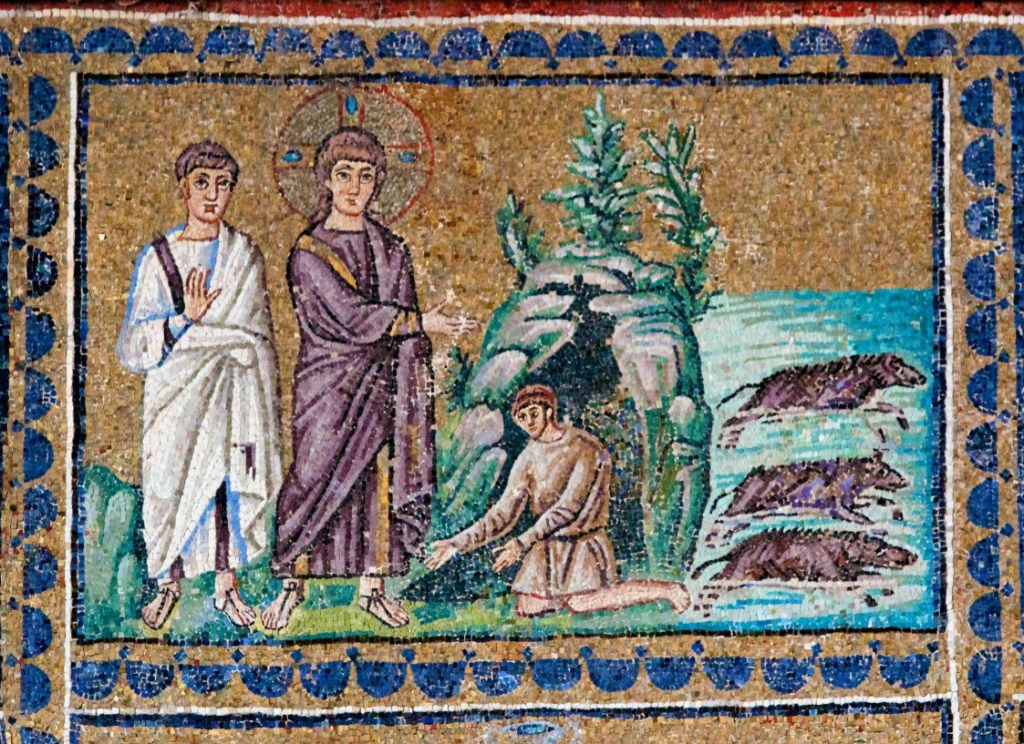
6th century mosaic of the exorcism of the Gerasene demoniac, Basilica di Sant’Apollinare Nuovo, Ravenna, Italy

They went across the lake to the region of the Gerasenes. When Jesus got out of the boat, a man with an impure spirit came from the tombs to meet him. This man lived in the tombs, and no one could bind him anymore, not even with a chain. For he had often been chained hand and foot, but he tore the chains apart and broke the irons on his feet. No one was strong enough to subdue him. Night and day among the tombs and in the hills he would cry out and cut himself with stones.

When he saw Jesus from a distance, he ran and fell on his knees in front of him. He shouted at the top of his voice, “What do you want with me, Jesus, Son of the Most High God? In God’s name don’t torture me!” For Jesus had said to him, “Come out of this man, you impure spirit!”

Then Jesus asked him, “What is your name?”

“My name is Legion,” he replied, “for we are many.” And he begged Jesus again and again not to send them out of the area.

A large herd of pigs was feeding on the nearby hillside. The demons begged Jesus, “Send us among the pigs; allow us to go into them.” He gave them permission, and the impure spirits came out and went into the pigs. The herd, about two thousand in number, rushed down the steep bank into the lake and were drowned.

Those tending the pigs ran off and reported this in the town and countryside, and the people went out to see what had happened. When they came to Jesus, they saw the man who had been possessed by the legion of demons, sitting there, dressed and in his right mind; and they were afraid. Those who had seen it told the people what had happened to the demon-possessed man—and told about the pigs as well. Then the people began to plead with Jesus to leave their region.

As Jesus was getting into the boat, the man who had been demon-possessed begged to go with him. Jesus did not let him, but said, “Go home to your own people and tell them how much the Lord has done for you, and how he has had mercy on you.” So the man went away and began to tell in the Decapolis how much Jesus had done for him. And all the people were amazed. (New International Version)

Jesus cures the Gerasene demoniac,from the Gospel Book of Otto III, Reichenau,
Germany, c.1000

The Evangelist Mark wants his readers and hearers to understand and know that Jesus is the Divine Warrior who fights against evil in the world. Many times in his earthly ministry, the Lord Jesus encountered some rather militant demons. In today’s Gospel lesson, an entire legion of them were tormenting a man who was unable to be with others and hung out in cemeteries all the time, practicing self-harm.

Much like Pharaoh’s army being drowned in the Red Sea by an act of God, so Jesus sent the legion of demons into a herd of pigs who rushed over an embankment and into the sea to drown.

The chaotic man comes to his right mind. The chaos evoked by the demonic realm is restored to order.

But, similar to an Old West movie in which the townsfolk are shortsighted to the sheriff’s heroic feat, the people in the region of the Gerasenes only see the loss of pigs, and not the loss of demons. So, the people pleaded with Jesus to leave the area.

Yet, at some point, everyone must deal with Jesus, simply because he is a force to be reckoned with. 

Eventually, we all face unseen forces that are beyond our control. It might not be today, and the sun may out, but the weather will change; everyday isn’t the same. Summer will give way to autumn, and then winter. The landscape will look very different. It’s not a question of “if” but “when.” We may console ourselves that we don’t have to deal with those forces today, but contend with them we shall.

Jesus will come. A person might not have to deal with him today, maybe not tomorrow. However, eventually, there will be a whopper of a gale force, and we will have to deal with it.

In today’s Gospel lesson, a man who was severely influenced by a strong demonic force approached Jesus. Inside of him was such a terrible inner storm that the demons shouted at Jesus.

Jesus, unfazed by the man’s inner violence and outer screams, uttered a command from a place of confidence. As fierce as the man was, Jesus had the authority to deal with the situation. As a result, the terrible force within the man subsided.

Yet, the bad weather was not over – it picked up momentum with the townsfolk. It seems they had been living their merry lives with no thought to Jesus. But he showed up. So, they had to contend with his authority right there in front of them. Unfortunately, they chose poorly. 

The Evangelist, Mark, wants us to see a connection in the story between the demons who begged Jesus, and the people of the town who begged Jesus. They did not humbly beg to follow him; they begged him to get away and leave them alone.

Jesus is an authoritative force to be reckoned with… and he is coming to your town.  Maybe not today, perhaps not tomorrow. But things will not always be the way they are right now. People will have to contend with unseen forces, and they will eventually face Jesus, one way or another.

Jesus Christ, Son of God, you are Lord over the wind, the waves, and the weather. You also command the unseen, and they obey. You are God with us. Oh, that all people would beg to follow you and not beg you to leave! I am grateful for your power and authority over all things. Amen.

God Is Bigger (Psalm 46)

God is our refuge and strength,
    a very present help in trouble.
Therefore we will not fear, though the earth should change,
    though the mountains shake in the heart of the sea,
though its waters roar and foam,
    though the mountains tremble with its tumult.

There is a river whose streams make glad the city of God,
    the holy habitation of the Most High.
God is in the midst of the city; it shall not be moved;
    God will help it when the morning dawns.
The nations are in an uproar; the kingdoms totter;
    he utters his voice; the earth melts.
The Lord of hosts is with us;
    the God of Jacob is our refuge.

Come, behold the works of the Lord;
    see what desolations he has brought on the earth.
He makes wars cease to the end of the earth;
    he breaks the bow and shatters the spear;
    he burns the shields with fire.
“Be still, and know that I am God!
    I am exalted among the nations;
    I am exalted in the earth.”
The Lord of hosts is with us;
    the God of Jacob is our refuge. (New Revised Standard Version)

Fear is one of those things that we don’t get over simply by telling ourselves to not be afraid. In fact, that approach typically makes us even more fearful – namely, because we focus on the fear itself. But to cope and deal with fear, it requires a focus on something bigger than the fear.

God is bigger than the boogie man.
He’s bigger than Godzilla,
or the monsters on TV.
Oh, God is bigger than the boogie man.
And He’s watching out for you and me.

So, when I’m lying in my bed,
and the furniture starts creeping,
I’ll just laugh and say,
“Hey, cut that out!”
And get back to my sleeping.
‘Cause I know that God’s the biggest,
and He’s watching all the while.
So, when I get scared I’ll think of Him,
and close my eyes and smile.

God is bigger than the boogie man.
He’s bigger than Godzilla,
or the monsters on TV.
Oh, God is bigger than the boogie man.
And He’s watching out for you and me. – VeggieTales

Psalms and songs of trust in God help us focus on divine hugeness instead of human puniness.

Changing Circumstances

Even though people may find themselves in the dire straits of natural disasters, they can have confidence smack in the middle of all the crazy chaos. Whereas those who focus on their fear become ever more anxious and feel as if the world is out of control, the believer isn’t threatened when overwhelming circumstances occur.

We will not fear, because God – who created the world and its vast natural systems – stands above it all and is therefore able to establish order out of chaos. Just as we are certain that the sun will again rise in the morning, so too, we have full confidence that God shall rise over the darkness and bring light and warmth to all that is shadowy and cold.

Shaky Politics

The nations and their governments who rule with injustice and care nothing for religion, breathe-out their threats and posture themselves as supreme leaders. They, too, are chaotic forces. But God is far above them, as well as above the flood and the famine. The leader’s bellicose blustering sounds merely like a chattering chipmunk to God.

And like natural disasters, the uproar of the nations does damage; but national leaders cannot topple God. Instead, God will shake up the unjust nations, like a protein shake in a blender. When delusional leaders encounter the voice of God, they cower in fear – but God’s people don’t. The spiritual person’s foundation will not be shaken, whereas the would-be dictator will find himself without anyone to lead.

A Working God

God is always working, albeit most of the time behind the scenes. God’s dominion extends over everything and everyone. God can obliterate any and all threats because God is everywhere present.

Based on this view of God, all we as people need do is be still and know that the Lord is God. Like Jesus rebuking the waves and the sea, resulting in immediate stillness, so God’s word brings us stillness, calmness, and freedom from fear and anxiety.

God is with us. God is in control. God cares for us. There are a lot of things we don’t know – such as why we have to personally endure the natural disasters and the unnatural dictators – but we can know without a shadow of a doubt that the presence of God surrounds us, and the love of God squeezes us.

With a transcendent Being who commands the angelic hosts of heaven, our source of security comes not from within but from without. The Lord is a trustworthy God who is vigilant in watching over us.

Trusting the Lord

Armies, security systems, and protective coverings all have their needed purpose in human life. Yet, when we look to our ultimate protection – the kind that provides security of both body and soul – it is God’s presence that sustains our highest and greatest needs.

Perhaps you understand the psalm’s message, yet still find it difficult or untenable to place faith in such an ancient writing and an even older God. Maybe you much prefer to trust in something that isn’t so ethereal, something you can engage with your five senses.

It could be that you prefer a strong political leader, more and bigger weapons, higher and thicker walls of protection. You work hard to have as much money as possible to keep you safe from harm. You seek to gain as much influence in the form of earthly power and authority as you can.

The problem is, however, that none of this earthly posturing is going to protect you from what you fear the most. All that work is going to prove unreliable in the end.

God is the only sure defense. Ultimate power belongs to the Lord God almighty, creator of heaven and earth. Deliverance of body and soul does not ultimately come through the strength of the military, the economy, or any human ingenuity or hard work; for the Christian, it comes through the suffering, death, and resurrection of Jesus Christ.

Any inclination to place saving trust in personal resources, human institutions, or world might, will result in sure failure. They cannot remedy our fear, for nothing is able to match the power of God. Indeed, God is bigger than anyone and anything. We need the mighty fortress which is our God.

A mighty Fortress is our God
A Bulwark never failing
Our Helper He amid the flood
Of mortal ills prevailing

For still our ancient foe
Doth seek to work us woe
His craft and power are great
And armed with cruel and hate
On earth is not his equal

Did we in our own strength confide
Our striving would be losing
We’re not the right Man on our side
The Man of God’s own choosing
Dost ask who that may be?
Christ Jesus, it is He
Lord Sabaoth His Name
From age to age, the same
And He must win the battle

That word above all earthly powers
No, thanks to them, abideth
The Spirit and the gifts are ours
Through Him who with us sideth
Let goods and kindred go
This mortal life also
The body they may kill
God’s truth abideth still
His Kingdom is forever

Amen

The All-Sufficient One (Genesis 17:1-13)

When Abram was ninety-nine years old, the Lord appeared to him and said, “I am God Almighty; walk before me faithfully and be blameless. Then I will make my covenant between me and you and will greatly increase your numbers.”

Abram fell facedown, and God said to him, “As for me, this is my covenant with you: You will be the father of many nations. No longer will you be called Abram; your name will be Abraham, for I have made you a father of many nations. I will make you very fruitful; I will make nations of you, and kings will come from you. I will establish my covenant as an everlasting covenant between me and you and your descendants after you for the generations to come, to be your God and the God of your descendants after you. The whole land of Canaan, where you now reside as a foreigner, I will give as an everlasting possession to you and your descendants after you; and I will be their God.”

Then God said to Abraham, “As for you, you must keep my covenant, you and your descendants after you for the generations to come. This is my covenant with you and your descendants after you, the covenant you are to keep: Every male among you shall be circumcised. You are to undergo circumcision, and it will be the sign of the covenant between me and you. For the generations to come every male among you who is eight days old must be circumcised, including those born in your household or bought with money from a foreigner—those who are not your offspring. Whether born in your household or bought with your money, they must be circumcised. My covenant in your flesh is to be an everlasting covenant. (New International Version)

There were 13 years between the events of chapters 16 and 17 of Genesis. God’s servant, Abram, did not hear from God in those years. Then, all of a sudden, the Lord showed up, with a new self-reference as “God Almighty.”

“God Almighty” (“El Shaddai,” the all-sufficient God) appeared to Abram. The Lord brought a self-revelation to Abram as the all-competent God, the adequate God, the God who has the big picture and knows what to do with it.

Within those 13 years before El Shaddai showed up, Abram tried his own plan for acquiring an heir to God’s covenant promises. It didn’t go quite as designed. Along with Abram, people in every age need to discover or recover the presence of God Almighty, El Shaddai, the Lord who is completely sufficient for anything and everything in life.

Our role, much like Abram’s, is to bring a wholehearted devotion to our walk with God – not looking for some extra supplement to the Lord, as if divine resources and help is inadequate or untrustworthy. We are to have a sincere and obedient stance toward God Almighty.

Too many people seek to serve two masters, as if this will help cover all the bases of what we need. But Jesus was savvy to this, understanding that it only complicates things:

“No one can serve two masters. Either you will hate the one and love the other, or you will be devoted to the one and despise the other.”

Jesus (Matthew 6:24; Luke 16:13, NIV)

God Almighty wanted Abram to know and believe that El Shaddai doesn’t allow any dual allegiances – mainly because all of us can only really serve one master.

This realization and determination to serve God Almighty alone elicits El Shaddai giving Abram a new name: Abraham. Knowing God in a new or different way always changes us, as if we are new people with new names. For Abram, now Abraham, the change is one of moving from the “exalted father” who had his own ideas, to the “father of many nations” who will bless all those with the same discovery and determination to let God be God, without all the puny human interference.

And You Shall Circumcise the Flesh of Your Foreskin, by Gerard Hoet (1648-1733)

With any seminal change of life, a very real and tangible sign is important, in order to never forget who God is, and who we as people are. For Abraham and those born to him, circumcision was that sign.

And what a sign it was! God actually told Abraham that all the males in his household were to have their foreskin removed. If anything, this was a sign given which could never get lost! It was enduring, always there, and unforgettable. It is a constant reminder that the people of Abraham, the Hebrews, are to be different and singularly devoted to El Shaddai.

In Christianity, we are to have a circumcision of the heart, and not necessarily the flesh. It is the heart, which is to be completely devoted to God Almighty, that is, the entirety of a person’s life. The whole person is to be oriented to one master who rules both body and soul.

A person is not a Jew who is one only outwardly, nor is circumcision merely outward and physical. No, a person is a Jew who is one inwardly; and circumcision is circumcision of the heart, by the Spirit, not by the written code. Such a person’s praise is not from other people, but from God. (Romans 2:28-29, NIV)

The one devoted to God Almighty in Jesus Christ is to use body, mind, emotions, and spirit for good divine purposes. Christians are meant to rely solely and completely upon Christ. They are to take every action, every thought, every feeling, every imagination and make it captive to Christ.

To be circumcised is to be set apart for good and noble purposes, to have a heart fully devoted to God Almighty as the ever-living, ever-loving, all-sufficient Sovereign of the universe.

God Almighty, open our eyes that we may see; incline our hearts that we may desire; and order our steps that we may follow the way of your commandments, now and forever, through Jesus Christ our Lord, who with you and the Holy Spirit are one God, for all time. Amen.