There Is No Other God (Daniel 3:1-30)

Shadrach, Meshach, and Abednego are thrown into a fiery furnace, by Chris Torre

King Nebuchadnezzar made a gold statue. It was ninety feet high and nine feet wide. He set it up in the Dura Valley in the province of Babylon. King Nebuchadnezzar then ordered the chief administrators, ministers, governors, counselors, treasurers, judges, magistrates, and all the provincial officials to assemble and come for the dedication of the statue that he had set up.

So the chief administrators, ministers, governors, counselors, treasurers, judges, magistrates, and all the provincial officials assembled for the dedication of the statue that King Nebuchadnezzar had set up. They stood in front of the statue the king had set up.

The herald proclaimed loudly: “Peoples, nations, and languages! This is what you must do: When you hear the sound of the horn, pipe, zither, lyre, harp, flute, and every kind of instrument, you must bow down and worship the gold statue that King Nebuchadnezzar has set up. Anyone who will not bow down and worship will be immediately thrown into a furnace of flaming fire.”

So because of this order as soon as they heard the sound of the horn, pipe, zither, lyre, harp, flute, and every kind of instrument, all the peoples, nations, and languages bowed down and worshipped the gold statue that King Nebuchadnezzar had set up.

At that moment some Chaldeans came forward, seizing a chance to attack the Jews. They said to King Nebuchadnezzar:

“Long live the king! Your Majesty, you gave a command that everyone who hears the sound of the horn, pipe, zither, lyre, harp, flute, and every kind of instrument should bow down and worship the gold statue. Anyone who wouldn’t bow and worship would be thrown into a furnace of flaming fire. Now there are some Jews, ones you appointed to administer the province of Babylon—specifically, Shadrach, Meshach, and Abednego—who have ignored your command. They don’t serve your gods, and they don’t worship the gold statue you’ve set up.”

In a violent rage Nebuchadnezzar ordered them to bring Shadrach, Meshach, and Abednego. They were brought before the king.

Nebuchadnezzar said to them: “Shadrach, Meshach, and Abednego: Is it true that you don’t serve my gods or worship the gold statue I’ve set up? If you are now ready to do so, bow down and worship the gold statue I’ve made when you hear the sound of horn, pipe, zither, lyre, harp, flute, and every kind of instrument. But if you won’t worship it, you will be thrown straight into the furnace of flaming fire. Then what god will rescue you from my power?”

Shadrach, Meshach, and Abednego answered King Nebuchadnezzar: “We don’t need to answer your question. If our God—the one we serve—is able to rescue us from the furnace of flaming fire and from your power, Your Majesty, then let him rescue us. But if he doesn’t, know this for certain, Your Majesty: we will never serve your gods or worship the gold statue you’ve set up.”

Nebuchadnezzar was filled with rage, and his face twisted beyond recognition because of Shadrach, Meshach, and Abednego. In response he commanded that the furnace be heated to seven times its normal heat. He told some of the strongest men in his army to bind Shadrach, Meshach, and Abednego and throw them into the furnace of flaming fire. 

So Shadrach, Meshach, and Abednego were bound, still dressed in all their clothes, and thrown into the furnace of flaming fire. (Now the king’s command had been rash, and the furnace was heated to such an extreme that the fire’s flame killed the very men who carried Shadrach, Meshach, and Abednego to it.) So these three men, Shadrach, Meshach, and Abednego, fell, bound, into the furnace of flaming fire.

Then King Nebuchadnezzar jumped up in shock and said to his associates, “Didn’t we throw three men, bound, into the fire?”

They answered the king, “Certainly, Your Majesty.”

He replied, “Look! I see four men, unbound, walking around inside the fire, and they aren’t hurt! And the fourth one looks like one of the gods.” Nebuchadnezzar went near the opening of the furnace of flaming fire and said, “Shadrach, Meshach, and Abednego, servants of the Most High God, come out! Come here!”

Then Shadrach, Meshach, and Abednego came out of the fire. The chief administrators, ministers, governors, and the king’s associates crowded around to look at them. The fire hadn’t done anything to them: their hair wasn’t singed; their garments looked the same as before; they didn’t even smell like fire!

Nebuchadnezzar declared: “May the God of Shadrach, Meshach, and Abednego be praised! He sent his messenger to rescue his servants who trusted him. They ignored the king’s order, sacrificing their bodies, because they wouldn’t serve or worship any god but their God. I now issue a decree to every people, nation, and language: whoever speaks disrespectfully about Shadrach, Meshach, and Abednego’s God will be torn limb from limb and their house made a trash heap, because there is no other god who can rescue like this.”

Then the king made Shadrach, Meshach, and Abednego prosperous in the province of Babylon. (Common English Bible)

Daniel’s three companions in the fiery furnace, by Adrianoupolitis Konstantinos, 1725

At the core of today’s story, and of the entire book of Daniel, is the assertion and demonstration that there is no other God but Yahweh.

King Nebuchadnezzar believed that he himself was big stuff. It turns out, not so much. Even the great king ended up confessing that there is no other god who is able to deliver like the God of Shadrach, Meshach, and Abednego. When the mighty king looked into the fire, all of his pomp and control and wrath and power proved to be nothing before the One God of all.

The earthly king threw all of his weight into showing how powerful and great he could be; and all of that unleashing of kingly destructive force did absolutely nothing to even singe the hair of the three worshipers of God.

Nebuchadnezzar did a lot of talking, a lot of posturing, and showed a lot of anger. Conversely, God said nothing, and was supremely successful over him. Turns out that Nebuchadnezzar was only a little yippee puppy barking in front of the large Mastiff dog who could squish him with but a movement of his paw if he wanted.

The experience of King Nebuchadnezzar is a telling lesson on all earthly rulers who presume to be supreme and all-powerful in their position.

And even in the great king’s confession of God’s true might and power, it’s almost tongue-in-cheek, as if Nebuchadnezzar himself is delusional enough to think that he’s the one who is setting up God as God. For those who are familiar with the prophecy of Daniel, they know what’s coming up in Nebuchadnezzar’s future that will purge him of that idea once and for all.

In truth, whatever strength Nebuchadnezzar had, it was God-given. In reality, you and I are recipients of God’s grace and strength; not a one of us conjured up our own success.

Things like a pompous attitude, a spirit of self-centeredness, and a position of hubris are totally out of sync with the values of God’s rule and reign on this earth. We fret and strut upon the stage of this planet in vain; the Lord is really the One who holds it all. Carrying the world on our shoulders is to be way out of touch with our job description as humans. Such a thing will only make us look as foolish as old King Nebuchadnezzar.

In between a rock and a hard place, within the throes of trouble, there is no step by step formula in dealing with it. Even in searching for clear instructions betrays that we desire to have situations within our own control. Shadrach, Meshach, and Abednego did not presume upon God, but fully trusted God and knew that they had no control over the circumstance other than choosing their own attitude in it.

All of the officials had gathered before Nebuchadnezzar’s statue; but by the end of the story they stood as witnesses to the work of the true God. Their worship of the statue had gained them nothing; they ended up under a new threat from Nebuchadnezzar. The king commended Shadrach, Meshach, and Abednego’s defiance of his decree, but followed it with a new decree commanding the worship of their God.

King Nebuchadnezzar commanded others, but he himself did not worship. His death-threat is hardly a fitting way to bring people to worship the true God. That sort of behavior ought to highly instruct us in this American  election year cycle.

The oppressor does not have the last word. God creates a future beyond oppressive human systems.

Sovereign Lord, I pray that You will right all wrongs taking place in our world; and vindicate those being treated unjustly. Keep us from taking matters into our own hands, for vengeance is Yours, not mine. In Your grace and mercy, give justice and peace to all who have been cruelly and unfairly treated by their fellow humanity. May injustice and carelessness end, and may all people be drawn into Your saving arms of grace. Amen.

Recall the Faithfulness of God (Psalm 105:1-11, 37-45)

The Delivery of Israel out of Egypt, by Francis Danby, 1825

O give thanks to the Lord; call on his name;
    make known his deeds among the peoples.
Sing to him, sing praises to him;
    tell of all his wonderful works.
Glory in his holy name;
    let the hearts of those who seek the Lord rejoice.
Seek the Lord and his strength;
    seek his presence continually.
Remember the wonderful works he has done,
    his miracles and the judgments he has uttered,
O offspring of his servant Abraham,
    children of Jacob, his chosen ones.

He is the Lord our God;
    his judgments are in all the earth.
He is mindful of his covenant forever,
    of the word that he commanded for a thousand generations,
the covenant that he made with Abraham,
    his sworn promise to Isaac,
which he confirmed to Jacob as a statute,
    to Israel as an everlasting covenant,
saying, “To you I will give the land of Canaan
    as your portion for an inheritance….

Then he brought Israel out with silver and gold,
    and there was no one among their tribes who stumbled.
Egypt was glad when they departed,
    for dread of them had fallen upon it.
He spread a cloud for a covering
    and fire to give light by night.
They asked, and he brought quails
    and gave them food from heaven in abundance.
He opened the rock, and water gushed out;
    it flowed through the desert like a river.
For he remembered his holy promise
    and Abraham, his servant.

So he brought his people out with joy,
    his chosen ones with singing.
He gave them the lands of the nations,
    and they took possession of the wealth of the peoples,
that they might keep his statutes
    and observe his laws.
Praise the Lord! (New Revised Standard Version)

Some stories are worth repeating over and over again. For example, on the birthday of each of my children (and now grandchildren) I recount and remember their birth story; on Christmas, I read the first chapter of Luke’s Gospel to the family in order to recall and remember the birth of Jesus.

Psalm 105 is a remembering and retelling of the ancient Israelites’ exodus event, their deliverance from Egyptian slavery. That event permeates much of the Old Testament, and rightly so. God’s faithfulness, grace, and steadfast love dominates the psalm, namely because the Lord’s majesty, power, and sovereignty was overwhelmingly evident through the deliverance from Egypt.

And so, it is appropriate for the psalmist to express gratitude and praise to God in remembering that deliverance. It only makes sense, in such a retelling, that we are encouraged to continually seek the Lord. Seeking the Lord is a common biblical admonition, and is linked to memories of what God has done in the past.

Glory in his holy name;
    let the hearts of those who seek the Lord rejoice.
Seek the Lord and his strength;
    seek his presence continually.
Remember the wonderful works he has done,
    his miracles and the judgments he uttered. (1 Chronicles 16:10-12, NRSV)

God graciously works in history by choosing a people and making a covenant with them. The Lord is faithful to that arrangement by giving them everything they need to maintain obedience on their end of the covenant. For God doesn’t merely call persons who are already equipped and ready for high level spiritual service. Rather, the Lord equips those who are called.

Abraham was called by God, not because he had some sort of superior spirituality or inclination toward the divine, but only because God chose him, period. And once he was called, Abraham doggedly and faithfully sought the Lord.

God brought the Israelites out of Egypt because of the covenant made to Abraham. The Lord promised him and his descendants a people and a land. It may have seemed that becoming enslaved in Egypt would negate the promise. But not so. The exodus happened.

Being freed from slavery, the people could seek the Lord and pursue knowing God without any hindrance or obstacle. From that point on, the people were expected to utilize their memory of God’s saving actions to seek God with all their heart, soul, and mind.

The entire aim of recounting God’s covenant and the exodus event is to remind the people to observe God’s commands. Since a powerfully good God has acted in history, then we are to keep the faith by embracing the powerfully good words of God and following them with the utmost commitment.

Remembering that we belong to God, enables us to keep on seeking the Lord throughout all of life, for the rest of our lives. The consistent retelling of deliverance stories can strengthen our faith and equip us for what is ahead.

When times are tough, it is good and helpful to recall the divine deliverance that has already happened. Our memory can then serve us well, by renewing our minds and energizing us to persevere in the spiritual life.

O Lord our God, we pray that your Spirit would guide and inspire our life and worship, our contemplation and our action. Open our mouths to sing and speak your praise, our ears to hear your Word, our eyes to see to you at work among us, and our hearts to receive your divine love. Help us to remember your goodness, seek your face continually, and serve you always. Amen.

A Divine Appointment (2 Kings 8:1-6)

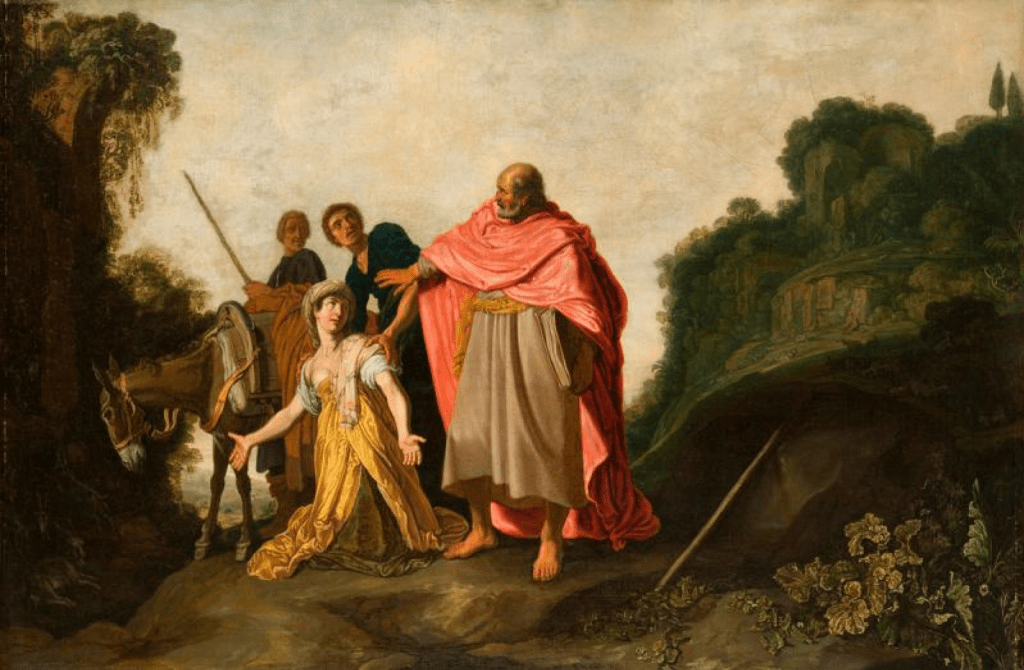
The prophet Elisha and the Shunammite woman, by Pieter Lastman, 1620

Elisha spoke to the woman whose son he had brought back to life: “You and your household must go away and live wherever you can, because the Lord has called for a famine. It is coming to the land and will last seven years.”

So the woman went and did what the man of God asked. She and her household moved away, living in Philistia seven years. When seven years had passed, the woman returned from Philistia. She went to appeal to the king for her house and her farmland. The king was speaking to Gehazi, the man of God’s servant, asking him, “Tell me about all the great things Elisha has done.” So Gehazi was telling the king how Elisha had brought the dead to life. At that very moment, the woman whose son he had brought back to life began to appeal to the king for her house and her farmland.

Gehazi said, “Your Majesty, this is the woman herself! And this is her son, the one Elisha brought to life!”

The king questioned the woman, and she told him her story. Then the king appointed an official to help her, saying, “Return everything that belongs to her, as well as everything that the farmland has produced, starting from the day she left the country until right now.” (Common English Bible)

People of faith typically don’t see divine appointments coming at all; they often show up in the middle of hard mundane days.

The prophecies and actions of the prophet Elisha are covered in the book of 2 Kings with a series of ten incredible narratives (chapters 2-9). Each of them are designed to demonstrate the power of God over (and sometimes against) the power of the king.

This was important because the royal decisions and actions of most of the Israelite kings were quite disconnected from God’s law and justice. Most kings did whatever they wanted, sometimes to the point of completely leading the people away from the worship of Yahweh and toward the worship of other gods.

Today’s Old Testament lesson concerns the ninth story in this series of narratives. A widow, whose son Elisha had restored to life in the second narrative (2 Kings 4:8-37) left for the land of the Philistines when there was a severe famine. Although the woman was simply listening to the prophet and doing what he said, squatters took advantage of the situation and took over her house and property while she was away.

In a clear demonstration of what a “divine appointment” looks like in Holy Scripture, Elisha’s servant and the king were talking together about this very woman and the miracle that took place with her son. The prophet had essentially raised her dead child to life. Then, lo and behold, the woman walked into the conversation to appeal the injustice that had happened to her and her family.

Even the worst of kings would discern the right thing to do in such a situation. After questioning the woman, the king ensured that she would get everything restored to her. Through it all, we are meant to see the power and sovereignty of God over the human authority of political kings.

I hope that you, at some point in your life, have experienced a meeting with another person that you can see was unmistakably arranged by God. And a great need you had was met because of this encounter. The Lord blessed you through it in a way that you didn’t see coming at all.

The fact of the matter is that God is sovereign, all-knowing, and all-powerful, along with being infinitely gracious, good, just, right, and loving. Therefore, God sets about to bless both us and other people. And when God determines to do something, nothing and no one in heaven or on earth can stop it.

Wherever you presently are, and whatever it is you are doing now in your life, is really no accident. And if your life situation is awful and far from any sort of idyllic scene of blessing, then please know that this is a circumstance that is ripe for a divine appointment.

For how could we ever know God as the Great Deliverer unless we were between a rock and a hard place with nowhere to turn? How could we ever experience God as the Divine Healer unless we were broken and/or brokenhearted?

How could we ever realize God as Provider unless we were out of resources and down to our last penny? Or God as Helper unless we were desperate and unable to move? Or God as the One who restores unless we had lost everything?

Just as there cannot be resurrection and new life without a crucifixion and an old life, so our lives will inevitably take a trajectory of suffering and hardship before glory and blessing. In order to allow the good to completely fill us, we must be totally emptied of everything else.

Maybe you will never experience something quite as dramatic as the woman did with gaining her son back to life, and her property restored after a terrible famine, but know this: The great Lord and God of all, the Sovereign of the universe, has your back through all that you’re going through on this earth.

I often get asked by patients and parishioners alike, “Where is God?” It feels to them that God is absent, silent, and far from understanding what they’re going through in the midst of their very challenging adversity.

Really, however, it’s actually an easy question for me to answer: Jesus is our Immanuel, God with us. The Spirit of God is right beside you, walking with you, even holding you up at times, through all the crud and crap of this old fallen sinful world of ours. Seeing only one set of footsteps in the sand, it turns out God is the One that carries the weak and weary in their trouble. The Lord is anything but absent.

If God has authority over earthly rulers, then the Lord most certainly has power to handle your life.

O God, why have you abandoned me? Though you have hidden your face from me, still from this dread and empty place, I cry to you, who have promised me that underneath are your everlasting arms. God, you are my help and comfort; you shelter and surround me in love so tender that I may know your presence with me, now and always. Amen.

The Everlasting God (Isaiah 40:21-31)

Don’t you know? Haven’t you heard?
    Wasn’t it announced to you from the beginning?
    Haven’t you understood since the earth was founded?
God inhabits the earth’s horizon—
    its inhabitants are like locusts—
    stretches out the skies like a curtain
    and spreads it out like a tent for dwelling.
    God makes dignitaries useless
    and the earth’s judges into nothing.
Scarcely are they planted, scarcely sown,
    scarcely is their shoot rooted in the earth
    when God breathes on them, and they dry up;
    the windstorm carries them off like straw.
So to whom will you compare me,
    and who is my equal? says the holy one.

Look up at the sky and consider:
    Who created these?
    The one who brings out their attendants one by one,
    summoning each of them by name.
Because of God’s great strength
    and mighty power, not one is missing.
Why do you say, Jacob,
    and declare, Israel,
    “My way is hidden from the Lord,
    my God ignores my predicament”?
Don’t you know? Haven’t you heard?
    The Lord is the everlasting God,
    the creator of the ends of the earth.
    He doesn’t grow tired or weary.
His understanding is beyond human reach,
    giving power to the tired
    and reviving the exhausted.
Youths will become tired and weary,
    young men will certainly stumble;
    but those who hope in the Lord
    will renew their strength;
    they will fly up on wings like eagles;
    they will run and not be tired;
    they will walk and not be weary. (Common English Bible)

Strength, endurance, and perseverance are vital resources which come from the reservoir of spiritual resources.  One does not simply will it into reality, and, poof! It is there! No, these resources must be drawn from a source that is reliable and continual.

Whenever you and I are persuaded to use an unreliable and/or limited resource, like our own, or some slick marketed one, we are not revived or restored to keep going and persevere through a given situation. In such times, we may naively think that God is absent, and cry, “God ignores my predicament.”

But God isn’t sleeping. The Lord hasn’t gone out to lunch or taken a bathroom break. God is not the problem. 

We actually thought we could handle our own junk, independently, without any help, saying, “I’ve got this!”  Maybe, for a while, you did. But then the strength ran out; weariness overwhelmed you. All of sudden, it seems, you have overestimated yourself, and underestimated God. 

With no steady and reliable resource to draw from, your brain’s thinking became distorted, and your heart’s confidence sunk. That’s because the sovereign and majestic God is the One who gives power and life, and there was trust in other things beside the Lord.

Yet, placing our hope in the God who is there, is to plunge into an inexhaustible and gracious pool of strength.  God enables us to fly and soar above our human predicaments and our daily problems. With the power God provides, we can carry-on and follow-through with the demands, duties, and desires of life on this earth which God created for us.

To draw from the deep well of God, it is thus extremely necessary to meet with this God on a regular and consistent basis. If food and drink for the body requires multiple daily attention and time, then filling the soul is just as, and even more, important.

This need for daily spiritual food and drink is why I choose to engage in the Divine Hours, also known as the Daily Office, or Fixed Hour Prayer. At certain set times in the day I break away from what I’m doing to give attention to the soul by drawing from the merciful resources of God. 

Perhaps this might be for you, as well, a fresh way to address your parched and needy soul.

Here is a link to the Divine Hours, based on the book of prayers compiled by Phyllis Tickle:

explorefaith.org/prayer/fixed/hours.php

Yet, no matter the particulars of how we address meeting with God, consistently drawing from the well of grace is vital to our spiritual and emotional health.

Set me free, O God, from the bondage of my sins, and give me the liberty of that abundant life which you have made known to me in your Son our Savior Jesus Christ; who lives and reigns with you and the Holy Spirit, one God, now and forever. Amen