Some Perspective: Pray Like You Mean It (Psalm 61)

Hear my cry, O God;
    listen to my prayer.
From the end of the earth I call to you,
    when my heart is faint.

Lead me to the rock
    that is higher than I,
for you are my refuge,
    a strong tower against the enemy.

Let me abide in your tent forever,
    find refuge under the shelter of your wings.
For you, O God, have heard my vows;
    you have given me the heritage of those who fear your name.

Prolong the life of the king;
    may his years endure to all generations!
May he be enthroned forever before God;
    appoint steadfast love and faithfulness to watch over him!

So I will always sing praises to your name,
    as I pay my vows day after day. (New Revised Standard Version)

Some Historical Perspective

Historically, the book of Psalms has been the Church’s prayer book. Yet, over the centuries, the biblical psalms have tended to lose this understanding of being a written expression of one’s inner response to God.

Protestant Evangelicalism, in particular, has tended to disdain anything written, rote, and repetitive. Instead, the Evangelical understanding of true spirituality tends toward a strong bent of extemporaneous prayers.

Some Personal Perspective

I still remember years ago, when I was a young Pastor, a parishioner happened to see that I had a written prayer in my notes for the worship service. This person ended up “reporting” me to the church elders, questioning my relationship to God – simply because I read a prayer, instead of improvising it for the congregation.

The church elders had a discussion with me and “dressed me down” for the practice of using written prayers. What’s more, they didn’t like the content of the prayer – charging that I must be emotionally and spiritually unstable for having crafted such a prayer (assuming that I wrote the prayer myself).

After they were all done (and having not asked me why I “read” my prayer) I responded to them calmly, stating, “Yes, I read a prayer on Sunday. And the prayer I read was Psalm 61. By the way, that’s in the Bible. And I apologize that I didn’t have it memorized.”

Some Logical Perspective

Aside from my sarcastic and passive-aggressive statements at the end, it is a sad affair whenever we are unable to take advantage of Holy Scripture for it’s intended use in the life of the believer.

To be sure, the condemnation of written prayers originally came about because of clergy and lay persons alike reading prayers without any sincerity or heart behind it – sometimes not even understanding what they were reading.

Yet, it’s illogical and unreasonable to simply throw out the baby with the bath water. The problem was never with the prayers themselves, or the act of reading them; the issue always has been with the person praying.

Some Existential Perspective

All of this is to say that I am inviting you to read today’s psalm, out loud and several times; and to adopt it as your own and express it as your own offering to God in prayer.

Because it is truly possible (and I would argue necessary and important) to read biblical prayers with personal flavor, resonating with their content and intent.

Furthermore, I also invite you to restate the psalm in your own words, to write out your understanding of the text (with actual pen and paper) so that the concepts and ideas of the psalm are expressed from the heart. This is just one way of embracing both the written and personal aspects of praying to God.

Some Biblical Perspective

Psalm 61 is a personal lament of King David, concerned with having the reassurance of God’s protective presence. David found security in the Lord as his refuge and strength. Whatever particular circumstances prompted the prayer, it seems David was facing an adversity out and away from the worship center of Jerusalem.

David longed to be in that center, to be in the place where God dwells. He pictured himself under the shelter of angelic wings, as if he were there inside the Ark of God itself, as close to the Lord as he could possibly get.

Because it is in the presence of God that there is perfect steadfast love and faithfulness. There’s no better place in all the world than to be in that spot, enjoying the peace and protection of the sovereign almighty God of the universe.

Ultimately, deliverance from threatening situations, fearful circumstances, and dire straits, comes from the Deliverer, the Savior, the God who sees all, knows all, and has the power to do something about it!

Some Prayerful Perspective

So, having said all that, here is my own expression/translation/transliteration of Psalm 61 – and may the Lord’s blessing and peace rest upon you this day, and every day, as you pray for yourself and for those who are good and godly leaders:

God, listen to my loud echoing shout,
    and bend your ear to respond to my heartfelt prayer.
When I am experiencing a disappointed heart and at my last breath,
    from a place that seems the very end of the earth,
I cry out and call to You from the highest lonely mountain,
    so that You may hear me above all else that’s going on in the world.

You’ve always given me plenty of space and grace to be myself,
    and provided for me a place to get away from it all on this messed-up planet,
You have always taken me seriously, God,
    welcoming me under the shadow of your wings, letting me reside permanently in Your tent.

I know that You will let the days of the benevolent ruler add up,
    and that there will be years and years of good and just leadership.
Make this good leader’s chair last forever, in the full light of God.
    Post the sentries of Steadfast Love and Faithful Truth as ever-watching lookouts.
Then, it will be me who makes a grand musical fuss to You forever and ever,
    and I shall make good on that promise every single day.

Amen.

There Is Hope (Psalm 89:20-37)

Ethiopian Orthodox depiction of Jesus

“I have found my servant David;
    with my holy oil I have anointed him;
my hand shall always remain with him;
    my arm also shall strengthen him.
The enemy shall not outwit him;
    the wicked shall not humble him.
I will crush his foes before him
    and strike down those who hate him.
My faithfulness and steadfast love shall be with him,
    and in my name his horn shall be exalted.
I will set his hand on the sea
    and his right hand on the rivers.
He shall cry to me, ‘You are my Father,
    my God, and the Rock of my salvation!’
I will make him the firstborn,
    the highest of the kings of the earth.
Forever I will keep my steadfast love for him,
    and my covenant with him will stand firm.
I will establish his line forever
    and his throne as long as the heavens endure.
If his children forsake my law
    and do not walk according to my ordinances,
if they violate my statutes
    and do not keep my commandments,
then I will punish their transgression with the rod
    and their iniquity with scourges,
but I will not remove from him my steadfast love
    or be false to my faithfulness.
I will not violate my covenant
    or alter the word that went forth from my lips.
Once and for all I have sworn by my holiness;
    I will not lie to David.
His line shall continue forever,
    and his throne endure before me like the sun.
It shall be established forever like the moon,
    an enduring witness in the skies.” (New Revised Standard Version)

Back when today’s psalm was originally crafted, there was a lot of stress for the Jews in Jerusalem. The city was in ruins, the land without their king, and the people were experiencing divine judgment from their God.

Into this situation, the psalmist brought some light from darkness; and hope for the survivors, that blessings lay in the future. The psalm is a song of prayer, speaking of the Lord’s faithfulness and steadfast love because of the promises made to the people’s ancient ancestor, King David.

The covenant between God and the people, made so many centuries ago, will never be broken. Why? Because fidelity to that covenant doesn’t depend on the people, but on the faithfulness of God and God’s timeless moral law.

The Lord God, the Almighty, did not forsake nor forget the people. The Lord’s mercies are new every morning; and God’s faithful love is forever.

Renewal and restoration are very real possibilities, despite the dire circumstances, and the people’s spiritual infidelity. Once again in history, one worthy of the throne of David will sit to judge the people with equity and grace.

The Son of David will be the custodian of God’s covenant promises. Evil shall be defeated. Authority to forgive sins, and to grant eternal life, will be established on earth. Indeed, the Lord’s enduring words and ways will be accomplished on this earth, as they are always done in God’s heaven.

The divine covenant will find its ultimate fulfillment in One whose throne is established for all eternity. The anointed one, the God-Man, will carry the burden of government on his shoulders; his rule and authority shall extend over the whole earth. (Isaiah 9:7)

Acting with the power of God, this Ruler is the visible image of the invisible God – the Mighty God, Eternal Father, Prince of Peace. For the Christian, these qualifications and descriptions are all met in the person of Jesus the Christ.

In a thoroughly and unabashed Christo-centric reading of the psalm, Jesus is the ultimate Messiah and High Priest who offered himself as the faultless, acceptable, eternal, and final sacrifice on behalf of the whole world. (Isaiah 53)

Therefore, since we are justified by faith, we have peace with God through our Lord Jesus Christ, through whom we have obtained access to this grace in which we stand, and we boast in our hope of sharing the glory of God. (Romans 5:1-2, NRSV)

Through Jesus, the New Testament perspective is that the old Mosaic Covenant became obsolete, and the New Covenant – promised by the prophets Jeremiah and Ezekiel – took its place. (Jeremiah 31:31-34; Ezekiel 36:25-27; Hebrews 8:13)

Although this High Priest died, he also was raised to life, and ascended to heaven – where he continues to intercede for God’s people.

He holds his priesthood permanently because he continues forever. Consequently, he is able for all time to save those who approach God through him, since he always lives to make intercession for them. (Hebrews 7:24-25, NRSV)

Before David was anointed king, Saul and his enemies hunted him and tried to kill him. Yet, through all of those twists and turns of harrowing circumstances, David trusted in the Lord and patiently waited for God to ensconce him as king. In time, that is precisely what happened. And David became the greatest king Israel ever had.

In much the same way, that fox King Herod tried to kill Jesus. Then later, Herod’s son, along with the religious establishment, sought to kill Jesus, as well. Behind the murderous intent, and every intent of doing away with the innocent, are the dark evil forces of this world.

The Accuser, Satan, the devil, tried to tempt the Christ and subvert the will of God, thus making the New Covenant something that would never happen. But Jesus was obedient to the Father – obedient even to death. (Philippians 2:8)

Christ Jesus offered himself willingly. His death may have been orchestrated by the existence of evil on this earth, yet it was God who allowed it all to occur, so that evil’s murderous tool, death, would become impotent.

The power of sin, death, and hell has been broken; but it will take awhile before the kingdom of God is established in all its grace and glory, and David’s fallen Tabernacle restored.

No matter how difficult, chaotic, and frustrating our current earthly situation may be, God will still establish the king; the good work begun and effected shall ultimately be thoroughly fulfilled. Jesus is coming again.

Until then, the good news is proclaimed that the kingdom of God is near. There is grace and forgiveness in the name of Jesus. Peace is no longer a pipe dream. Hope is real.

O Lord, when evil darkens our world, give us light. When despair numbs our souls, give us hope. When we stumble and fall, lift us up. When doubts assail us, give us faith. When nothing seems sure, give us trust. When ideals fade, give us vision. When we lose our way, be our guide, so that we may find serenity in Your presence, and purpose in doing Your will. Amen.

A Thunderous Beauty (Psalm 68:24-35)

Your solemn processions are seen, O God,
    the processions of my God, my King, into the sanctuary—
the singers in front, the musicians last,
    between them young women playing tambourines:
“Bless God in the great congregation,
    the Lord, O you who are of Israel’s fountain!”
There is Benjamin, the least of them, in the lead,
    the princes of Judah in a body,
    the princes of Zebulun, the princes of Naphtali.

Summon your might, O God;
    show your strength, O God, as you have done for us before.
Because of your temple at Jerusalem,
    kings bear gifts to you.
Rebuke the wild animals that live among the reeds,
    the herd of bulls with the calves of the peoples.
Trample under foot those who lust after tribute;
    scatter the peoples who delight in war.
Let bronze be brought from Egypt;
    let Cush hasten to stretch out its hands to God.

Sing to God, O kingdoms of the earth;
    sing praises to the Lord,
O rider in the heavens, the ancient heavens;
    listen, he sends out his voice, his mighty voice.
Ascribe power to God,
    whose majesty is over Israel
    and whose power is in the skies.
Awesome is God in his sanctuary,
    the God of Israel;
    he gives power and strength to his people.

Blessed be God! (New Revised Standard Version)

From psalm to psalm, the entire biblical psalter is consistent in praising God. Foremost among the praise is celebrating God’s inherent character, and for how that divine character acts with power and grace in the world.

Since God is an infinitely immense Being, our human language cannot begin to adequately contain or describe such incredible divinity. Yet, words are what the psalms have for trying to communicate the attributes of such an awesome God.

That’s why the use of metaphors is significant. Whenever we can picture something we are familiar with, then imaginatively place God alongside it, it helps give us at least a rudimentary idea and feeling of who God is, what God is all about.

To gain a glimpse of God’s majesty and sovereignty over the universe, the psalmist invites us to see with our spiritual eyes that God riding the sky; and to hear with our spiritual ears the thunderous shout that roars and reverberates throughout the cosmos.

Along with our eyes and ears, we are invited to respond by using our power of words and speech to proclaim God’s power. And, I must say, that power is well beyond our ability to describe.

With all of the powerful forces in this world, they are but a mere puff of breath to the God who reigns supreme over all powers, both in heaven and on earth. God’s power is a thunderous beauty. God’s splendor and strength rise larger than thunderheads.

Having grown up in Midwest America, I’ve seen my share of large thunderheads (massive cumulus clouds which form just before a storm), thunderstorms replete with bright lightning and noise so awesome it shakes the farmhouse, and tornados with such force that they rip the roof off a barn as if it were a Lego building.

The appropriate response to such a great God is to make music for the One who strides the ancient skies in a heavenly chariot; and yet stoops to listen and care about puny humans.

The reasonable response to such a breathtaking God is to listen to the divine voice thundering in the world, and submit to the sound which seems like it might split the heavens open.

To gain a mere glimpse of God’s strength and power will inevitably result in a response of giving up our all to the Lord of the universe – everything we have, and all that we are.

To know, even a tiny smidgeon, of such a God will bring our own loud shouts of proclaiming God’s goodness, grace, and generosity to anyone who will listen to us.

To glimpse what the psalmist sees will consume us with awe, as we intuitively connect with the glory which is constantly streaming from heaven.

What’s more, God shares divine strength with people. God doesn’t have to do that. The Lord has no obligation to do so. Yet, it happens, despite our fickle praise and inconsistent devotion.

So, let’s give our highest praise to the God of the psalms. Let’s imbibe of God’s thunderous presence among us.

I guarantee that it will make us happier than a gopher in soft dirt; or a butcher’s dog; or a unicorn eating cake on a rainbow.

Eternal Trinity – blessed Father, Son, and Spirit – the awesome God whom I serve: The more I enter you, the more I discover, and the more I discover, the more I seek you. A massive thunderhead is but a small cloud next to you, the Godhead, the incredible Three-in-One.

Through you, almighty Lord, I shall come to know myself and my world. And that knowledge is a mighty love for humanity which spans longer and higher than the universe itself. May the love, unity, harmony, community, goodness, and power which is always present within yourself, mighty God, be present with me, your servant.

For just a molecule of You is enough to power me for eternity. Praise the Lord! Amen.

The “Fool’s” Speech (2 Corinthians 11:16-33)

I repeat: Let no one take me for a fool. But if you do, then tolerate me just as you would a fool, so that I may do a little boasting. In this self-confident boasting I am not talking as the Lord would, but as a fool. Since many are boasting in the way the world does, I too will boast. You gladly put up with fools since you are so wise! In fact, you even put up with anyone who enslaves you or exploits you or takes advantage of you or puts on airs or slaps you in the face. To my shame I admit that we were too weak for that!

Whatever anyone else dares to boast about—I am speaking as a fool—I also dare to boast about. Are they Hebrews? So am I. Are they Israelites? So am I. Are they Abraham’s descendants? So am I. Are they servants of Christ? (I am out of my mind to talk like this.) I am more. I have worked much harder, been in prison more frequently, been flogged more severely, and been exposed to death again and again. 

Five times I received from the Jews the forty lashes minus one. Three times I was beaten with rods, once I was pelted with stones, three times I was shipwrecked, I spent a night and a day in the open sea, I have been constantly on the move. I have been in danger from rivers, in danger from bandits, in danger from my fellow Jews, in danger from Gentiles; in danger in the city, in danger in the country, in danger at sea; and in danger from false believers. I have labored and toiled and have often gone without sleep; I have known hunger and thirst and have often gone without food; I have been cold and naked. Besides everything else, I face daily the pressure of my concern for all the churches. Who is weak, and I do not feel weak? Who is led into sin, and I do not inwardly burn?

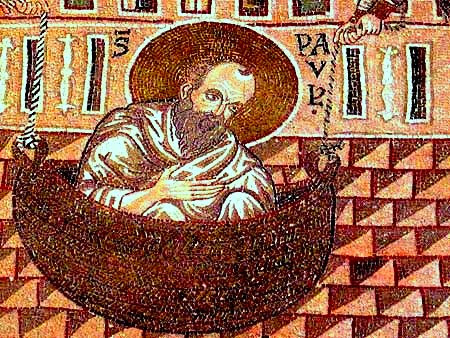
If I must boast, I will boast of the things that show my weakness. The God and Father of the Lord Jesus, who is to be praised forever, knows that I am not lying. In Damascus the governor under King Aretas had the city of the Damascenes guarded in order to arrest me. But I was lowered in a basket from a window in the wall and slipped through his hands. (New International Version)

Paul escaped the city of Damascus by being lowered in a basket at night (Acts 9: 23-25)

At this point in the Apostle Paul’s second letter to the Corinthian Church, he levels a direct and devastating attack on his proud, arrogant, and boastful opponents in the church. He points out the foolishness of their boasting, by means of playing the fool himself.

The gist of Paul’s argument was to boast of his humiliating experiences. In truth, Paul had plenty of glorious accomplishments he could have droned on about. Instead, he sought to expose the wide gulf that separated his understanding of apostolic ministry, and theirs.

With some rather hefty sarcasm behind his words, Paul offered some foolish boasting according to the human standards of his opponents. The Corinthians believed themselves to have superior strength and wisdom. Surely, they’re able to put up with these pathetic apostolic weaklings!

In reality, it is Paul’s weakness – and not humanly contrived understandings of strength – which establish his credibility and superiority as a minister of Christ’s gospel. The evidence is his hardships and trials – not his many triumphs. Paul intended for this irony to be felt by the Corinthians.

The Apostle’s litany of woes and adversities wasn’t meant to one-up the Corinthians. Rather, it was intended to be a parody of the Corinthians’ claims to superior wisdom and spiritual power.

While the church boasted of all the things that showed their strength, Paul boasted of his weaknesses – because it’s truly in weakness that the transcendent power of God is made known and manifested in this world.

Paul’s experience in Damascus not only illustrated the extreme danger he was in, but it served as an example of his weakness in contrast to the mighty strength of the Roman Empire.

In the Roman army, the soldier with the greatest strength and valor was the one who scaled the enemy wall first. The courageous ascent of the Roman soldier is viewed alongside the inglorious descent of Paul along the wall in escaping.

Christianity grew, flourished, and thrived not because of superior earthly strength, but because of humiliating weakness which allowed the power of heaven to work through it.

In light of Paul’s view of leadership and ministry, I find that many contemporary leadership theories are woefully lacking in an understanding of how people tick.

For example, some philosophies treat humans as if they were machines, and treat workers as cogs or parts in a larger mechanistic worldview, as if they could be replaceable.

Yet, leadership that relies on the factory system will inevitably demean a person’s basic humanity and see nothing of their inherent uniqueness and deserving of respect.

Instead, a more biblical, compassionate, and practical leadership style discerns that relationships are key; and that individual persons bring something special to their work, even if they are doing the same job as others.

In this understanding of leadership, every single person does their work or ministry in a way that isn’t fully reproducible by others. Our individual human uniqueness ensures that our place in the world is needed, and that what we bring to every endeavor we do is a special one-of-a-kind offering that no one else can do.

What’s more, in this view of leadership, there’s no room for boasting, at all. And no place for arrogant pride, because boasting is based upon comparison.

If every person is a unique creation of God, and everyone brings something individually special to their efforts, then comparison is a foolish waste of time, and boasting is nothing more than a fool’s game.

You can always tell the fool by how they keep talking and cannot keep their mouth shut about all of their accomplishments and everything they know. If they believe they’re right, and try and prove it with their comparative superiority to others, then you can bet that what you have in front of you is a card-carrying honest-to-goodness genuine Fool, with a capital “F.”

We can do better. And we can be better leaders and offer better leadership philosophies which are based in humility, the value of each person, sound relationships, and effective peacemaking.

Anything less than that will likely get a sarcastic comment from the Apostle Paul in heaven.

Give us, O God,
leaders whose hearts are large enough
to match the breadth of our own souls;
and give us souls strong enough
to follow leaders of vision and wisdom. Amen.