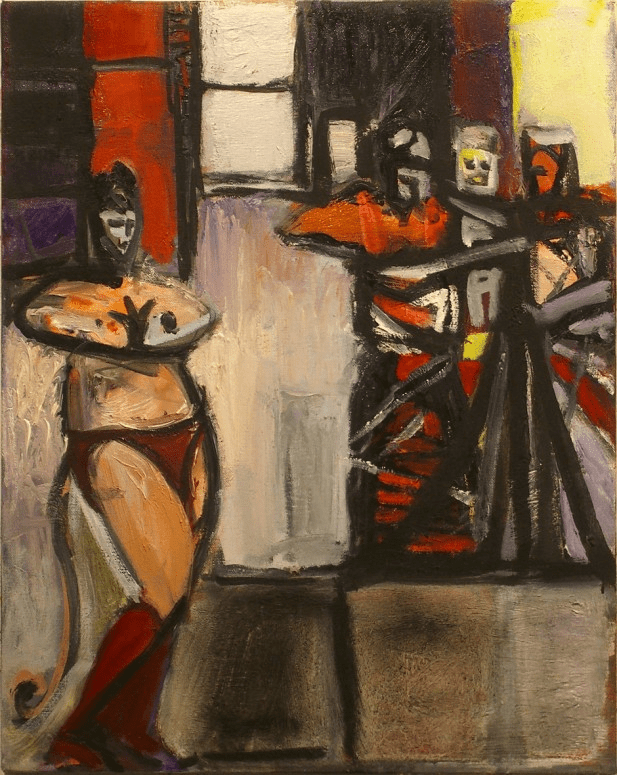
There Is a Behemoth In the Room (Job 40:1-24)

And the Lord said to Job:

“Shall a faultfinder contend with the Almighty?
    Anyone who argues with God must respond.”

Then Job answered the Lord:

“See, I am of small account; what shall I answer you?
    I lay my hand on my mouth.
I have spoken once, and I will not answer,
    twice but will proceed no further.”

Then the Lord answered Job out of the whirlwind:

“Gird up your loins like a man;
    I will question you, and you declare to me.
Will you even put me in the wrong?
    Will you condemn me that you may be justified?
Have you an arm like God,
    and can you thunder with a voice like his?

“Deck yourself with majesty and dignity;
    clothe yourself with glory and splendor.
Pour out the overflowing of your anger,
    and look on all who are proud and humble them.
Look on all who are proud and bring them low;
    tread down the wicked where they stand.
Hide them all in the dust together;
    bind their faces in the world below.
Then I will also acknowledge to you
    that your own right hand can give you victory.

“Look at Behemoth,
    which I made just as I made you;
    it eats grass like an ox.
Its strength is in its loins
    and its power in the muscles of its belly.
It makes its tail stiff like a cedar;
    the sinews of its thighs are knit together.
Its bones are tubes of bronze,
    its limbs like bars of iron.

“It is the first of the great acts of God;
    only its Maker can approach it with the sword.
For the mountains yield food for it
    where all the wild animals play.
Under the lotus plants it lies,
    in the covert of the reeds and in the marsh.
The lotus trees cover it for shade;
    the willows of the wadi surround it.
Even if the river is turbulent, it is not frightened;
    it is confident though Jordan rushes against its mouth.
Can one take it with hooks
    or pierce its nose with a snare? (New Revised Standard Version)

At various times throughout my life, and the life of my dear family, we have been referred to by others as “the family of Job.” Believe me, it’s not really a moniker you’d like to have.

It can be good to know that there are others who see you and affirm your undeserved suffering. Yet, suffering is not something I have ever asked for or wanted.

Suffering is like an uninvited guest who crashes life’s party. And there is no bouncer I can turn to in order to get this unwanted behemoth out of my life.

Speaking of behemoths, it just so happens that “Behemoth” is mentioned by God in today’s Old Testament lesson.

The word “behemoth” is simply an English transliteration (bəhēmōṯ) of the Hebrew word (בְּהֵמוֹת). This is because nobody really knows what the Behemoth is, or was.

This, however, didn’t stop some English translations from interpreting Behemoth, e.g. “hippopotamus” in the Contemporary English Version; and, the Easy-to-Read Version uses “behemoth” but inserts the footnote that “This might be a hippopotamus, a rhinoceros, or possibly an elephant.”

Whatever Behemoth actually was, it was very big and strong. And the fact that God can have one as a pet is meant to speak of how immense and powerful God is.

A big old Behemoth is something we may be awe-inspired by, or even admire from afar. But I don’t think any of us would want one in our living room, especially if the Behemoth is bigger than the room.

But that’s exactly where I too often find myself. I come home, and there is this great big behemoth that I cannot get around nor ignore. I have to deal with it.

The Behemoth makes me realize that I am rather puny and weak; I am therefore very limited in how I can deal with it. Compared to this Behemoth, I am nothing. My human limitations come annoyingly to the forefront as a pathetic display of ineffectiveness.

And that is precisely what I don’t like. I absolutely despise being limited. I keep holding to the ridiculous notion that in any and every situation, I feel that I should be able to handle it. I should be the smartest person in the room. I ought to be the best person for the job. I should be up to whatever job is in front of me.

I can easily “should” myself to death, believing that because I look like Clark Kent, I am really Superman. But the truth is that I am vulnerable, limited, and don’t have all the answers.

I have no problem whatsoever affirming God’s power, size, and ability. I have plenty of faith to believe that God’s plans and purposes will be accomplished in this world. And I have all kinds of trust that God is good for divine promises made.

But I have some serious problems with my own limitations. I hate having a lack of knowledge, awareness, and strength. I despise not being able to help. I want nothing to do with what my late aged parents described as “being a burden to my family.”

Yet, here I am. A human, with all the weaknesses, limitations, and ignorance that goes with it.

And this is the core of my problem: I cannot help God, be more like Jesus, and have the strength of the Holy Spirit. In other words, I am not God. I’m about as close to being like God as both ends of the universe are.

As big as that huge Behemoth is in my life – which for me, is actually my insipid and frustrating limitations – God is infinitely bigger than the biggest Behemoth there ever was.

It turns out that my not wanting to submit to anything but God, is really a lack of submission to God. The Lord wants to use my wife, my children, my colleagues, my neighbors, and even people I don’t know and/or don’t like to help me in my limitations.

When God shows up, it usually isn’t in a dramatic whirlwind; God typically comes in the form of the person right in front of me.

Almighty God, the Creator and Sustainer of the universe, you have no limits. Yet, I am quite limited. My body cannot do everything. My mind cannot know all things. My ability to feel and express emotion is too often suppressed and purposely limited. And my spirit is too often limited to the three dimensions of my physical existence. Help, Lord; I need you.

May your divine grace and peace surround me and fill me, so that even when I am weak in body, I am strong in faith. Help me to accept my human limitations, as well as help from others; and to embrace and pursue my spiritual possibilities; through Jesus Christ my Lord. Amen.

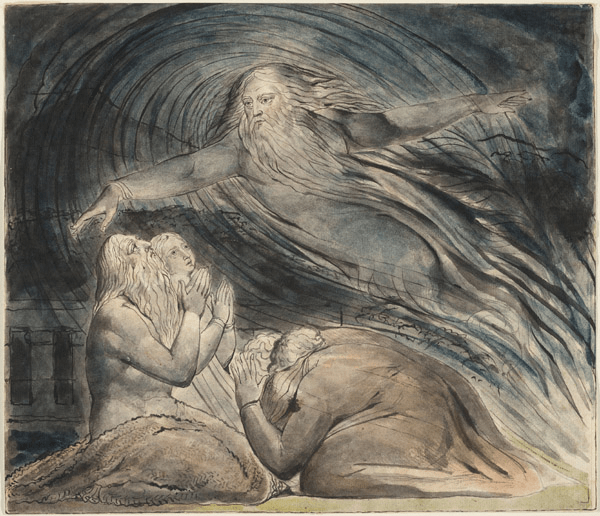
Questions Without Answers (Job 38:1-7, 38-41)

God Answers Job Out of the Whirlwind, by William Blake, 1805

Then the Lord answered Job out of the whirlwind:

“Who is this that darkens counsel by words without knowledge?
Gird up your loins like a man;
    I will question you, and you shall declare to me.

“Where were you when I laid the foundation of the earth?
    Tell me, if you have understanding.
Who determined its measurements—surely you know!
    Or who stretched the line upon it?
On what were its bases sunk,
    or who laid its cornerstone
when the morning stars sang together
    and all the heavenly beings shouted for joy?…

“Can you lift up your voice to the clouds,
    so that a flood of waters may cover you?
Can you send forth lightnings, so that they may go
    and say to you, ‘Here we are’?
Who has put wisdom in the inward parts
    or given understanding to the mind?
Who has the wisdom to number the clouds?
    Or who can tilt the waterskins of the heavens
when the dust runs into a mass
    and the clods cling together?

“Can you hunt the prey for the lion
    or satisfy the appetite of the young lions,
when they crouch in their dens
    or lie in wait in their covert?
Who provides for the raven its prey,
    when its young ones cry to God
    and wander about for lack of food? (New Revised Standard Version)

The Book of Job is rather long. After the initial two chapters which set the scene for Job’s awful suffering, we then get an extended and agonizing thirty-five chapters of speeches between Job and his companions. It’s a lot of words which generally go nowhere.

So, by the time we get to this point in chapter 38 of Job, we may likely say, “Finally, God speaks!” Indeed, this is the moment Job has anticipated.

Perhaps we are looking for something in Job’s story which may help us in our own story of suffering. Like Job, maybe we’re looking for vindication of our situation, a restoration to some semblance of life before the grief, or to have our reputation upheld.

But that is not what we get from God. For the next nearly four chapters, God only speaks in questions, and does not answer a single one of them.

If it’s answers to questions we’re searching for, it is unlikely you will get them, at least on this side of heaven. You are more likely to get even more questions than you started with. And then, imagine being questioned by God, and having no answers for God whatsoever.

Yet, that is the point. We humans know jack squat – absolutely nothing, in comparison to an omnipresent and omniscient God.

If it’s God’s voice you really want to hear, you may not know what you’re actually asking for. That was certainly true for Job and his friends. God’s questions are really rather rhetorical; there is no way any of us could really answer them with any sort of knowledge or understanding. It would be a bit like a parent asking their toddler to describe his own birth and how it happened.

God’s unanswerable questions revolve mostly around the workings of the universe. God is the Creator, and none of us were around when it all came into existence. So, of course, we have no answers.

Yet, with all of the questions, we quickly get the impression that humans have very little control over much of anything. And I think that perhaps God wants us to be aware of that reality.

It seems to me that with every question of God, we are led to believe that God is God, and is really big; and that we are not God, and are pretty dang small.

I don’t think any of this is meant to make us feel irrelevant or disposable. Rather, it gives us some needed perspective, that is, that our perspective on world issues, events, and problems is very narrow. But God sees the whole big picture and has a stellar full perspective of all things and all people.

The God in the Book of Job is no vending machine deity, in which we can pick-and-choose what we like and don’t like. There is no grand certainty that if we press the right buttons in prayer that we get what we want.

Therefore, God is not some automaton who predictably rewards the righteous, and punishes the wicked (according to our definitions of those terms). Yet this is the God that Job’s friends believed in – which is why they reflexively interpreted Job’s situation as Job himself being a sinful man.

Even Job believed in this sort of God, at least to some degree. Up to the point of his terrible trouble, he was good and righteous, and received due reward for his faithfulness. The divine system was serving Job well.

But then the system seems to have broken down. Job interpreted God as not doing the expected divine job of operating within the predictable divine structure.

Believers in every generation and era must come to grips with the reality that – although personal virtue and devotion are important – one’s piety does not necessarily lead to personal health nor wealth.

In other words, good guys don’t always win in this life, because having faith typically means we will actually suffer, rather than not.

This is, to me, good news. Why? Because it means, conversely, that persons victimized by violence, poverty, and loss are not necessarily to blame for their troubles. Frankly, there are times when bad things happen to us that are not our fault, and we don’t see any good reason for it happening.

Whenever God is silent, we might start to think that God is also absent. We may begin to entertain nihilist thoughts that nothing matters, that everything in this universe is just random chaos.

Yet, God’s response with all the questions lets us know that there is a solid structural foundation to this universe that we aren’t always aware of. In other words, there is meaning, purpose, and order to it all. We are not forgotten. God sees and remembers us.

I do believe there is a reason for everything. However, I do not believe that we are always privy to know what that purpose may be. Which means that oftentimes, like Job, we don’t have any answers to our existential questions of human tragedy and trouble. This line of thinking isn’t meant to be a cop out; it’s meant to help us accept that we are human.

Sometimes all we can do is affirm what we know to be true, and accept the limits of our own human understanding of things such as:

  • God is God. I am not.
  • God created the world. I didn’t.
  • God established order in the universe. I sometimes see order, and oftentimes see what looks like random chaos.
  • God is Love all the time. I love, but not always.
  • God is with us, even though I may not always sense or feel that divine presence.

Maybe what is most important is that we humans keep up our dialogue with God – our questions, musings, emotions, and expressions of faith and devotion. Because it is in the relationship that we discover the key to the universe.

O God, by whom the meek are guided in judgment, and light rises up in darkness: Grant us, in all our doubts and uncertainties, the grace to ask what you would have us to do, so that the Spirit of wisdom may save us from all false choices, and that in your light we may see light, and in your straight path may not stumble. Amen.

Hold Onto Faith (Job 26:1-14)

Job, by Gonzalo Carrasco (1860-1936)

Then Job replied:

“How you have helped the powerless!
    How you have saved the arm that is feeble!
What advice you have offered to one without wisdom!
    And what great insight you have displayed!
Who has helped you utter these words?
    And whose spirit spoke from your mouth?

“The dead are in deep anguish,
    those beneath the waters and all that live in them.
The realm of the dead is naked before God;
    Destruction lies uncovered.
He spreads out the northern skies over empty space;
    he suspends the earth over nothing.
He wraps up the waters in his clouds,
    yet the clouds do not burst under their weight.
He covers the face of the full moon,
    spreading his clouds over it.
He marks out the horizon on the face of the waters
    for a boundary between light and darkness.
The pillars of the heavens quake,
    aghast at his rebuke.
By his power he churned up the sea;
    by his wisdom he cut Rahab to pieces.
By his breath the skies became fair;
    his hand pierced the gliding serpent.
And these are but the outer fringe of his works;
    how faint the whisper we hear of him!
    Who then can understand the thunder of his power?” (New International Version)

Sarcasm is a form of criticism. Criticism is a form of anger. Job was angry at his “friends.” Namely, because they had proved themselves to be not very good companions.

Job needed comfort and consolation, not hellfire sermons about his being sinful. Because, in fact, he had not sinned. His intense pain and suffering were not a punishment from God, as the prologue to the story of Job makes clear. (Job 1:1-22)

But neither Job nor his friends knew what was going on behind the scenes in the cosmic court of heaven.

Job only knew he was getting a lot of undeserved tragedy. And Job’s friends only knew that he was suffering terribly.

Job didn’t know how to interpret his situation. Job’s friends misinterpreted his situation as condemnation from the Lord.

Thus, Job became exasperated and angry. Job’s friends became the ignoramuses of ancient history.

Job was certainly no ignoramus. He knew what it meant to be right with God – which was why he was so doggone confused and confounded as to why he felt abandoned by God. Job knew his suffering wasn’t a result of unfaithfulness.

The biblical character Job came face to face with the reality that good people suffer, too.

The friends of Job kept reiterating how unworthy and sinful people are; and that Job must be especially sinful to be experiencing such trouble. And, of course, Job found this line of reasoning asinine.

The majesty of God, as Job understood it, is much greater and higher than his supposed friends could ever imagine. The dead know this better than anyone. Job himself was nearly dead, and so, he seems to see some things more clearly from his perspective of abject suffering.

Job’s observations of creation are profound reflections of God’s greatness and sovereignty in the world. His faith rested firmly with God alone, as Creator and Sustainer of the universe. So, he looked beyond the water and the clouds to heaven above.

Even in the realms we humans cannot see, God has authority and power over angelic beings. We cannot fathom the breadth and depth and extent of God’s reach and knowledge of all things. Indeed, humanity only observes a mere fraction of God’s rule and reign. And we barely know anything in comparison to God’s wisdom and knowledge.

In other words, our incredible God is so mighty and wondrous that it is incomprehensible to us.

Oh, the depth of the riches of the wisdom and knowledge of God!
    How unsearchable his judgments,
    and his paths beyond tracing out! (Romans 11:33, NIV)

God is big, to the point that only the fringes of God’s robe can fit inside the temple:

I saw the Lord, high and exalted, seated on a throne; and the train of his robe filled the temple. (Isaiah 6:1, NIV)

Although Job was flummoxed as to why God was silent and allowed suffering to happen, Job nevertheless had a majestic view of God which remained intact.

And, what’s more, Job seems to have gained an even more expansive view of God through his awful experience of suffering in both body and soul. In other words, Job got to know God better, and not for worse, because of his terrible situation.

Satan certainly meant to upend Job and cause him to renounce his faith; but God meant it all, ironically, for good.

Even though Job’s words about God appear similar to the words of his friends, they come from a very different place.

It’s one thing to talk of God’s majesty, sovereignty, and power when everything is going okay for you in your life. But it is an altogether different thing whenever your life has unraveled and distress is what you eat for breakfast.

To affirm God’s inherent power and goodness, smack in the middle of grinding hardship and ill health – and truly mean it – is the genuine article of faith.

Authentic faith is resilient and gains strength when tested and tried. Bogus faith crumbles like burnt toast when it is put through the fire.

True faith is always connected to hope and love. False faith evaporates and becomes nihilistic and hateful in the face of hellish circumstances.

Real faith perseveres through suffering, knowing that God is good, no matter what. Skin deep faith is herky-jerky, vacillating between confidence and doubt.

The only way for faith to be shown as real or fake is in the crucible of suffering. How we handle the adverse situations of life demonstrates where our faith is truly placed.

Satan’s statement to God was that Job’s faith would be shown to be a mere façade because God had blessed him with health, wealth, and family.

Satan was wrong. God was right. However, we may wonder about what Job thought of all this, once the suffering subsided.

I don’t know about Job. I can only speak for myself. I won’t list the long litany of trials and tribulations I have personally encountered in my life, and those I am facing presently. Yet, I will say that each of my experiences have taught me something important about God; and those hard experiences have changed and strengthened my faith in ways I could not have imagined.

Although I would never want to go through all of the past adversity again, I would not change a thing in my life. Because each of my experiences were formative in making me the person I am today – full of robust faith in God and confident in the Lord, no matter the circumstances.

Strengthen us, O Lord, by your grace, so that through your mighty power we may overcome all spiritual enemies, and with pure hearts serve you; through Jesus Christ our Lord, who lives and reigns with you and the Holy Spirit, one God, for ever and ever. Amen.

Divine Providence (Esther 1:1-20)

The Refusal of Vashti, by Gustave Doré (1832-1883)

These events happened in the days of King Xerxes, who reigned over 127 provinces stretching from India to Ethiopia. At that time Xerxes ruled his empire from his royal throne at the fortress of Susa. In the third year of his reign, he gave a banquet for all his nobles and officials. He invited all the military officers of Persia and Media as well as the princes and nobles of the provinces. The celebration lasted 180 days—a tremendous display of the opulent wealth of his empire and the pomp and splendor of his majesty.

When it was all over, the king gave a banquet for all the people, from the greatest to the least, who were in the fortress of Susa. It lasted for seven days and was held in the courtyard of the palace garden. The courtyard was beautifully decorated with white cotton curtains and blue hangings, which were fastened with white linen cords and purple ribbons to silver rings embedded in marble pillars. Gold and silver couches stood on a mosaic pavement of porphyry, marble, mother-of-pearl, and other costly stones.

Drinks were served in gold goblets of many designs, and there was an abundance of royal wine, reflecting the king’s generosity. By edict of the king, no limits were placed on the drinking, for the king had instructed all his palace officials to serve each man as much as he wanted.

At the same time, Queen Vashti gave a banquet for the women in the royal palace of King Xerxes.

On the seventh day of the feast, when King Xerxes was in high spirits because of the wine, he told the seven eunuchs who attended him—Mehuman, Biztha, Harbona, Bigtha, Abagtha, Zethar, and Carcas—to bring Queen Vashti to him with the royal crown on her head. He wanted the nobles and all the other men to gaze on her beauty, for she was a very beautiful woman. But when they conveyed the king’s order to Queen Vashti, she refused to come. This made the king furious, and he burned with anger.

He immediately consulted with his wise advisers, who knew all the Persian laws and customs, for he always asked their advice. The names of these men were Carshena, Shethar, Admatha, Tarshish, Meres, Marsena, and Memucan—seven nobles of Persia and Media. They met with the king regularly and held the highest positions in the empire.

“What must be done to Queen Vashti?” the king demanded. “What penalty does the law provide for a queen who refuses to obey the king’s orders, properly sent through his eunuchs?”

Memucan answered the king and his nobles, “Queen Vashti has wronged not only the king but also every noble and citizen throughout your empire. Women everywhere will begin to despise their husbands when they learn that Queen Vashti has refused to appear before the king. Before this day is out, the wives of all the king’s nobles throughout Persia and Media will hear what the queen did and will start treating their husbands the same way. There will be no end to their contempt and anger.

“So if it please the king, we suggest that you issue a written decree, a law of the Persians and Medes that cannot be revoked. It should order that Queen Vashti be forever banished from the presence of King Xerxes, and that the king should choose another queen more worthy than she. When this decree is published throughout the king’s vast empire, husbands everywhere, whatever their rank, will receive proper respect from their wives!”

The king and his nobles thought this made good sense, so he followed Memucan’s counsel. (New Living Translation)

Vashti Refuses, by Richard McBee

The Jews were living in exile. The Babylonian Empire had taken Jerusalem, destroyed the temple, and exiled many of the people to Babylon. Later, the Medes and Persians conquered Babylon and ruled over a vast area of many different peoples.

The story of Esther begins with the story of King Xerxes and Queen Vashti. They were the most powerful people in the world, at that time. This meant that Vashti had more power and authority than any woman on earth, at that time.

Although most women had few rights, Vashti was not one of them. However, when it came to the king, the queen was most definitely second fiddle.

Today, we can understand Vashti’s response to Xerxes. But back then, it was unthinkable. It wasn’t only Xerxes who ruled the land; misogyny did, as well.

Queen Vashti appears in the story as a strong-willed independent woman of power. While the king and queen were each having their respective parties, things started to go sideways.

No limits on the bar meant unlimited drinking. A drunk King Xerxes had one of those moments that seemed logical to the inebriated mind, but was actually nonsensical. He insisted that his queen stop her celebration, leave her guests, get all gussied up in her royal accoutrements, and parade around for a bunch of drunk guys to gawk at.

As readers of the story, we can tell this is not going to have a good ending for Vashti. She was in an impossible situation. She could submit and face humiliation, or worse. So, the queen chose not to abide by the king’s order.

Little did Vashti know that she was paving the way for a new queen to ascend to the side of King Xerxes. The extreme action of Xerxes attempting to use his queen then turned into another action of consulting his advisors and deposing the queen. Vashti was banned from the court, and the kingdom.

Hence, events were set in motion to find a new queen. As the story unfolds, Esther is a young Jewish woman living in this forced diaspora of the Persian Empire. Little did she know that Vashti’s fall was the beginning of her own rise.

“So the last will be first, and the first will be last.”

Jesus (Matthew 20:16)

Although the story of Esther never mentions the word “God,” we see an incredible Providence guiding events through the biblical book of Esther. Young Esther found favor with the king, became queen, and risked her life to save the Jewish people from destruction.

Esther’s story is the Jewish story – a tale of others pronouncing pogroms upon them and attempting to rid themselves of these others who live strangely and differently. But a champion arises; one who bring deliverance.

The Jewish story is one of resilience as a people throughout the millennia. Rather than ignoring, or worse, persecuting Jews, we can observe how they have had to deal with the enduring issues of perseverance through suffering; preserving their identity; and ensuring their survival in the middle of social and cultural pressures.

We also see that just because one is in the courts of power and is not one of the peoples who is persecuted, does not necessarily mean that there is an exemption from harm. Vashti was a powerful woman, but her power didn’t last.

In the end, Vashti was treated more like an oppressed Jew than a privileged Gentile; and Esther would move from powerless to powerful.

And from a Christian perspective, we can see Jesus as the Savior who puts himself at risk to save the world from sin, death, and hell.

And let us run with perseverance the race marked out for us, fixing our eyes on Jesus, the pioneer and perfecter of faith. (Hebrews 12:1b-2a, NIV)

We can, as well, observe that God is not fazed by any big earthly political power. The Lord sees all, knows all, and has the authority to do something about injustice and accomplishing just purposes on this earth.

O God, your never-failing providence sets in order all things both in heaven and earth: Put away from us, we entreat you, all hurtful things, and give us those things which are profitable for us; through Jesus Christ our Lord, who lives and reigns with you and the Holy Spirit, one God, for ever and ever. Amen.