
Psalm 69:1-5, 30-36 – The Praise of Suffering

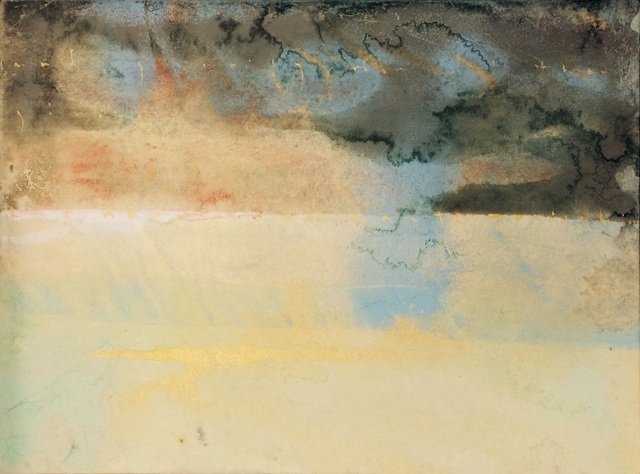
Psalm 69 by Japanese painter Makoto Fujimura

Save me, God,
    because the waters have reached my neck!
I have sunk into deep mud.
    My feet cannot touch the bottom!
I have entered deep water;
    the flood has swept me up.
I am tired of crying.
    My throat is hoarse.
    My eyes are exhausted with waiting for my God.

More numerous than the hairs on my head
    are those who hate me for no reason.
My treacherous enemies,
    those who would destroy me, are countless.
    Must I now give back
    what I did not steal in the first place?
God, you know my foolishness;
    my wrongdoings are not hidden from you….

I will praise God’s name with song;
    I will magnify him with thanks
    because that is more pleasing to the Lord than an ox,
    more pleasing than a young bull with full horns and hooves.
Let the afflicted see it and be glad!
    You who seek God—
    let your hearts beat strong again
    because the Lord listens to the needy
        and does not despise his captives.

Let heaven and earth praise God,
    the oceans too, and all that moves within them!
God will most certainly save Zion
    and will rebuild Judah’s cities
    so that God’s servants can live there and possess it.
The offspring of God’s servants will inherit Zion,
    and those who love God’s name will dwell there. (CEB)

As the Church’s and the Christian’s prayer book, the psalms offer a way to come to God when our feelings and emotions have us not knowing how to pray, at all.  If you are depressed because of people who would like to see you fail or are out to get you, then this is the psalm for you to pray!

When you are voiceless, the psalter can voice it for you. When you are unable to put your thoughts into words, the Scripture can word it for you. Two of the great attributes of God are divine power and love, which means that the Lord is more than able to do something about your situation, and it will always be done in a loving way.  Know today that God hears you and is working on a response to your lament – even if it is not in your own words but the words of Holy Scripture.
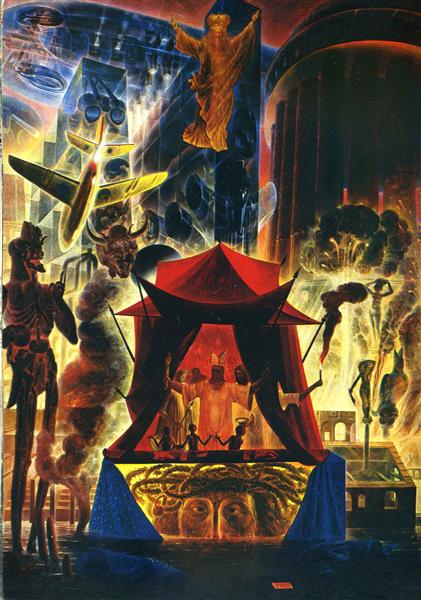
Psalm 69 by Austrian artist Ernst Fuchs, 1960

God will come through in God’s own good time. However, you can still praise the Lord right now, smack in the middle of your dilemma. David, the author of today’s psalm, chose to praise God, even though he did not get an immediate answer to his prayers. Perhaps God is more concerned to change us before changing our circumstances.

We need a solid theology of suffering. And that biblical psalms give it to us. I know of no one who wakes in the morning, sits on the edge of their bed, and says, “Gee, I want to suffer today and feel lots of emotional and spiritual pain.” No, we want happiness and joy, not agony and hardship. Yet suffering has much to teach us and the Lord is rarely quick to snatch us from its lessons. The hardship of personal suffering teaches us faith and dependence upon God, as well as leading us to ask for help from others so that we are lovingly supported.

“The way you look at things is the most powerful force in shaping your life.”

john o’donohue

Tribulations in life are common to all people without exception. The issue is whether we will submit to its hard-knock education, or not – whether we will become better people, or bitter. The Irish teacher and poet, John O’Donohue, penned a poem entitled, “For Suffering,” concerning the blessing of hard things:

May you be blessed in the holy names of those

Who, without knowing it,

Help to carry and lighten your pain.

May you know serenity

When you are called

To enter the house of suffering.

May a window of light always surprise you.

May you be granted the wisdom

To avoid false resistance;

When suffering knocks on the door of your life,

May you glimpse its eventual gifts.

May you be able to receive the fruits of suffering.

May memory bless and protect you

With the hard-earned light of past travail;

To remind you that you have survived before

And though the darkness is now deep,

You will soon see approaching light.

May the grace of time heal your wounds.

May you know that though the storm may rage,

Not a hair of your head will be harmed.

To Bless the Space Between Us: A Book of Blesings (Doubleday, 2008)

We have all likely at times felt the anguish of the psalmist – being so overwhelmed that it feels like we are drowning. The feeling is compounded exponentially when behind the sense of trying to keep our heads above water there are people who do not like us – maybe even hate us, to the point of undermining our work every chance they get.  It is in such circumstances we might experience sleepless nights hoping that somehow and someway God will show up.

The typical modus operandi for some within adverse situations is the age-old route of complaining and wishing things were different. Yet neither griping about our problems nor dishing out slander and gossip toward others is a healthy way of dealing with adversity. Just the opposite response is the proper path to the bone-crushing feeling of opposition: to praise God’s name with a song and magnify the Lord with thanksgiving. 

The reason the believer can engage in adoring God during trouble is not some Jedi-type mind trick to make us think more positively. Instead, the basis for praise is in knowing God. It is God who ultimately will deal with the wicked; it is the Lord who will bend to listen to our lament when times are hard. 

Thanking God for answers to prayer in advance of them being answered is a biblical thing to do. Having a faith robust enough to see ahead toward hope can bring love to a loveless situation, and usher in praise before the divine deed of deliverance is even accomplished.

Saving God, thank you for your deliverance!  I give you praise for loving me through sending your Son, the Lord Jesus, to this earthly realm so that I might experience salvation from sin, death, and hell. By Christ’s authority, in the power of the Holy Spirit given to me, I resist the enemy’s attempts to seize control of my life.  I belong to you, holy God. Amen.

Psalm 29 – The Voice of the Lord and the Power of Words

Welcome, friends! Click the video below and hear a message from God’s Word…

Psalm 29

The words of Psalm 29 spoken by children…

A song inspired by the words of Psalm 29…

May God’s peace, which goes beyond anything we can imagine, guard your thoughts and emotions through Christ Jesus. Amen.

The Voice of the Lord and the Power of Words

The Power of Words by Tiffany Hagen, 2015

I have always felt comforted during thunderstorms. Having grown up in Iowa, strong thunderstorms are a given every summer. When my daughters were small children and frightened by the loud clap of thunder, I would say to them, “That’s just God letting us know he is powerful and watching over us.”

God spoke and stirred up a storm… So, they cried out to the Lord in their distress, and God brought them out safe from their desperate circumstances. God quieted the storm to a whisper; the sea’s waves were hushed. (Psalm 107:25, 29-30, CEB)

God’s very voice is the source of all power. In the beginning God created the heavens and the earth – with words. The Lord Almighty spoke the entire world into existence. God’s words are generative, that is, the speech of God creates and gives life. When God’s voice goes forth, things happen:

God said, “Let there be light,” and there was light… (Genesis 1:3, NIV)

God said, “Let there be a vault between the waters to separate water from water….” And it was so. (Genesis 1:6-7, NIV)

God said, “Let the waters under the sky come together into one place so that the dry land can appear.” And that is what happened. (Genesis 1:9, CEB)

God said, “Let the earth produce plants—some to make grain for seeds and others to make fruits with seeds in them. Every seed will produce more of its own kind of plant.” And it happened. (Genesis 1:11, NCV)

God said, “Let lights appear in the sky to separate the day from the night. Let them be signs to mark the seasons, days, and years. Let these lights in the sky shine down on the earth.” And that is what happened. (Genesis 1:14-15, NLT)

God said, “Let the land produce living creatures according to their kinds: the livestock, the creatures that move along the ground, and the wild animals, each according to its kind.” And it was so. (Genesis 1:24, NIV)

God creates and gives through speech. Yes, the mechanism of God’s provision for us is words. This means language is vitally important. The Lord creates, gives, sustains, and blesses creation through language – with humans as the only creatures formed in the image and likeness of God.

God said, “Now we will make humans, and they will be like us. (Genesis 1:26, CEV)

People, then, are capable of speech. Even more, with our ability of language, we also have the capacity to form generative words. We have the God-given means to give life with our speech.

“Life and death lie in the power of language.”

helen keller

I believe we all intuitively know this is true. As we reminisce the history of our lives, we can observe events where another’s words impacted us so significantly that it was as if they gave us the gift of life. We never forget those words. We also have had times when another’s words cut us emotionally and it felt as if a part of us died. We tend to remember those as well, and they hold us back in our own life-giving speech to ourselves and others.

“The godless destroy their neighbors by their words, but the righteous are saved by their knowledge.” (Proverbs 11:9, CEB)

We must listen to the voice of the Lord. God’s speech does not disappoint or destroy. God’s Word is eternal life. The better we listen to God, the better we can have the generative power of words to provide life for others. It only takes a cursory look at Holy Scripture to realize that words are powerful and are to be used with great care. We are all to continually develop the craft of wordsmithing so that we might ascribe to the Lord the glory due his name as well as bless the world.

“As a tree gives fruit, healing words give life, but dishonest words crush the spirit.” (Proverbs 15:4, NCV)

The language we use—spoken and written words, sign language, facial expressions, bodily gestures, singing—helps us understand ourselves and lets us create relationships with others. Our words give us the power to describe our past, define our present, and dream of our future. 

“Words from wise people are like water bubbling up from a deep well—the well of wisdom.” (Proverbs 18:4, ERV)

“Words are singularly the most powerful force available to humanity. We can choose to use this force constructively with words of encouragement, or destructively using words of despair. Words have energy and power with the ability to help, to heal, to hinder, to hurt, to harm, to humiliate and to humble.”

Yehuda Berg

We need to speak mindfully, paying careful attention to give people words of encouragement and compassion. We must discipline ourselves to use our words in a way that conveys respect, gentleness, and humility.

We adults may balk at the notion that words are anything more than a creative expression. Yet, as I believe is typical with most things, children are closer to the kingdom of God. They effortlessly make connections between words and reality whereas us older folks barely have an idea this even occurs. My grandson once remarked when I was talking to him about being cautious at the playground, “How am I supposed to meet new people if I can’t talk to strangers?”

“When I asked my son (5 years old) how his day was, he said it was awesome. I asked him what made it so awesome – his response was ‘because I wanted it to be.’”

Tanya Niedzwiecki (Huffington Post, November 2015)

The voice of the Lord exhibits a mighty God who has the power to create, recreate, and renew with but a word. As people in God’s likeness, our words are powerful tools to be used with wisdom and care. Our speech allows us to praise God and encourage one another. Even more, the use of language enables us to speak into existence new realities for ourselves and others. May those words bring forth hope and blessing to a world in need of healing.

Psalm 148 – Praise the Lord!

Welcome, friends! Along with all creation, let us praise our gracious, loving, and mighty God! Click the video below as we consider the psalmist’s words…

Psalm 148

For the Scripture set to song…

Psalm 148 (Highly Exalted) Official Lyric Video performed by Sixteen Cities and written by Josiah Warneking and Jennie Lee Riddle

For a classic hymn praising our great God…

All Creatures Of Our God And King | First Baptist Church of Dallas, Texas, Choir and Orchestra

The Lord bless you and keep you;
the Lord make his face shine on you,
and be gracious to you;
the Lord turn his face towards you
and give you peace;
and the blessing of God almighty,
the Father, the Son, and the Holy Spirit,
be among you and remain with you always. Amen.