The Authority of Jesus

They went to Capernaum, and when the Sabbath came, Jesus went into the synagogue and began to teach. The people were amazed at his teaching because he taught them as one who had authority, not as the teachers of the law. Just then a man in their synagogue who was possessed by an impure spirit cried out, “What do you want with us, Jesus of Nazareth? Have you come to destroy us? I know who you are—the Holy One of God!”

“Be quiet!” said Jesus sternly. “Come out of him!” The impure spirit shook the man violently and came out of him with a shriek.

The people were all so amazed that they asked each other, “What is this? A new teaching—and with authority! He even gives orders to impure spirits and they obey him.” News about him spread quickly over the whole region of Galilee. (NIV)

When I was in college, I drove a big car – an Oldsmobile Delta 88 with a 455 Rocket engine. Because I had the largest car around, I could fit a lot of people into my vehicle to drive to church on Sundays. Since I often gave rides to people I did not know very well, one Sunday I picked up two sisters who had never been to my church before.

Everything went like a typical Sunday morning, until toward the end of the pastor’s sermon one of the sisters began yelling and crying out in the service, maybe much like the account we have in our Gospel account for today. The pastor quickly brought an end to the worship service and the congregation hurriedly filed out of the building. I stayed behind because, well, I was her ride.

What happened next is an entire story for another day. I will just say that I saw some crazy stuff that did not seem readily explainable with our five human senses. And, I might add, there was a deliverance on that Sunday from whatever or whomever was influencing the young lady.

Ever since my experience on that Sunday, I continually wonder: What are our expectations when we come to a worship service?  Do we anticipate Jesus will be present via the Holy Spirit?  If so, do we believe he is there to confront demons and bring deliverance to people? Do folks even believe there is such beings as angels and demons anymore? How do we make sense of stories like this?

Perhaps there is so little deliverance from evil in our own experiences and in many faith communities because we simply have no expectation that such a thing will happen. Maybe the demons just sleep through gatherings knowing that their influence is not being threatened.

This brings me to the bread and butter of today’s message. I will give you three pre-suppositions (that is, things that we assume or take for granted) from which I work from when approaching Scripture and ministry. I will also make three observations of this story about Jesus, because ultimately the story is really all about him and not about demons. Finally, I offer three applications based on today’s Gospel lesson.

First Pre-supposition: Demons are real.  We know almost nothing about the man in the Gospel story other than he was “possessed by an evil spirit” which meant he was being influenced by a demon. I believe there is an unseen reality we cannot perceive with our physical eyes.

Second Pre-supposition:  Jesus has authority over demons.  Jesus took charge of the situation because he had the authority to do so. Throughout Mark’s Gospel, Jesus is portrayed as one who came to decisively deal with the powers of sin and death, especially as expressed through the demonic realm.

Third Pre-supposition:  Demons could be here.  I do not mean to scare anyone. I simply intend to point out that demons, or any type of evil manifestations, are not just out there somewhere in the world. Today’s story takes place in the sacred space of worship to God: the synagogue. Although it is a rather dramatic story, most demonic activity goes unaware because demons do not like to be recognized; they like the anonymity of the shadows and to operate in the dark where no one can detect them.  If we knew they were around, we would do something about it!  Just because we have dedicated spaces to the worship of God does not mean that it magically keeps evil out. God’s people must be savvy to evil demonic ways and take charge to use our authority in Christ with truth, justice, peace, faith, and the message of the gospel so that we might live wisely and shoo the devil away.

Based upon those three assumptions, the following are three observations about God and Jesus concerning the Christian life. These realities ought to evoke confidence in our lives without fear of the demonic realm…

First Observation: Jesus is directly interested in people.  Jesus came to seek and to save the lost. Christ came to directly confront evil and deliver humanity from sin, death, and hell.  Jesus showed interest, care, and love to people.  In the story, Jesus went to Capernaum to begin his ministry. Capernaum was a non-descript small village that was of no interest to anybody outside of it. Yet, Jesus sought to reach common ordinary people as well as the rich and famous because all are in need.  Furthermore, Jesus is concerned about every part of our lives, and not just the spiritual matters.

Second Observation: Jesus deals with pain and suffering.  One of the truest theological statements I could ever say to you is this: God loves you in the person of Jesus through the power and presence of the Holy Spirit.  Jesus suffered on our behalf. Christ is against everything that destroys. In fact, Jesus did not even destroy the demon, who was probably expecting that to happen. Instead, the Lord Jesus took the demon’s power away.  Jesus has taken the sting out of death.  Anything that robs life of its intended flourishing, Jesus is ready to do away with.  This can be a tricky point because God will use pain and suffering to teach us and form us into faithful people. Yet, that does not mean God is the author of pain or enjoys suffering. It just means that God’s grace will bend any circumstance, whether good or evil, to divine purposes for our benefit.

Third Observation: Jesus gives grace.  Every instance of healing, each miracle, and every event of deliverance from evil are all because Jesus loves us and cares about us, despite whether we deserve it or not.

Now let’s pull this together into some points of application…

First Application: We need the deliverance of Jesus, and not only psychological therapy.  I am a big believer in counseling and therapy for all kinds of emotional issues. It seems to me that far too many persons do not take advantage of the resources we have today in the psychological realm. What is more, I daily provide a range of counseling for individuals as both a church pastor and hospital chaplain. However, this in no way diminishes the need for spiritual deliverance or that therapy can somehow replace Jesus. If demons are real, and evil truly present, then no amount of counseling will deal decisively with Satan because only Jesus can do that.  I believe Jesus is not merely one option among a smorgasbord of people who could help us. Rather, Jesus is the Messiah who delivers us from evil, like no other can.

Second Application: Amazement is not faith.  The people in the Gospel story were amazed at Christ’s teaching and deliverance ministry. They had never seen or heard anything like it. Yet being impressed is not the same as naked trust. Spreading news of what Jesus did is not the same as putting Christ’s teaching into practice and personally experiencing divine power to deliver from sin.

Third Application: The Lord’s Table brings healing.  Christian communion is neither only a remembrance of what Jesus did on the cross, nor a magical act of bringing deliverance. Rather, the Table is a means of grace in which we partake of the elements in faith knowing Jesus is victorious over the demonic realm. What is more, the Spirit will join us to Christ and give us the confidence and hope to confront all that ails us. Liturgical rhythms of grace consistently and surely work their way into us and bring about the healing we need and want.

Conclusion

Jesus Christ has authority over everything, including the demonic realm. This makes him perfectly suited and situated to provide spiritual deliverance from evil – which is precisely how Christ encouraged us to pray. So, let us pray the prayer our Lord taught us:

Our Father which art in heaven, hallowed be thy name.

Thy kingdom come, thy will be done in earth, as it is in heaven.

Give us this day our daily bread.

And forgive us our debts, as we forgive our debtors.

And lead us not into temptation but deliver us from evil: For thine is the kingdom, and the power, and the glory, forever. Amen.

Psalm 46 – Divine Help

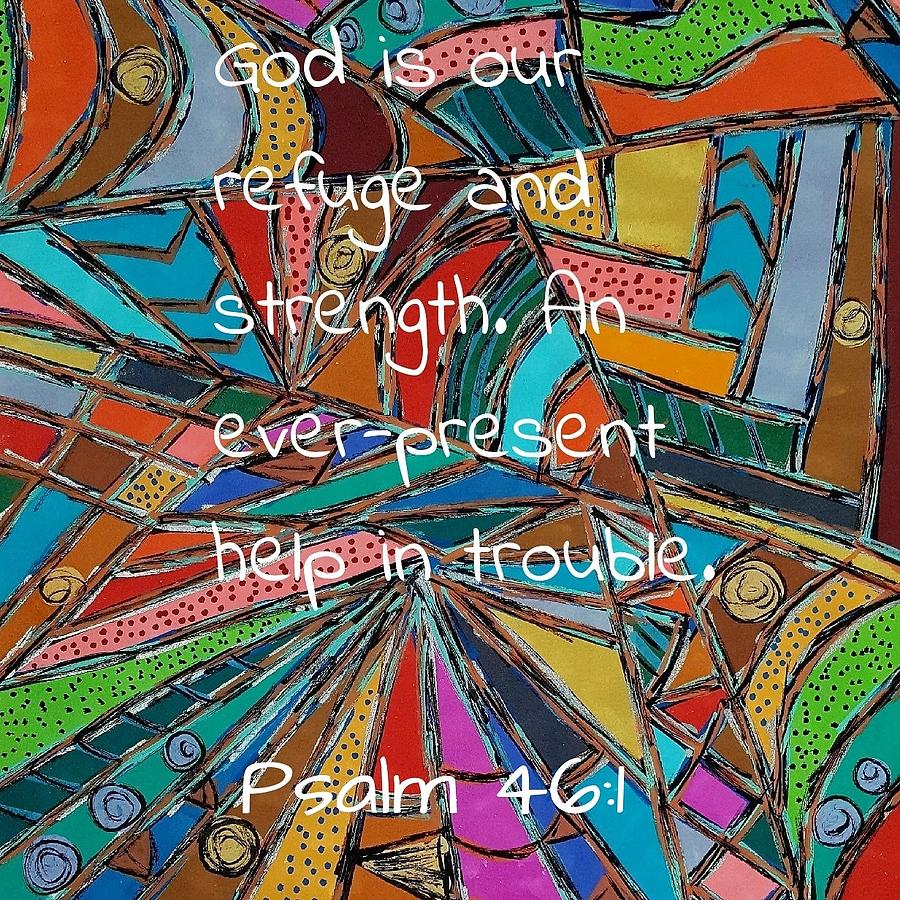
Psalm 46:1 by Connie Van Huss

God is our refuge and strength,
    a help always near in times of great trouble.
That’s why we won’t be afraid when the world falls apart,
    when the mountains crumble into the center of the sea,
    when its waters roar and rage,
    when the mountains shake because of its surging waves.

There is a river whose streams gladden God’s city,
    the holiest dwelling of the Most High.
God is in that city. It will never crumble.
    God will help it when morning dawns.
Nations roar; kingdoms crumble.
    God utters his voice; the earth melts.
The Lord of heavenly forces is with us!
    The God of Jacob is our place of safety. 

Come, see the Lord’s deeds,
    what devastation he has imposed on the earth—
    bringing wars to an end in every corner of the world,
    breaking the bow and shattering the spear,
        burning chariots with fire.

“That’s enough! Now know that I am God!
    I am exalted among all nations; I am exalted throughout the world!”

The Lord of heavenly forces is with us!
    The God of Jacob is our place of safety. (CEB)

We possess the unconditional presence of God. Yes indeed, the Lord of all creation is always with us. What a wonderful and radical thought!  But that is not all. What is more, God helps us. The Lord does not stand by idly to watch us squirm in tough situations. Because God is present with you and I, there is divine assistance which can help us in troubling times.

Something we can all seem to agree on is that we are in times of trouble and hardship. Everyone is collectively experiencing adversity. COVID-19 has punched us in our worldly gut and caused us to bend over, writhing in pain. We need the Lord. We require Divine help.

The psalms, as Hebrew poetry, were designed with a certain structure. Unlike the way we arrange things with a thesis statement said right up front, Hebrew poetry has the most important statement smack in the middle of the psalm. What comes before that statement is a growing crescendo meant to highlight the central idea. Everything that comes after is the decrescendo pointing back to the main idea.

What we have in the middle of today’s magnificent psalm is the important truth that the Lord of heavenly forces is with us. This reality is meant to drop its weight on us so that we will feel the impact of God’s presence and power. Consider some of English translations of the Hebrew statement:

The Lord All-Powerful is with us. The God of Jacob is our fortress. (CEV)

The Lord of Armies is with us. The God of Jacob is our stronghold. (GW)

Jacob-wrestling God fights for us, God-of-Angel-Armies protects us. (MSG)

The Lord Almighty is with us; the God of Jacob is our fortress. (NIV)

The Lord of Heaven’s Armies is here among us; the God of Israel is our fortress. (NLT)

Yahweh of Armies is with us. Jacob’s God is a turret for us. (FT)

Today (and everyday) is a good day to use the statement, “The Lord of heavenly forces is with us,” as a point of thought, contemplation, and deep consideration. God has the back of those who do right and seek to be just in all things. Whenever you are waiting, driving in the car, in-between scheduled stuff, or just sitting at home, repeat this biblical statement many times to yourself and to the Lord. Then, allow God’s Spirit to bring the truth of it home to the depths of your soul. There is no better security, no better hope than to know God is with us.

God Almighty, great upheaval in this world does not make you nervous because you are above it all.  Thank you that you are with me in all the great churnings of my life, as well as all the small things of trouble.  Even if all around me changes, you do not; through Christ my Savior, I pray. Amen.

Psalm 62:5-12 – Our Place of Safety

Psalm 62 by Christa Rosier (1960-2011)

Only God gives inward peace,
    and I depend on him.
God alone is the mighty rock
    that keeps me safe,
    and he is the fortress
    where I feel secure.
God saves me and honors me.
    He is that mighty rock
    where I find safety.

Trust God, my friends,
    and always tell him
each one of your concerns.
    God is our place of safety.

We humans are only a breath;
    none of us are truly great.
All of us together weigh less
    than a puff of air.
Don’t trust in violence
or depend on dishonesty
    or rely on great wealth.

I heard God say two things:
   “I am powerful,
    and I am very kind.”
The Lord rewards each of us
    according to what we do. (CEV)

My girls, now grown with families of their own, are wonderful mothers. Recently, I got to hold my newest grandson, which is wonderful! A close second to that experience is watching Mom hold her baby. The little guy has not a worry in the world when he is in her arms. For there is no doubt of perfect love and security.

God is our place of safety. For the believer, it is as if we are a baby having finished nursing, lying peacefully and contentedly in God’s loving and secure arms. There is complete trust because God is the one holding us. Our enemies are nothing but a puff of smoke – toothless lions who can make all the noise they want but will never get a bite on us with God around.

I was reminded of yet another truth as I watched my daughter and grandson. Although tired, both are genuinely happy. Neither riches nor fame can ever buy security and happiness. God, as the source of steadfast love and perfect safety, is our Rock. The Lord’s power and kindness meld together in a wondrous and active care for us.

God’s kingdom is constructed on solid rock, not sinking sand. Trusting in violent vengeance, deceitful scheming, or great wealth might build an impressive looking edifice, but will only be destroyed in the first big wind that comes along. Depending upon God as our refuge and strength is building a relationship which will last and stand the test of time and tribulation.

Jesus, aware of the Psalm’s theology, drew upon the image of the rock to impress on his listeners the need for making wise choices (Matthew 7:24-29). The foundation is the key element. The house built on the rock will withstand the storm; the foundation built on sand will not. The cornerstone of faith’s foundation for the Christian is Jesus. The way of Jesus is the entrance into the kingdom of heaven, and the stabilizing presence of peace our lives need. Christ is our place of safety.

May the risen and ascended Christ, mightier than the hordes of hell, more glorious than the heavenly hosts, be with you in all your ways.

May the cross of the Son of God protect you by day and by night, at morning and at evening, at all times and in all places.

May Christ Jesus guard and deliver you from the snares of the devil, from the assaults of evil spirits, from the wrath of the wicked, from all base passions and from the fear of the known and unknown.

And the blessing of God almighty, the Father, the Son, and the Holy Spirit, be upon you and remain with you always. Amen.

Psalm 139:1-6, 13-18 – Specially Crafted by the Divine

Psalm 139 stained glass by Dutch artist Ted Felen (1931-2016)

Lord, you have examined me.
    You know me.
You know when I sit down and when I stand up.
    Even from far away, you comprehend my plans.
You study my traveling and resting.
    You are thoroughly familiar with all my ways.
There isn’t a word on my tongue, Lord,
    that you don’t already know completely.
You surround me—front and back.
    You put your hand on me.
That kind of knowledge is too much for me;
    it’s so high above me that I can’t reach it….

You are the one who created my innermost parts;
    you knit me together while I was still in my mother’s womb.
I give thanks to you that I was marvelously set apart.
    Your works are wonderful—I know that very well.
My bones weren’t hidden from you
    when I was being put together in a secret place,
    when I was being woven together in the deep parts of the earth.
Your eyes saw my embryo,
    and on your scroll every day was written that was being formed for me,
    before any one of them had yet happened.
God, your plans are incomprehensible to me!
    Their total number is countless!
If I tried to count them—they outnumber grains of sand!
    If I came to the very end—I’d still be with you. (CEB)

It is no wonder so many people struggle with their self-image. Beautiful people reign in television and movies; the rich and powerful are highlighted in the media; and people with perfect teeth and immaculate attire are splashed in front of us in the daily barrage of advertisements. Meanwhile, the rest of us 99% of the population quickly notice we do not measure up to such a standard. You don’t have to be a people watcher to know that less than perfect bodies are the norm and that most folks do not have a budget to live like the other 1% humanity.

If we make comparisons with others too much and for too long, it gets downright depressing. Yet, into this dark abyss of one’s self-image enters the biblical truth that each one of us, no matter our station in life, was personally hand-crafted by a heavenly Being who loves us dearly. We are indeed fearfully and wonderfully made.

The Creator God took great care to make us and form us just so. The psalmist, David, praised God for the way we were created. The real standard from which we ought to judge ourselves is this: God knows us intimately, inside-and-out, and neither condemns us nor shames us but loves us wholly.

Psalm 139 by Dutch painter Ellen Van Randeraat, 2013

So then, rather than wasting our emotional energy and mental faculties on wishing we looked different or were more like so-and-so who seems to always have it all together, try practicing what David did: Praise God. 

Whenever we have the notion that we do not measure up to our imposed arbitrary standard, keep in mind that the only real measurement is grace. No matter who we are, the entire race of humanity has been created in the image of God, and, on that basis alone, we have inherent value, worth, and majesty. Let us, then, treat ourselves and others with the yardstick of grace.

The inner critic, that is, the inner judgmental dialogue we have with ourselves, needs to be replaced with the truth of Psalm 139. Although we might be rather hard on ourselves and say things in the reclusive parts of our minds and hearts that we would never say to others, nor tolerate others saying about someone else – God speaks to us with tender words of grace. Perhaps you think that only you know the depth of your own sorrows, hurts, fears, insecurities, and worries.  Except….

God. The Lord knows it all intimately – and is not one bit repulsed. You see, God knows that the answer to all the self-doubts is Divine care and protection. You and I have the freedom to plumb the recesses of our hearts and souls – to bring out all that is inside the cluttered closet of our minds and lay it all on the table without fear of God calling you what you call yourself.

Therefore, please do not quickly pass over the inspired words from Holy Scripture contained in today’s psalm. Take the time to carefully digest each phrase slowly so that the message becomes internalized and believed in real-time experience.

One of the theories of human psychology is that people are driven by two primary needs: 

  1. To intimately know another person.
  2. To be intimately known by another person. 

God knows us even better than we know ourselves – and still loves us! There is nothing we learn about ourselves that God does not already know. No human relationship can even come close to the level of knowing that God has for us and about us.

To know God is perhaps the greatest and highest pursuit we could ever enjoy. God is so immense and infinite that we will spend an eternity getting to know the Lord and will never get to the end of it. That is the kind of God we serve. Be encouraged today and always with the reality that you are known and can know God – and even more, loved deeply as a specially fashioned creature.

O God, thank you that I am wonderfully made in your likeness.  I praise you that I am fully accepted, even when I do not accept myself.  In Jesus Christ you have demonstrated the height of your love and mercy.  May this grace be with me every day so that I will conduct myself in a manner worthy of being part of the human family.  Amen.