Jesus the King (Mark 11:1-11)

Entry Into the City, by John August Swanson (1938-2021)

As they approached Jerusalem and came to Bethphage and Bethany at the Mount of Olives, Jesus sent two of his disciples, saying to them, “Go to the village ahead of you, and just as you enter it, you will find a colt tied there, which no one has ever ridden. Untie it and bring it here. If anyone asks you, ‘Why are you doing this?’ say, ‘The Lord needs it and will send it back here shortly.’”

They went and found a colt outside in the street, tied at a doorway. As they untied it, some people standing there asked, “What are you doing, untying that colt?” They answered as Jesus had told them to, and the people let them go. When they brought the colt to Jesus and threw their cloaks over it, he sat on it. Many people spread their cloaks on the road, while others spread branches they had cut in the fields. Those who went ahead and those who followed shouted,

“Hosanna!”

“Blessed is he who comes in the name of the Lord!”

“Blessed is the coming kingdom of our father David!”

“Hosanna in the highest heaven!”

Jesus entered Jerusalem and went into the temple courts. He looked around at everything, but since it was already late, he went out to Bethany with the Twelve. (New International Version)

We are presently in the 12 Days of Christmas (December 25–January 5), the annual celebration of Christ’s birth on the Christian Calendar. It may seem odd that the Revised Common Lectionary daily readings have included a text associated with Palm Sunday. However, this is reminder to us that Jesus was born a king – which is why old King Herod saw a little baby as such a threat. (Matthew 2:1-18)

“Christ” is not the surname of Jesus, but instead is a title, meaning “anointed one.” In other words, in the New Testament Gospels, Jesus is referred to as an anointed king. It was broadly understood, within the religious milieu of the ancient Jews, that the Messiah (the Hebrew term for Christ) would come and beat up God’s enemies, restore God’s people to their former glory, and usher in an everlasting state of peace.

Jerusalem had a history as the royal city – the place where ancient Jewish kings lived and ruled. So, most ancient Jews made a clear connection between the Messiah, the king, returning to reign in Jerusalem. They anticipated that the City of David would once again be the seat of power, without any meddling Gentiles to complicate things.

Nativity, by John August Swanson

So, when Jesus entered Jerusalem – in what turned out to be the final week of his earthly life – many people looked upon this as a triumphal entry. He was close to ascending the ancient throne. The disciples of Jesus were waiting for this, and ready for a future of greatness and glory alongside their Rabbi.

Not only did people lay their palm fronds on the road in front of him declaring the ancient refrain, “Blessed is he who comes in the name of the Lord!” (Psalm 118:26) but they also added an explicit reference to the days of King David stating, “Blessed is the coming kingdom of our ancestor David!” The city was awash in the messianic hope of no longer being subject to foreign rule.

Yet we know the tragic and ironic end of the week. Jesus knew it, too, even at the time. He knew what fate awaited him by entering Jerusalem (Mark 8:31; 10:33-34). And Jesus knew without a shadow of a doubt that he was not going to be a king who gains and keeps power through military might and the bloodshed of war. Instead, only his own blood would be offered, as a sacrifice for many. The power of Love will overcome any and every earthly power.

Those with the eyes to see and the spirit to discern could understand this Jesus riding on a humble donkey instead of the proud warhorse. It made complete sense. Jesus did not enter this world with the fanfare of the rich and powerful, but quietly slipped onto the earth in a non-descript and poor Jewish family. His birth, life, and ministry, were all counter cultural. So, why not also his eventual death, resurrection, ascension, and glorification?

Yes, Jesus is a king. But no, he is not a king in any conventional sense. It is Jesus, beginning with his incredible and unexpected incarnation, who helps us reimagine what power and authority can and ought to look like.

All the trappings of control we can get so enamored about, such as wielding influence through economic wealth, social status, political power, and religious weight, all get tossed aside as mere stuffed animals compared to the real deal of moral dignity, ethical love, and compassionate justice shown to people who had absolutely no ability to either pay back Jesus or prop up a throne for him to sit upon.

Jesus is a king who gives his life for the healing of humanity – all people everywhere – including the ones we don’t much like or care about. I have no problem calling Jesus a king, just as long as we understand what sort of kingship we are actually talking about.

I serve King Jesus because he throws a monkey wrench into oppressive systems that seek to keep other people under a heavy hand of injustice. My allegiance is with Christ the Lord because he uses his prodigious authority to bring peace, light, wholeness, and integrity to all the places of the world (and the human heart) that are dark and clueless.

Today I celebrate in this Christmas season the birth of a baby who was born to die to the world and for the world. I rejoice with the angels that Christ is born in Bethlehem, the king of kings and lord of lords, the prince of peace who himself became peace so that we might live in peace.

May you discover deliverance from guilt, shame, and regret, through the One who came and was wounded for us so that we might be healed. Amen.

You Have Found Favor with God (Luke 1:26-38)

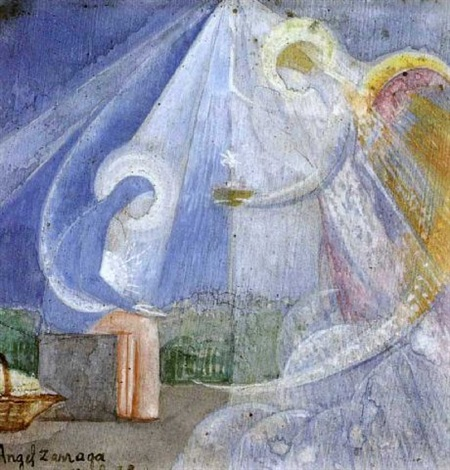
The Annunciation, by Liviu Dumitrescu

Six months after Elizabeth had become pregnant, God sent the angel Gabriel to Nazareth, a city in Galilee. The angel went to a virgin promised in marriage to a descendant of David named Joseph. The virgin’s name was Mary.

When the angel entered her home, he greeted her and said, “You are favored by the Lord! The Lord is with you.”

She was startled by what the angel said and tried to figure out what this greeting meant.

The angel told her,

“Don’t be afraid, Mary. You have found favor  with God.

You will become pregnant, give birth to a son,
and name him Jesus.

He will be a great man
and will be called the Son of the Most High.
The Lord God will give him
the throne of his ancestor David.
Your son will be king of Jacob’s people forever,
and his kingdom will never end.”

Mary asked the angel, “How can this be? I’m a virgin.”

The angel answered her, “The Holy Spirit will come to you, and the power of the Most High will overshadow you. Therefore, the holy child developing inside you will be called the Son of God.

“Elizabeth, your relative, is six months pregnant with a son in her old age. People said she couldn’t have a child. But nothing is impossible for God.”

Mary answered, “I am the Lord’s servant. Let everything you’ve said happen to me.”

Then the angel left her. (God’s Word Translation)

The Annunciation, by Angel Zárraga

Most of life is lived in the mundane. For the most part, we go about our business and deal with the daily grind.  That’s because we are common ordinary people.

So, we can especially relate to Mary. She is rather plain. Mary is of junior high age. If she were living in our day and age, Mary would likely be wearing clothes from the local Goodwill. She cannot read, because girls of her day rarely did.

Mary’s parents make all the decisions that affect her life, including the one that she should be married to an older man named Joseph. We don’t know if she even liked him. She lives in a small town that most people can’t even point to on a map. 

One night, this young girl is visited by the brightly beaming divine messenger Gabriel, whose name means, “God has shown himself mighty.” Mary stands there in her flannel nightgown; her life very quickly moving from the ordinary to extraordinary. The juxtaposition could not be more pronounced:

  • a mighty angel and a plain teen-ager
  • a messenger of the Most High God and a girl barely past puberty
  • holy angelic light in a simple candlelit bedroom
  • awesome power and complete vulnerability

Mary, compared to Gabriel, is defenseless, fragile, and overwhelmed. She’s in over her head. And that’s why we can relate to her. We can get our human arms around Mary. She’s like us. She has faced life with little power to make it turn out the way she planned. Forces beyond her control have rearranged her life and altered it forever. Mary is the Matron Saint of the Ordinary. We can totally understand why she responds the way she does.

Young Mary’s initial reaction was to be greatly troubled. She was disturbed, and was shaking in her ratty old slippers. The angel confidently told Mary that she had found favor with God. In other words Mary was quite literally “graced” by God. 

The situation was not that Mary had some extreme spirituality; but rather that God simply chose her to be the mother of Jesus. 

And Mary needed to come to grips with what was happening to her. This was not what she was looking for.  Becoming pregnant with the Savior of the world was not an answer to prayer for Mary. This was not on her agenda. 

Mary immediately sensed the crazy disconnect between what was being told to her and who she was. After all, she was a plain ordinary girl from the hick town of Nazareth, and she was being told that she would raise a king.  Maybe somebody in heaven screwed up. It could very well be that Gabriel got the wrong girl. Perhaps the angel’s Google map popped up the wrong town to visit. 

Relating to Mary, we can totally understand that she would question how in the world all this was going to happen. Not only is Mary ordinary, and far from royalty, but she is also very much a virgin. None of this made any sense whatsoever.

But the angel lets Mary know that God specializes in the impossible. I understand why many English translators chose to phrase the original rendering as “for nothing is impossible with God.” But I rather like a more literal translation which is “for there is nothing outside of God’s power.” 

There is nowhere we can go, no place on earth, no situation whatsoever that is beyond God’s ability, reach, and power to effect the divine will.

We do not always get straightforward answers to our questions about God. Yet, Mary asked a question and got a straight answer. She really can be pregnant with Jesus because the Holy Spirit will come upon her and overshadow her with power. 

If the story were to end here it would be a great story.  But to me the most astonishing part of this narrative is Mary’s response to what was happening to her.

Mary believed the message and took Gabriel’s words at face value. And so, having believed, she then submitted herself completely to God’s will for her life. 

I think we might totally understand if Mary simply said in her ordinary way that she was not prepared for this.  We would completely “get it” if Mary pushed back on what the angel said to her.

We could relate if Mary just dismissed it all, like Scrooge in the Christmas Carol, with the angel and his message being all humbug as if it were just “an undigested bit of beef, a blot of mustard, a crumb of cheese, a fragment of an underdone potato.  There’s more of gravy than of grave about you, whatever you are!”

And yet, Mary not only believed, but she also humbly submitted herself to what was happening. And, to me, this is what we need to relate to most about Mary – not her being just a plain ordinary person in a non-descript village, but stepping up to the calling she received. 

We, too, have received a calling in our lives. We, too, have been given the power of the Holy Spirit. And we, too, are ordinary people who have been given a very extraordinary task. 

It seems to me that our response today can and ought to be the same as Mary: “I am the Lord’s servant; may it be to me as you have said.” 

The Church is pregnant with possibilities because of the Holy Spirit. We know the end of Mary’s story. She gave birth to Jesus. She raised him in her plain ordinary way. She watched him grow up. She saw him embark on his ministry to proclaim that the kingdom of God has come near. 

Mary did not always understand what Jesus said or what he was doing. And she experienced every mother’s nightmare: seeing her beloved son killed in a terribly gruesome manner right in front of her eyes. 

Yet, just as the Holy Spirit was with the birth of Jesus, so the Spirit was with Jesus at his resurrection from the dead. Jesus, like his earthly mother, lived an ordinary life in a very extraordinary way. And today Jesus invites us to do the same. 

Because Jesus accomplished his mission of saving people from their sins and establishing a kingdom that will never end, he has given us the same Holy Spirit to follow him forever and call other people to follow him, too. 

The Christian life may often be difficult; but it is really not complicated. It’s rather simple, just like Mary. 

Mary responded to God’s revelation with faith, choosing to fully participate in what God was doing. “I am the Lord’s servant” is to be our confession, as well. “May it be to me as you have said” is to be our cry, along with Mary. 

The message Christians proclaim is that Jesus saves – he delivers from sin and Satan and will restore all things.

May you know the presence and the power of God today and always, through knowing Christ Jesus the Lord of all. Amen.

A Great Restoration (Psalm 126)

When the Lord restored the fortunes of Zion,
    we were like those who dream.
Then our mouth was filled with laughter
    and our tongue with shouts of joy;
then it was said among the nations,
    “The Lord has done great things for them.”
The Lord has done great things for us,
    and we rejoiced.

Restore our fortunes, O Lord,
    like the watercourses in the Negeb.
May those who sow in tears
    reap with shouts of joy.
Those who go out weeping,
    bearing the seed for sowing,
shall come home with shouts of joy,
    carrying their sheaves. (New Revised Standard Version)

I personally think that God is amazing. The Lord not only brings restoration and wholeness to people; God also reverses people’s fortunes so that what was lost is found again. Indeed, reversal has a prominent place in today’s psalm, inviting us to recognize that God does more than compensate persons in a loss, but also brings about a complete reversal of reality.

God is the expert at restoring people’s fortunes. For a nation who was overrun by the Babylonians, sent into exile, and then had the ability to return from that exile back to Jerusalem, it very much indeed, felt like a grand restoration. The effect it had on the people was profound. The psalmist describes it like this:

It’s like waking from a dream and realizing that it’s reality.

It’s like the best party – full of celebration, singing, and laughter – that anyone has ever experienced.

It’s like being a real live miracle.

Being invaded, attacked, violated, taken away from your home and traumatized – and then living in oppression and having forced suppression in living your life the way you believe you ought to, is an awfully sad and discouraging way to exist.

But then, fortunes are restored. The grieving and lamenting give way to laughter and joy. That feeling of a 500 pound weight on your shoulders is lifted; you now feel light as a feather. And it isn’t only a personal reversal of tangible resources; it’s also a psychological turn around.

The nations frequently mock and ridicule God’s people. They look at the suffering, as if God has abandoned them – or wonder even if there is a God, at all. The thinking of other nations, is that Israel’s God is nothing but a local god who is impotent outside of Judah. Besides, he probably doesn’t care about a bunch of losers anyway, they reason.

Don’t give the other nations a reason to say,
    “Where is their God? Can’t he help them?”
Let us see you punish those people.
    Punish them for killing your servants. (Psalm 79:10, ERV)

But the God of the Bible is no limited territorial being; the Lord is sovereign over all the earth. And this God is able to effect a radical reversal of body, mind, and spirit – even to those other nations. The disrespectful mouths that once mocked are reversed to giving praise to Israel’s God and acknowledging that the Lord has done great things for the people.

This God has both the will and the ability to intervene and effect real change that completely reverses a person’s and even a nation’s life. Once someone has experienced what God can do, they forever know that God can do it again.

One of the things which personally motivates me is that the Lord has changed my life and my fortunes on many occasions – and even used me to help effect a reversal in other people’s lives, as well. So, no matter how bad things get (and sometimes they get awfully darned bad!) I have confidence and trust that a good, merciful, and loving God sees it all, knows it all, and has the power to do something about it. I may have to wait for a while – maybe even an agonizingly long time – yet I am convinced that the same God who restored the fortunes of Israel can reverse my situation, too.

And the change is so wonderfully dramatic, that it’s like a wadi in the desert, a life-giving river that emerges in the bone dry desert, bringing new growth and sustaining animal life, after the rains finally come and reverse the landscape and the environment completely.

We are, however, reminded that a great reversal and a complete restoration does not happen immediately. When the farmer plants in the Spring, it will be months before there is a harvest of crops. It takes time for the seed to germinate, break the soil, and grow into a mature plant, ready for the harvester.

Get-rich schemes rarely work in life, and never really happen in the spiritual life. Renewal, restoration, and a reversal of fortunes is not an instantaneous event, but rather a process that develops and eventually happens. A lot of blood, sweat, and tears go into any meaningful and sustainable process of change. Yet, where there is weeping, the end will be shouts of celebration and joy.

Believers can live expectantly, and fully convinced, that their suffering will eventually give way to glory. Grief and tears will not have the last word; God’s restorative and reversing grace will.

Many of you long for restoration – either for yourselves or for others you love and care about – because you recognize there needs to be a great reversal of fortunes. Advent is the season for waiting, the time for anticipation, knowing that deliverance will come in the form of a baby. And our waiting shall not be in vain.

O Lord our God, accept the fervent prayers of your people; in the multitude of your mercies look with compassion upon us and all who turn to you for help; for you are gracious, O lover of souls, and to you we give glory, Father, Son, and Holy Spirit, now and forever. Amen.

The Righteous and the Wicked (Isaiah 26:7-15)

The path of the righteous is level;
    you, the Upright One, make the way of the righteous smooth.
Yes, Lord, walking in the way of your laws,
    we wait for you;
your name and renown
    are the desire of our hearts.
My soul yearns for you in the night;
    in the morning my spirit longs for you.
When your judgments come upon the earth,
    the people of the world learn righteousness.
But when grace is shown to the wicked,
    they do not learn righteousness;
even in a land of uprightness they go on doing evil
    and do not regard the majesty of the Lord.
Lord, your hand is lifted high,
    but they do not see it.
Let them see your zeal for your people and be put to shame;
    let the fire reserved for your enemies consume them.

Lord, you establish peace for us;
    all that we have accomplished you have done for us.
Lord our God, other lords besides you have ruled over us,
    but your name alone do we honor.
They are now dead, they live no more;
    their spirits do not rise.
You punished them and brought them to ruin;
    you wiped out all memory of them.
You have enlarged the nation, Lord;
    you have enlarged the nation.
You have gained glory for yourself;
    you have extended all the borders of the land. (New International Version)

Within the Bible, there are really only two sorts of people: the righteous and the wicked. Repeatedly throughout Scripture, we are told that God attends to the needs, hopes, and prayers of the righteous; and conversely, God is opposed to the unjust practices and oppressive acts of the wicked.

The righteous are people who are attentive to God’s law and trust God with all their heart, soul, mind, and strength. For the righteous, God will make a way where there seems to be no way. If there’s a mountain obstructing the way of the righteous, they believe the Lord will flatten it. And if it isn’t flattened immediately, the righteous patiently wait, seeking to be obedient and full of faith, until it happens.

The world learns about life and faith and the divine through these postures of living by righteous persons. The exception to this is the wicked; they learn nothing. The wicked could see a mountain leveled before their very eyes, and refuse to see or acknowledge the power of God behind it.

All this is to say that the truly righteous persons among us stand out like a sore thumb to the prevailing wickedness of the world. Thus, the wicked would like to see them leveled, instead of a mountain. So, the wicked persons among us are committed to lies, half-truths, injustice, and even violence. They’ll use any practice that would knock down the righteous and advance the wicked person’s agenda.

Yet, in making this distinction between the two groups of people, we need to be very careful. Because whenever we group people, there is always the danger of assuming that the righteous are always righteous and the wicked always wicked – as if the righteous could never do any wrong, nor the wicked ever do anything right and just.

However, the reality is that we don’t live in a completely black and white world; there is a lot of gray. The world is far more complex than our simplistic categories of good and bad. This is why it can be so maddening to try and navigate this world each and every day.

So, when we speak of the righteous and the wicked, let’s have some clarity and understanding of the basic patterns of a person’s or a group’s life.

Biblically, the righteous are righteous – not because they are intensely moral and always actively obedient – but because the basic orientation of their lives is committed to communing and relating to the God of the universe.

And the wicked are wicked – not because they are belligerent and bullying – but because the general direction of their lives is continually bent inward to serve their own interests and ignore the Divine.

Therefore, the righteous have the foundational characteristics of yearning for God, and pursuing the Lord with all their energy. They desire a meaningful relationship with God that gives shape to their plans and purposes for living.

The righteous, as a general pattern of living, find their ultimate longings in life through belonging to God. They seek divine interventions for everything, and deeply desire the divine presence to envelop them and surround the world with love, mercy, and justice. Along with the psalmist, the righteous say:

I ask only one thing, Lord:
Let me live in your house
    every day of my life
to see how wonderful you are
    and to pray in your temple. (Psalm 27:4, CEV)

Like a deer drinking from a stream,
    I reach out to you, my God.
My soul thirsts for the living God.
    When can I go to meet with him? (Psalm 42:1-2, ERV)

As long as I have God, I don’t need anyone else in heaven or on earth. (Psalm 73:25, GW)

In contrast to these heartfelt longings, the wicked are dense and obtuse. They fail to see the beauty in any of this. Their end will be precisely what they have wanted throughout life: To be left alone and have space away from God altogether – which is the classic definition of hell.

But the righteous will also have their desires fulfilled, and shall experience peace and right relations forever with God.

How then shall we live?

Blessed is the person who does not
follow the advice of wicked people,
take the path of sinners,
or join the company of mockers.

Rather, he delights in the teachings of the Lord
and reflects on his teachings day and night.

He is like a tree planted beside streams—
a tree that produces fruit in season
and whose leaves do not wither.
He succeeds in everything he does.

Wicked people are not like that.
Instead, they are like husks that the wind blows away.

That is why wicked people will not be able to stand in the judgment
and sinners will not be able to stand where righteous people gather.

The Lord knows the way of righteous people,
but the way of wicked people will end. Amen. (Psalm 1, GW)