Monday of Holy Week (John 12:1-11)

Mary Anoints the Feet of Jesus, by Wayne Forte

Six days before the Passover Jesus came to Bethany, the home of Lazarus, whom he had raised from the dead. There they gave a dinner for him. Martha served, and Lazarus was one of those reclining with him. Mary took a pound of costly perfume made of pure nard, anointed Jesus’s feet, and wiped them with her hair. The house was filled with the fragrance of the perfume. 

But Judas Iscariot, one of his disciples (the one who was about to betray him), said, “Why was this perfume not sold for three hundred denarii and the money given to the poor?” (He said this not because he cared about the poor but because he was a thief; he kept the common purse and used to steal what was put into it.) 

Jesus said, “Leave her alone. She bought it so that she might keep it for the day of my burial. You always have the poor with you, but you do not always have me.”

When the great crowd of the Jews learned that he was there, they came not only because of Jesus but also to see Lazarus, whom he had raised from the dead. So the chief priests planned to put Lazarus to death as well, since it was on account of him that many of the Jews were deserting and were believing in Jesus. (New Revised Standard Version)

Sharing a meal around a table is much more than just eating some food together. There is the chance to look one another in the eye. An opportunity is afforded to truly see one another and find acceptance. The conditions are ripe for receiving the blessing of blessings.

Please notice with me that on this last week of Christ’s earthly life and ministry, the people who are around the table with Jesus. He shares his cup with his disciples, including both women and men. Mary and Martha are there, along with Peter, James, and John, and, of course, Judas Iscariot, as well.

Jesus, those various people, and others, had the great privilege of looking into the eyes of Jesus, and having Jesus look directly into theirs. It appears, however, that not everyone took advantage of this situation. But Mary did. She evidences having looked into the face of Jesus, and having Jesus gaze into her eyes with divine love.

To look, to see, to gaze, is to connect. To look away and not see, is to disconnect. It is the difference between acceptance and rejection. Jesus looked as long as he could at the friend he loved.

Let us never forget that the presence of God needs to be experienced – not just in the mind, nor even only in the heart – but as a feeling in every cell of the body.

Christ’s divine gaze communicated more than words ever could. Mary knew she belonged with God, and became convinced she was accepted and loved. So, she did what a person who has been touched with the eyes does: Mary responded with the most heartfelt devotion she could, with what she had at the time.

Mary Anointing the Feet of Jesus, by David Finley

Mary anointed the feet of Jesus with expensive perfume by using her own hair to apply it. She shared in the presence and in the love of Christ.

This really ought to make complete sense to the one reading this story whose life has been seen and touched by Jesus. For through such divine love, we become a witness in testifying to the light, much like John the Baptist. The one devoted to Jesus understands that they are not even worthy to untie the thong of Christ’s sandal.

Women never touch a rabbi. Yet, long ago in the town of Bethany in Judea, a woman was worthy to do even more than untie a sandal – Mary was permitted to anoint Christ’s feet. The house became filled not only with the fragrance of the perfume, but also with the aroma of Mary’s witness to us of Jesus and his incredible work in her life as a disciple.

In considering such a story on this Monday of Holy Week, it’s easy to focus on what Mary did, how much it truly cost her, and even on the pathetic and judgmental reaction of Judas to it all. Yet, here we see, if we are looking, what Jesus does for Mary.

The love of Jesus turned Mary into a witness. Jesus lifted her up, even above all the men. And that is what Christ continually did for the lowly, the outcast, the ostracized, the poor. For to them belongs the dominion of God.

Through a simple heartfelt response to Christ’s love, we are filled with the aroma of God, experience a cup of blessing, and see the light of Jesus for us. What’s more, the world’s judgmental spirit is undone. Judas is silenced, along with all of our petty selfish agendas.

Mary directs us to Jesus, and to all those who were previously unseen, unloved, and rejected. Mercy simultaneously puts away the judgmental spirit so it is not seen, while bringing the poor in spirit into the light of God’s grace and love.

Merciful and loving God, Your name is glorified even in the anguish of your Son’s death. Grant us the courage to receive your anointed servant who embodies a wisdom and love that is foolishness to the world. Empower us in witness so that all the world may recognize in the scandal of the cross the mystery of reconciliation. Amen.


Share Your Story (Psalm 107:1-16)

Psalm 107, by Erin Beardemphl

O give thanks to the Lord, for he is good,
    for his steadfast love endures forever.
Let the redeemed of the Lord say so,
    those he redeemed from trouble
and gathered in from the lands,
    from the east and from the west,
    from the north and from the south.

Some wandered in desert wastes,
    finding no way to an inhabited town;
hungry and thirsty,
    their soul fainted within them.
Then they cried to the Lord in their trouble,
    and he delivered them from their distress;
he led them by a straight way,
    until they reached an inhabited town.
Let them thank the Lord for his steadfast love,
    for his wonderful works to humankind.
For he satisfies the thirsty,
    and the hungry he fills with good things.

Some sat in darkness and in gloom,
    prisoners in misery and in irons,
for they had rebelled against the words of God
    and spurned the counsel of the Most High.
Their hearts were bowed down with hard labor;
    they fell down, with no one to help.
Then they cried to the Lord in their trouble,
    and he saved them from their distress;
he brought them out of darkness and gloom,
    and broke their bonds apart.
Let them thank the Lord for his steadfast love,
    for his wonderful works to humankind.
For he shatters the doors of bronze
    and cuts in two the bars of iron. (New Revised Standard Version)

Every person of faith has a story, a testimony of God’s redeeming, saving, and loving deliverance from trouble. And each one of those stories is sacred and special; no one story is better or greater than another. There’s no need, therefore, to act like you’re taking a course in comparative storytelling – as if you don’t have nearly the spiritual testimony of someone else.

The fact of the matter is that there is no trouble like your own personal trouble. Although others can relate to elements of each of our stories, no one else knows what your own experience is like. The old black spiritual is right in saying. “Nobody knows the trouble I’ve seen. Nobody knows but Jesus.”

It’s important to have others empathize with us and help normalize the experience we are going through. It’s necessary to have another validate our emotions and affirm the feelings we’re feeling. And, even after that, there’s nothing quite like a compassionate and caring Being who intimately knows everything about your trouble, how you experience it, and steps-in according to perfect divine timing, to bring uplift, hope, and salvation.

There is such a Being. God. Yahweh. The Lord. Pure Goodness. Redeemer. Savior. And most of all, Lover who is infinite Love with a capital “L.”

Why am I so confident about such a Being as this? Did I take too much methadone? Am I only an old fart who still believes in God? Or perhaps, you think, I’m a weird sort of giddy about God because of the Bible. Well, yes, and no. Scripture – especially the Psalms – just happens to put into words my actual experience and emotions.

But I don’t much care about parsing out whether I’m a deluded metaphysician or a sappy magpie or whatever other label gets affixed to me. It just doesn’t matter – because every epistemic fiber of my lower case being resonates with the upper case Being who bestows steadfast love because that Being’s character is actually made up of Love. It’s as if God is the biggest ultimate Teddy Bear, stuffed with holy love for all creation.

And, what’s more, this God seems to specialize and enjoy paying attention to the least, the lost, and the lowly among us humans. I was once in such a deep, dark, dank, black hole of spiritual nothingness that I knew I could never get out of, that is, on my own. I needed deliverance, or there wouldn’t be any hope whatsoever.

Others have experienced something akin to wandering alone out in a desert spiritual wasteland with no water, no food, no nothing but oppressive heat and loneliness. And others have had the trouble of real flesh and blood people seeking to do them harm, both physically and mentally. Yet others felt like they were bereft of options on a plantation of slavery in which all they could do was work like animals just to survive another day.

What all these persons have in common is that they cried out to the Lord, the maker of heaven and earth. And most of them didn’t just do it once; some cried out until they had no voice and were too weak to even speak anymore.

God showed up. God also showed off. Not only was there deliverance, but there was also an upgrade. For me, it was not like Tim 2.0, but Tim 1,000.0 – a filling of divine grace that goes beyond mere words. Because of God’s grace and love in my own life, it has enabled me to tap into that storehouse of mercy and pray with spiritual confidence.

When my dear wife had a spine surgery several years ago and awoke from it unable to move her legs, I prayed. I asked for mercy. I pleaded for grace. And I did it for hours at the foot of her hospital bed. I remember that I stubbornly would not accept the fact that she could not move her lower body.  And I decided to stand there and pray until I got an answer from God.

Eventually, I prayed myself asleep. My wife woke me up sometime in the early morning the next day. She told me to pull back the covers and look at her right big toe…. She could give it an ever-small twitch. We called the nurse, who was so excited that she called everyone she could get a hold of.

With a dozen hospital staff huddled around the hospital bed, my wife proceeded to give that big toe a hearty move. The staff erupted with clapping, and I am not kidding when I say that we had a party with noise and shouts in a hospital room at 4am. Nobody cared we were going nuts. I certainly did not.

My friend, God is still in the business of answering prayer, of showing up and showing off.

Through the hard times, the good times, and the confusing times, the Lord is our constant ballast for all seasons of life, whether good or bad. And I love God for that abiding presence. I can also give testimony that through all of the adverse situations my wife and I have faced, we have learned to stop, be still, and find that all we ever wanted we already have, even when everything changes.

Psalm 107 lets us know that personal testimony expressed to the community is an important aspect of strengthening everyone’s faith. Our stories are important, and they are meant to be shared. The spiritual and emotional health of us all is at stake.

Accept, O Lord, our thanks and praise for all that you have done for us. We thank you for the splendor of the whole creation, for the beauty of this world, for the wonder of life, and for the mystery of love.

We thank you for the blessing of family and friends, and for the loving care which surrounds us on very side.

We thank you for setting us at tasks which demand our best efforts, and for leading us to accomplishments which satisfy and delight us.

We thank you also for the disappointments and failures that lead us to acknowledge our dependence on you alone.

Above all, we thank you for your Son Jesus Christ; for the truth of his Word and the example of his life; for his steadfast obedience, by which he overcame temptation; for his dying, through which he overcame death; and for his rising to life again, in which we are raised to the life of your kingdom.

Grant us the gift of your Spirit; that we may know you and make you known; and through your Spirit, at all times and in all places, may give thanks to you in all things. Amen.

Selective Memory (Psalm 25:1-10)

To you, O Lord, I lift up my soul.
O my God, in you I trust;
    do not let me be put to shame;
    do not let my enemies exult over me.
Do not let those who wait for you be put to shame;
    let them be ashamed who are wantonly treacherous.

Make me to know your ways, O Lord;
    teach me your paths.
Lead me in your truth and teach me,
    for you are the God of my salvation;
    for you I wait all day long.

Be mindful of your mercy, O Lord, and of your steadfast love,
    for they have been from of old.
Do not remember the sins of my youth or my transgressions;
    according to your steadfast love remember me,
    for the sake of your goodness, O Lord!

Good and upright is the Lord;
    therefore he instructs sinners in the way.
He leads the humble in what is right
    and teaches the humble his way.
All the paths of the Lord are steadfast love and faithfulness,
    for those who keep his covenant and his decrees. (New Revised Standard Version)

I admit there are things from my past I am neither proud of nor happy about. Yet, I give praise and thanksgiving to the Lord God Almighty because of divine selective memory. 

“I will forgive their iniquity and remember their sin no more.”

God (Jeremiah 31:34, NRSV)

God remembers according to the divine nature and God’s character of merciful grace and steadfast love. I’m glad the Lord doesn’t act based upon the stupid sins of my younger yesteryear. God freely chooses to forgive and has made the means available for us to experience daily cleansing and victory through the Lord Jesus Christ.

Memory is a major theme in the Old Testament. The importance of remembering pops up again and again throughout Holy Scripture. The way in which our minds and hearts remember past events is of great spiritual significance. 

Remember that you were a slave in the land of Egypt, and the Lord your God brought you out from there with a mighty hand and an outstretched arm; therefore the Lord your God commanded you to keep the Sabbath day. (Deuteronomy 5:15, NRSV)

“And remember, I am with you always, to the end of the age.”

Jesus (Matthew 28:20b, NRSV)

Remember Jesus Christ, raised from the dead, a descendant of David—that is my gospel, for which I suffer hardship, even to the point of being chained like a criminal. But the word of God is not chained. (2 Timothy 2:8-9, NRSV)

We are not to keep dwelling upon and remembering the former indiscretions of ourselves or others. To continue ruminating on a foolish decision or a poor choice only erodes our ability for resilience and perseverance.

The fact of the matter is that God does not hold those past regrets over our heads, and so, neither are we to do it. Forgiveness isn’t only for others; it’s meant to be directed to ourselves, as well. The ability to forgive enables us to leave the past in the past, without belching it up every day and chewing on it, like a cow with her cud.

Sometimes we are prone to remember the things we ought to forget, and forget those things we really should remember. Before us and in our minds continually is to remember the great works of God, especially in redemption. 

Forgetting what lies behind and straining forward to what lies ahead, I press on toward the goal, toward the prize of the heavenly call of God in Christ Jesus. (Philippians 3:13b-14, NRSV)

What we have done or failed to do, and what has happened to us in the past, is not the real problem; the most prescient issue right now is how you and I interpret those past events.

Today we can choose to remember the way God remembers. The health of all our relationships is dependent on this ability. Everyone on planet earth encounters difficult people, challenging relationships, obnoxious neighbors, and hurtful family members. Paying attention to our memory and how we choose to remember can be a significant part of interacting with others. 

I do not cease to give thanks for you as I remember you in my prayers, that the God of our Lord Jesus Christ, the Father of glory, may give you a spirit of wisdom and revelation as you come to know him. (Ephesians 1:16-17, NRSV)

If we like it that God has shown grace to us, then the least we can do is let that same grace flow from us to others – and to ourselves – we who neither deserve it, nor expect it. 

Let’s give thanks to the Lord, for God is good in forgiving sin and showing infinite mercy. And let’s express our gratitude through selfless words and acts of grace which reflect the nature of God.

Gracious God, you do not hold grudges; you always act according to your own loving character. Even though you could have condemned me, you saved me. Despite the fact that I have fallen short of your glory, you delivered me. I today remember your mighty redemptive deeds accomplished in your Son, my Lord, Jesus Christ, who with you and the Holy Spirit are one God, now and forever. To you, blessed Holy Trinity, I give my abiding praise and thanksgiving. Amen.

A Divine Appointment (2 Kings 8:1-6)

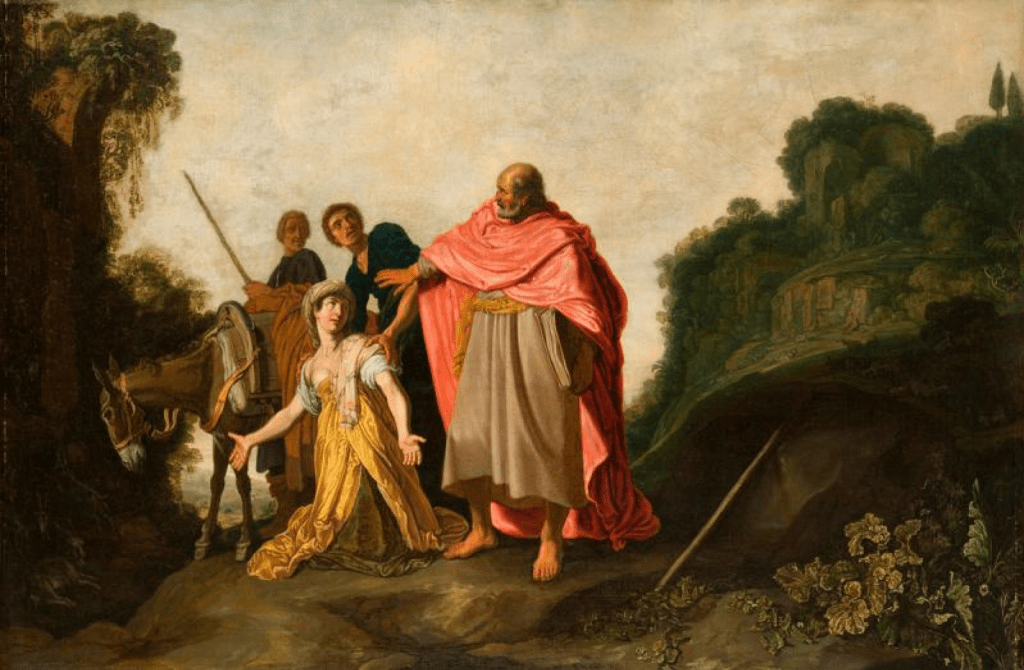
The prophet Elisha and the Shunammite woman, by Pieter Lastman, 1620

Elisha spoke to the woman whose son he had brought back to life: “You and your household must go away and live wherever you can, because the Lord has called for a famine. It is coming to the land and will last seven years.”

So the woman went and did what the man of God asked. She and her household moved away, living in Philistia seven years. When seven years had passed, the woman returned from Philistia. She went to appeal to the king for her house and her farmland. The king was speaking to Gehazi, the man of God’s servant, asking him, “Tell me about all the great things Elisha has done.” So Gehazi was telling the king how Elisha had brought the dead to life. At that very moment, the woman whose son he had brought back to life began to appeal to the king for her house and her farmland.

Gehazi said, “Your Majesty, this is the woman herself! And this is her son, the one Elisha brought to life!”

The king questioned the woman, and she told him her story. Then the king appointed an official to help her, saying, “Return everything that belongs to her, as well as everything that the farmland has produced, starting from the day she left the country until right now.” (Common English Bible)

People of faith typically don’t see divine appointments coming at all; they often show up in the middle of hard mundane days.

The prophecies and actions of the prophet Elisha are covered in the book of 2 Kings with a series of ten incredible narratives (chapters 2-9). Each of them are designed to demonstrate the power of God over (and sometimes against) the power of the king.

This was important because the royal decisions and actions of most of the Israelite kings were quite disconnected from God’s law and justice. Most kings did whatever they wanted, sometimes to the point of completely leading the people away from the worship of Yahweh and toward the worship of other gods.

Today’s Old Testament lesson concerns the ninth story in this series of narratives. A widow, whose son Elisha had restored to life in the second narrative (2 Kings 4:8-37) left for the land of the Philistines when there was a severe famine. Although the woman was simply listening to the prophet and doing what he said, squatters took advantage of the situation and took over her house and property while she was away.

In a clear demonstration of what a “divine appointment” looks like in Holy Scripture, Elisha’s servant and the king were talking together about this very woman and the miracle that took place with her son. The prophet had essentially raised her dead child to life. Then, lo and behold, the woman walked into the conversation to appeal the injustice that had happened to her and her family.

Even the worst of kings would discern the right thing to do in such a situation. After questioning the woman, the king ensured that she would get everything restored to her. Through it all, we are meant to see the power and sovereignty of God over the human authority of political kings.

I hope that you, at some point in your life, have experienced a meeting with another person that you can see was unmistakably arranged by God. And a great need you had was met because of this encounter. The Lord blessed you through it in a way that you didn’t see coming at all.

The fact of the matter is that God is sovereign, all-knowing, and all-powerful, along with being infinitely gracious, good, just, right, and loving. Therefore, God sets about to bless both us and other people. And when God determines to do something, nothing and no one in heaven or on earth can stop it.

Wherever you presently are, and whatever it is you are doing now in your life, is really no accident. And if your life situation is awful and far from any sort of idyllic scene of blessing, then please know that this is a circumstance that is ripe for a divine appointment.

For how could we ever know God as the Great Deliverer unless we were between a rock and a hard place with nowhere to turn? How could we ever experience God as the Divine Healer unless we were broken and/or brokenhearted?

How could we ever realize God as Provider unless we were out of resources and down to our last penny? Or God as Helper unless we were desperate and unable to move? Or God as the One who restores unless we had lost everything?

Just as there cannot be resurrection and new life without a crucifixion and an old life, so our lives will inevitably take a trajectory of suffering and hardship before glory and blessing. In order to allow the good to completely fill us, we must be totally emptied of everything else.

Maybe you will never experience something quite as dramatic as the woman did with gaining her son back to life, and her property restored after a terrible famine, but know this: The great Lord and God of all, the Sovereign of the universe, has your back through all that you’re going through on this earth.

I often get asked by patients and parishioners alike, “Where is God?” It feels to them that God is absent, silent, and far from understanding what they’re going through in the midst of their very challenging adversity.

Really, however, it’s actually an easy question for me to answer: Jesus is our Immanuel, God with us. The Spirit of God is right beside you, walking with you, even holding you up at times, through all the crud and crap of this old fallen sinful world of ours. Seeing only one set of footsteps in the sand, it turns out God is the One that carries the weak and weary in their trouble. The Lord is anything but absent.

If God has authority over earthly rulers, then the Lord most certainly has power to handle your life.

O God, why have you abandoned me? Though you have hidden your face from me, still from this dread and empty place, I cry to you, who have promised me that underneath are your everlasting arms. God, you are my help and comfort; you shelter and surround me in love so tender that I may know your presence with me, now and always. Amen.