Welcome, friends! The world cannot stand up under judgment, criticism, and unkindness. Instead, the earth spins on the axis of mercy. Everyone needs basic human kindness, compassion, and grace. Click the videos below, and let’s explore the blessing of mercy….
Matthew 5:7, Pastor Tim Ehrhardt
We do not presume to come to you, O merciful Lord, trusting in our own righteousness, but in your abundant and great mercies. We are not worthy so much as to gather up the crumbs under your table; but you are the same Lord whose character is always to have mercy. Grant us, therefore, gracious Lord, so to receive your dear Son Jesus Christ, that our sinful bodies may be made clean by his body, and our souls washed through his most precious blood, and that we may evermore dwell in him, and he in us. Amen.
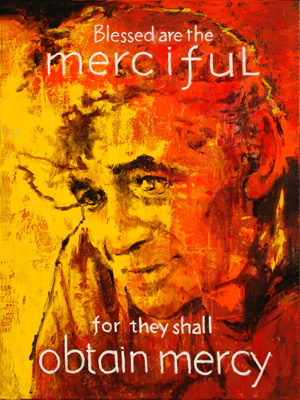
“Blessed are the merciful, for they will be shown mercy.” (NIV)
“Mercy” is one of the most rich and important words in all of the Holy Bible. Randomly turn to any page of Scripture and you will most likely find the word “mercy.” Mercy is highly significant because God is merciful.
King David was known as a man after God’s own heart (1 Samuel 13:14). This is first and foremost about mercy. In the ancient world, when a new king came to power who was from a different lineage than the previous ruler, it was a common practice to kill all the male heirs from the former king because they posed a grave threat to the throne. David, however, did not do that; he did just the opposite. David ascended the throne and said:
“Is there anyone still left of the house of Saul to whom I can show kindness?” (2 Samuel 9:1, NIV)
Indeed, there was. His name was Mephibosheth. He happened to be lame in both feet. That meant, literally, he was not able to run away when David became king. I am sure Mephibosheth believed he was being summoned by King David to his death. But when he arrived, David said to him:
“Don’t be afraid, for I will surely show you kindness…. I will restore to you all the land that belonged to your grandfather Saul, and you will always eat at my table.” (2 Samuel 9:7, NIV)
That, my friend, is the very definition of mercy. And that is precisely the character quality Jesus was talking about in his Beatitudes.
Just as David used his power to extend mercy and kindness to potential rivals instead of exterminating them to consolidate his power, so the true follower of Jesus will identify with the powerless and give them a seat at the table.
If we are wondering, at all, whether this is really what Jesus is talking about with mercy, his words in the Gospel of Luke make it crystal clear:
“If you love those who love you, what credit is that to you? Even sinners love those who love them. And if you do good to those who are good to you, what credit is that to you? Even sinners do that. And if you lend to those from whom you expect repayment, what credit is that to you? Even sinners lend to sinners, expecting to be repaid in full. But love your enemies, do good to them, and lend to them without expecting to get anything back. Then your reward will be great, and you will be children of the Most High, because he is kind to the ungrateful and wicked. Be merciful, just as your Father is merciful.” (Luke 6:32-36, NIV)
Merciful folks are gracious, kind, and accept others, especially an unworthy person, because they know that they themselves are unworthy of God’s great mercy and grace. The merciful person’s mantra is: “God has shown me mercy; therefore, I will show mercy to others.”
Those who are merciful will be shown mercy. If anyone treats another harshly and without mercy, they should not expect to receive blessing from God. This raises an important question which needs to be asked: Are we kind and merciful, or do we have a bent toward wanting to see others judged and punished? I share a hypothetical story….
My dear middle daughter was a remarkably busy girl. Whenever we were in public, it was my standing rule that she always holds my hand. The reason for this was that she always ran instead of walked. Holding her hand was the only way I could keep her safe and not literally run into harm’s way.
Here comes the hypothetical part: One day we are walking down the street holding hands. She gets away from my grip and runs… right into oncoming traffic… and is struck by a car. I run up to her, bend over her bleeding and broken body and say, “Well, that’s what you get for disobeying me. After all, you reap what you sow!”
Oh, my, no!… My daughter is now a Mom. And, lo and behold, she has a son just like her. I need to hold his hand, too! If an accident were ever to happen in reality, I can guarantee my response would be to run to him, bend over his bleeding and broken body, cry uncontrollably, and determine to do everything in my grandfatherly power to save his life and see him healed from his injuries.
So, then, my sisters and brothers, why in the world would we ever tell a broken hearted person – perhaps in the throes of depression or riddled with anxiety from hardship – emotionally and spiritually bleeding on the inside: “Get over it!” “Just stop worrying!” or “You need to be strong!”
God, forbid! No! Mercy! I insist, mercy! The world does not revolve on the axis of judgment, criticism, or giving someone what they deserve. God’s great big world spins because of mercy, grace, and basic human kindness that comes from the hand of a good benevolent Lord who cares about all humanity. Perhaps I must be even more specific…
The one filled with God’s righteousness will go out of their way to show kindness, love, and compassion to the LGBTQ+ community, becoming familiar with their needs, struggles, and heartaches as they listen without judgment and full of mercy.
The person touched by the mercy of God will intentionally seek to give people of color a seat at the table and the freedom to speak freely while listening with ears of mercy.
The human being who follows Jesus will see the image of God in our Native American sisters and brothers and will mercifully do everything within their power to advocate for them when it comes to things like inequities of poverty, disease, addiction, and death.
The person filled with the righteousness of God will respect all other religious people, regardless of their spirituality. They will be merciful to Buddhists, Muslims, Hindus, and even Wiccans, not because they see them as potential converts, but just because they need mercy, like the rest of us.
Consider what others have to say about mercy….
“God tolerates even our stammering and pardons our ignorance whenever something inadvertently escapes us – as, indeed, without this mercy there would be no freedom to pray.”
John Calvin
“Darkness cannot drive out darkness; only light can do that. Hate cannot drive out hate; only love can do that.”
Martin Luther King, Jr.
“It is mercy, not justice or courage or even heroism, that alone can defeat evil.”
Peter Kreeft
Consider what Holy Scripture has to say about mercy…
Some Pharisees asked Jesus’ disciples, “Why does your teacher eat with tax collectors and other sinners?” Jesus heard them and answered, “Healthy people don’t need a doctor, but sick people do. Go and learn what the Scriptures mean when they say, ‘Instead of offering sacrifices to me, I want you to be merciful to others.’ I didn’t come to invite good people to be my followers. I came to invite sinners.” (Matthew 9:11-13, CEV)
The Lord’s kindness never fails! If he had not been merciful, we would have been destroyed. The Lord can always be trusted to show mercy each morning. Deep in my heart I say, “The Lord is all I need; I can depend on him!” (Lamentations 3:22-24, CEV)
May we not succumb to thoughts of violence and revenge today, but rather to thoughts of mercy and compassion. We are to love our enemies and be merciful to all so that we might reverse the curse on humanity and restore them, by God’s grace, to their right mind, heart, and spirit.
Coptic Church icon of Christ healing the blind man
As Jesus was coming near Jericho, there was a blind man sitting by the road, begging. When he heard the crowd passing by, he asked, “What is this?”
“Jesus of Nazareth is passing by,” they told him.
He cried out, “Jesus! Son of David! Have mercy on me!”
The people in front scolded him and told him to be quiet. But he shouted even more loudly, “Son of David! Have mercy on me!”
So, Jesus stopped and ordered the blind man to be brought to him. When he came near, Jesus asked him, “What do you want me to do for you?”
“Sir,” he answered, “I want to see again.”
Jesus said to him, “Then see! Your faith has made you well.”
At once he was able to see, and he followed Jesus, giving thanks to God. When the crowd saw it, they all praised God. (Good News Translation)
This is one of my very favorite stories in the entirety of Holy Scripture. And I will tell you why….
Because Jesus listens with ears of mercy.
Jesus was headed to Jerusalem and had a lot on his mind and his heart. He knew what was coming, that his passion and death awaited him. No one would fault Jesus for not hearing a blind man shouting. But Jesus was listening so that he might hear someone just like the needy blind man. Rather than being distracted and lost in his head, Jesus was just the opposite – being attentive and aware of the humble folk right in front of him.
Because Jesus speaks with words of mercy.
Once Jesus listened, he responded by asking a question. I am impressed with Jesus throughout the Gospels. Christ gave people the gift of choice. He acknowledged people and respected them by not simply and indiscriminately healing, as if he were some fix-it guy. Jesus Christ bestowed on the lowliest of people the human dignity of choice by empowering them to answer a question.
Because Jesus pays attention with divine appointments of mercy.
Our Lord took the time to heal the blind man. Jesus could have simply healed him without even stopping his journey. He could have just waved his hand and the man would be healed. What’s more, Jesus could have even started a healing factory where everyone with a need got healed: bring ‘em in, move ‘em out, and keep the line moving. Jesus was doing more than giving sight; he was giving a man the blessing of time and personal attention. The Gospel is never impersonal, which is why we ought to resist being non-relational in ministry to others. It isn’t simply about meeting a need but about blessing other people with the gift of relationship.
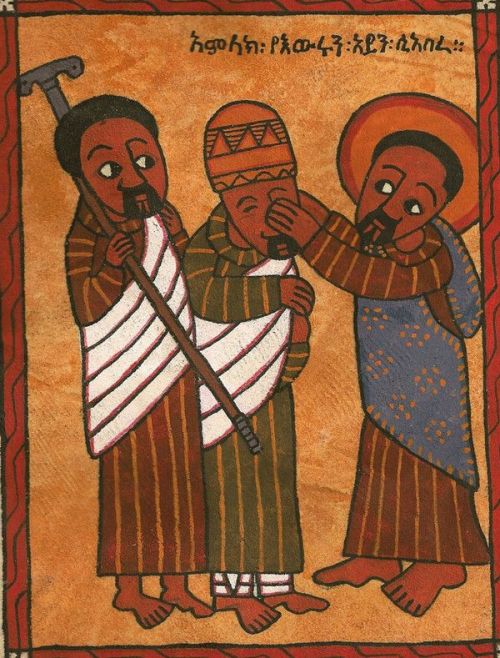
Ethiopian Orthodox Church depiction of Jesus healing the blind man
Because Jesus reaches out with the touch of mercy.
Jesus touched the man’s eyes (Matthew 20:29-34; Mark 10:46-54). He didn’t have to do that. The Lord of all most certainly could have healed without touching. In fact, it most likely may have been downright gross. A lot of people had eye diseases with runny pussy eyes in the ancient world.
Because the blind man didn’t listen to the crowd.
I really love that! Maybe it’s the rebel in me. I just believe it is such a beautiful thing whenever someone refuses to be shamed by another and embraces their need. That is exactly what the blind man did. He not only refused to give-in to peer pressure, but he also responded to them by shouting all the louder. May his tribe increase!
Because the blind man could actually see.
The man already had sight – not physical sight but spiritual eyes which could see better than anyone else in the crowd. One of the great ironies throughout the Gospels is that the sighted crowd seems to never see who Jesus really is, while blind folk see Christ clearly for who he is: the Son of David, the rightful king, the Savior of all. It matters not how much faith one possesses but in whom that faith is placed. A thimble-full of faith is enough to move mountains, while a water tower full of faith misplaced in someone else cannot even provide a single glass of refreshment.
Because the blind man followed Jesus.
Once healed by Jesus, there were plenty of persons who simply walked away and went about their lives. Yet, this man, who was given the gift of physical sight, started following Jesus and giving thanks to him. It feels a lot like my own testimony of experiencing the love of God in Christ and not ever wanting to leave it, so I’ve been following Jesus for over forty years, still having gratitude in my heart.
Because one lowly non-descript blind man made a difference.
I don’t think the man ever set out to change the world. Yet, he did. Here we are reading his testimony all these millennia later. At the time, please take note that one man becoming a disciple of Jesus and living a life of gratitude changed the entire crowd from being a group of shushing church ladies to a robust throng of worshipers. One individual makes a difference. Don’t let anyone tell you otherwise.
Lord Jesus Christ, Son of God, have mercy on me, a sinner.
Lord Jesus Christ, Son of David, heal me, a broken person.
Lord Jesus Christ, Son of Man, help me, a lost and lonely individual.
Lord have mercy, Christ have mercy, Lord have mercy on my love-starved soul. Amen.
“Are you Israelites more important to me than the Ethiopians?” asks the Lord. “I brought Israel out of Egypt, but I also brought the Philistines from Crete and led the Arameans out of Kir.
“I, the Sovereign Lord, am watching this sinful nation of Israel. I will destroy it from the face of the earth. But I will never completely destroy the family of Israel,” says the Lord. “For I will give the command and will shake Israel along with the other nations as grain is shaken in a sieve, yet not one true kernel will be lost. But all the sinners will die by the sword— all those who say, ‘Nothing bad will happen to us.’
“In that day I will restore the fallen house of David. I will repair its damaged walls. From the ruins I will rebuild it and restore its former glory. And Israel will possess what is left of Edom and all the nations I have called to be mine.” The Lord has spoken, and he will do these things.
“The time will come,” says the Lord, “when the grain and grapes will grow faster than they can be harvested. Then the terraced vineyards on the hills of Israel will drip with sweet wine! I will bring my exiled people of Israel back from distant lands, and they will rebuild their ruined cities and live in them again. They will plant vineyards and gardens; they will eat their crops and drink their wine. I will firmly plant them there in their own land. They will never again be uprooted from the land I have given them,” says the Lord your God. (New Living Translation)
Guilt
Doom and hope, judgment and grace, suffering and glory. These are the movements and rhythms of the Old Testament prophets. The great sin of Israel which warranted divine wrath was not only that they trampled on the poor and needy. On top of it all, they saw nothing wrong with their way of life.
This profound lack of awareness, rooted in the spiritual blindness of greed, is what led to judgment. It would take the form of having the Assyrian Empire come, seize the land, and take the people away to a place where they would have no chance to oppress others. Sadly, death would come to many.
“The work of restoration cannot begin until a problem is fully faced.”
Dan Allender
The sin of oppressing others and believing there’s nothing wrong with it comes with severe consequences. The people relied too much on their ethnicity. The ancient Israelites wrongly assumed that because they were the people of the covenant, this somehow inoculated them from disaster. Their belief in Jewish exceptionalism was their downfall.
Grace
Yet, all would not be an endless gloom. The Lord will not destroy completely. God’s anger lasts for a moment. However, God’s grace lasts forever. Restoration, renewal, and fruitful times will come because of God’s mercy.
Yes, God pronounces judgment when it is warranted. But God also makes and keeps promises to people. In our lesson for today, the Lord promises to restore the fortunes of the people through rebuilding ruined cities and letting them inhabit them once again.
God steps in and graciously acts on behalf of all people because that is what God does. We might get the notion in our heads that God executes judgment to teach people a lesson or to make a point. In my line of work, it is common to hear people express the idea they are under divine punishment because of personal illness or hard circumstances.
God, however, acts independently out of a vast storehouse of righteousness and mercy. The Lord maintains holy decrees while showing grace to the undeserving. The nation of Israel, in the days of the prophet Amos, deserved only judgment, not grace.
It seems to me God would have been completely justified to never restore or renew a recalcitrant people. Yet, God’s grace overwhelms and swallows human sin. Try as you might to understand grace, you will end up befuddled. That’s because grace is wildly illogical, nonsensical, and unconditionally free. Grace shows radical acceptance where there ought to be only the punishing fire of hell.
Gratitude
The height of grace and the pinnacle of restoring the fortunes of Israel (from a Christian perspective) came through a baby and a humble birth in the small village of Bethlehem. Jesus came to save the people from their sins. God acted by entering humanity with divine free love so that there could be new life and fresh hope.
So, let grace wash you clean. Allow mercy to renew your life. Receive the gift of gracious forgiveness, merciful love, and divine peace. Look ahead and see there is hope on the horizon. Give thanks for God’s indescribable kindness.
Merciful God, although you are careful to uphold your great holiness, your mercy extends from everlasting to everlasting. May the gospel of grace form all my words and actions so that true righteousness reigns in my life through Jesus, my Lord, in the power of the Holy Spirit. Amen.








 Rev. Tim Ehrhardt