Welcome, friends. The Gospel of John, chapter 13, provides the last words and final actions of Jesus Christ for his disciples. And it all centers in humble love. Click the videos below, and let us observe and remember…
Maundy Thursday, Pastor Tim Ehrhardt
Behold the Lamb (Communion Hymn) – sung by Keith & Kristyn Getty, words by Stuart Townsend, 2009
Holy God, you give us this meal of bread and wine in which we celebrate your great compassion; grant that we may work with you to fulfil our prayers, and to love and serve others as Christ has loved us; this we ask through Jesus Christ our Redeemer, who is alive with you in the unity of the Holy Spirit, one God, now and for ever. Amen.
It was before Passover, and Jesus knew that the time had come for him to leave this world and to return to the Father. He had always loved his followers in this world, and he loved them to the very end.
Even before the evening meal started, the devil had made Judas, the son of Simon Iscariot, decide to betray Jesus.
Jesus knew that he had come from God and would go back to God. He also knew that the Father had given him complete power. So, during the meal Jesus got up, removed his outer garment, and wrapped a towel around his waist. He put some water into a large bowl. Then he began washing his disciples’ feet and drying them with the towel he was wearing.
But when he came to Simon Peter, that disciple asked, “Lord, are you going to wash my feet?”
Jesus answered, “You don’t really know what I am doing, but later you will understand.”
“You will never wash my feet!” Peter replied.
“If I don’t wash you,” Jesus told him, “you don’t really belong to me.”
Peter said, “Lord, don’t wash just my feet. Wash my hands and my head.”
Jesus answered, “People who have bathed and are clean all over need to wash just their feet. And you, my disciples, are clean, except for one of you.” Jesus knew who would betray him. That is why he said, “except for one of you.”
After Jesus had washed his disciples’ feet and had put his outer garment back on, he sat down again. Then he said:
Do you understand what I have done? You call me your teacher and Lord, and you should, because that is who I am. And if your Lord and teacher has washed your feet, you should do the same for each other. I have set the example, and you should do for each other exactly what I have done for you. I tell you for certain that servants are not greater than their master, and messengers are not greater than the one who sent them. You know these things, and God will bless you, if you do them….
Now the Son of Man will be given glory, and he will bring glory to God. Then, after God is given glory because of him, God will bring glory to him, and God will do it very soon.
My children, I will be with you for a little while longer. Then you will look for me, but you won’t find me. I tell you just as I told the people, “You cannot go where I am going.” But I am giving you a new command. You must love each other, just as I have loved you. If you love each other, everyone will know that you are my disciples. (CEV)
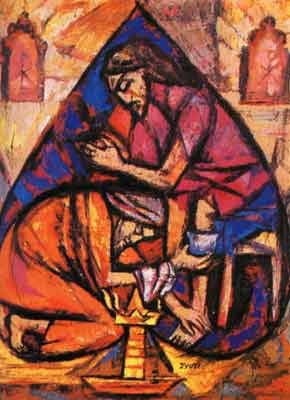
Jesus Washing the Feet of His Disciple by Japanese artist Sadao Watanabe (1913-1996)
We all need to receive love and to give love. Without love, there is little to live for. Apart from love, relationships devolve into silent standoffs and destructive triangles. Indeed, with an absence of love the world ceases to spin on its axis.
Yet, where love is present all things are beautiful. Personal relations have meaning and joy. All seems right and just in the world.
Love, however, comes at a cost. Because we live in a broken world full of pride and hubris, greed, and avarice, hate and envy, we are victims of loveless systems and unjust actions. We need love to rescue us, to redeem us from the sheer muck of existence. It’s as if we are constantly walking knee deep through sludge so thick, we can barely get anywhere. We need saving. We need Jesus.
Christians everywhere around the world are journeying through Holy Week, the most sacred time of the year for followers of Christ. When we think about Holy Week, we are familiar with Good Friday and certainly Easter, but Maundy Thursday?
On this day, the Church remembers the final evening Jesus shared with his disciples in the upper room before his arrest and crucifixion. The experiences in the upper room were highly significant because this was the last teaching, modeling, and instruction Jesus gave before facing the cross. Jesus was careful and deliberate to communicate exactly what was important to him: to love one another.
Maundy Thursday marks three important events in Christ’s Last Supper with his disciples:
The washing of the disciples’ feet (the action of loving service)
The instituting of the Lord’s Supper (the remembrance of loving sacrifice)
The giving of a “new” commandment to love one another (the mandate of a loving lifestyle).
For Jesus, his last night with the disciples was all about love, God’s love. On that fateful night, having loved his disciples for the past three years, Jesus showed them the full extent of his love by taking the posture of a servant and washing each one of the disciples’ feet, including Judas. After demonstrating for them humble service, Jesus said,
“I have set you an example that you should do as I have done for you” (John 13:15, NIV).
This was an incredible act of love. Jesus Christ loves me just as I am, and not as I should be. He loves me even with my dirty stinky feet, my herky-jerky commitment to him, and my pre-meditated sin.
The Last Supper by Indian artist Francis Newton Souza (1924-2002)
Not only did Jesus wash the disciples’ feet, but he lifted the cup of wine and boldly asserted:
“Take this and divide it among you. For I tell you I will not drink again of the fruit of the vine until the kingdom of God comes.” And he took the bread, gave thanks, and broke it, and gave it to them, saying, “This is my body given for you, do this in remembrance of me.” In the same way, after the supper he took the cup saying, “This cup is the new covenant in my blood, which is poured out for you” (Luke 22:17-20, NIV).
Because of these words, the church throughout the world, for two millennia, have practiced this communion so that we might have the redemptive events of Jesus pressed firmly into our minds and our hearts by means of the visceral and common elements of bread and wine. We are to not just know about Jesus; we are to experience being united with him.
Having washed the disciples’ feet, and proclaiming to them the meaning of his impending death, Jesus gave them a clear commandment:
“A new command I give you: Love one another. As I have loved you, so you must love one another. By this everyone will know that you are my disciples, if you love one another.” (John 13:34-35, NIV)
Love one another, insisted Jesus, by imitating his humble service. We represent Christ on this earth when we carefully, diligently, and persistently practice love. Although love was not a new concept for the disciples, in the form and teaching of Jesus love was shown with four distinctions:
Jesus is the new model of love.
A new motive of love, that Christ first loved me.
A new motivator to help us love, the Holy Spirit.
A new mission, the evangelization of the world, utilizing the power of Christ’s love to accomplish it.
Maundy Thursday is a highly significant day on the Church Calendar – one which deserves to be observed, and an opportunity to remember the important words and actions of Jesus on our behalf. Through Jesus Christ we are to live always in love, modeling our life and church ministry after him.
In Christ, love is to characterize our life together as we proclaim God’s love in both word and deed. A watching world will only take notice and desire to be a part of our fellowship if we are deeply and profoundly centered in the love of God in Christ. This is the reality Maundy Thursday brings to us.
O give thanks to the Lord, for he is good; his steadfast love endures forever!
Let Israel say, “His steadfast love endures forever….”
Open to me the gates of righteousness, that I may enter through them and give thanks to the Lord.
This is the gate of the Lord; the righteous shall enter through it.
I thank you that you have answered me and have become my salvation. The stone that the builders rejected has become the chief cornerstone. This is the Lord’s doing; it is marvelous in our eyes. This is the day that the Lord has made; let us rejoice and be glad in it. Save us, we beseech you, O Lord! O Lord, we beseech you, give us success!
Blessed is the one who comes in the name of the Lord. We bless you from the house of the Lord. The Lord is God, and he has given us light. Bind the festal procession with branches, up to the horns of the altar.
You are my God, and I will give thanks to you; you are my God, I will extol you.
O give thanks to the Lord, for he is good, for his steadfast love endures forever. (NRSV)
Show me a spiritual sourpuss, and I’ll show you a person who lives without daily gratitude toward God and others. But show me a gracious person who liberally gives thanks, and I will show you a person profoundly in touch with God’s steadfast love.
The psalmist chose to give thanks for God’s goodness and faithful love. I wonder how much different each day would be if we began it with the psalmist’s great call to worship: “This is the day the Lord has made; let us rejoice and be glad in it.”
There is a misguided notion that only certain people have the attitude of gratitude – that some folks are just naturally ornery, and some are just born happy. But the truth is that gratitude and giving thanks is a practice which needs to be carefully cultivated. As it grows and develops, gratitude bears the fruit of joy.
Thankfulness is a daily decision of faith to have the kind of attitude which pleases God and blesses others.
We now know so much more about the human brain. Research has discovered that the brain is made up of an estimated 100 billion neurons making a total of 100 trillion neural connections. That’s a lot of neural power! Most of those neural pathways are good and healthy. For example, I didn’t have to think about how to tie my shoes this morning because I have a well-developed neural pathway that automatically makes the connection to do it.
However, some of those neural pathways are not good, even unhealthy. There might be connections in our heads which lead to substance abuse when under stress, or to violently lash out when afraid or hurt, or things like plain old procrastination. If you have ever had the experience of telling yourself that you’re not going to respond a particular way, then end up doing it anyway, it is likely you have a well-worn neural pathway which connects certain events to a set of focused actions.
What this all means is that willpower won’t do the trick in changing behavior. That’s because our brains don’t work that way. The good news is that all those neural connections and pathways, like ruts in a gravel road, can fade away and new ones can be developed. Scientists call this “neural plasticity.”
There are practices which can help unhealthy neural connections go away and create new healthy pathways.
One of those practices is gratitude. Giving thanks changes our brain chemistry! Yet, it doesn’t happen overnight. But if we identify three persons or possessions which we are grateful for and say them out loud at least three times a day over the next three months, then we have developed a new neural pathway in our brain.
So, in the future, when we face a stressful event – whereas in the past we might deal with it in an unhealthy way – now our brains reflexively go to a different place and see the situation in a different way than before. And we choose different actions and behaviors.
Readers of this blog know that I continually encourage reading the psalms out loud as prayers to God. If we make this a practice, it will not only change our brains – it will create new spiritual pathways in our souls which fortify us for those times in life when things are tough and hard.
Spiritual practices have a purpose. And when we use those disciplines, we end up developing connections with the Lord which support us and sustain us for a lifetime – not to mention that we become a delight for others to be around instead of being a tedious fart.
Loving God, this is the day you have made; I rejoice in it and am glad that your steadfast love covers all things. Help me to connect every good thing with your gracious hand upon me so that I will not look and act like I was baptized in pickle juice. To the glory of Jesus Christ, I pray. Amen.
Instead of being abandoned, hated, and forbidden, I will make you majestic forever, a joy for all generations. You will suck the milk of nations, and nurse at royal breasts. You will know that I am the Lord, your savior and your redeemer, the mighty one of Jacob. Instead of bronze I will bring gold; instead of iron I will bring silver; instead of wood, bronze; and instead of stones, iron. I will make peace your governor and righteousness your taskmaster. Violence will no longer resound throughout your land, nor devastation or destruction within your borders. You will call your walls Salvation, and your gates Praise. The sun will no longer be your light by day, nor will the moon shine for illumination by night. The Lord will be your everlasting light; your God will be your glory. Your sun will no longer set; your moon will no longer wane. The Lord will be an everlasting light for you, and your days of mourning will be ended. Your people will all be righteous; they will possess the land forever. They are the shoot that I planted, the work of my hands, to glorify myself. The least will become a thousand, and the smallest a powerful people. I am the Lord; at the right moment, I will hurry it along. (CEB)
The people of ancient times typically had a love/hate relationship with prophets. After all, the Lord’s messengers gave verbal punches to the gut with bad news of judgment. But they also were bearers of good news, as well. So, it is important to hold both judgment and grace together. We need to always keep in mind that, despite human foibles, grace exists and is the grand operating force in God’s big world.
Good news turns to great news when there is a realization that judgment is deserved, yet it won’t have the last word. God’s grace always prevails in the end. God has a tenacious resolve to work out good for people, not ill. Although the Lord dispenses justice, sometimes with a firm hand, there is an unflagging commitment to divine love which will shine through the darkest of times.
God expertly knows how to make a reversal in people’s situations from hopeless despair to incredible fortune (and, I might add, vice versa). The Lord truly has plans of goodness and well-being for humanity. Humiliation and powerlessness will give way to exaltation and empowerment. Peace will eventually overcome both the human heart and human institutions.
Salvation and deliverance from the ills which plague both body and soul comes from the God who specializes in penetrating the blackest darkness with overwhelming light. And it is much more than personal well-being. Isaiah’s prophecy communicates a cosmic vision of peace which thoroughly works its way in all the shadowy places of the world. It is a vision of a new world and new life.
Because of God’s action in a broken and bruised world, we can make some bold and hopeful theological claims for God’s people:
God’s good grace and steadfast love are the superior forces in the church and the world. Because grace and love are pure gifts from the Lord, they are not dependent upon whether we deserve them, or not. The sheer fact that we need them is what prompts God to give generously and unsparingly. A new heaven and new earth are coming. Sin and death are not permanent.
Then I saw a new heaven and a new earth; for the first heaven and the first earth had passed away. (Revelation 21:1, NRSV)
God is the center of every good thing that was, is, and is coming. God’s world runs on God’s providence and power, and not on human agency. God is in control. All the Lord’s good promises shall not fail but will be realized. For the Christian, those promises are ultimately fulfilled in the person and work of Jesus Christ. When circumstances are at their worst, faith is at its best.
In everything we have won more than a victory because of Christ who loves us. I am sure that nothing can separate us from God’s love—not life or death, not angels or spirits, not the present or the future, and not powers above or powers below. Nothing in all creation can separate us from God’s love for us in Christ Jesus our Lord! (Romans 8:37-39, CEV)
God’s promises extend well beyond the “spiritual” to all of life. God’s peace will work its way into the fabric of the whole world, not just individual hearts. God’s benevolent kingdom and ethical will shall be done on earth as it is always done in heaven. Just as every human institution and all creation have been profoundly touched by sin, so everything will be touched by grace and renewed. Our prayers are to encompass this grand scope of God’s renewing vision for the world.
May your Kingdom come soon. May your will be done on earth, as it is in heaven. (Matthew 6:11, NLT)
God’s plans are more than good and gracious; they are cosmic in their scope and include an expansive realm of peace which is so incredible that the Lord’s glory will overwhelm all darkness and shall shine forever. Human sin might seem as though it is so pervasive as to win the day, yet it will not always be this way. God’s light will penetrate, overcome, and dispel guilt, shame, and disobedience. And it has already begun…
Almighty God give us a new vision of you, of your love, of your grace and power; and then, give us a new vision of what you would have us do as your people, and an awareness that in the strength of your Spirit we can do it to your glory, through Jesus Christ our Lord. Amen.








 Rev. Tim Ehrhardt