Hosea 3:1-5 – Reconcile the Past

Then the Lord said to me, “Go and love your wife again, even though she commits adultery with another lover. This will illustrate that the Lord still loves Israel, even though the people have turned to other gods and love to worship them.”

So, I bought her back for fifteen pieces of silver and five bushels of barley and a measure of wine. Then I said to her, “You must live in my house for many days and stop your prostitution. During this time, you will not have sexual relations with anyone, not even with me.”

This shows that Israel will go a long time without a king or prince, and without sacrifices, sacred pillars, priests, or even idols! But afterward the people will return and devote themselves to the Lord their God and to David’s descendant, their king. In the last days, they will tremble in awe of the Lord and of his goodness. (New Living Translation)

Sometimes you have to get your behind in the past before you can put your past behind you.

The ancient nation of Israel was in a spiritual pickle. Gradually, over hundreds of years, they made small decisions of compromised religion which added up to a severe breach of faith with their historic God.

The relationship between God and God’s people, throughout the prophetic books of the Old Testament, is many times likened to a marriage of two spouses – God, the faithful spouse, and Israel, the unfaithful spouse who adulterated themselves by seeking the love of other gods.

This situation evoked feelings of sadness and anger within God. To help restore the broken marriage, the Lord used the prophet Hosea as an earthly illustration of the divine/human dilemma.

Just as Hosea graciously took a wife of dubious repute, so God mercifully took Israel. Just as Hosea’s wife, Gomer, slept with other men, so Israel went to bed with other gods. And just as Hosea remained faithful and actively sought to reconcile the past with his wife, so God tenaciously and dramatically honored the covenant relationship with Israel by showing steadfast love, despite her sordid past.

Israel needed to do her part by reconciling the past – returning to the Lord through acknowledging the truth of the situation and owning their responsibility to make things right.

Holy Scripture exhorts the believer to live according to truth. Whenever we fail to do so, we suffer spiritual loss. We are told to confess and reject unfaithful patterns of past behavior and not allow them to influence us today (Titus 2:12; 1 Peter 1:14, 18). 

Neglecting our responsibility inevitably causes emotional, mental and physical repercussions, as well as spiritual. In the New Testament, when the Apostle Paul said he was forgetting what is behind and straining toward what is ahead, he could say that because he had come to terms with and reconciled his own terrible unfaithful past with God. (Philippians 3:4-13)

It is both helpful and necessary to go back into one’s life and deal with the past on the basis of truth. In doing so, we honor our relationship with God. We must ask the Lord to turn the searchlight of truth on us and our past. 

Trust God to help you remember all the times in which you need to reconcile what has happened (or failed to happen). Make the choice before God to be as honest as you possibly can. 

The following are some suggestions from a former professor and mentor, the late Dr. Victor Matthews, (put in my own words) to carefully follow:

  1. Write out every time you were unfaithful or were hurt by another’s unfaithfulness (reject the temptation to just think and/or talk about it). Be complete, name the people involved, state what happened, do not try and protect yourself or other people and do not fantasize and let your thoughts run amok.
  2. Evaluate each past event on the basis of truth. If you were unfaithful, then confess it to God truthfully and receive forgiveness and cleansing (1 John 1:9). If you were hurt by someone, and it was their fault, then state out loud that “_______ should not have done that to me.” When you have finished writing out the event(s) deliberately stop and completely forgive the person(s) (Mark 11:25-26).  If you were at fault in some way, then confess that to God, as well.
  3. Resist the temptation to hurry with this process! Do not generalize by putting many events into one. Be specific and take the time necessary to get in touch with what God is trying to help you connect with.  This practice of reconciling the past is not introspection, so do not indulge in self-pity, self-criticism, or develop a martyr syndrome.
  4. Affirm that your inner critic, others, and any dark force may no longer use your past against you. “In the Name of the Lord Jesus Christ I take this event away from Satan and declare that he may not use it against me anymore!” (Ephesians 4:27; 5:11; 6:14).
  5. Receive the healing provided for those who believe and live according to God’s words and ways (Isaiah 53:5). “Now that I have made this right with you, O Lord, I receive the healing you have provided for me through the cross of Jesus Christ.” (Galatians 2:19-20)

When you have finished your work, then count it finished. When Jesus said, “It is finished!” he meant what he said. (John 19:30)

Reconciling the past means leaning into the finished work of Jesus for our complete healing. If and when we think of our unfaithful past, then firmly state: “I have dealt with that truthfully. It is settled, once and for all.” 

Whenever unfaithful, from this point forward, confess it, receive forgiveness, and make the affirmations of truth. In doing so, we are living by faith in the Son of God who loved us and gave himself for us. Amen.


Psalm 57 – Prayer and Praise in the Middle of Trouble

Above the Heavens by painter Melani Pyke

Be merciful to me, O God, be merciful to me,
    for in you my soul takes refuge;
in the shadow of your wings I will take refuge,
    until the destroying storms pass by.
I cry to God Most High,
    to God who fulfills his purpose for me.
He will send from heaven and save me,
    he will put to shame those who trample on me.
God will send forth his steadfast love and his faithfulness.

I lie down among lions
    that greedily devour human prey;
their teeth are spears and arrows,
    their tongues sharp swords.

Be exalted, O God, above the heavens.
    Let your glory be over all the earth.

They set a net for my steps;
    my soul was bowed down.
They dug a pit in my path,
    but they have fallen into it themselves.
My heart is steadfast, O God,
    my heart is steadfast.
I will sing and make melody.
    Awake, my soul!
Awake, O harp and lyre!
    I will awake the dawn.
I will give thanks to you, O Lord, among the peoples;
    I will sing praises to you among the nations.
For your steadfast love is as high as the heavens;
    your faithfulness extends to the clouds.

Be exalted, O God, above the heavens.
    Let your glory be over all the earth. (New Revised Standard Version)

One thing we all share about the human experience is that, sooner or later, someone or a group of people will let us down. 

On top of that, many have experienced, or will experience, some sort of abuse and victimization from another person or group – leaving one scarred by trauma. What’s more, there are those who have even had their very lives at risk because someone intentionally sought to actually kill them. That is the company David found himself in when King Saul, and when his son Absalom, sought to do away with his life.

To David’s credit, he never retaliated and did not try and turn the tables by putting a hit out on either Saul or Absalom. Instead, David cried out to God. And we get to listen in on the prayer. Today’s psalm is David’s prayerful reliance upon the God in whom he put all his trust and praise. 

The entire basis of prayer is to let God be God. So, how do we exactly do that?

When the storms of life assail us, calloused persons trample on us with impunity, devious individuals set traps for us, and greedy organizations prey upon us, we refuse to respond in kind. Instead, we deliberately praise God and rely on divine protection, praying to the Lord and steadfastly holding to our confidence that if God is for us, nothing can be against us.

That advice may seem like some sort of pie-in-the-sky rot of ginning up positive thoughts when there is nothing positive to be seen in the experience. Indeed, we must never, and I repeat, never invalidate another’s experience nor our own, when those experiences are hellish.

Yet, there is also always hope. There are two unshakable truths which are constant and never diminished by any adverse circumstance: God is present. And God loves.

If we know nothing else, and all else seems to be descending into the abyss of tragedy, the twin towers of divine presence and attention stand tall as the strongest sentinels over our dilapidated situation and struggling faith.

Letting God be God means not trying to exercise control over things we have no control over – but affirming that the Lord is willing and capable of handling our worst. It could be that we are stuck in the belly of whale because, without our knowing, there are sharks surrounding us who cannot get to us.

Our perspective of matters is, at best, severely limited. It is much better to place faith in the God who sees it all with an expansive eye which misses nothing.

One of the best things about the psalms is that they are a wonderful collection of prayers we can adopt for our own. Not only can we use them for ourselves, but we are also obliged to do so. If anyone has been in an adverse situation so deep that it feels like having ambled into a pride of lions, it is quite likely that the experience leaves one with no adequate words to say. It’s as if you are paralyzed with fear. 

So, let the psalm say for you what you cannot even begin to utter yourself. The Word of God is not meant to sit on a coffee table or rest on a shelf; it is meant to be opened and used for prayer. Allow it to do its intended purpose.

Who knows? Perhaps your faith in the mercy of God and your praises lifted to God will give rise to settled confidence and peace so that you can rest secure even when all around you is going to hell.

Be merciful to me, O God, for in you my soul takes refuge.  Even though I feel the slash of people with tongues as swords, my heart is steadfast and will exalt your name above the heavens.  Let your glory be over all the earth!  Amen.

Matthew 7:7-11 – Ask. Seek. Knock.

“Keep on asking, and you will receive what you ask for. Keep on seeking, and you will find. Keep on knocking, and the door will be opened to you. For everyone who asks, receives. Everyone who seeks, finds. And to everyone who knocks, the door will be opened.

“You parents—if your children ask for a loaf of bread, do you give them a stone instead? Or if they ask for a fish, do you give them a snake? Of course not! So, if you sinful people know how to give good gifts to your children, how much more will your heavenly Father give good gifts to those who ask him. (New Living Translation)

In the dog days of summer, and the long season of Ordinary Time in the Church Calendar, it is good to be reminded of what it is we need to keep doing without giving up.

At the conclusion of his Sermon on the Mount, Jesus issued a warning about the pitfall of failing to persist in a trusting relationship with God. We are to have an ongoing dynamic of asking, seeking, and knocking.

We might too often neglect to ask, seek, and knock because we rely on our own determination, abilities, education, or observations. The action of the three action words is a reference to prayer. The idea is that it is difficult to live a virtuous life, so we must continually ask, seek, and knock to receive an answer.

The demands of Christian discipleship are significant. Throughout Christ’s Sermon, he not only dealt with the outward actions of a follower but also the inward state of the heart.

Humility, meekness, mercy, purity, and peace characterize the inner person who walks in the way of Christ. Not only is murder wrong, but the bitter anger which it produces is to be dealt with. Adultery is also a violation of God’s law, along with the impure thoughts and intents of the heart which bring it about. Love for enemies, giving from the heart, praying with appropriate motives, fasting in secret, and building treasure in heaven are all expectations of the devout Christian believer.

These are inner attitudes and outward behaviors which require a constant stream of asking, seeking, and knocking on the door of heaven. They are more than natural abilities; what Jesus is looking for is to live a supernatural life. This, then, requires supernatural resources.

“I am the door, and the person who enters through me will be saved and will be able to come in and go out and find pasture.”

Jesus (John 10:9, NCV)

No one enters God’s realm because of sheer determination. God’s kingdom is only accessed through humble prayer. God is the One with the supernatural resources to help us live the Christian life.

And God is pleased to provide what we need to live that life. The Lord answers in love and not begrudgingly. Out of the infinite storehouse of grace, God delights in hearing our asking’s, responding to our seeking’s, and answering our knocking’s. With God, there is no daydreaming while we ask, no avoiding us when we seek, and no pulling the shades as the door is being knocked.

In love, God looks forward to our asking, seeking, and knocking.

The key takeaway from today’s Gospel lesson is repetition – not vain repetition which believes that the more prayer is repeated, the greater possibility of the answer we want – but a routine lifestyle of persistently and consistently praying.

Ask

You want things, but you don’t get them. So, you kill and are jealous of others. But you still cannot get what you want. So, you argue and fight. You don’t get what you want because you don’t ask God. Or when you ask, you don’t receive anything, because the reason you ask is wrong. You only want to use it for your own pleasure. (James 4:2-3, ERV)

James, learning from his brother, Jesus, gets behind the asking to the heart of why we ask and why we do not ask. This, in no way, is to discourage us from asking or to be doubtful whether God cares about our asking, or not. James also said:

But anyone who needs wisdom should ask God, whose very nature is to give to everyone without a second thought, without keeping score. Wisdom will certainly be given to those who ask. Whoever asks shouldn’t hesitate. They should ask in faith, without doubting. Whoever doubts is like the surf of the sea, tossed and turned by the wind. People like that should never imagine that they will receive anything from the Lord. They are double-minded, unstable in all their ways. (James 1:5-8, CEB)

Seek

If you seek the Lord your God, you will find him if you seek him with all your heart and with all your soul. (Deuteronomy 4:29, NIV)

Seek the Lord while he may be found, call upon him while he is near. (Isaiah 55:6, NRSV)

Prayer is much like a wrestling match. It requires a great deal of effort. In fact, every good thing in life demands blood, sweat, and tears. We are to keep on seeking, to continue searching and looking for God amid our life circumstances. The Lord will be found.

Knock

God has said, “When you pray, I will answer you. When you call to me, I will respond.” (Isaiah 58:9, GNT)

The balance to the continual searching and diligently seeking is the immediate answer to our knocking on heaven’s door.

And God has also said, “I will answer their prayers before they finish praying.” (Isaiah 65:24, CEV)

It is to God’s glory whether our prayers are answered quickly, or not. It is to our glory that we exercise our own ability to enter God’s throne room and ask, seek, and knock. We have the assurance that whatever the answer is from God, it will always be a merciful response.

For God mercifully gives us what we ask for, and also mercifully does not give us what we ask for.

We do not know what tomorrow may hold for us. All we know for certain is that we are known by a God who hears when we ask, is worth seeking, and answers when we knock.

O God, you are my God, early and often I will seek you. New are your mercies every morning, O Lord; and great is your faithfulness. Pour out on all who desire it the spirit of grace. Deliver us, when we draw near to you, from coldness of heart and wanderings of mind, that with steadfast thoughts and affections we may worship you in spirit and in truth, through Jesus Christ our Lord. Amen.

John 4:31-38 – Real Food

Meanwhile his disciples urged him, “Rabbi, eat something.”

But he said to them, “I have food to eat that you know nothing about.”

Then his disciples said to each other, “Could someone have brought him food?”

“My food,” said Jesus, “is to do the will of him who sent me and to finish his work. Don’t you have a saying, ‘It’s still four months until harvest’? I tell you, open your eyes and look at the fields! They are ripe for harvest. Even now the one who reaps draws a wage and harvests a crop for eternal life, so that the sower and the reaper may be glad together. Thus, the saying ‘One sows, and another reaps’ is true. I sent you to reap what you have not worked for. Others have done the hard work, and you have reaped the benefits of their labor.” (New International Version)

Today’s Gospel narrative reads something like the stereotypical mother concerned for her son saying, “Sit down and eat some of Mama’s pasta. You need some food!” As if preparing and serving a meal will make everything better.

Food has both the power to bring us together, as well as separate us. A meal can create the conditions for fellowship, acceptance, and enjoyment. Eating can bond people together through hospitable love. On the other hand, sitting down to eat can also be a way to avoid painful emotions. In this manner, eating becomes an obstacle to giving and receiving love.

It seems Christ’s disciples were doing the latter. They were uncomfortable and perhaps a bit stressed. Looking to fill up with food instead of with God, the disciples’ sense of unfulfillment was coming out sideways by opening the refrigerator, poking through the meager leftovers, and putting the emphasis on feeling better.

I know we can be hard on the disciples in the Gospels. Their ups and downs from faith to fear and back to faith again can be weird. Yet, through it all, I believe their hearts (excepting Judas Iscariot) were in the right place.

Jesus could see through the entire scenario and put the focus off eating. He addressed the disciples’ soul hunger through putting the spotlight on doing the will of God. Deep within they were hungering and thirsting for righteousness.

Paying attention to our vocation and discovering our humble work in the service of God, rather than a vacation to the pantry to cover our unwanted feelings, is the essence of Christ’s interaction with his disciples.

People are much more ready for the gospel of Jesus than we think. There are times we can become so insular, and lost within our own heads, that we are then unable to see the world as ripe for a harvest of people who are actually eager to be gathered into the community of the redeemed.

Jesus just had a significant interaction with the Samaritan woman. Back in that day, you just didn’t have dialogues with half-breed Samaritans – an unholy mix of Jewish and hated ancient Assyrian Gentile blood – let alone a man talking with a woman of disrepute who experienced several failed marriages.

Christ had a way of doing the will of God, despite conventional thinking of the time. And a lot of people got their undies in a bundle from it. The disciples, having a front seat to most of Christ’s shenanigans, did a few too many palms to the forehead, believing their Rabbi’s un-orthopraxis was going to make him unpopular. They feared no one would follow him.

Looks like the disciples didn’t quite get that one right.

The Samaritan woman received Jesus as Living Water, having her ultimate needs met by the penultimate Lord of all. The disciples hadn’t quite caught up to this, so fell back on their old ways of physical food and drink to assuage the weirdness happening inside them.

The woman was gushing over with Living Water, becoming a wellspring of good news to her community. Whereas the disciples (eventually becoming an incredible fountain of the gospel after Christ’s death and resurrection) are here nothing but an annoying drip from the kitchen faucet.

A non-descript ethnically suspect woman of dubious character coming to faith was meant by Jesus to open the disciples’ eyes to a new reality: The good news of Christ is meant for the world, not just Jewish men.

The disciples were given the opportunity to participate in the world’s takeover – a mission of bringing the love of God where love wasn’t present, of helping all kinds of people awaken to the deep spirituality within them, of lifting their downcast faces of guilt and shame to see the Living God wanting to bless the world with the body and blood of Jesus.

For this is real food and real drink.

Many believers in Jesus today think they are working hard for the Lord by seeking people for their churches. Yet, the real work is being done by the triune God – the heavenly Father who scans the world and seeks spiritual misfits to bless; the gracious and truthful Son who put hands and feet to that blessing; and the wild Holy Spirit who moves in unpredictable ways – are working infinitely harder for our churches, our families, our neighborhoods, and our world.

All of our work, no matter how big or small, is made possible by the pre-work of the Holy Trinity. The great Three-in-One has done all the preparations of chopping the onions, mincing the garlic, slicing the carrots, and peeling the potatoes so that we, his followers, can make a savory stew of diverse people sharing a common pot of God’s love and hospitality.

This is the food we know nothing about, and that God knows intimately.

O God, you made us in your own image, and you have redeemed us through your Son Jesus Christ: Look with compassion on the whole human family; take away the arrogance and hatred which infect our hearts; break down the walls that separate us; unite us in bonds of love; and work through our struggle and confusion to accomplish your purposes on earth; that, in your good time, all nations and races may serve you in harmony around your heavenly throne; through Jesus Christ our Lord. Amen.

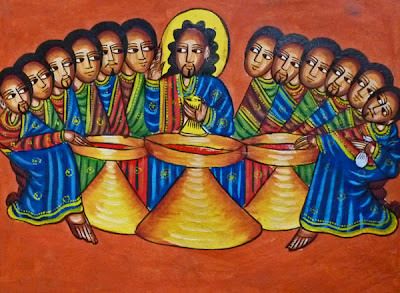
*Above painting: Ethiopian Orthodox Church depiction of the Last Supper