The Beauty of Love (Song of Songs 1:1-17)

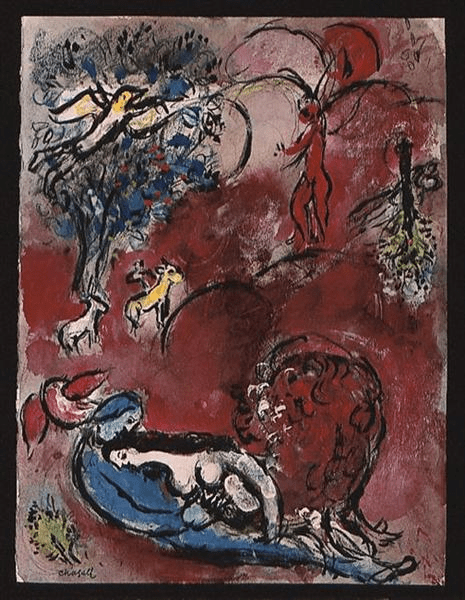
Song of Songs I, by Marc Chagall, 1960

The Song of Songs, which is for Solomon.

[Woman]

If only he would give me some of his kisses . . .

Oh, your loving is sweeter than wine!
Your fragrance is sweet;
        your very name is perfume.
        That’s why the young women love you.
Take me along with you; let’s run!

My king has brought me into his chambers, saying,
“Let’s exult and rejoice in you.
Let’s savor your loving more than wine.
        No wonder they all love you!”

Dark am I, and lovely, daughters of Jerusalem—
        like the black tents of the Kedar nomads,
        like the curtains of Solomon’s palace.
Don’t stare at me because I’m darkened
        by the sun’s gaze.
My own brothers were angry with me.
        They made me a caretaker of the vineyards—
        but I couldn’t care for my own vineyard.

Tell me, you whom I love with all my heart—
        where do you pasture your flock,
        where do you rest them at noon?—
            so I don’t wander around with the flocks of your companions.

[Man]

If you don’t know your way,
    most beautiful of women,
        then follow the tracks of the herds
            and graze your little goats
            by the tents of the shepherds.

I picture you, my dearest,
        as a mare among Pharaoh’s chariots!
Lovely are your cheeks, adorned with ear hoops;
        your neck, with beads.
Let’s make hoops of gold beaded with silver for you!

[Woman]

With my king close by,
        my perfume filled the air.
A sachet of myrrh is my love to me,
        lying all night between my breasts.
A cluster of henna flowers is my love to me
        in the desert gardens of En-gedi.

[Man]

Look at you—so beautiful, my dearest!
        Look at you—so beautiful! Your eyes are doves!

[Woman]

Look at you—so beautiful, my love!
        Yes, delightful! Yes, our bed is lush and green!
The ceilings of our chambers are cedars;
        our rafters, cypresses. (Common English Bible)

The Song of Songs is an unabashedly sensuous biblical book. It is, throughout its contents, an erotic paean to love. In eight chapters, a man and a woman pursue each other through verdant fields and lush valleys. The excitement they have, being together, is palpable.

For most of church history, the Song of Songs has been viewed as an allegory, a love poem between Christ and the Church. And in the case of Hebrew Scripture, the covenant love which exists between God and Israel, has been the predominant interpretive lens.

Seen from this perspective, the Song of Songs reflects that we ought to love the Lord with overpowering commitment, as if we were love-sick for our Beloved. Our thoughts are constantly on the object of our love – how we can please our beloved one.

And yet, there still seems to be room to read the Song in the very down-to-earth realness of physical love between two lovers. Since we are embodied people, such love ought to be celebrated, and is anything but base or to be refused. Sex is a gift from the Creator, and encouraged by God.

I think that the Song of Songs is not an either/or; it is a both/and; it’s both literal and allegorical. That’s not a weird thing. On the allegorical level, the Song is a beautiful poem describing the Divine Eros for God’s people, and the faithful’s heartfelt love for the God whose very name is Love.

Concerning a literal view, the Song celebrates the sanctity of human love, seeing within it the symbol of God’s love for us. Our very real bodies are themselves sacred, just as much as our souls.

Yet, however one chooses to look at the Song of Songs, it remains a statement of mutual admiration, of committed love and affection. It is indeed a poetic lifting of love above all else.

Indeed, if love isn’t the answer, we are not asking the right question.

Believe it or not, the Song of Songs was once viewed as an important key, capable of unlocking the entirety of Holy Scripture.

In fact, C.H. Spurgeon, the Prince of Preachers, in the nineteenth century, preached 59 sermons from this book; in Victorian England, no less. Spurgeon discerned the Song as central to the whole of the Bible. Reflecting on Song of Songs 1:7, he said:

“These words express the desire of the believer after Christ, and his longing for present communion with Him…. Tell me where Thou feeds, for wherever Thou stands as the Shepherd, there will I lie down as a sheep; for none but Thyself can supply my need. I cannot be satisfied to be apart from Thee. My soul hungers and thirsts for the refreshment of Thy presence….

“Satan tells me I am unworthy; but I always was unworthy, and yet Thou hast long loved me; and wherefore my unworthiness cannot be a bar to my having fellowship with Thee now. It is true I am weak in faith, and prone to fall, but my very feebleness is the reason why I should always be where Thou feeds Thy flock, that I may be strengthened, and preserved in safety beside the still waters.

“Why should I turn aside? There is no reason why I should, but there are a thousand reasons why I should not, for Jesus beckons me to come. If He withdraw Himself a little, it is but to make me prize His presence more. Now that I am grieved and distressed at being away from Him, He will lead me yet again to that sheltered nook where the lambs of His fold are sheltered from the burning sun.” Charles Haddon Spurgeon

The Song, in history past, once functioned as a beautiful path to deep intimacy with God. Methinks it behooves us to recover this.

The two lovers in the Song see beauty everywhere. They see it in each other, in the fields where the sheep are pastured, in the orchards where love is consummated, in the seasons, in the animals, trees, and hills. Beauty is all around them, and it is they themselves.

All things which God has created are lovely. Nothing is too small or too insignificant when the eyes of love look upon them. Beauty is designed to be noticed, celebrated, and praised. Love is meant to be expressed out loud, with flavor.

Each time love is stated, every exhalation of adoration, and all of the instances when beauty is acknowledged and affirmed, the ones who speak bind themselves more deeply to God and God’s big world. Together, they call all of it good.

Today’s Old Testament lesson is a wondrous reminder that beauty and love will have its way. Regardless of class, race, family, or societal norms, lovers will continue to seek and find one another and claim their relationship.

While the daughters may stare, and the brothers may be angry, the lovers will yet affirm the beauty of their love. And they will find contentment with each other.

You and I are no accident on this earth; we were created by a loving Creator who has an eye for beauty. And no matter how separated we may get from our divine source, God will seek us out; and if we seek the Lord, he will be found.

O God, you have prepared for those who love you such good things as surpass our understanding: Pour into our hearts such love towards you, so that we, loving you in all things and above all things, may obtain your promises, which exceed all that we can desire. Amen.


Be Merciful to Me (Psalm 57)

“For thy mercy is great unto the heavens, and thy truth unto the clouds.” (Psalm 57:10, KJV) by Bible Art

Be merciful to me, O God; be merciful to me,
    for in you my soul takes refuge;
in the shadow of your wings I will take refuge,
    until the destroying storms pass by.
I cry to God Most High,
    to God who fulfills his purpose for me.
He will send from heaven and save me;
    he will put to shame those who trample on me.
God will send forth his steadfast love and his faithfulness.

I lie down among lions
    that greedily devour human prey;
their teeth are spears and arrows,
    their tongues sharp swords.

Be exalted, O God, above the heavens.
    Let your glory be over all the earth.

They set a net for my steps;
    my soul was bowed down.
They dug a pit in my path,
    but they have fallen into it themselves.
My heart is steadfast, O God;
    my heart is steadfast.
I will sing and make melody.
    Awake, my soul!
Awake, O harp and lyre!
    I will awake the dawn.
I will give thanks to you, O Lord, among the peoples;
    I will sing praises to you among the nations.
For your steadfast love is as high as the heavens;
    your faithfulness extends to the clouds.

Be exalted, O God, above the heavens.
    Let your glory be over all the earth. (New Revised Standard Version)

The Human Condition

Maybe it’s just me, yet it seems, over the past several years, that our world has become increasingly depressed, jaded, and unkind. Things like appreciation and encouragement of others are found less and less as time goes on. It’s as if we are all in some sort of collective funk, in which everyone has an underlying sullenness and frustration about them.

Humanity has suffered a great deal of change and loss, without a healthy means of grieving and lamenting for what has happened to them. In other words, we simply don’t know what to do with our hurt, so we end up projecting our hurt onto others. *Sigh*

There is something that we all share together about the human experience: Sooner or later, someone or a group of people will let us down. They will hurt us in some way. And that hurt will change us – either for good or for ill.

What’s worse, many have experienced, or will experience, some sort of abuse and victimization from another person or group – leaving them scarred by trauma. And, what’s more, there are those who have had their very lives at risk, because someone intentionally sought to kill them. 

King David’s Condition

That is the company David found himself in when King Saul, and the later when his son Absalom, sought to do away with his life.

To David’s credit, he never retaliated and did not try and turn the tables by putting a hit out on either Saul or Absalom. Instead, David cried out to God. And we get to listen in on the prayer. Today’s psalm is David’s prayerful reliance upon the God in whom he put all his trust and praise. 

The entire basis of prayer is to let God be God. So, how do we exactly do that?

Our Condition

Whenever the storms of life assail us, calloused persons trample on us with impunity, devious individuals set traps for us, and greedy organizations prey upon us, we must refuse to respond in kind.

Instead, let us deliberately praise the Lord, rely on divine protection, and pray to God, so that we might steadfastly hold on to our confidence. Because if God is for us, nothing nor no one, can be against us.

That advice may seem like a sort of pie-in-the-sky rot of ginning up positive thoughts when there is nothing positive to be seen in the experience. Yet, please keep in mind that we must never, and I repeat, never invalidate another’s experience, nor our own, when those experiences are hellish.

There is always hope. There are two unshakable truths which are constant, and are never diminished by any adverse circumstance:

  1. God is present with us
  2. God loves us

If we know nothing else, and everything seems to be descending into the abyss of tragedy, the twin towers of divine presence and divine mercy stand guard as the strongest sentinels over our dilapidated situation, and struggling faith.

Letting God be God means not to try and control things we have no control over. Rather, it means to affirm that the Lord is willing and capable of handling our worst stuff.

It could be that we are stuck in the belly of a whale because, without our knowing it, there are sharks surrounding us, who cannot get to us because of divine attention and protection.

Our perspective of life-circumstances is, at best, severely limited. It is much better to place faith in the God who sees it all, with an expansive eye which misses nothing.

One of the best things, to me, about the psalms is that they are a wonderful collection of prayers we can adopt for our own. Not only can we use them for ourselves, but we are also obliged to do so. 

If anyone has been in an adverse situation, so deep that it feels like having ambled into a pride of lions, it’s quite likely that the experience leaves one with no adequate words to say. There we are – paralyzed with fear, and unable to move. 

So, let the psalm say for you what you cannot even begin to utter yourself. The Word of God is not meant to sit on a coffee table,  or to rest on a shelf; it is meant to be opened and used for prayer. Allow it to do its intended purpose.

Who knows? Perhaps your faith in the mercy of God, and your praises lifted to God, will give rise to a newfound confidence and peace, so that you can rest secure, even when all around you is going to hell.

Be merciful to me, O God, for in you my soul takes refuge. Even though I feel the slash of people with tongues as swords, my heart is steadfast, and I will exalt your name above the heavens. Let your glory be over all the earth! Amen.

Family Drama (2 Samuel 13:37-14:24)

The woman of Tekoa before King David, by Caspar Luiken, 1700

Absalom fled and went to Talmai son of Ammihud, the king of Geshur. But King David mourned many days for his son.

After Absalom fled and went to Geshur, he stayed there three years. And King David longed to go to Absalom, for he was consoled concerning Amnon’s death.

Joab son of Zeruiah knew that the king’s heart longed for Absalom. So Joab sent someone to Tekoa and had a wise woman brought from there. He said to her, “Pretend you are in mourning. Dress in mourning clothes, and don’t use any cosmetic lotions. Act like a woman who has spent many days grieving for the dead. Then go to the king and speak these words to him.” And Joab put the words in her mouth.

When the woman from Tekoa went to the king, she fell with her face to the ground to pay him honor, and she said, “Help me, Your Majesty!”

The king asked her, “What is troubling you?”

She said, “I am a widow; my husband is dead. I your servant had two sons. They got into a fight with each other in the field, and no one was there to separate them. One struck the other and killed him. Now the whole clan has risen up against your servant; they say, ‘Hand over the one who struck his brother down, so that we may put him to death for the life of his brother whom he killed; then we will get rid of the heir as well.’ They would put out the only burning coal I have left, leaving my husband neither name nor descendant on the face of the earth.”

The king said to the woman, “Go home, and I will issue an order in your behalf.”

But the woman from Tekoa said to him, “Let my lord the king pardon me and my family, and let the king and his throne be without guilt.”

The king replied, “If anyone says anything to you, bring them to me, and they will not bother you again.”

She said, “Then let the king invoke the Lord his God to prevent the avenger of blood from adding to the destruction, so that my son will not be destroyed.”

“As surely as the Lord lives,” he said, “not one hair of your son’s head will fall to the ground.”

Then the woman said, “Let your servant speak a word to my lord the king.”

“Speak,” he replied.

The woman said, “Why then have you devised a thing like this against the people of God? When the king says this, does he not convict himself, for the king has not brought back his banished son? Like water spilled on the ground, which cannot be recovered, so we must die. But that is not what God desires; rather, he devises ways so that a banished person does not remain banished from him.

“And now I have come to say this to my lord the king because the people have made me afraid. Your servant thought, ‘I will speak to the king; perhaps he will grant his servant’s request. Perhaps the king will agree to deliver his servant from the hand of the man who is trying to cut off both me and my son from God’s inheritance.’

“And now your servant says, ‘May the word of my lord the king secure my inheritance, for my lord the king is like an angel of God in discerning good and evil. May the Lord your God be with you.’”

Then the king said to the woman, “Don’t keep from me the answer to what I am going to ask you.”

“Let my lord the king speak,” the woman said.

The king asked, “Isn’t the hand of Joab with you in all this?”

The woman answered, “As surely as you live, my lord the king, no one can turn to the right or to the left from anything my lord the king says. Yes, it was your servant Joab who instructed me to do this and who put all these words into the mouth of your servant. Your servant Joab did this to change the present situation. My lord has wisdom like that of an angel of God—he knows everything that happens in the land.”

The king said to Joab, “Very well, I will do it. Go, bring back the young man Absalom.”

Joab fell with his face to the ground to pay him honor, and he blessed the king. Joab said,

“Today your servant knows that he has found favor in your eyes, my lord the king, because the king has granted his servant’s request.”

Then Joab went to Geshur and brought Absalom back to Jerusalem. But the king said, “He must go to his own house; he must not see my face.” So Absalom went to his own house and did not see the face of the king. (New International Version)

By Bible Art

Absalom’s sister, Tamar, was sexually assaulted by their half-brother Amnon. As a result, Absalom brought Tamar to live in his house, because she had become a desolate woman.

When their father, King David, heard all this, he was, of course, furious; yet, he did nothing. And Absalom never talked to Amnon again; he hated Amnon because he had disgraced his sister Tamar.

For two years, Abasalom stewed on the terrible event of his sister’s assault. When the man’s bitterness came to it’s full poison, Abasalom created a ruse in order to kill Amnon. And the murderous plot was successful.

Then, Absalom fled and went to Geshur (north of Israel, in present day Syria) and stayed there three years. King David longed to go to Absalom, but he never did, nor did he do anything, either good or bad.

All of that stuff is what led up to today’s story about bringing Absalom back. When I was younger, I would read these stories of David and his sons and scratch my head as to why a guy that’s so wise to so many things seems stupid when it comes to his own family.

And then I became a father myself, with grown adult children. Now, I understand David’s actions and in-actions. I get it. When it comes to being a parent of adult kids, there is a very different perspective. It’s an outlook that’s hard to communicate and put into words.

Sometimes I wonder if it’s how God looks at us.

The nearest I can get to describing it, is that the sense of awe and wonder at that little baby being born never quite goes away.

The incredible and seemingly miraculous thing we call childbirth creates a view that this human being is so special, there is always hope they will become a little child again, that is, not literally, but in the sense of being yet again humble, right, good, and endearing – that the relational value will return.

In this sense, a parent never loses hope. And I think that is something of what King David was experiencing with his own adult children. What’s more, it seems that God has this unfailing love for us that continually longs for humanity to come back to the divine relationship.

God appears in Holy Scripture as this heavenly Father (and Mother) who is slow to judgment and long on steadfast love and covenant loyalty. The Lord is not slow in keeping promises or doing what is right. Rather, God is patiently waiting for humans to come to repentance and faith.

Admittedly, there is the sense that King David seems unreasonable, that he was unwilling to do something about his adult children’s shenanigans. Yet, there is also this sense of longing, of King David knowing the potential of his children, and holding out the hope that they will live into who they were created to be on this earth.

I definitely don’t think David always got it right. But he also didn’t always get it wrong, either. Which is pretty darned close to how every parent is doing, if we are honest about it. So, here is a blessing for parents of adult children:

May the Lord bless your adult children with the gift of the Holy Spirit. May they be filled with faith, hope, love, peace, truth, and spiritual power, so that they may be blessed and be a blessing to others.

And may God guide parents everywhere with discernment and wisdom, so that everything they do will come from the place of grace, truth, and love. Amen.

The Feeding of the Four Thousand (Mark 8:1-8)

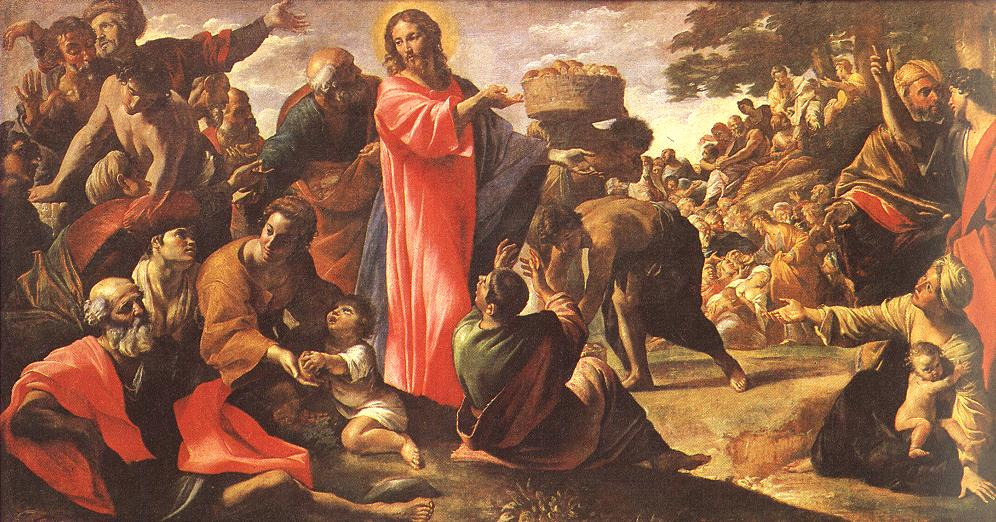
Miracle of the Loaves and Fishes, by Giovanni Lanfranco, c.1620

In those days when there was again a great crowd without anything to eat, he called his disciples and said to them, “I have compassion for the crowd because they have been with me now for three days and have nothing to eat. If I send them away hungry to their homes, they will faint on the way—and some of them have come from a great distance.” 

His disciples replied, “How can one feed these people with bread here in the desert?” He asked them, “How many loaves do you have?” They said, “Seven.” 

Then he ordered the crowd to sit down on the ground, and he took the seven loaves, and after giving thanks he broke them and gave them to his disciples to distribute, and they distributed them to the crowd. They had also a few small fish, and after blessing them he ordered that these, too, should be distributed. 

They ate and were filled, and they took up the broken pieces left over, seven baskets full. Now there were about four thousand people. And he sent them away. And immediately he got into the boat with his disciples and went to the district of Dalmanutha. (New Revised Standard Version)

This was an incredible miracle by Jesus. And it was also an incredible lack of faith on the part of his disciples. Christ had already taught them an important faith lesson by feeding 5,000 people earlier. You’d think they would have gotten it right this time.

It appears that the disciples were anxious about the situation. After all, whenever we are given to anxiety within a stressful circumstance, we typically are not thinking wisely about what to do.

There simply was no evidence that the disciples were tapping into their wise minds – even though they could have. And there’s where the rub is: Do we have the wherewithal to pause, in order to connect with what and who we know?

Let’s notice in the story that Jesus did not seem at all perturbed by the disciples’ small faith. And he certainly was not hindered in any way by the meager supply of food which was on hand. So, a remedial lesson was provided.

All the food the disciples pulled together was given to Jesus. It wasn’t much for thousands of people. Seven loaves of bread and a few fish. Yet, Christ transformed it into enough to feed the entire crowd of mostly Gentiles, without depriving the disciples of their share. They collected enough to fill seven baskets large enough to hold a man.

So there’s the lesson redone and restated, but with a different twist. Whereas the earlier miracle of food was provided for mostly Jews, the feeding of the four thousand consisted of nearly all Gentiles.

Perhaps the disciples did not really want a miracle to begin with. Maybe they believed their ministry ought to be with Israel, and not the heathen nations around them. It could be that Christ’s disciples simply did not want to be in Gentile territory at all, let alone have to engage in ministry to them, up close and personal.

So, we may be dealing with something more than an issue of faith; we might be looking at plain old fashioned prejudice against another group of people. Discriminatory behavior shrinks one’s faith and makes it small – whereas including others, and seeing their inherent worth as God’s image-bearing creatures, increases our faith and helps it grow large.

Jesus had a heart big enough, a mind open enough, and more than enough ability to make the miracle of food happen. In other words, Christ wanted to do it. He had compassion on the people, regardless of the fact that they were not like him.

It could be that a lesson in prejudice was the teaching he wanted them to get a hold of.

We see in today’s story a trajectory of inclusion, that the kingdom of God is meant to be full of diverse people from every nation, race, and background. Jesus purposely went to the Decapolis, a geographical region with a lot of different people – mostly non-Jews.

The Decapolis (which means “Ten Cities”) was a group of ten Hellenistic cities. It was a center of Greek and Roman culture, in a region mostly populated by Jews and Arameans. Each city functioned as a sort of city-state which was dependent upon Rome. There was enough diversity within the Decapolis itself which seemed to prevent them from working together as an organized region.

When it comes to Christian ministry, there are often two issues going on, namely because ministry is all about working with people. One is that we may have a problem, like the disciples of old, in going to a place we’ve never been before – and really don’t ever want to go. We have particular ideas about the people who live there and what they’re like – and we’d rather not have to deal with them.

The second issue is that we may have a problem with ourselves. Unlike the first issue in which we wonder why Jesus would care about those people, the second is wondering if Jesus really cares about me.

In this, you have no problem believing that Jesus would go to the Decapolis and have compassion on the Gentiles. But you struggle with God caring for you, and that Jesus could ever use you in ministry to people like those in the Decapolis. You can think of all sorts of other people who could do the job much better than yourself.

Since you know yourself pretty well, you understand your own doubts, weaknesses, and sins; and have a hard time trusting that the Lord could or would want to involve you in any ministry.

We, of course, could read today’s Gospel lesson from either of the two issues. Yet, we probably need not make it an either/or issue; it may be more of a both/and issue.

That is, Christ’s disciples – including those past and present – likely struggle with both: We continually keep finding that we have personal prejudices which prevent us from reaching out to particular people; and we also have personal insecurities and inhibitions about God truly loving us enough to use us in effective ministry.

Within the story of Jesus feeding the four thousand, both issues can find their resolution. The fact of the matter is that Jesus cared about the people in the region of the Decapolis, and created a miracle in order to take care of them; and, Jesus used a group of men who probably were likely prejudiced, and also insecure about being used for such a ministry.

May you know that you are infinitely loved by God – and loved alongside all sorts of other people, as well, from everywhere in every place. And may you understand that God has you on this earth to be a blessing to all kinds of persons.

May it be so, to the glory of God. Amen.