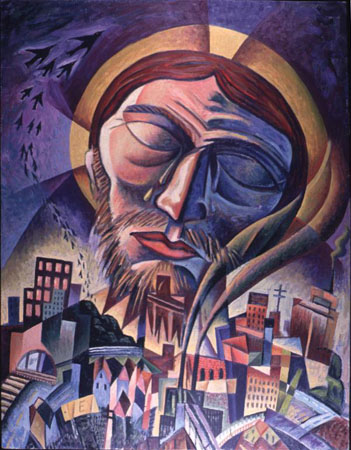
“As Jesus came to the city and observed it, he wept over it. He said, ‘If only you knew on this of all days the things that lead to peace. But now they are hidden from your eyes. The time will come when your enemies will build fortifications around you, encircle you, and attack you from all sides. They will crush you completely, you and the people within you. They won’t leave one stone on top of another within you, because you didn’t recognize the time of your gracious visit from God.’” (CEB)
There are Christians who believe in as much withdrawal from the world – its earthly political and cultural realm – as is humanly possible this side of heaven. There are yet others who believe in as much accommodation as possible to the world, its structures and society. And there are others who believe that the world and the church are simply two distinct realms which Christians simply move back and forth within, like taking one hat off and doffing another.
Let us leave that all aside for a moment and just observe the pathos of Jesus. He came to the city of Jerusalem, a city which was both deeply religious and very worldly. Jesus stood and looked affectionately and longingly at the city… and he wept. This was not a quiet shedding of a tear. No, the word “wept” means that Jesus openly cried aloud over the city. Think of the kind of crying which takes place when a person is in the throes of grief. These were great heaves of loud weeping.
The reason Jesus was lamenting with so much feeling was that the city did not recognize they had a gracious visit from God. The Lord looked at the city and saw all the future disaster which was coming. He knew it could be different, and he was emotionally undone by the city’s inability to see God, right in front of their own face.
Now let us return to our view of the world and our involvement in it. Taking some cues from our Lord Jesus, the first and foremost posture we are to take toward the worldly city is not separation, accommodation, or dual citizenship – it is, rather, to grieve and lament.
The longing Jesus had in his heart was to see the city of Jerusalem annexed and incorporated into the kingdom of God. The way of peace, of shalom on this earth, is to bring all things and all the world under the benevolent reign of God. It is as if there are Twin Cities, like Minneapolis and St. Paul, which exist side-by-side but have different municipal structures.
The kingdom of this world and the kingdom of God exist next to each other. Jesus wanted to bring the earthly kingdom into the peaceful and gracious realm of God’s kingdom. But the people would have nothing to do with it. Both the religious establishment and the secular authorities of the city wanted their own municipal conceptions of how things should go – and they both rejected the Christ who could bring them all true harmony.
We are about to enter the season of Lent. It is a time set aside in the Christian Year for repentance and preparation to receive King Jesus as our rightful benevolent ruler. Let us lament the world full of both religious and secular people who do not recognize the time of God’s visitation. Let it be a time to journey with Jesus and follow him in his Passion for this world and all its inhabitants.
Blessed Father, Son, and Holy Spirit, the holy Trinity whom I serve – the world and even sometimes the church is estranged from grace – they have not recognized your gracious coming and presence. I lament such a state of things, and ask you, blessed Spirit may draw all people to the Savior, Jesus Christ, in whose name I pray. Amen.
Come Follow Me by Argentine painter Jorge Cocco Santángelo
After John was put in prison, Jesus went into Galilee, proclaiming the good news of God. “The time has come,” he said. “The kingdom of God has come near. Repent and believe the good news!”
As Jesus walked beside the Sea of Galilee, he saw Simon and his brother Andrew casting a net into the lake, for they were fishermen. “Come, follow me,” Jesus said, “and I will send you out to fish for people.” At once they left their nets and followed him.
When he had gone a little farther, he saw James son of Zebedee and his brother John in a boat, preparing their nets. Without delay he called them, and they left their father Zebedee in the boat with the hired men and followed him. (Mark 1:14-20, NIV)
This Gospel lesson is straightforward with two main points:
The call of Jesus on our lives.
The message Jesus gave us to proclaim.
The call of Jesus is to pursue him, and he will develop us. “Come, follow me,” Jesus said to Peter and Andrew, “and I’ll show you how to fish for people.” The simple truth here is that this is neither a suggestion nor really an invitation but a command. Jesus did the same with James and John, and all the original disciples. They listened to Jesus, dropped everything they were doing, and immediately followed him.
I am wondering what would make you drop everything to pursue an entirely new life. I am curious what could cause you to follow Jesus without any conditions attached. I am impressed that Peter and Andrew immediately obeyed Jesus. They did not question Jesus as to whether this was a short-term project or a long-term assignment. They did not seek a contract with Jesus or ask how he would impact their stock portfolio.
The first disciples simply dropped everything and left with Jesus. I suspect they followed Jesus for the same reason I originally decided to follow him – because Jesus is such a compelling person, so gracious, interesting, and loving that it was really no decision at all. Everything else pales in comparison with Jesus.
Read all four Gospels and the book of Acts in the New Testament and you will find that believers in Jesus follow Jesus; and those who do not follow Jesus are not believers. It really is that simple. Followers follow, and those who do not follow are not Christ’s disciples.
Jesus calls us, commands us, to follow him and he will make us fishers of humanity. You might be concerned and retort, “I have no idea how to fish for people.” The good news is that Jesus said he would make us fishers of people. Jesus is not looking for people with skills he can use. Instead, Jesus calls people and develops them into fishers. Christ forms people with the ability to follow his call.
Jesus will train us, which means we only need to answer the call to follow. When I was five years old my Dad took the training wheels off my bike and told me to ride it. I told him I couldn’t. He told me to get on the bike and he would run beside me. I got on the bike and started to ride with him holding it. When I began to panic approaching a tree I started talking to my Dad. He didn’t answer… because he wasn’t beside me. He dropped out from shagging me a long way back. The same thing happened with learning to swim. I insisted that I needed to be supported or I would drown for sure. Dad didn’t keep his hands underneath me. Yet, I’m still here – I didn’t drown.
We are not called to follow Jesus based on our skills, but on the lack of them so that Jesus will do in us a work of total allegiance and loyalty to the kingdom of God. Jesus will make sure to develop the competence we need to do what he has called us to do. We only need to hear and answer the call of Jesus to follow and to make us fishers of people.
The Fishermen by Cuban sculptor Rafael Consuegra, Petrozavodsk, Russia
The following is a parable about the church and being fishers of people: “Now it came to pass that a group existed who called themselves fishermen. Week after week those who called themselves fishermen met in meetings and talked about their call to fish, the abundance of fish, and how they might go about fishing. They discussed the importance of fishing and that fishing is the task of every fisherman. They listened to special speakers talk about fishing and they promoted fishing and looked at all the latest equipment for fishing. They built large buildings called ‘Fishing Headquarters’ so that they could tell as many people as possible about fishing. They organized boards of people to send out fishermen to other places. They offered teaching and classes on how to fish and the best and latest fishing methods. With much training a good many persons got their fishing licenses and became upstanding members of Fishing Headquarters. There was just one thing that they did not do: they didn’t fish. When one person dared to suggest that those who do not catch fish are not really fishermen, the group became angry and kicked that crazy person out their group.”
The call is not for a few but for everyone to embody and proclaim that the kingdom of God is near. Therefore, we are to repent and believe this good news. Even though this is a simple straightforward message, it deserves some attention because we do not typically use this kind of language. Instead, we tend to say something like “Accept Jesus into your heart and someday you will go to heaven.” That sort of language you will not find Jesus saying. So, let’s stick with what he did say.
For Jesus, the word “kingdom” means God’s intentions and will for this world to come true. When Jesus said the kingdom is near, every pious Jew understood. They anticipated a coming Ruler (king) with themselves as the ruled (subjects) and a realm (land). They thought beyond a mere spiritual kingdom and did not use kingdom as a synonym for heaven. Instead, Christ’s disciples considered Jesus as King, ruling his followers over the sacred space of the entire world.
Thus, Jesus was saying he is creating a new society, thoroughly biblical to the core – which meant Caesar was not Lord and that people’s loyalty was not ultimately to the Roman Empire. It is the kingdom of heaven, God’s dream society, which will eventually spread across the entire earth so that the whole world is God’s sacred space, devoted to love, shaped by justice, living in peace, and abounding with wisdom. Jesus encouraged us to pray consistent with this idea by encouraging us to pray, “May your kingdom come, and your will be done on earth as it is in heaven.”
If we find ourselves not really working toward Christ’s idea of kingdom, then we need to repent and believe the good news that God is working toward restoring all things to their original beauty and luster. “Repent” means a change of mind which leads to a change of behavior. “Believe” means to put all our eggs in God’s kingdom basket.
None of this is a suggestion. It is a forthright call to follow Jesus in his kingdom building enterprise on this earth. And so, it would be a travesty to just think about the message for a while and follow Jesus if we feel like it or get around to it whenever.
We are being called to live for Jesus continually each day by fishing for people – and to make this our life’s work. Wherever you are, Jesus wants to make you a fisher in your family, workplace, neighborhood, and all the places within your normal sphere of living:
Go where the fish are. Fishing would be easy if we could put a basket by the water and have the fish jump into them! But that is not how it works. Rather, we need to intentionally choose activities that put us in contact with people in our communities.
Cast the nets. Peter and Andrew did more than take their boat out to the middle of the lake. To catch fish, they threw their nets into the water. Here is what I believe this means for us: We do what is fair and just to our neighbors. We extend compassion to them and are steadfast in our love, even when others are unlovely. And we do not take ourselves too seriously—we take God seriously, instead.
Obey Jesus and walk with him. After Christ’s resurrection, Jesus came to some of the disciples, who had fished unsuccessfully all night. He told them to throw their nets on the other side of the boat – which seemed like nonsense, but they did it anyway. It brought a great catch (John 21:1-14). During the three years of Christ’s earthly ministry, the disciples did everything with him – they walked, talked, and ate with Jesus. And when he ascended to heaven, they acted on the Great Commission given to them by Jesus to make other disciples (Matthew 28:16-20).
May God cleanse our lips and our lives so that we might proclaim the good news of Christ’s kingdom with glad and sincere hearts to the glory of Father, Son, and Spirit. Amen.
Only God gives inward peace, and I depend on him. God alone is the mighty rock that keeps me safe, and he is the fortress where I feel secure. God saves me and honors me. He is that mighty rock where I find safety.
Trust God, my friends, and always tell him each one of your concerns. God is our place of safety.
We humans are only a breath; none of us are truly great. All of us together weigh less than a puff of air. Don’t trust in violence or depend on dishonesty or rely on great wealth.
I heard God say two things: “I am powerful, and I am very kind.” The Lord rewards each of us according to what we do. (CEV)
My girls, now grown with families of their own, are wonderful mothers. Recently, I got to hold my newest grandson, which is wonderful! A close second to that experience is watching Mom hold her baby. The little guy has not a worry in the world when he is in her arms. For there is no doubt of perfect love and security.
God is our place of safety. For the believer, it is as if we are a baby having finished nursing, lying peacefully and contentedly in God’s loving and secure arms. There is complete trust because God is the one holding us. Our enemies are nothing but a puff of smoke – toothless lions who can make all the noise they want but will never get a bite on us with God around.
I was reminded of yet another truth as I watched my daughter and grandson. Although tired, both are genuinely happy. Neither riches nor fame can ever buy security and happiness. God, as the source of steadfast love and perfect safety, is our Rock. The Lord’s power and kindness meld together in a wondrous and active care for us.
God’s kingdom is constructed on solid rock, not sinking sand. Trusting in violent vengeance, deceitful scheming, or great wealth might build an impressive looking edifice, but will only be destroyed in the first big wind that comes along. Depending upon God as our refuge and strength is building a relationship which will last and stand the test of time and tribulation.
Jesus, aware of the Psalm’s theology, drew upon the image of the rock to impress on his listeners the need for making wise choices (Matthew 7:24-29). The foundation is the key element. The house built on the rock will withstand the storm; the foundation built on sand will not. The cornerstone of faith’s foundation for the Christian is Jesus. The way of Jesus is the entrance into the kingdom of heaven, and the stabilizing presence of peace our lives need. Christ is our place of safety.
May the risen and ascended Christ,mightier than the hordes of hell,more glorious than the heavenly hosts,be with you in all your ways.
May the cross of the Son of Godprotect you by day and by night,at morning and at evening,at all times and in all places.
May Christ Jesus guard and deliver youfrom the snares of the devil,from the assaults of evil spirits,from the wrath of the wicked,from all base passionsand from the fear of the known and unknown.
And the blessing of God almighty,the Father, the Son, and the Holy Spirit,be upon you and remain with you always. Amen.
The Lord of the Parables by Argentine artist Jorge Cocco Santangelo
“What do you think? There was a man who had two sons. He went to the first and said, ‘Son, go and work today in the vineyard.’
“‘I will not,’ he answered, but later he changed his mind and went.
“Then the father went to the other son and said the same thing. He answered, ‘I will, sir,’ but he did not go.
“Which of the two did what his father wanted?”
“The first,” they answered.
Jesus said to them, “Truly, I tell you, the tax collectors and the prostitutes are entering the kingdom of God ahead of you. For John came to you to show you the way of righteousness, and you did not believe him, but the tax collectors and the prostitutes did. And even after you saw this, you did not repent and believe him. (NIV)
I once cheated on a college exam. It was a required class for which I was not much interested, so my grade was rather tenuous going into the final exam of the semester. When the professor stepped out of the classroom for a few minutes during the final, my fellow students began sharing answers. I gave in and went with the others.
I got an “A” on the exam and passed the class easily. However, I royally flunked God’s test. After a few days of misery, I went to the professor’s office and confessed what I had done. I was prepared to take a failing grade for both the exam and the class, yet I think the professor was so shocked that I would come and admit such a thing that he worked up my grade right there in front of me… I passed, but just barely.
I originally said “no” to what was right, but then said “yes” and made it right. For those who practice repentance, there is a God of grace waiting for them. God also has no tolerance for those who profess truth with a big “yes” on the outside but are passive-aggressive on the inside and say “no,” undermining the truth by how they live.
Today’s Gospel lesson highlights entrance into the kingdom of God – and the people entering might surprise us. Turns out, there are spiritual insiders on the outside of the kingdom, and spiritual outsiders end up as the ones who really inherit the kingdom.
Christ’s parable is a warning to all the spiritually serious: Beware, lest our insider energies be spent in correctness, conformity of belief, and cockiness rather than following Jesus. At the same time, the parable encourages outsiders with the wonderful possibilities of a changed life.
Christ was warning those who arrogantly assume they have the inside track by what they believe, and not by doing God’s will. It may be challenging for us to imagine how truly offensive this story was to the original hearers of the parable, so I restate it in a more contemporary form:
There was a man who was well respected in the community and had two sons. One son grew up and became a respectable member of the community, too. He was a successful businessman and gave lots of money to causes in his community, including new lights for the school football field – which was no small cost. He only asked that appropriate and prominent recognition be given him with a plaque bearing his name on each of the light poles.
The other son was not so successful. He was the one in school who the teachers said, “Why can’t you be more like your brother?” There was nothing spectacular about this son. In fact, he lived an ‘alternate lifestyle’ and people murmured behind his back.
One day the father said to this son: “Son, go and work at my place of business today; I am going away and need you to do some of the tedious paperwork I have gotten behind on.” “No way!” he answered, but later felt heartsick about the way he spoke to his father and decided to go and do all the grunt work his father needed done.
The father went to the well-respected son and said the same thing about needing him to do all the thankless paperwork that was piled up. That son answered, “Yes, sir, I will; anything you need I will do.” But that son did not go. Instead, he chose to go golfing with some people whom he was trying to coy favor with.
After telling the story, Jesus asked all the upstanding faith leaders and the people listening: “Which of the two did what his father wanted?” “The first,” they answered.
Jesus said, “I tell you the truth, folks with different sexual orientations, unemployed persons on the low rung of society, and the religiously different with esoteric beliefs are entering the kingdom of God ahead of you. For you have had heard thousands of sermons about grace and the way of righteousness, yet you did not believe by putting God’s Word into practice; but the others did. And even after you saw how God can change a person’s life from the inside-out, you yourselves did not repent and believe.
For Jesus to tell such a story was so incredibly scandalous that, frankly, it got him killed. Specifically, the scandal is this: Merely believing rightly and living as an upstanding citizen is not the way of salvation. Tax collectors and prostitutes were some of the most despised people in Christ’s time. It was assumed they were outside of God.
Affirmation of Faith by Indian painter Jyoti Sahi, 1986
However, the proof of genuine belief is not lip service but actively obeying God when no one is looking:
My friends, what good is it to say you have faith, when you don’t do anything to show that you really do have faith? Can that kind of faith save you? If you know someone who doesn’t have any clothes or food, you shouldn’t just say, “I hope all goes well for you. I hope you will be warm and have plenty to eat.” What good is it to say this, unless you do something to help? Faith that doesn’t lead us to do good deeds is all alone and dead! Suppose someone disagrees and says, “It is possible to have faith without doing kind deeds.” I would answer, “Prove that you have faith without doing kind deeds, and I will prove that I have faith by doing them.” You surely believe there is only one God. That’s fine. Even demons believe this, and it makes them shake with fear. (James 2:14-19, CEV)
The Christian life comes down to obedience, not cheap talk. Jesus wants to bless a lost world in need of God’s love and grace.
If we have ears to listen, we can hear numerous lost souls crying in the dark. If we have eyes to see, there are people caught in addictions standing in front of us. If we have hands willing to labor, needy folks surround us who can neither help themselves nor ask for it.
Honestly, I am heartsick over the grinding loneliness of so many people; the boatloads of shame which thousands secretly carry; and the silent pain experienced by individuals everywhere. I feel this way because I genuinely believe my Lord feels the same. Jesus is looking to activate grace through his people to a world sinking in the depths of incredible human need.
Christ’s parable, however, is more than a warning; it is a story that opens the door of mercy for unlikely people seemingly far from God – people who ruined their lives by saying “no” to God. The parable is an invitation for all the screw-ups and those with little faith to come to Jesus.
There is a rather obscure Scripture reference, tucked away in the Old Testament. David was on the outside looking in. King Saul was on the inside trying to capture and kill him, even though David had done nothing wrong. Here is what happened:
David got away and escaped to the Cave of Adullam. When his brothers and others associated with his family heard where he was, they came down and joined him. Not only that, but all who were down on their luck came around—losers and vagrants and misfits of all sorts. David became their leader. There were about four hundred in all. (1 Samuel 22:1-2, MSG)
This rag-tag group of outsiders in Israel became Israel’s insiders as David eventually became king and these were the “mighty men,” the ones who helped bring Israel into prominence.
Jesus Christ came into this world and identified himself as the Savior to the outsider when he quoted the prophet Isaiah:
Jesus went to the synagogue on the sabbath day, as was his custom. He stood up to read, and the scroll of the prophet Isaiah was given to him. He unrolled the scroll and found the place where it was written:
“The Spirit of the Lord is upon me, because he has anointed me to bring good news to the poor. He has sent me to proclaim release to the captives and recovery of sight to the blind, to let the oppressed go free, to proclaim the year of the Lord’s favor.”
And he rolled up the scroll, gave it back to the attendant, and sat down. The eyes of all in the synagogue were fixed on him. Then he began to say to them, “Today this scripture has been fulfilled in your hearing.” (Luke 4:16-21, NRSV)
In Christ, there are no lost causes and no persons too far on the outside to be redeemed. Therefore, now is the time to act on what we believe – to not only affirm right doctrine, but to live out that doctrine in obedience to God’s call.







 Rev. Tim Ehrhardt