Against Injustice (Jeremiah 19:1-15)

This is what the Lord says: “Go and buy a clay jar from a potter. Take along some of the elders of the people and of the priests and go out to the Valley of Ben Hinnom, near the entrance of the Potsherd Gate. There proclaim the words I tell you, and say, ‘Hear the word of the Lord, you kings of Judah and people of Jerusalem. This is what the Lord Almighty, the God of Israel, says:

Listen! I am going to bring a disaster on this place that will make the ears of everyone who hears of it tingle. For they have forsaken me and made this a place of foreign gods; they have burned incense in it to gods that neither they nor their ancestors nor the kings of Judah ever knew, and they have filled this place with the blood of the innocent. 

They have built the high places of Baal to burn their children in the fire as offerings to Baal—something I did not command or mention, nor did it enter my mind. So beware, the days are coming, declares the Lord, when people will no longer call this place Topheth or the Valley of Ben Hinnom, but the Valley of Slaughter.

“‘In this place I will ruin the plans of Judah and Jerusalem. I will make them fall by the sword before their enemies, at the hands of those who want to kill them, and I will give their carcasses as food to the birds and the wild animals. I will devastate this city and make it an object of horror and scorn; all who pass by will be appalled and will scoff because of all its wounds. I will make them eat the flesh of their sons and daughters, and they will eat one another’s flesh because their enemies will press the siege so hard against them to destroy them.’

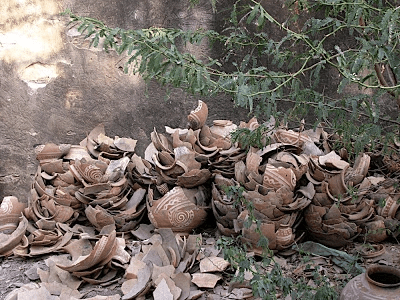
“Then break the jar while those who go with you are watching, and say to them, ‘This is what the Lord Almighty says: I will smash this nation and this city just as this potter’s jar is smashed and cannot be repaired. They will bury the dead in Topheth until there is no more room. This is what I will do to this place and to those who live here, declares the Lord. I will make this city like Topheth. The houses in Jerusalem and those of the kings of Judah will be defiled like this place, Topheth—all the houses where they burned incense on the roofs to all the starry hosts and poured out drink offerings to other gods.’”

Jeremiah then returned from Topheth, where the Lord had sent him to prophesy, and stood in the court of the Lord’s temple and said to all the people, “This is what the Lord Almighty, the God of Israel, says: ‘Listen! I am going to bring on this city and all the villages around it every disaster I pronounced against them, because they were stiff-necked and would not listen to my words.’” (New International Version)
When God wants to get someone’s full attention, the Lord engages the people’s full senses in order to communicate an important message. Through the prophet Jeremiah, we get symbolic action that does just that.

The symbolism, in this case, is a judgment speech, visually and viscerally depicted through the breaking of a pottery jug. The point of the action, and the words, was meant to convey a singular message: God will bring disaster and destruction against Jerusalem and its surrounding towns.

The act of breaking the pottery took place at the entrance to the Potsherd Gate – which was also known as the Dung Gate because that is where the garbage and refuse came out of the city to a dump located in the Valley of Ben Hinnom. It just so happened that this valley was also the location of altars to false gods other than Yahweh. Idolatrous practices – including child sacrifice – were carried on there.

In the ancient Near East, smashing pottery was a ritual act that depicted the destruction of enemies.

I will proclaim the Lord’s decree:

He said to me, “You are my son;
    today I have become your father.
Ask me,
    and I will make the nations your inheritance,
    the ends of the earth your possession.
You will break them with a rod of iron;
    you will dash them to pieces like pottery.” (Psalm 2:7-9, NIV)

The prophet Jeremiah was going to make his oracle against the people both unforgettable and irreversible. He wanted to be clear about what God truly thinks about harming children in religious rituals. But more than that, that it’s absolutely unacceptable for people who worship Yahweh to let it happen, just outside their own city gates, and to even participate in it.

The pottery jar represented Jerusalem. And when a piece of pottery is broken and smashed, there is no opportunity of remaking it from all that destruction. That’s what it would be like for the city who turned their backs on the Lord’s holiness.

Sometimes contemporary people may struggle with the reality that God gets angry – even angry to the point of pouring out wrath on a city. Yet, perhaps we fail to notice the gross and terrible injustice that has been done in the name of religion. The anger of God is always a reflection of God’s love. For love cannot contend with evil perpetrated on innocent people, especially children.

Love is purely subversive. It declares that harming others and hurting people by means of religious violence is not to be accepted nor tolerated. Love is an absolute refusal to settle for the injustice that exists in the world.

Today, and every day, is our opportunity, purpose, and privilege to put love where love is not – to upset the status quo of injustice and establish love as the supreme ethic of God’s commands.

Grant us, Lord God, a vision of your world as your love would have it:
a world where the weak are protected, and none go hungry or poor;
a world where the riches of creation are shared, and everyone can enjoy them;
a world where different races and cultures live in harmony and mutual respect;
a world where peace is built with justice, and justice is guided by love.
Give us the inspiration and courage to build it, through Jesus Christ our Lord. Amen.

Jesus the King (Mark 11:1-11)

Entry Into the City, by John August Swanson (1938-2021)

As they approached Jerusalem and came to Bethphage and Bethany at the Mount of Olives, Jesus sent two of his disciples, saying to them, “Go to the village ahead of you, and just as you enter it, you will find a colt tied there, which no one has ever ridden. Untie it and bring it here. If anyone asks you, ‘Why are you doing this?’ say, ‘The Lord needs it and will send it back here shortly.’”

They went and found a colt outside in the street, tied at a doorway. As they untied it, some people standing there asked, “What are you doing, untying that colt?” They answered as Jesus had told them to, and the people let them go. When they brought the colt to Jesus and threw their cloaks over it, he sat on it. Many people spread their cloaks on the road, while others spread branches they had cut in the fields. Those who went ahead and those who followed shouted,

“Hosanna!”

“Blessed is he who comes in the name of the Lord!”

“Blessed is the coming kingdom of our father David!”

“Hosanna in the highest heaven!”

Jesus entered Jerusalem and went into the temple courts. He looked around at everything, but since it was already late, he went out to Bethany with the Twelve. (New International Version)

We are presently in the 12 Days of Christmas (December 25–January 5), the annual celebration of Christ’s birth on the Christian Calendar. It may seem odd that the Revised Common Lectionary daily readings have included a text associated with Palm Sunday. However, this is reminder to us that Jesus was born a king – which is why old King Herod saw a little baby as such a threat. (Matthew 2:1-18)

“Christ” is not the surname of Jesus, but instead is a title, meaning “anointed one.” In other words, in the New Testament Gospels, Jesus is referred to as an anointed king. It was broadly understood, within the religious milieu of the ancient Jews, that the Messiah (the Hebrew term for Christ) would come and beat up God’s enemies, restore God’s people to their former glory, and usher in an everlasting state of peace.

Jerusalem had a history as the royal city – the place where ancient Jewish kings lived and ruled. So, most ancient Jews made a clear connection between the Messiah, the king, returning to reign in Jerusalem. They anticipated that the City of David would once again be the seat of power, without any meddling Gentiles to complicate things.

Nativity, by John August Swanson

So, when Jesus entered Jerusalem – in what turned out to be the final week of his earthly life – many people looked upon this as a triumphal entry. He was close to ascending the ancient throne. The disciples of Jesus were waiting for this, and ready for a future of greatness and glory alongside their Rabbi.

Not only did people lay their palm fronds on the road in front of him declaring the ancient refrain, “Blessed is he who comes in the name of the Lord!” (Psalm 118:26) but they also added an explicit reference to the days of King David stating, “Blessed is the coming kingdom of our ancestor David!” The city was awash in the messianic hope of no longer being subject to foreign rule.

Yet we know the tragic and ironic end of the week. Jesus knew it, too, even at the time. He knew what fate awaited him by entering Jerusalem (Mark 8:31; 10:33-34). And Jesus knew without a shadow of a doubt that he was not going to be a king who gains and keeps power through military might and the bloodshed of war. Instead, only his own blood would be offered, as a sacrifice for many. The power of Love will overcome any and every earthly power.

Those with the eyes to see and the spirit to discern could understand this Jesus riding on a humble donkey instead of the proud warhorse. It made complete sense. Jesus did not enter this world with the fanfare of the rich and powerful, but quietly slipped onto the earth in a non-descript and poor Jewish family. His birth, life, and ministry, were all counter cultural. So, why not also his eventual death, resurrection, ascension, and glorification?

Yes, Jesus is a king. But no, he is not a king in any conventional sense. It is Jesus, beginning with his incredible and unexpected incarnation, who helps us reimagine what power and authority can and ought to look like.

All the trappings of control we can get so enamored about, such as wielding influence through economic wealth, social status, political power, and religious weight, all get tossed aside as mere stuffed animals compared to the real deal of moral dignity, ethical love, and compassionate justice shown to people who had absolutely no ability to either pay back Jesus or prop up a throne for him to sit upon.

Jesus is a king who gives his life for the healing of humanity – all people everywhere – including the ones we don’t much like or care about. I have no problem calling Jesus a king, just as long as we understand what sort of kingship we are actually talking about.

I serve King Jesus because he throws a monkey wrench into oppressive systems that seek to keep other people under a heavy hand of injustice. My allegiance is with Christ the Lord because he uses his prodigious authority to bring peace, light, wholeness, and integrity to all the places of the world (and the human heart) that are dark and clueless.

Today I celebrate in this Christmas season the birth of a baby who was born to die to the world and for the world. I rejoice with the angels that Christ is born in Bethlehem, the king of kings and lord of lords, the prince of peace who himself became peace so that we might live in peace.

May you discover deliverance from guilt, shame, and regret, through the One who came and was wounded for us so that we might be healed. Amen.

Struggling to Accept (Habakkuk 2:1-5)

The prophet Habakkuk cries out to God, by Unknown 19th century artist

I will stand at my guard post.
I will station myself on the wall.
I will watch to see what he will say to me
and what answer I will get to my complaint.

Then the Lord answered me,
“Write the vision.
Make it clear on tablets
so that anyone can read it quickly.
The vision will still happen at the appointed time.
It hurries toward its goal.
It won’t be a lie.
If it’s delayed, wait for it.
It will certainly happen.
It won’t be late.

“Look at the proud person. He is not right in himself.
But the righteous person will live because of his faithfulness.
Also because wine is treacherous
he is arrogant and never rests.
He has a large appetite like the grave.
He is like death—never satisfied.
He gathers all the nations to himself.
He collects all the people to himself. (God’s Word Translation)

The prophet Habakkuk is unique among the prophetic books of the Old Testament. It is more an account of the prophet’s own wonderings and questions before God, than it is bringing a specific word from God to the people.

The book of Habakkuk revolves around the prophet’s queries to the Lord; the Lord’s responses; and the prophet’s struggles to wrap both his head and his heart around those answers.

Habakkuk struggled with the rampant sins of injustice and unrighteousness amongst his own people. He contended with God about how long all this was going to go on. Today’s Old Testament lesson is something of a lament – grieving the loss of justice and righteousness, and longing for God’s salvation from the nation’s troubles. Habakkuk was determination to name the evil, bring it before God, and wait with a determined spirit for a divine response.

The prophet asked a question, and waited for an answer. His complaint is an age old one. He was weary of seeing injustice day after day, of observing the arrogant and the wicked exploit the poor and the needy. He wanted to hear from God; and when the awaited response finally came, it wasn’t what Habakkuk was expecting.

Habakkuk’s first question is one that many today can relate to:

How long, O Lord, am I to cry for help,
but you will not listen?
I cry out to you, “There’s violence!”
yet you will not come to the rescue.
Why do you make me see wrongdoing?
And why do you watch wickedness? (Habakkuk 1:2-3, GW)

God answered the prophet’s question. And Habakkuk didn’t like the answer, at all:

I am going to send the Babylonians,
that fierce and reckless nation.
They will march throughout the earth
to take possession of lands that don’t belong to them. (Habakkuk 1:6, GW)

The problem with this answer, is that, even though the prophet’s own people were unjust and violent, the Babylonians were an even worse lot of people. It was nonsense to Habakkuk that God would use an evil nation to judge God’s own people. So, the prophet asked yet another question of God:

Why do you keep watching treacherous people?
Why are you silent when wicked people swallow those
who are more righteous than they are? (Habakkuk 1:13, GW)

There are many persons who freely admit they are sinful. There is a problem, however, when a person points to others whom they believe are more sinful than they are. Habakkuk, like many contemporary believers, essentially says, “Well, I’m a sinner. I’m not perfect. But I’m not like the Babylonians! They don’t even worship God! And they do a lot worse things than I do!”

If one wants divine judgment, then one must be content with whom it comes from, and how it is done. Otherwise, the person seeks to be the judge, instead of letting the Lord handle the trouble.

We all struggle with navigating the injustice of this world. People of faith will discern that they must trust the Lord by viewing God’s deliverance and actions with a big picture perspective. They remember that God has acted with faithfulness and justice in the past; and the Lord can do it again.

Believers may have to endure some dark valleys, hard circumstances, and plenty of suffering; yet they trust that God will show up. They only need to wait patiently for divine deliverance. Eventually, we all need to conclude with the prophet, after waiting and wrestling over God’s divine plan for the situation we don’t like:

Though the fig tree does not bud
    and there are no grapes on the vines,
though the olive crop fails
    and the fields produce no food,
though there are no sheep in the pen
    and no cattle in the stalls,
yet I will rejoice in the Lord,
    I will be joyful in God my Savior.

The Sovereign Lord is my strength;
    he makes my feet like the feet of a deer,
    he enables me to tread on the heights. (Habakkuk 3:17-19, NIV)

The prophet finally accepted the words of God; and, despite the circumstances, this willingness to receive those words opened to him the possibility to take joy and confidence yet again in the Lord.

God grant me the serenity to accept the things I cannot change; courage to change the things I can; and wisdom to know the difference. Living one day at a time; enjoying one moment at a time; accepting hardships as the pathway to peace; taking, as He did, this sinful world as it is, not as I would have it; trusting that He will make all things right If I surrender to His will; so that I may be reasonably happy in this life, and supremely happy with Him forever in the next. Amen.

Beat the Swords into Plowshares (Micah 4:1-5)

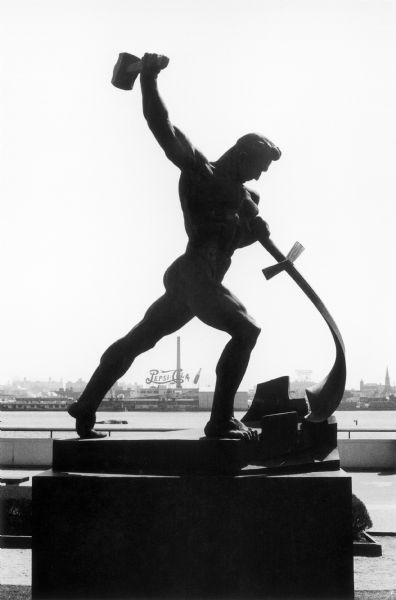
Let Us Beat Swords into Plowshares, by Yevgeniy Vuchetich (1908-1974)

In days to come
    the mountain of the Lord’s temple
shall be established as the highest of the mountains
    and shall be raised up above the hills.
Peoples shall stream to it,
    and many nations shall come and say:
“Come, let us go up to the mountain of the Lord,
    to the house of the God of Jacob,
that he may teach us his ways
    and that we may walk in his paths.”
For out of Zion shall go forth instruction,
    and the word of the Lord from Jerusalem.
He shall judge between many peoples
    and shall arbitrate between strong nations far away;
they shall beat their swords into plowshares
    and their spears into pruning hooks;
nation shall not lift up sword against nation;
    neither shall they learn war anymore;
but they shall all sit under their own vines and under their own fig trees,
    and no one shall make them afraid,
    for the mouth of the Lord of hosts has spoken.

For all the peoples walk,
    each in the name of its god,
but we will walk in the name of the Lord our God
    forever and ever. (New Revised Standard Version)

Yes, we are presently in the muck of the world. But no, it will not always be this way. There is a time coming, when all is said and done, when justice shall prevail. People will seek after God, and they will stop thinking about how to kill each other.

Weapons will be a thing of the past. They’ll just be repurposed for fostering life instead of death. Peace and security will take hold so that each person will be able to work and rest without worrying about poverty or protection.

If this sounds like an idyllic world and a utopian society, that’s because it is. I believe there is a longing within each of us to realize this hope. And someday, in God’s good time, it will happen.

It seems almost impossible, in this contemporary world of ours, that we could live without constant fear and anxiety, that people could actually live together in unity, harmony, and wholeness of being. We were meant for peace, which is why we yearn for it more than an Iowa boy yearning for bacon at breakfast.

Just because this is a prophetic utterance that the faithful believe will happen, doesn’t mean that we need not work toward this ideal now. For it is very possible, and likely real, that we have a large part to play in God’s drama of making a new world.

The day of the Lord will come like a thief. The heavens will disappear with a roar; the elements will be destroyed by fire, and the earth and everything done in it will be laid bare. Since everything will be destroyed in this way, what kind of people ought you to be? You ought to live holy and godly lives as you look forward to the day of God and speed its coming. (emphasis mine, 2 Peter 3:10-12, NIV)

If we are impatient to see an end to wars and rumors of wars, of oppression and hate, then let’s roll up our sleeves and do everything humanly possible (and trusting in divine power!) to bring justice everywhere we can. The future idyllic hope we have is not yet a present reality. We have a bit of say whether it’s going to be sooner or later.

It’s easy to destroy. It takes little imagination and effort to criticize and tear down someone with our words. It’s nothing to send missiles and rockets of destruction in order to raze a community. Bombs can be dropped with but a switch. A neighborhood can disappear in days with just a few bulldozers.

But to bring life and security and peace to a people requires our best efforts and everything we’ve got to make it happen. It’s hard, and takes a lot of committed sweaty work. Building something that will last always takes a great deal of time, resolve, and struggle.

We need the hard work of healers, not the easy path of harmers; we need peacemakers, not warmongers; public servants, not public strangers; faithful leaders, not fat louses; arbitrators, not disputers; religious penitents, not pious know-it-alls; and lovers, not haters.

In short, we need a whole cadre of caring citizens for a new society that prizes egalitarian relations, social and economic justice, personal and public righteousness, and compassionate service.

Injustice must be dismantled; and we need to become content with having enough. That’s what it means to walk in the name of the Lord our God.

If all things belong to God (which they do) and believers hold all things loosely as stewards (which they should) then there is no need to dig in and defend something which is not ours to begin with. Fear is taken away. Injustice becomes irrelevant.

Although we may not be able to make everything right in this present evil age, we can still make a difference and continue to pray:

Maranatha. Come, Lord Jesus, come. Amen.