Fight, Flight, Freeze, or Faith (Psalm 11)

I have taken refuge in the Lord.
    So how can you say to me,
    “Flee to the hills like a bird
        because the wicked
        have already bent their bows;
        they’ve already strung their arrows;
        they are ready to secretly shoot
        those whose heart is right”?
When the very bottom of things falls out,
    what can a righteous person possibly accomplish?

But the Lord is in his holy temple.
    The Lord! His throne is in heaven.
His eyes see—
    his vision examines all of humanity.
The Lord examines
    both the righteous and the wicked;
    his very being hates anyone who loves violence.
God will rain fiery coals and sulfur on the wicked;
    their cups will be filled
    with nothing but a scorching hot wind
    because the Lord is righteous!
    He loves righteous deeds.
    Those whose heart is right will see God’s face. (Common English Bible)

We all know what it feels like to take the brunt of someone’s poison verbal darts. It’s scary and stressful. What do you do? In a state of fear, shock, or panic, we will likely either fight, flight, freeze, or faith.

Fight

If you have ever received a nasty email based on half-truths and accusations; stood dumbfounded as someone hurled misinformation and criticism at you; and/or experienced the victimization that comes from slanderous and gossiping tongues, then the psalmist knows exactly how you feel. 

Cobbling together a hasty email response, full of anger and vitriol, only sucks us into the person’s evil ways. Metaphorically punching someone in the face for their slap to your face is how the demonic realm handles offenses. Fighting back with an equal or greater force is diametrically opposed to the way of Jesus in loving our enemies and praying for those who persecute us.

Flight

Then, there is the response of taking flight from the nastiness. Indeed, it sometimes seems as if good people are always getting swallowed whole by unjust words and behaviors directed squarely at them. 

And it doesn’t help when the downers among us stroll along and give us their unhelpful fatalism about how there is nothing we can do and how nothing will ever change.

Freeze

Some folks are just plain dumbfounded that another person can be so mean or controlling, so they freeze, unable to speak or do anything. They end up suffering in silence, without their victimization having a voice.

Faith

To be the target of evil speech or malevolent actions is, at the least, unsettling, and, at worst, can bring years of struggle, depression, and inability to serve. Yet, there is someone who sees it all, and that someone will address the wrong. 

We have an option beyond fighting back in anger, fleeing altogether in fear, or freezing in our tracks. We can trust God. We can have faith.

God Sees

The Lord sits aloft, overseeing all, and knows everything humanity does and says. God always does right and wants justice done. Everyone who shares a divine sense of what is right and just will see God’s face. God will act because the Lord abhors and despises those who are cruel and enjoy violence.

It’s not a good idea to get on God’s bad side. The way to flare God’s anger is by possessing an acerbic tongue; relishing in verbal violence; and, having no remorse about any of it. Because God loves people, God hates evil. 

The righteous can take solace in the truth that God really does see the harm done and is in a position to do something about it. Like the psalmist, we seek the Lord. The Lord fights our battles.
Not Okay

Whenever we are harassed and the ungodly give us a hard time, the psalmist isn’t offering some nice religious platitudes such as, “Just let go and let God,” “Everything works for the good of those who love God,” or “It’s okay, you’ll be in heaven someday.”

In another context, maybe those statements are helpful. But being in the teeth of the wicked, all is not okay. As much as some folks try to sanitize an evil situation with rainbows and butterflies, the evil is real, and it’s there.

The truth is that everything is not okay. And it’s okay to not feel okay. The earth is filled with violence, malevolence, oppression, injustice, and systemic evil. The psalmist knows this, all too well.

Humble yourselves under God’s power so that he may raise you up in the last day. Throw all your anxiety onto him because he cares about you.

1 Peter 5:6-7, CEB

God Acts

Today’s psalm is reminding and reassuring us that the Lord is aware of what’s going on and will most certainly do something about it. God will act to punish the wicked and deliver the Lord’s people.

There may not be peace this present moment, yet it will not always be this way. We shall behold the face of the Lord.

The Lord is a righteous judge. Justice is the foundation of God’s throne. God sees the entire spectrum of humanity and can make a right assessment of people’s thoughts, intents, words, and actions.

We, however, cannot. Therefore, it is most necessary for us to put our trust in a Divine Being who cares about right and wrong and has the power to act with justice.

Whenever we are hemmed-in through the schemes of diabolical persons and are powerless, there is always the choice to trust in the Lord. The outcome of every life on earth rests in the hands of God. And it will be a just and right rendering.

Trust in the Lord and do good. Seek peace and pursue it. We might struggle mightily on both the inside and outside – our hard circumstance might not change immediately – yet God is the One who will vindicate the just person when the time is right.

You are not alone. The Lord is with you always.

God of justice, look at the state of your servant and act on my behalf. Do not let evil prevail. Thwart the ungodly so that they can no longer do any harm. Amen.

Divine Goodness, Despite Human Ingratitude (Psalm 78:23-29)

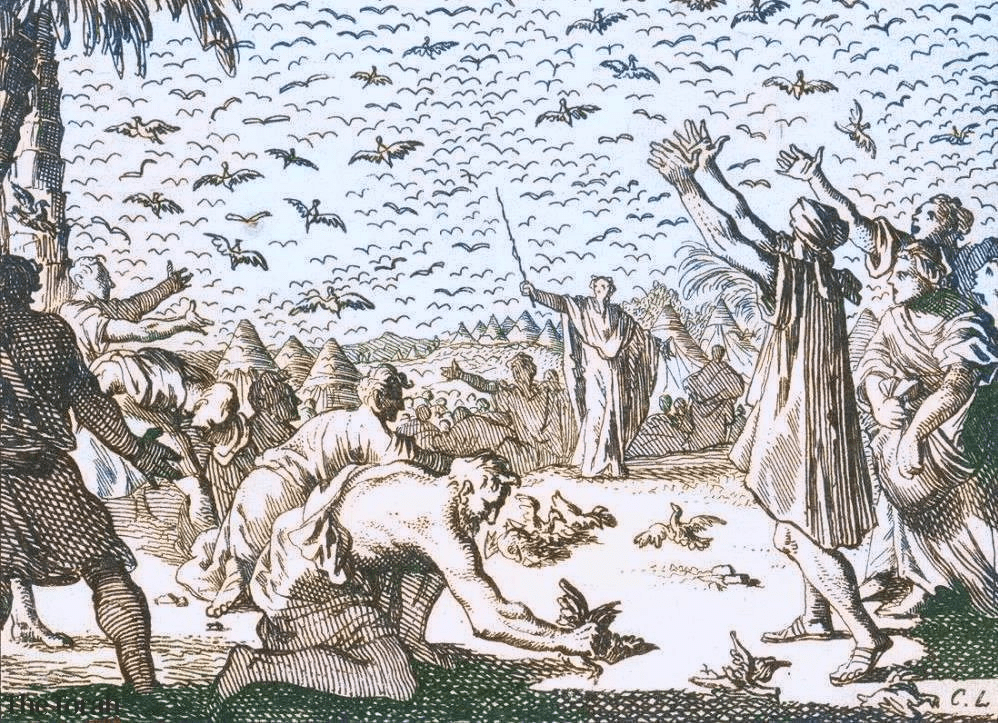
Quail in the Wilderness, by Caspar Luyken, 1698

Yet he commanded the skies above
    and opened the doors of heaven;
he rained down on them manna to eat
    and gave them the grain of heaven.
Mortals ate of the bread of angels;
    he sent them food in abundance.
He caused the east wind to blow in the heavens,
    and by his power he led out the south wind;
he rained flesh upon them like dust,
    winged birds like the sand of the seas;
he let them fall within their camp,
    all around their dwellings.
And they ate and were well filled,
    for he gave them what they craved. (New Revised Standard Version)

Today’s psalm is the second longest in the psalter (72 verses, with Psalm 119 the longest at a hefty 176 verses). Along with Psalms 105-106, Psalm 78 remembers and rehearses the history of Israel. This is a psalm which is meant for teaching and passing on important lessons.

The upshot of this psalm’s historical recollection is that the people’s ancestors were faithless; therefore, those reading the psalm now should live differently in a positive life of goodness, having observed how the past actors serve as a negative example of ingrates.

The psalmist, Asaph, viewed past events as highly informative for present circumstances. His purpose for crafting the psalm was explicit. He wanted the people:

 to put their hope in God—
        never forgetting God’s deeds,
        but keeping God’s commandments—
    and so that they won’t become like their ancestors:
    a rebellious, stubborn generation,
        a generation whose heart wasn’t set firm
        and whose spirit wasn’t faithful to God. (Psalm 78:7-8, CEB)

The verses for today’s lectionary reading have a unique place within the psalmist’s rehearsal of the past. They connect to the previous section (verses 9-22) which recounts the Lord’s angry response concerning Israel’s unbelief and rebellion.

In many ways, Psalm 78 has a consistent theme of human stubbornness, lack of faith, and wanting to do their own thing apart from God. Bucking God’s covenant code and moral law was ever-present in Israel’s history. And yet…

The Lord remained the same: Faithful and true. Furthermore, God stubbornly showed steadfast divine love and covenant loyalty to the people, despite their herky-jerky commitment and fickle faith.

Manna from heaven

Although the theme of human failure runs throughout the psalm, the dominant idea points to God’s gracious mercy, eternal faithfulness, and steadfast love. Most of all, the psalmist wanted his readers to remember the goodness and grace of God.

The people’s unbelief in no way stymied the promises of God. That’s because salvation and deliverance, faith and hope, do not originate and are not sustained by humans, but by the Lord God almighty who created heaven and earth.

Even though the people were faithless, and thus, had no trust in God’s power; nevertheless, the Lord opened the doors of heaven in order to meet the needs of people who did not deserve divine help.

The verses for today remember the story of God’s provision of manna and quail in the desert (Exodus 16). The Lord was gracious, merciful, and kind to the Israelites, despite their incessant grumbling. God responded to them because of their sheer need, and not because of any righteousness coming from them.

God not only provided food, but gave the manna in abundance, and the quail in superabundance. The contrast could not be any more glaring: Israel murmured, grumbled, complained, and demonstrated a lack of faith; God granted the Israelites a ridiculous amount of food, and evidenced steadfast faithfulness to the covenant.

The supreme goodness of God brings out, in stark relief, the incredible foolishness of Israel’s attitude. In the Exodus account, while the meat was still in their mouths, God’s anger flared because of the people’s recalcitrance.

On the surface, the divine response of judgment may appear out of sorts to the divine grace shown to Israel. Yet, the Lord cares about the holistic needs of people, and not only in giving sustenance.

God wants faithful and obedient people. The Lord desires goodness, righteousness, and justice to be the hallmark of the community.

To have your belly full and your spirit empty is an affront to God – because the Lord is good, right, and just, and does not tolerate impertinence, impudence, and impetuousness. Vice and ingratitude only makes a person an imbecile who is worthless to their fellow humanity.

Divine punishment – anywhere you find it in Holy Scripture – is meant to draw people back into relationship with God. Another way of phrasing this, is that God delivers people and grants them freedom, so that they will have no obstacles toward living a good, right, and just life.

No matter the response of God – whether it is by miraculous provision or by divine punishment – it’s always a response of grace; the Lord consistently acts from a place of compassion and commitment to doing what is best for the community.

Whereas the Israelites repeatedly cycled themselves through spirals of faith and unbelief, gratitude and grumbling, obedience and disobedience; God, however, constantly demonstrated the presence of grace and mercy, righteousness and justice, holiness and love.

The only reason the Israelites (and the entire human race, for that matter) are not wiped out is because God forgave their iniquity and did not destroy them. What’s more, the Lord didn’t even let them destroy themselves, unwittingly by their own unawareness and foolishness. (Psalm 78:36-39)

I am profoundly glad that God is the bigger person in the relationship with humanity. The Lord is continually mindful of who we are, as well as God’s own divine essence and power.

Yet he, being compassionate,
    forgave their iniquity
    and did not destroy them;
often he restrained his anger
    and did not stir up all his wrath.
He remembered that they were but flesh,
    a wind that passes and does not come again. (Psalm 78:38-39, NRSV)

As people created in the image and likeness of God, we find our highest joy and greatest fulfillment in receiving the good things from God with gratitude; and of giving goodness to others in a spirit of love – no matter what.

Gracious and almighty God: Open wide the eyes of my soul that I may see the good in all things. Grant me today a new vision of your truth. Inspire me with the spirit of joy and gladness. Make me a cup of strength to suffering souls. Amen.

Avoid the Downward Spiral (Judges 6:1-10)

The Israelites did evil in the eyes of the Lord, and for seven years he gave them into the hands of the Midianites. Because the power of Midian was so oppressive, the Israelites prepared shelters for themselves in mountain clefts, caves and strongholds. Whenever the Israelites planted their crops, the Midianites, Amalekites and other eastern peoples invaded the country. 

They camped on the land and ruined the crops all the way to Gaza and did not spare a living thing for Israel, neither sheep nor cattle nor donkeys. They came up with their livestock and their tents like swarms of locusts. It was impossible to count them or their camels; they invaded the land to ravage it. Midian so impoverished the Israelites that they cried out to the Lord for help.

When the Israelites cried out to the Lord because of Midian, he sent them a prophet, who said, “This is what the Lord, the God of Israel, says: I brought you up out of Egypt, out of the land of slavery. I rescued you from the hand of the Egyptians. And I delivered you from the hand of all your oppressors; I drove them out before you and gave you their land. I said to you, ‘I am the Lord your God; do not worship the gods of the Amorites, in whose land you live.’ But you have not listened to me.” (New International Version)

Frankly, the biblical Book of Judges is rather depressing. Its descriptive arc is a sad downward spiral of forgetfulness and disobedience – with the people crying out for deliverance and being saved – and then another slide, even lower than before, into memory issues, and negligence of the law.

Newer and greater levels of depravity occur, the further one reads into the Book of Judges. Indeed, early in the book we are given the reason for such an immoral and idolatrous slide:

The people served the Lord throughout the lifetime of Joshua and of the elders who outlived him and who had seen all the great things the Lord had done for Israel…

After that whole generation had been gathered to their ancestors, another generation grew up who knew neither the Lord nor what he had done for Israel. Then the Israelites did evil in the eyes of the Lord and served the Baals. They forsook the Lord, the God of their ancestors, who had brought them out of Egypt. They followed and worshiped various gods of the peoples around them. They aroused the Lord’s anger because they forsook him and served Baal and the Ashtoreths. 

In his anger against Israel the Lord gave them into the hands of raiders who plundered them. He sold them into the hands of their enemies all around, whom they were no longer able to resist. Whenever Israel went out to fight, the hand of the Lord was against them to defeat them, just as he had sworn to them. They were in great distress. (Judges 2:7, 10-15, NIV)

In today’s Old Testament lesson, yet another round of disobedience brought yet another threat, in the form of the Midianites and Amalekites. Midian’s annual raids of Israelite land destroyed crops and led to the livestock eventually starving. The people were left just trying to eek-out a living and survive.

The Midianites were a nomadic people, subsisting mostly through trade. They were not farmers, and really did not need to raid Israel. It seems they came and did their damage just to keep Israel weak and under their thumb, unable to compete in the caravan markets that Midian depended upon.

The story of crop destruction, and Midianites as thick as locusts, communicates divine judgment and connects with Joshua’s warning to remember God and be faithful to the covenant law:

“If you violate the covenant of the Lord your God, which he commanded you, and go and serve other gods and bow down to them, the Lord’s anger will burn against you, and you will quickly perish from the good land he has given you.” (Joshua 23:16, NIV)

The Israelites cried out in their distress to God for deliverance. They were answered by an unknown prophet who clearly connected the people’s disloyalty to their adverse situation. Although Canaanite gods may have been tolerant of worshiping other deities, the Lord, Israel’s God, is certainly not.

In the case of the ancient Israelites, the people’s disobedience caused their suffering. The prophet did not promise any sort of deliverance. And the distressed people were left wondering if they had been abandoned by God.

This entire situation is a set up for the character of Gideon, who will come on the scene as one of the dominant deliverers in the Book of Judges. And Gideon’s story further illustrates the ever-increasing relationship between Israel, Canaan, and immoral behavior.

By the time we get to the end of the book, there is a sort of morbid and depressing anarchy that has settled amongst the people, ending in the statement:

In those days Israel had no king; everyone did as they saw fit. (Judges 21:26, NIV)

That was not a statement of freedom, but of depravity. It was almost like living in a dystopian society in which nobody was really safe.

Yet God always has had a remnant of people who are faithful and remember the great things which the Lord has done.

So, if we want to avoid the downward spiral in the Book of Judges, the believer is encouraged to keep memory of God’s works, words, and ways in this world; and to remain faithful in obeying God’s law and embracing God’s love.

We need the law of love, and the love of law, in order to rightly relate to our neighbor and be concerned for the common justice of all persons – instead of living in a bubble of supposed safety, doing only what seems right to me.

Lord God, almighty and everlasting Father, you have brought us in safety to this new day: Preserve us with your mighty power, that we may not fall into sin, nor be overcome by adversity; and in all we do, direct us to the fulfilling of your purpose; through Jesus Christ our Lord. Amen.

Seeking God in Hard Times (Psalm 9:9-20)

By Bible Art

The Lord is a safe place for the oppressed—
    a safe place in difficult times.
Those who know your name trust you
    because you have not abandoned
    any who seek you, Lord.

Sing praises to the Lord, who lives in Zion!
    Proclaim his mighty acts among all people!
Because the one who avenges bloodshed
    remembers those who suffer;
    the Lord hasn’t forgotten their cries for help.

Have mercy on me, Lord!
    Just look how I suffer
    because of those who hate me.
But you are the one who brings me back
    from the very gates of death
        so I can declare all your praises,
        so I can rejoice in your salvation
        in the gates of Daughter Zion.

The nations have fallen
    into the hole they themselves made!
    Their feet are caught
        in the very net they themselves hid!
The Lord is famous for the justice he has done;
    it’s his own doing that the wicked are trapped.

Let the wicked go straight to the grave,
    the same for every nation that forgets God.

Because the poor won’t be forgotten forever,
    the hope of those who suffer won’t be lost for all time.

Get up, Lord! Don’t let people prevail!
    Let the nations be judged before you.
Strike them with fear, Lord.
    Let the nations know they are only human. (Common English Bible)

I firmly believe that there is hopeful comfort in the Lord – that when people go through awful things, God is there to be a safe place for them.

I also believe that, in the end, good triumphs and evil perishes. That’s because I am convinced that the Lord is an equitable judge; God hears the cries of defenseless righteous victims and acts on behalf of the oppressed without prejudice or favoritism.

Yet, that does not mean God’s people will always be inoculated from trouble, hardship, and adversity. What it does mean is that the Lord is with us, and that God loves us.

Everyone goes through difficult times. Some folks endure horrible trauma. And those experiences can dog us and torment us, even long after the event. Even in good times, we might sometimes become anxious or frantic without any real threat in front of us.

We may want to praise God with genuineness and sincerity. However, we might not yet feel vindicated or released. And there still may be some unjust suffering going on. We long to declare the goodness of God, but we also want to do so with a testimony of deliverance and healing.

That is precisely how the psalmist felt. He knows the wicked won’t endure, but he also wants to give praise to the Lord for seeing them sink in the sinister pit they’ve dug for others.

God is a righteous judge. And there are times when the Lord brings judgment upon evil by letting the wicked self-destruct with their own words and behavior. In other words, God at times engages in direct judgment, and other times lets the moral gravity of the earth crush them in their duplicitous crimes.

Whenever circumstances are hard, it’s easy to feel forgotten, as if no one sees or hears our suffering; they don’t realize the depth of our hurt by a wicked person. It’s appropriate, as the psalmist did, to cry out and plead with God to rise up on behalf of the weak and powerless; and to call for an end of the mindless and godless insanity of arrogant people.

It is equally hard to observe others we care about experience oppression. We cry out to the Lord on their behalf, that they will no longer have to endure such injustice. We want our loved ones to thrive and enjoy life and thrive – not to be crushed under an unjust burden from selfish people who only care about themselves.

We boldly ask God to knock them off the evil hill they’ve built for themselves – to blot them out because of their continual oppression of the righteous. The wicked think no one can touch them atop their proud strong perch. They believe they’re above accountability and can get away with anything. That makes us angry!

Whenever we are wronged or treated unfairly – or observe another person or group of people experiencing injustice – it stirs up our anger.

Anger, in and of itself, is neither good nor bad. It just is. It’s what we do with our anger that gets dicey. A lot of human anger gets expressed in unhealthy ways by either passively stuffing it and ignoring it; aggressively lashing out with verbal and/or physical violence; or passive-aggressively doing indirect jabs at the object of our anger.

The psalmist, however, is assertive with his anger. He offered straightforward observations with definite feelings to God. He also affirmed that the Lord is the One who administers justice with fairness and equity.

There are times when only God can bring an evil system, institution, organization, government, nation, group of people, or individual to heel.

When the poor are overlooked or oppressed by the rich, it’s unjust. It creates anger, both human and divine. In their misery and hardship, the needy can flee to God, who is faithful to care for them and treat them with respect and dignity, as people carrying the divine image.

The nations of the earth are not all attentive to the needy. They don’t all serve their citizens and try to do right by them. Unfortunately, many people throughout the world groan under national leadership which is enamored with power and privilege – and forget those who are powerless, unable to lift themselves by their bootstraps.

In the teeth of such a reality, the psalmist petitioned God. He asked, even insisted, that God step in and act as judge and jury. It was an assertive use of anger that went to the source of true help, to the Lord, who possesses both the will and the ability to overturn injustice and establish a right use of power.

Do you know what I want? I want justice—oceans of it. I want fairness—rivers of it. That’s what I want. That’s all I want.

Amos 5:24, MSG

The Lord, thankfully, is a strong fortress for the oppressed and a protective force in times of trouble.

God remembers the prayers of the down-and-out.

Sooner, or later, those who are wicked in their dealings through exploitation of the powerless, will know firsthand that they are puny humans, and that God is immensely big.

God almighty, you have given all peoples one common origin. It is your will they be gathered together as one family in yourself. Fill the hearts of humanity with the fire of your love and with the desire to ensure justice for all.

By sharing the good you give us, may we ensure equity for all our brothers and sisters throughout the world. May there be an end to division, strife and war. May there be a dawning of a truly human society built on love and peace, through Jesus Christ, our Lord. Amen.