

Against Injustice (Jeremiah 19:1-15)

This is what the Lord says: “Go and buy a clay jar from a potter. Take along some of the elders of the people and of the priests and go out to the Valley of Ben Hinnom, near the entrance of the Potsherd Gate. There proclaim the words I tell you, and say, ‘Hear the word of the Lord, you kings of Judah and people of Jerusalem. This is what the Lord Almighty, the God of Israel, says:

Listen! I am going to bring a disaster on this place that will make the ears of everyone who hears of it tingle. For they have forsaken me and made this a place of foreign gods; they have burned incense in it to gods that neither they nor their ancestors nor the kings of Judah ever knew, and they have filled this place with the blood of the innocent. 

They have built the high places of Baal to burn their children in the fire as offerings to Baal—something I did not command or mention, nor did it enter my mind. So beware, the days are coming, declares the Lord, when people will no longer call this place Topheth or the Valley of Ben Hinnom, but the Valley of Slaughter.

“‘In this place I will ruin the plans of Judah and Jerusalem. I will make them fall by the sword before their enemies, at the hands of those who want to kill them, and I will give their carcasses as food to the birds and the wild animals. I will devastate this city and make it an object of horror and scorn; all who pass by will be appalled and will scoff because of all its wounds. I will make them eat the flesh of their sons and daughters, and they will eat one another’s flesh because their enemies will press the siege so hard against them to destroy them.’

“Then break the jar while those who go with you are watching, and say to them, ‘This is what the Lord Almighty says: I will smash this nation and this city just as this potter’s jar is smashed and cannot be repaired. They will bury the dead in Topheth until there is no more room. This is what I will do to this place and to those who live here, declares the Lord. I will make this city like Topheth. The houses in Jerusalem and those of the kings of Judah will be defiled like this place, Topheth—all the houses where they burned incense on the roofs to all the starry hosts and poured out drink offerings to other gods.’”

Jeremiah then returned from Topheth, where the Lord had sent him to prophesy, and stood in the court of the Lord’s temple and said to all the people, “This is what the Lord Almighty, the God of Israel, says: ‘Listen! I am going to bring on this city and all the villages around it every disaster I pronounced against them, because they were stiff-necked and would not listen to my words.’” (New International Version)
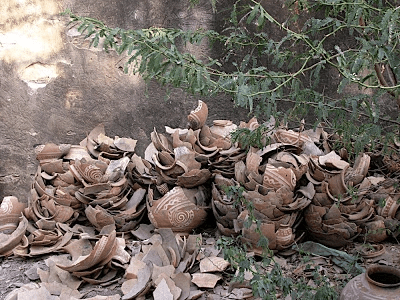
When God wants to get someone’s full attention, the Lord engages the people’s full senses in order to communicate an important message. Through the prophet Jeremiah, we get symbolic action that does just that.

The symbolism, in this case, is a judgment speech, visually and viscerally depicted through the breaking of a pottery jug. The point of the action, and the words, was meant to convey a singular message: God will bring disaster and destruction against Jerusalem and its surrounding towns.

The act of breaking the pottery took place at the entrance to the Potsherd Gate – which was also known as the Dung Gate because that is where the garbage and refuse came out of the city to a dump located in the Valley of Ben Hinnom. It just so happened that this valley was also the location of altars to false gods other than Yahweh. Idolatrous practices – including child sacrifice – were carried on there.

In the ancient Near East, smashing pottery was a ritual act that depicted the destruction of enemies.

I will proclaim the Lord’s decree:

He said to me, “You are my son;
    today I have become your father.
Ask me,
    and I will make the nations your inheritance,
    the ends of the earth your possession.
You will break them with a rod of iron;
    you will dash them to pieces like pottery.” (Psalm 2:7-9, NIV)

The prophet Jeremiah was going to make his oracle against the people both unforgettable and irreversible. He wanted to be clear about what God truly thinks about harming children in religious rituals. But more than that, that it’s absolutely unacceptable for people who worship Yahweh to let it happen, just outside their own city gates, and to even participate in it.

The pottery jar represented Jerusalem. And when a piece of pottery is broken and smashed, there is no opportunity of remaking it from all that destruction. That’s what it would be like for the city who turned their backs on the Lord’s holiness.

Sometimes contemporary people may struggle with the reality that God gets angry – even angry to the point of pouring out wrath on a city. Yet, perhaps we fail to notice the gross and terrible injustice that has been done in the name of religion. The anger of God is always a reflection of God’s love. For love cannot contend with evil perpetrated on innocent people, especially children.

Love is purely subversive. It declares that harming others and hurting people by means of religious violence is not to be accepted nor tolerated. Love is an absolute refusal to settle for the injustice that exists in the world.

Today, and every day, is our opportunity, purpose, and privilege to put love where love is not – to upset the status quo of injustice and establish love as the supreme ethic of God’s commands.

Grant us, Lord God, a vision of your world as your love would have it:
a world where the weak are protected, and none go hungry or poor;
a world where the riches of creation are shared, and everyone can enjoy them;
a world where different races and cultures live in harmony and mutual respect;
a world where peace is built with justice, and justice is guided by love.
Give us the inspiration and courage to build it, through Jesus Christ our Lord. Amen.

Struggling to Accept (Habakkuk 2:1-5)

The prophet Habakkuk cries out to God, by Unknown 19th century artist

I will stand at my guard post.
I will station myself on the wall.
I will watch to see what he will say to me
and what answer I will get to my complaint.

Then the Lord answered me,
“Write the vision.
Make it clear on tablets
so that anyone can read it quickly.
The vision will still happen at the appointed time.
It hurries toward its goal.
It won’t be a lie.
If it’s delayed, wait for it.
It will certainly happen.
It won’t be late.

“Look at the proud person. He is not right in himself.
But the righteous person will live because of his faithfulness.
Also because wine is treacherous
he is arrogant and never rests.
He has a large appetite like the grave.
He is like death—never satisfied.
He gathers all the nations to himself.
He collects all the people to himself. (God’s Word Translation)

The prophet Habakkuk is unique among the prophetic books of the Old Testament. It is more an account of the prophet’s own wonderings and questions before God, than it is bringing a specific word from God to the people.

The book of Habakkuk revolves around the prophet’s queries to the Lord; the Lord’s responses; and the prophet’s struggles to wrap both his head and his heart around those answers.

Habakkuk struggled with the rampant sins of injustice and unrighteousness amongst his own people. He contended with God about how long all this was going to go on. Today’s Old Testament lesson is something of a lament – grieving the loss of justice and righteousness, and longing for God’s salvation from the nation’s troubles. Habakkuk was determination to name the evil, bring it before God, and wait with a determined spirit for a divine response.

The prophet asked a question, and waited for an answer. His complaint is an age old one. He was weary of seeing injustice day after day, of observing the arrogant and the wicked exploit the poor and the needy. He wanted to hear from God; and when the awaited response finally came, it wasn’t what Habakkuk was expecting.

Habakkuk’s first question is one that many today can relate to:

How long, O Lord, am I to cry for help,
but you will not listen?
I cry out to you, “There’s violence!”
yet you will not come to the rescue.
Why do you make me see wrongdoing?
And why do you watch wickedness? (Habakkuk 1:2-3, GW)

God answered the prophet’s question. And Habakkuk didn’t like the answer, at all:

I am going to send the Babylonians,
that fierce and reckless nation.
They will march throughout the earth
to take possession of lands that don’t belong to them. (Habakkuk 1:6, GW)

The problem with this answer, is that, even though the prophet’s own people were unjust and violent, the Babylonians were an even worse lot of people. It was nonsense to Habakkuk that God would use an evil nation to judge God’s own people. So, the prophet asked yet another question of God:

Why do you keep watching treacherous people?
Why are you silent when wicked people swallow those
who are more righteous than they are? (Habakkuk 1:13, GW)

There are many persons who freely admit they are sinful. There is a problem, however, when a person points to others whom they believe are more sinful than they are. Habakkuk, like many contemporary believers, essentially says, “Well, I’m a sinner. I’m not perfect. But I’m not like the Babylonians! They don’t even worship God! And they do a lot worse things than I do!”

If one wants divine judgment, then one must be content with whom it comes from, and how it is done. Otherwise, the person seeks to be the judge, instead of letting the Lord handle the trouble.

We all struggle with navigating the injustice of this world. People of faith will discern that they must trust the Lord by viewing God’s deliverance and actions with a big picture perspective. They remember that God has acted with faithfulness and justice in the past; and the Lord can do it again.

Believers may have to endure some dark valleys, hard circumstances, and plenty of suffering; yet they trust that God will show up. They only need to wait patiently for divine deliverance. Eventually, we all need to conclude with the prophet, after waiting and wrestling over God’s divine plan for the situation we don’t like:

Though the fig tree does not bud
    and there are no grapes on the vines,
though the olive crop fails
    and the fields produce no food,
though there are no sheep in the pen
    and no cattle in the stalls,
yet I will rejoice in the Lord,
    I will be joyful in God my Savior.

The Sovereign Lord is my strength;
    he makes my feet like the feet of a deer,
    he enables me to tread on the heights. (Habakkuk 3:17-19, NIV)

The prophet finally accepted the words of God; and, despite the circumstances, this willingness to receive those words opened to him the possibility to take joy and confidence yet again in the Lord.

God grant me the serenity to accept the things I cannot change; courage to change the things I can; and wisdom to know the difference. Living one day at a time; enjoying one moment at a time; accepting hardships as the pathway to peace; taking, as He did, this sinful world as it is, not as I would have it; trusting that He will make all things right If I surrender to His will; so that I may be reasonably happy in this life, and supremely happy with Him forever in the next. Amen.

Becoming Holy (Isaiah 4:2-6)

And that’s when God’s Branch will sprout green and lush. The produce of the country will give Israel’s survivors something to be proud of again. Oh, they’ll hold their heads high! Everyone left behind in Zion, all the discards and rejects in Jerusalem, will be reclassified as “holy”—alive and therefore precious. God will give Zion’s women a good bath. He’ll scrub the bloodstained city of its violence and brutality, purge the place with a firestorm of judgment.

Then God will bring back the ancient pillar of cloud by day and the pillar of fire by night and mark Mount Zion and everyone in it with his glorious presence, his immense, protective presence, shade from the burning sun and shelter from the driving rain. (The Message)

One of the characteristics of Holy Scripture I deeply appreciate are the wonderful prose sections letting us, the readers and listeners, know that our longings for better days will come. There is a day coming when all of our good imaginings of the future shall be realized; and our present circumstances of hatred, discord, jealousy, and envy of one another shall be a thing of the past.

Unfortunately, we will likely (and biblically!) have to see some devastating and violent loss, and experience some terrible and awful destruction of both body and soul. All of the Old Testament prophets spoke messages of both judgment and grace, suffering and glory. Although hammered with ruin, biblical readers are given glimpses of hope to see the possibility of life beyond all of the carnage.

In other words, there will indeed be restoration and renewal. All shall not be lost forever. Death does not have the last word; resurrection does. It will happen because God has a determined resolve to find resilient ways of restoring the divine/human relationship back to its original and intended peaceful good.

It takes faith to have hope, and hope to have faith, and love to win the day forever. If God can create ex nihilo, out of nothing, then the Lord can reform and renew that which already exists, even though it may be in an awfully deformed state.

The ones who remain, the survivors, are the remnant of true believers, the people who hold onto faith and patience in the face of adversity, hardship, and difficulty. These are the dreamers, the seers, the prophets who foresaw both the need for divine judgment, and equally understood the promise of divine restoration.

The earth will once again be blessed. A rainbow of promise shall rise to remind us all that the storms which ravaged us have passed, never to return again.

But let us also clearly understand that it is because of human stubbornness, of hard-hearted people failing to love mercy and show steadfast love, that got us in this pickle of judgment to begin with. There comes a point when the repeated refusal to change, and use the gifts God has given us, leads to our shelf life on this earth coming to a moldy ruin. To be thrown into the divine incinerator is something brought on by us, not God.

Evil is like a cancer which must be purged from our existence so that we can be clean and healthy. The commands of God are not meant to keep people under a heavy divine thumb, but rather to help people live well in this world in a good healthy way. Living a holy life means that we participate in productive spiritual practices that strengthen faith and support the spirit.

People become “unclean” when they take a different path which is inconsistent with how we were designed by our Creator to live. It would be a bit like believing we can ignore all traffic laws and drive how we want, and then are surprised when we are nearly killed in an accident. Sadly, the unclean perish in their self-preoccupations, with God’s generosity completely off of their spiritual radar.

Yet, no matter where we’ve come from or what we have done, there is always the possibility of rehabilitation, of renewing our relationship to God, experiencing the divine presence, and receiving divine grace.

Getting in sync with the healthy spiritual forces of this universe is like having the ancient provision and protection of God’s pillar of cloud by day and fire by night – reassuring us that we are not alone and belong securely in the merciful arms of a loving Lord.

In Christianity, a holy life and a clean heart results from the person and work of Jesus Christ. God got down to it, taking the judgment we deserved and giving us grace. All of the temporary ritual cleanings merely pointed forward to the once for all scrubbing of the cross.

The blood of goats and bulls and the ashes of a heifer sprinkled on those who are ceremonially unclean sanctify them so that they are outwardly clean. How much more, then, will the blood of Christ, who through the eternal Spirit offered himself unblemished to God, cleanse our consciences from acts that lead to death, so that we may serve the living God!…

 and since we have a great priest over the house of God, let us draw near to God with a sincere heart and with the full assurance that faith brings, having our hearts sprinkled to cleanse us from a guilty conscience and having our bodies washed with pure water. Let us hold unswervingly to the hope we profess, for he who promised is faithful. (Hebrews 9:12-14, 10:21-23, NIV)

May you experience the blessing of becoming clean, and know the blessing of being holy and pure in all your relationships and activities. Amen.

Human Plans vs. Divine Plans (Micah 2:1-13)

The Prophet Micah Preaching, by Peter Gorban, 1990

Woe to those who plan iniquity,
    to those who plot evil on their beds!
At morning’s light they carry it out
    because it is in their power to do it.
They covet fields and seize them,
    and houses, and take them.
They defraud people of their homes,
    they rob them of their inheritance.

Therefore, the Lord says:

“I am planning disaster against this people,
    from which you cannot save yourselves.
You will no longer walk proudly,
    for it will be a time of calamity.
In that day people will ridicule you;
    they will taunt you with this mournful song:
‘We are utterly ruined;
    my people’s possession is divided up.
He takes it from me!
    He assigns our fields to traitors.’”

Therefore you will have no one in the assembly of the Lord
    to divide the land by lot.

“Do not prophesy,” their prophets say.
    “Do not prophesy about these things;
    disgrace will not overtake us.”
You descendants of Jacob, should it be said,
    “Does the Lord become impatient?
    Does he do such things?”

“Do not my words do good
    to the one whose ways are upright?
Lately my people have risen up
    like an enemy.
You strip off the rich robe
    from those who pass by without a care,
    like men returning from battle.
You drive the women of my people
    from their pleasant homes.
You take away my blessing
    from their children forever.
Get up, go away!
    For this is not your resting place,
because it is defiled,
    it is ruined, beyond all remedy.
If a liar and deceiver comes and says,
    ‘I will prophesy for you plenty of wine and beer,’
    that would be just the prophet for this people!

“I will surely gather all of you, Jacob;
    I will surely bring together the remnant of Israel.
I will bring them together like sheep in a pen,
    like a flock in its pasture;
    the place will throng with people.
The One who breaks open the way will go up before them;
    they will break through the gate and go out.
Their King will pass through before them,
    the Lord at their head.” (New International Version)

One of the reasons the Daily Lectionary has been giving us a generous portion of prophetic and divine judgment, is that Advent is upon us. In other words, Jesus didn’t just show up in a vacuum. Christ came in his incarnation because the world needs him. The time was ripe for the Lord to come.

Sin is like a humungous rat’s nest that’s been intertwined with the human heart. You cannot simply destroy the nest without also destroying the heart. It takes painstaking attention and patience to undo the connection. And it requires such consummate skill that only God has the combination of motivation, endurance, and ability to do the job.

Perhaps you, like me, are weary of sin’s presence in this world – not to mention having to deal with it daily within the shadows of our own hearts. To keep going, we need God. Secularism cannot help us here, because secular answers cannot offer us good and permanent directives for life.

What’s more, even our religious institutions and faith communities have become, for many, a source of grief instead of hope. Churches can be wracked with sin as much, or more, than any secular system. Though religion ought to help connect us with our true selves, it too often causes us to stray from our authentic self.

Religious bodies too often wed themselves with secular bodies, and encourage us toward extreme independence. Thus, we forget that our real destiny is to live in community within a larger human context – to contribute to the whole of humanity, and in turn, be enriched by others.

This situation is one of the reasons God sent the prophets to warn the people and call them back to a healthy and holistic way of life, connected to the divine and to one another in vital and joyous community.

The prophet Micah, along with his fellow prophets, warned and lamented that the people are abandoning the soul of Holy Scripture – keeping up appearances of holiness, while actually planning to take advantage of others for self-centered purposes.

Religious faith in the prophet’s day, as well as our own, is continuing to wane because its biblical foundation is being undermined – not by liberal or progressive theologians, as much as conservative and fundamental adherents who lose sight of Scripture’s spirit and gospel, in favor of hardline law.

We need light – not the dark negations of those who insist on remaining religious masters of extremely small worlds. We must pay attention to, and cultivate, the vineyard of the Lord. Let the faithful concern themselves with clarifying the important elements of religion, such as the nature of prophecy, the Holy Spirit, redemption, and the sanctification of individuals and the community.

As long as we only absorb ourselves with one’s personal piety and one’s small group of cronies, and ignores the common good of all persons, and justice in the world, refusing to look beyond the end of one’s nose, then we will continue to turn away from the prophetic utterance we already have within Scripture. And we will have no ability to discern nor hear the modern day prophet when they speak.

Micah the prophet made a specific charge against his fellow citizens who were powerful businessmen. They spent their time devising schemes to get possession of land from small farmers. Much like the big corporation today, the ancient business people carried out their schemes because they had the financial backing, political influence, and judicial power to do it.

In response, God devises his own plans to thwart the evil machinations of greedy and powerful persons. Micah was supremely confident that the wrongs in this world would eventually be made right; he firmly believed that a sovereign and just God would handle it.

Also, much like today, the greedy business persons and corporations simply dismiss all this God-talk as irrelevant; calamity will not overtake them. But keeping God out of sight and out of mind doesn’t mean that God isn’t there. They will have to give an account for their unethical business practices.

It seems, as in the day of Micah, that our contemporary situation is not so different. Much of the world’s institutions, corporations, and governments are so out of touch with religion and religious ethics, that if a charismatic person comes along proclaiming a gospel of injustice, the business leaders would hire that person on the spot.

Lord, have mercy.