Psalm 51:1-12 – Sin, Sinners, and God

Have mercy on me, O God,
    according to your steadfast love;
according to your abundant mercy
    blot out my transgressions.
Wash me thoroughly from my iniquity,
    and cleanse me from my sin.

For I know my transgressions,
    and my sin is ever before me.
Against you, you alone, have I sinned,
    and done what is evil in your sight,
so that you are justified in your sentence
    and blameless when you pass judgment.
Indeed, I was born guilty,
    a sinner when my mother conceived me.

You desire truth in the inward being
    therefore teach me wisdom in my secret heart.
Purge me with hyssop, and I shall be clean;
    wash me, and I shall be whiter than snow.
Let me hear joy and gladness;
    let the bones that you have crushed rejoice.
Hide your face from my sins,
    and blot out all my iniquities.

Create in me a clean heart, O God,
    and put a new and right spirit within me.
Do not cast me away from your presence,
    and do not take your holy spirit from me.
Restore to me the joy of your salvation,
    and sustain in me a willing spirit.
(New Revised Standard Version)
Sin. The word is rarely used anymore in places outside of churches. And when it is used within the church, sometimes it is grossly misrepresented, as if humanity’s identity is sin.

Although everyone has sinned and fallen short of God’s glory, our inherent personhood is not sinful. Every human is made in the image and likeness of God. Sin is like a permanent putrid abscess which never seems to go away.

Sin is everywhere – in our hearts, in our world, in our institutions, and in our families. It is on television, the internet, social media, and moves in and out of smartphones. Sin, apparently, is even in our desserts (oh, the decadence of chocolate!). If it takes one to know one, we are all experts on being sinners.

From a biblical vantage, sin is serious business. It is both the things we do (1 John 3:4), as well as the things we leave undone (James 4:17). Sin is both the breaking of God’s commands, and the lack of conforming to the teachings of Jesus.

Christians throughout the ages have generally understood that the Ten Commandments (Exodus 20:1-17) and Christ’s law of love (Luke 10:27) constitute a brief summary of God’s holy and moral instruction for humanity.  This is all based in the character of God as both holy and loving. 

Sin, then, might be defined as anything present within a person which does not express, or is contrary to, the basic character of God.

All sin, whether in actions or inactions, has at its root an attitude and activity of self-centeredness. It is a selfish bent of thinking, feeling, and acting. And, oh my, the consequences!

Sinful attitudes bring about an obsession with lust (1 John 8:34; Galatians 5:16); a broken relationship with God (Romans 3:23; Galatians 5:17); bondage to Satan (1 Timothy 3:6-7; 2 Timothy 2:26); death (Romans 6:23; 8:6); hardening of the heart (Hebrews 3:13); and deception (1 Corinthians 3:18; James 1:22, 26) just to a name a few.

Sin lurks in the shadows of the heart, drips from the tongue of the wicked, and lingers in the actions of the selfish and proud. Sin is not something to trifle with, dabble in, or even manage. No, sin, at its core, is a rebellion against God, a stiff-arm to the Lord that claims we know better than God about how to run our lives. 

Sin will eventually break us.  It may initially look good and meet a quick emotional need, but in the end it is like a poisonous snake bite that will kill unless treated.

People are guilty of transgressing basic morality, as well as failing to be ethically virtuous people on any on-going consistent basis. 

Well, that sounds like a total Debbie-Downer. Actually, it’s total depravity. Being depraved people does not mean we are never capable of doing good; it just means that sin has profoundly touched everything in our lives, without exception.

God is faithful and reliable. If we confess our sins, he forgives them and cleanses us from everything we’ve done wrong.

1 John 1:9, GW

When we come to the realization that we are in dire straits, then it is high time we blurt out a prayer of confession along with David. The book of Psalms is the Christian’s prayer book, and there is no better prayer to pray when we come to the end of ourselves than the psalmist’s plea for mercy, based in the steadfast love of God.

The ironic paradox of all this is that experiencing true joy and comfort comes through knowing how great our sin is. 

We can live above sin by being set free from it by the grace of God in Jesus Christ. If a person is to be redeemed from sin, then a provision must be made. Sin has been dealt with once for all through the person and work of Jesus. Christ is our representative, taking our place with the punishment we deserved (Galatians 4:4-5; Ephesians 2:5-6; Colossians 2:9-15; Hebrews 2:17-18; 1 John 2:1).

Jesus Christ is our ultimate substitute (Romans 5:8) which resulted in: our redemption (Galatians 5:13); satisfying all justice (Romans 3:25); and reconciliation to God (Romans 5:10). 

Therefore, the person who believes in Jesus is forgiven of sin because Christ’s sacrifice is sufficient to deal with all the effects of sin.  The Christian is complete in Christ (Colossians 2:10).

A genuine prayer of confession asks for mercy based upon God’s character and ability to heal, rather than trusting in the attempted quality of our petition. In other words, neither the eloquence nor the sheer word structure itself is the proper basis for confession; utterances of a broken and contrite heart, submitted to God, trusting solely in his grace to transform, are the only kind of words appropriate for approaching God with our sin. 

Such prayers are not to be few and far between; they are to be a regular regimen, engaged on a daily basis. Just as we take pills each day for all that ails us, so we need to take in the mercy of God through prayers of confession that link us to the true healing power which brings spiritual health and life.

Create a clean heart for me, God; put a new, faithful spirit deep inside me! Please don’t throw me out of your presence; please don’t take your holy spirit away from me. Return the joy of your salvation to me and sustain me with a willing spirit. Amen.

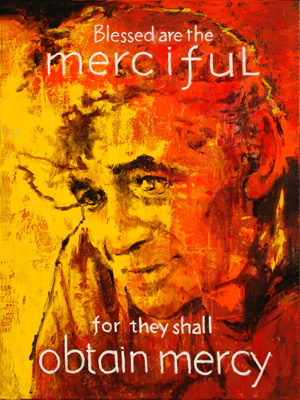
Blessed are the Merciful

Welcome, friends! The world cannot stand up under judgment, criticism, and unkindness. Instead, the earth spins on the axis of mercy. Everyone needs basic human kindness, compassion, and grace. Click the videos below, and let’s explore the blessing of mercy….

Matthew 5:7, Pastor Tim Ehrhardt

We do not presume to come to you, O merciful Lord,
trusting in our own righteousness,
but in your abundant and great mercies.
We are not worthy so much as to gather up
the crumbs under your table;
but you are the same Lord
whose character is always to have mercy.
Grant us, therefore, gracious Lord,
so to receive your dear Son Jesus Christ,
that our sinful bodies may be made clean by his body,
and our souls washed through his most precious blood,
and that we may evermore dwell in him, and he in us.  Amen.

Matthew 5:7 – Blessed are the Merciful

“Blessed are the merciful,
    for they will be shown mercy.” (NIV)

“Mercy” is one of the most rich and important words in all of the Holy Bible. Randomly turn to any page of Scripture and you will most likely find the word “mercy.” Mercy is highly significant because God is merciful.

King David was known as a man after God’s own heart (1 Samuel 13:14). This is first and foremost about mercy. In the ancient world, when a new king came to power who was from a different lineage than the previous ruler, it was a common practice to kill all the male heirs from the former king because they posed a grave threat to the throne. David, however, did not do that; he did just the opposite. David ascended the throne and said:

“Is there anyone still left of the house of Saul to whom I can show kindness?” (2 Samuel 9:1, NIV)

Indeed, there was. His name was Mephibosheth. He happened to be lame in both feet. That meant, literally, he was not able to run away when David became king. I am sure Mephibosheth believed he was being summoned by King David to his death. But when he arrived, David said to him:

“Don’t be afraid, for I will surely show you kindness…. I will restore to you all the land that belonged to your grandfather Saul, and you will always eat at my table.” (2 Samuel 9:7, NIV)

That, my friend, is the very definition of mercy. And that is precisely the character quality Jesus was talking about in his Beatitudes.

Just as David used his power to extend mercy and kindness to potential rivals instead of exterminating them to consolidate his power, so the true follower of Jesus will identify with the powerless and give them a seat at the table.

If we are wondering, at all, whether this is really what Jesus is talking about with mercy, his words in the Gospel of Luke make it crystal clear:

“If you love those who love you, what credit is that to you? Even sinners love those who love them. And if you do good to those who are good to you, what credit is that to you? Even sinners do that. And if you lend to those from whom you expect repayment, what credit is that to you? Even sinners lend to sinners, expecting to be repaid in full. But love your enemies, do good to them, and lend to them without expecting to get anything back. Then your reward will be great, and you will be children of the Most High, because he is kind to the ungrateful and wicked. Be merciful, just as your Father is merciful.” (Luke 6:32-36, NIV)

Merciful folks are gracious, kind, and accept others, especially an unworthy person, because they know that they themselves are unworthy of God’s great mercy and grace. The merciful person’s mantra is: “God has shown me mercy; therefore, I will show mercy to others.”

Those who are merciful will be shown mercy. If anyone treats another harshly and without mercy, they should not expect to receive blessing from God. This raises an important question which needs to be asked: Are we kind and merciful, or do we have a bent toward wanting to see others judged and punished? I share a hypothetical story….

My dear middle daughter was a remarkably busy girl. Whenever we were in public, it was my standing rule that she always holds my hand. The reason for this was that she always ran instead of walked. Holding her hand was the only way I could keep her safe and not literally run into harm’s way.

Here comes the hypothetical part: One day we are walking down the street holding hands. She gets away from my grip and runs… right into oncoming traffic… and is struck by a car. I run up to her, bend over her bleeding and broken body and say, “Well, that’s what you get for disobeying me. After all, you reap what you sow!”

Oh, my, no!… My daughter is now a Mom. And, lo and behold, she has a son just like her. I need to hold his hand, too! If an accident were ever to happen in reality, I can guarantee my response would be to run to him, bend over his bleeding and broken body, cry uncontrollably, and determine to do everything in my grandfatherly power to save his life and see him healed from his injuries.

So, then, my sisters and brothers, why in the world would we ever tell a broken hearted person – perhaps in the throes of depression or riddled with anxiety from hardship – emotionally and spiritually bleeding on the inside: “Get over it!” “Just stop worrying!” or “You need to be strong!”

God, forbid! No! Mercy! I insist, mercy! The world does not revolve on the axis of judgment, criticism, or giving someone what they deserve. God’s great big world spins because of mercy, grace, and basic human kindness that comes from the hand of a good benevolent Lord who cares about all humanity. Perhaps I must be even more specific…

  • The one filled with God’s righteousness will go out of their way to show kindness, love, and compassion to the LGBTQ+ community, becoming familiar with their needs, struggles, and heartaches as they listen without judgment and full of mercy.
  • The person touched by the mercy of God will intentionally seek to give people of color a seat at the table and the freedom to speak freely while listening with ears of mercy.
  • The human being who follows Jesus will see the image of God in our Native American sisters and brothers and will mercifully do everything within their power to advocate for them when it comes to things like inequities of poverty, disease, addiction, and death.
  • The person filled with the righteousness of God will respect all other religious people, regardless of their spirituality. They will be merciful to Buddhists, Muslims, Hindus, and even Wiccans, not because they see them as potential converts, but just because they need mercy, like the rest of us.

Consider what others have to say about mercy….

“God tolerates even our stammering and pardons our ignorance whenever something inadvertently escapes us – as, indeed, without this mercy there would be no freedom to pray.”

John Calvin

“Darkness cannot drive out darkness; only light can do that. Hate cannot drive out hate; only love can do that.”

Martin Luther King, Jr.

“It is mercy, not justice or courage or even heroism, that alone can defeat evil.”

Peter Kreeft

Consider what Holy Scripture has to say about mercy…

Some Pharisees asked Jesus’ disciples, “Why does your teacher eat with tax collectors and other sinners?” Jesus heard them and answered, “Healthy people don’t need a doctor, but sick people do. Go and learn what the Scriptures mean when they say, ‘Instead of offering sacrifices to me, I want you to be merciful to others.’ I didn’t come to invite good people to be my followers. I came to invite sinners.” (Matthew 9:11-13, CEV)

The Lord’s kindness never fails!
If he had not been merciful,
    we would have been destroyed.
The Lord can always be trusted
    to show mercy each morning.
Deep in my heart I say,
“The Lord is all I need;
    I can depend on him!” (Lamentations 3:22-24, CEV)

May we not succumb to thoughts of violence and revenge today, but rather to thoughts of mercy and compassion. We are to love our enemies and be merciful to all so that we might reverse the curse on humanity and restore them, by God’s grace, to their right mind, heart, and spirit.

*Above painting by Hyatt Moore

Galatians 6:11-18 – What Counts is the New Creation

See what large letters I use as I write to you with my own hand!

Those who want to impress people by means of the flesh are trying to compel you to be circumcised. The only reason they do this is to avoid being persecuted for the cross of Christ. Not even those who are circumcised keep the law, yet they want you to be circumcised that they may boast about your circumcision in the flesh. May I never boast except in the cross of our Lord Jesus Christ, through which the world has been crucified to me, and I to the world. Neither circumcision nor uncircumcision means anything; what counts is the new creation. Peace and mercy to all who follow this rule—to the Israel of God.

From now on, let no one cause me trouble, for I bear on my body the marks of Jesus.

The grace of our Lord Jesus Christ be with your spirit, brothers and sisters. Amen. (New International Version)

Motives matter. The interior life of a person is important. Life is neither a mere getting things done nor doing what is needed on the exterior. A house may be beautiful and orderly on the outside, with careful landscaping, a manicured lawn, and attractive appearance – yet on the inside it might be disorderly, full of relational discord, and completely discombobulated.

The exterior life of a person is also important. But it’s only half the person. And, unlike God who sees the heart, we aren’t always privy to what’s going on inside someone.

Folks who are enamored with outward displays of spirituality and righteousness tend to be compulsive about maintaining appearances – for both themselves, and everyone else.

Policing outward forms of righteousness through clear identifiable means is really nothing more than old fashioned judging of one another. It’s antithetical to grace. And it smacks of the snooty superiority of Star-Bellied Sneetches.

Rather than a star on the belly, in the Apostle Paul’s day it was circumcision. Those who had it were “in” and those without it were “out.” Never mind the interior life. A hard outward boundary of righteousness was established by false teachers who made the Christian life easy by simply holding to readily observable forms, like circumcision.

It wasn’t that circumcision was a bad thing. The issue was making it a necessary part of the Christian life. Not circumcised? Not a Christian, insisted the false teachers. In other words, one had to become Jewish before becoming a Christian. I can picture the Apostle Paul doing a hand to the forehead, saying, “Oy vey.”

For the Christian, one must be vigilant not to exaggerate baptism. On the one hand, I would argue far too many believers underestimate the significance and importance of baptism. Flippantly making it a personal choice, as if the individual is in complete control of one’s own salvation, is not only wrongheaded – it’s downright blasphemous.

Yet, on the other hand, a preoccupation with getting a person, especially a child, baptized, as if the world might end if it doesn’t happen, betrays the same problem as Paul faced with circumcision in the first century.

The proper approach, it seems to me, is to embrace the full spectrum of Christianity – both outward and inward – the whole person. And Paul addresses this by anticipating a question of the Galatian congregation: What, then, is of central importance?

The answer is: a new creation. To be transformed by the power of the Spirit is what really counts. The grace of God in Christ, applied to a person, brings a change to inner motives and attitudes, as well as outer behavior through loving actions.

We must always keep in mind that the sign points to the substance. It would be weird if I were traveling to Milwaukee on I-94 and pulled over on the interstate next to the sign marking the city is ahead, crawl all over it, and say, “I’m here!”

The overall thrust of Paul’s letter to the Galatians is that they were debasing the true worship of God into an outward show, honoring Christ with their lips but not holding him in their hearts.

Christianity is fundamentally not about what we do for God but what God has done for us in Jesus Christ. It is divine grace which saves people. We belong to God. Just as we neither chose our own parents nor the time when we were born, so akin to this is, before we chose God, God chose us. We don’t “born again” ourselves; God does the rebirthing.

And since it is solely the work of God in us, there is zero reason to boast about the circumstances of our new birth and becoming a new creation in Christ. We didn’t save ourselves. It would be something like getting a COVID-19 vaccine and then bragging about how we stopped the pandemic.

Instead, we are to bear the spiritual marks of Christ’s crucifixion on our inner selves. No one is saved because they deserve it but simply because they need saving.

Lord Jesus Christ, Son of God, grant us the faith to accept your saving work in the cross and to be so transformed by it that we will not be without excuse on Judgment Day. Help us not merely walk at your side, with mere words to offer. Convert us and give us new life in you so that in the end we will not be dry wood, but living branches in you, the true vine, bearing fruit for eternal life. Amen.