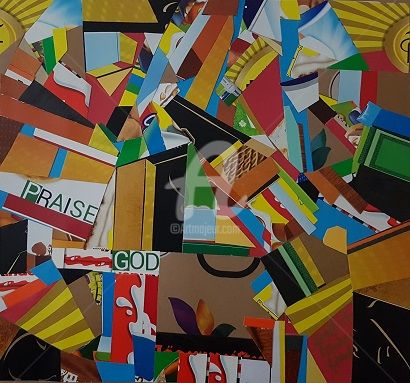
Psalm 113 – Shout Praises

“From Sunrise to Sunset Praise God” by Muha Rukab

Shout praises to the Lord!
Everyone who serves him,
    come and praise his name.

Let the name of the Lord
    be praised now and forever.
From dawn until sunset
    the name of the Lord
    deserves to be praised.
The Lord is far above
    all of the nations;
    he is more glorious
    than the heavens.

No one can compare
    with the Lord our God.
His throne is high above,
    and he looks down to see
    the heavens and the earth.
God lifts the poor and needy
    from dust and ashes,
    and he lets them take part
    in ruling his people.
When a wife has no children,
    he blesses her with some,
and she is happy.
    Shout praises to the Lord! (Contemporary English Version)

When my firstborn daughter was an infant, I was a busy seminarian as well as working a job. I had very little discretionary time on my hands. Yet, I could stand over the crib of my beautiful little bundle of a girl for long stretches of time without ever thinking about all my responsibilities. Whenever she awoke I spoke to her in that kind of baby talk that only a doting father can do. 

I imagine God looks at us in much the same way, as well as speaking and acting toward us in ways we can understand. Just as parents (hopefully) communicate on a level their kids can understand, so G-d condescends and stoops to our level in order to help us. 

The Lord is seated on high, looking down on the heavens and the earth. G-d looks at us with lovingkindness and seeks our best interests. The Lord notices the poor and acts justly on their behalf. G-d observes the needy and lifts them from their want to a place where they can thrive. The divine condescension of God is a beautiful thing because without it we would be like a helpless baby.

G-d, while being unknowable and unreachable in so many ways, has nevertheless communicated with humanity in a way people can understand and to which they can respond. The Lord has accommodated, or made allowance for, our language and general level of understanding.

The Lord, sovereign and high above us all, has chosen to stoop and coo over us here on earth. G-d’s love affectionately delights in us. The psalmist’s portrayal of G-d is not of some aloof Being who is bothered with humanity’s pestering. Rather, G-d sees, notices, and cares. We don’t need to do some sort of spiritual back flips to gain G-d’s attention. We already have it.

This psalm of praise to G-d celebrates how the Sovereign of the universe notices and acts. We are meant to remember the great deeds of G-d – both those things done in history, and the things done for us, personally. 

“Despite our earnest efforts, we couldn’t climb all the way up to God. So what did God do? In an amazing act of condescension, God climbed down to us and became one with us.”

Will Willimon

In Christianity, the concept of divine condescension and accommodation is given its supreme form in the person and work of Jesus Christ. By becoming human, Jesus accommodates himself to the human condition. Through his life, teaching, and ministry, Christ speaks as G-d, communicating sufficiently and effectively to humanity.

The redemptive events of Christ – his incarnation, holy life, death, resurrection, ascension, and glorification – are divine acts of grace, mercy, and love to all humanity. Praise and thanksgiving are the appropriate responses to such events done on our behalf.

This is one reason why the spiritual practice of journaling is such a good personal discipline because we then have a record of the ways in which G-d has acted on our behalf. When we look back and remember, we can praise the Lord all over again for lifting us from the ash heap. And this will fortify our spiritual mettle for the times when we need encouragement.

Keeping a gratitude journal and writing each day about at least one way the Lord has acted on your behalf, can bring encouragement, transformation, and joy to your life. I suggest you write for your own eyes only. This is between you and G-d. Therefore, you need not be concerned for correct spelling and grammar. It doesn’t even need to be legible, as long as you can read your own writing!

“Praise is the rehearsal of our eternal song. By grace we learn to sing, and in glory we continue to sing. What will some of you do when you get to heaven, if you go on grumbling all the way? Do not hope to get to heaven in that style. But now begin to bless the name of the Lord.”

Charles Spurgeon

What’s more, shouting our praises is not only appropriate but encouraged – even commanded. Shouting is both cathartic and fun. It builds emotional resilience and spiritual strength. Coupled with writing, shouting our praises has the effect of bringing spiritual growth and maturity to our lives.

We, of course, want to avoid shouting at others. Yet, we can take advantage of shouting while driving alone, out in the woods by ourselves, or even into a pillow. This isn’t weird. Shouting goes appropriately with praise and celebration.

In fact, it would be weird if there were no shouting. Try telling a sports fan watching their favorite team that they aren’t supposed to shout. Or just see what happens when a woman longing for children becomes pregnant for the first time.

Emotional expressions are expected whenever G-d shows up and accomplishes great deeds for us. To not do so is a sign of having spiders in your heart and garlic in your soul. It’s not right.

What are you thankful for today? Is there something in this day for which to praise the Lord, whether big or small? Will you give yourself permission to shout?

Accept, O Lord, our thanks and praise for all you have done for us. We thank you for the splendor of the whole creation, the beauty of this world, the wonder of life, and the mystery of love. We thank you for the blessing of family and friends, and the loving care which surrounds us on every side. We thank you for setting us at tasks which demand our best efforts and leading us to accomplishments which satisfy and delight us. We thank you also for those disappointments and failures that lead us to acknowledge our dependence on your mercy and grace.

Above all, we thank you for your Son, our Lord, Jesus Christ, the truth of his Word, the example of his life; his steadfast obedience, by which he overcame temptation; his dying, through which he overcame death; and his rising to life again, in which we are raised to new life. Grant us the gift of your Spirit so that we may know Christ and make him known; and through him, at all times and in all places, we may give thanks to you in and for all things. Amen.

Romans 5:6-11 – Christ Died For Us

“Golgotha” by Edvard Munch, 1900

You see, at just the right time, when we were still powerless, Christ died for the ungodly. Very rarely will anyone die for a righteous person, though for a good person someone might possibly dare to die. But God demonstrates his own love for us in this: While we were still sinners, Christ died for us.

Since we have now been justified by his blood, how much more shall we be saved from God’s wrath through him! For if, while we were God’s enemies, we were reconciled to him through the death of his Son, how much more, having been reconciled, shall we be saved through his life! Not only is this so, but we also boast in God through our Lord Jesus Christ, through whom we have now received reconciliation. (New International Version)

In Christianity, there is only one way of approaching God: Through the death of Jesus Christ. That means we cannot approach God by our good works, doing things right, or by our spiritual pedigree. We are justified and declared righteous by grace alone through faith in the cross of Christ.

Back when my youngest daughter was still living at home, sometimes I needed to go into her room to get something. More often than not, it ended up becoming an archaeological dig. I had to wade through layers of stuff. I didn’t always find what I was looking for, and other times I discovered things I didn’t know I had even lost. 

When the magisterial Reformer, Martin Luther (1483-1546) went digging into the Bible, he found he was wading through layers of church tradition and came upon something that was lost. Luther rediscovered that God justifies sinners by grace through faith apart from any good works done by us. Luther found in the Scriptures that we are completely and totally at the mercy of God in Christ.

The cross of Jesus Christ is the means of salvation from what ails us because the cross is an attack on human sin. Luther discovered we all have layers of stuff that has grown around our hearts to the degree that we no longer see the sheer grace of God in Christ alone to meet the most pressing needs of our lives. 

The Reformation has taught believers that apart from Christ, we are addicted to ourselves. The cross is the intervention we need to help us confront our constant me-ism.

We might justify ourselves with the fact we do good works. However, one of the legacies of the Reformation, coming from the book of Romans, is that good works do not earn us deliverance from sin. In fact, Luther said that our good deeds are the greatest hindrance to our salvation because we have the tendency to trust in those good deeds instead of the death of Christ. 

So, Luther actually called our good works a mortal sin that sets off God’s wrath and leads straight to hell. In other words, good deeds can be deadly, if they are done as a means of approaching and appeasing God. 

It is through the suffering of Jesus on the cross, his death for us while we were still sinners, not when we were lovely and looking fine with all our pious actions, that we are saved. 

“He who does not know Christ does not know God hidden in suffering. Therefore, he prefers works to suffering, glory to the cross, strength to weakness, wisdom to folly, and, in general, good to evil. These are the people who are under God’s wrath! God can only be found in suffering and the cross. It is impossible for a person not to be puffed by his good works unless he has first been deflated and destroyed by suffering and evil until he knows that he is worthless and that his works are not his but God’s.”

Martin Luther’s Heidelberg Disputation

God does not come to us in our beauty and goodness but in our ugliness and sin.

While we were still sinners, ungodly, enemies of God, powerless to save ourselves, Christ died on the cross for us. We spend too much time and effort concerned about looking good and doing good things in order to present ourselves acceptable to each other and even to God. 

But that is the very sin that sends people to a hellish existence. The hottest places of damnation are actually reserved for outwardly pious persons who trusted all their lives in themselves and how they looked to others without a thought, at all, about justification, reconciliation, and being restored to God through Christ.

Like a gold ring in a pig’s snout, is a person who has good deeds but knows nothing of God’s grace.

It is a totally human tendency to decide which sinful actions are trivial and which are the biggie sins. The Apostle Paul was really hard on his fellow Jews in the book of Romans because they tended to place their trust in who they were and what they did – being the covenant people and practicing all the good things a good person does. And Paul says the wrath of God is reserved for them. 

The way of approaching God is by seeing our true ugliness, our rebellious hearts, and that the hope of salvation is through the cross of Christ. We are justified by and reconciled to God because of Jesus, and not for any other reason. A new relationship is established based solely in God’s grace.

“Jesus Carrying The Cross” by Olga Bakhtina, 2017

When Christians grasp this truth, even a little bit, it should cause us to repent of our sinful good works (yes, sinful good works). Wherever there is humility that leads to a complete turning to Jesus, there is revival to new life in God, and a personal reformation around the doctrine of grace instead of the doctrine of my glorious works that I perform.

We, then, as Christians, saved and justified through the blood of Jesus, ought to be the most joyful and grateful people on the planet. We have deliverance from the deception of our hearts to life in Christ. Apathy and lethargy to the things of God are the twin evils that reign in the place of awe and appreciation for what God has done for us in Christ.

There is nothing more God can do to show us that he loves us than by actually dying for us, and by doing so, satisfying God’s own wrath against the sin which seeks to destroy us. The late Brennan Manning once told the story about how he got the name “Brennan.”

While growing up, his best friend was Ray. The two of them did everything together: bought a car together as teenagers, double-dated together, and went to school together. They even enlisted in the Army together, went to boot camp together and fought on the frontlines together.

One night while sitting in a foxhole, Brennan was reminiscing about the old days in Brooklyn while Ray listened and ate a chocolate bar. Suddenly, a live grenade came into the foxhole. Ray looked at Brennan, smiled, dropped his chocolate bar and threw himself on the live grenade. It exploded, killing Ray, but Brennan’s life was spared.

Later in life, when Brennan became a priest, he was instructed to take on the name of a saint. He thought of his friend, Ray Brennan. So, he took on the name “Brennan.”

Years later he went to visit Ray’s mother in Brooklyn. They sat up late one night having tea when Brennan asked her, “Do you think Ray loved me?” Mrs. Brennan got up off the couch, shook her finger in front of Brennan’s face and shouted, “What more could he have done for you?” Brennan said that at that moment he experienced an epiphany. He imagined himself standing before the cross of Jesus wondering, Does God really love me? And Jesus’ mother Mary pointing to her son, saying, “What more could he have done for you?”

The cross of Jesus is God’s way of doing all he could do for us. And yet we often wonder: Does God really love me? Am I important to God? Does God care about me? We tend to ask those questions when we are trusting in ourselves, because we never really know where we stand with God.

No matter how bad or how good you are, the path of suffering of our Lord Jesus has taken care of the sin issue once for all.

Week after week for the past two-thousand years, God’s people have gathered together to worship this same Lord Jesus who died on the cross. The only thing left for us to do, since Jesus has done it all for us, is to offer our lives to him.

While we were still sinners, enemies, estranged, hopeless, lost, despondent, proud, and stained by sin, Jesus died a cruel death on a cross to wash away your sins with his blood. It is my hope and prayer that today you are rediscovering the great Reformation truth that we are justified by grace alone through faith in Jesus alone, and the life of unbounded joy in knowing that we have now received reconciliation with God in Christ.

Lord God Almighty, the ground is level at the foot of the cross. We need you, Lord Jesus, and come to you on the basis of nothing else but your shed blood. I pray for all those who are wrestling with you right now. Oh, that you would revive those that need new life, that you would renew those who have become cold, and that you would reform all of our hearts so that our lives would completely be devoted around the person and work of Jesus Christ! 

Thank you, Lord Jesus, for dying for us while we were still powerless, sinful, and ungodly. Thank you for saving us from God’s wrath. Thank you, God Almighty, for reconciling us back to yourself through the cross. There are those needing you to break through their stubborn hearts; and those who need peace to their troubled hearts. O God, save us from ourselves, whether it is from our trust in our own perceived goodness, or our sense of shame and guilt. Thanks be to God, who gives us the victory through our Lord Jesus Christ. Amen.

Luke 10:25-37 – The Parable of the Good Samaritan

Good Samaritan by He Qi

A legal expert stood up to test Jesus. “Teacher,” he said, “what must I do to gain eternal life?”

Jesus replied, “What is written in the Law? How do you interpret it?”

He responded, “You must love the Lord your God with all your heart, with all your being, with all your strength, and with all your mind, and love your neighbor as yourself.”

Jesus said to him, “You have answered correctly. Do this and you will live.”

But the legal expert wanted to prove that he was right, so he said to Jesus, “And who is my neighbor?”

Jesus replied, “A man went down from Jerusalem to Jericho. He encountered thieves, who stripped him naked, beat him up, and left him near death. Now it just so happened that a priest was also going down the same road. When he saw the injured man, he crossed over to the other side of the road and went on his way. Likewise, a Levite came by that spot, saw the injured man, and crossed over to the other side of the road and went on his way. A Samaritan, who was on a journey, came to where the man was. But when he saw him, he was moved with compassion. The Samaritan went to him and bandaged his wounds, tending them with oil and wine. Then he placed the wounded man on his own donkey, took him to an inn, and took care of him. The next day, he took two full days’ worth of wages and gave them to the innkeeper. He said, ‘Take care of him, and when I return, I will pay you back for any additional costs.’ What do you think? Which one of these three was a neighbor to the man who encountered thieves?”

Then the legal expert said, “The one who demonstrated mercy toward him.”

Jesus told him, “Go and do likewise.” (Common English Bible)

In Christianity, no one justifies themselves. The kingdom of God turns on grace, and not with us working more or harder. As we anticipate Reformation Day, Christians remember the famous posting of the 95 Theses by Martin Luther on the Castle Church door in Wittenberg, Germany in 1517. 

Justification by grace through faith, apart from human effort, is the great theological emphasis and legacy of the Reformers. I suppose one would expect to look at the New Testament books of Romans and Galatians when it comes to dealing with justification. However, there might just be a better place to go….

Christ’s parable of the Good Samaritan is a famous and familiar story to many people, even for those outside of the Christian faith tradition. The parable is likely not the place one thinks to go when considering the Reformation. Yet, this parable is just the right place for considering the grand Reformation doctrine of justification.

“Every week I preach justification by faith to my people, because every week they forget it.”

Martin Luther (1483-1546)

The Gospel writer, Luke, gives us insight into the thought process of the person for whom Jesus told the parable to. That man sought to justify himself. 

When we view the parable from the angle of justification, we see the perspective of the wounded and hapless man, the victim of robbers. He was left for dead, and, indeed, in the story we know that he would die apart from help – the kind of help the man could not do for himself. He was completely dependent on someone to rescue him from his plight.

The Samaritan, the Christ figure in the story, comes and shows the man mercy. This grace was free, lacked any sort of favoritism, and was full of sheer kindness. Without the Samaritan’s actions of binding up the man’s wounds and getting him to a safe place, the victim would have died.  

Reformation Day, and every day, is a good day to celebrate the wonderful and glorious reality that Jesus Christ saves people from their terrible plight. 

Christ’s mercy is not dependent on what kind of people we are but is simply based on need. God graciously gives us the gift of faith and the mercy of deliverance. By Christ’s wounds we are healed. 

Take some time today to reflect on this most gracious of biblical truths: We do not need to justify ourselves. As Christians, we already possess justification by grace alone apart from human effort. 

Read the parable of the Good Samaritan carefully and slowly, absorbing it from this angle of the inability to justify ourselves and the incredible mercy of Christ. Let this wonderful truth sink deep in your soul to bring increased awareness, emotional wholeness, and spiritual healing.

Lord God, heavenly Father, you did not spare your only Son, but gave him up for us all to be our Savior, and along with him you have graciously given us all things. We thank you for your precious, saving gospel, and we pray that you would help us to believe in the name of our Savior faithfully and steadfastly, for he alone is our righteousness and wisdom, our comfort and peace, so that we may stand on the day of his appearing, through Jesus Christ, your dear Son, our Lord. Amen. – A Lutheran Collect of Thanksgiving

Psalm 146 – Underdog

Praise the Lord!

Let all that I am praise the Lord.
    I will praise the Lord as long as I live.
    I will sing praises to my God with my dying breath.

Don’t put your confidence in powerful people;
    there is no help for you there.
When they breathe their last, they return to the earth,
    and all their plans die with them.
But joyful are those who have the God of Israelas their helper,
    whose hope is in the Lord their God.
He made heaven and earth,
    the sea, and everything in them.
    He keeps every promise forever.
He gives justice to the oppressed
    and food to the hungry.
The Lord frees the prisoners.
    The Lord opens the eyes of the blind.
The Lord lifts up those who are weighed down.
    The Lord loves the godly.
The Lord protects the foreigners among us.
    He cares for the orphans and widows,
    but he frustrates the plans of the wicked.

The Lord will reign forever.
    He will be your God, O Jerusalem, throughout the generations.

Praise the Lord! (New Living Translation)

I confess to being a classic cartoon connoisseur. Adults told me when I was a kid that I would outgrow watching them. Well, I’m still waiting for that day. 

One of the cartoons I enjoyed (and still do!) watching is “Underdog” (1964-1973). There is something deep within the human psyche that cheers for the underdog. Wally Cox was the perfect voice for the mild-mannered shoe-shine boy to take his underdog super energy pill and fly through the sky to rescue Sweet Polly Purebread.

That “something” inside us which identifies with the underdog is the justice of G-d. 

It’s important to understand that when the term “justice” is used, it isn’t meant primarily in punitive terms, as we might typically think of it. Rather, justice is providing people with what they need to survive, thrive, and flourish in life. Conversely, withholding needs from individuals or groups of people in this world is “injustice.” 

Today’s Psalm lets us know G-d cares about the underdog – the one who lacks basic material and spiritual provisions for living. 

G-d is deeply concerned for those who are powerless, defenseless, and on the margins of society. The psalmist identifies such persons: the hungry; prisoners; the blind; those bowed down; the orphan; and the widow. All these people represent individuals without ability to be movers and shakers in society. In short, they need G-d and deserve justice.

The Lord delights to use divine power in championing the underdog and lifting them up. What’s more, truth be told, it turns out that all of us are underdogs. Everyone needs G-d. 

We are meant to both receive and provide justice without prejudice or discrimination. Every action and decision we make is really G-d’s grace and enablement to do it. Thus, the logical and reasonable response to such a G-d is praise – to declare our hallelujahs to the One who reigns forever and will always see humanity’s great need. 

So, how will you acknowledge and praise G-d today for divine attributes and actions? Let such praise shape your soul and lift your spirit as you intentionally connect with the gracious G-d who gives us what we need so that we can say, “There’s no need to fear. Underdog is here!”

Almighty God, Father of all mercies, we your unworthy servants give you humble thanks for all your goodness and loving-kindness to us and to all whom you have made. We bless you for our creation, preservation, and all the blessings of this life; but above all for your immeasurable love in the redemption of the world by our Lord Jesus Christ; for the means of grace, and for the hope of glory. Amen.