You Have Found Favor with God (Luke 1:26-38)

The Annunciation, by Liviu Dumitrescu

Six months after Elizabeth had become pregnant, God sent the angel Gabriel to Nazareth, a city in Galilee. The angel went to a virgin promised in marriage to a descendant of David named Joseph. The virgin’s name was Mary.

When the angel entered her home, he greeted her and said, “You are favored by the Lord! The Lord is with you.”

She was startled by what the angel said and tried to figure out what this greeting meant.

The angel told her,

“Don’t be afraid, Mary. You have found favor  with God.

You will become pregnant, give birth to a son,
and name him Jesus.

He will be a great man
and will be called the Son of the Most High.
The Lord God will give him
the throne of his ancestor David.
Your son will be king of Jacob’s people forever,
and his kingdom will never end.”

Mary asked the angel, “How can this be? I’m a virgin.”

The angel answered her, “The Holy Spirit will come to you, and the power of the Most High will overshadow you. Therefore, the holy child developing inside you will be called the Son of God.

“Elizabeth, your relative, is six months pregnant with a son in her old age. People said she couldn’t have a child. But nothing is impossible for God.”

Mary answered, “I am the Lord’s servant. Let everything you’ve said happen to me.”

Then the angel left her. (God’s Word Translation)
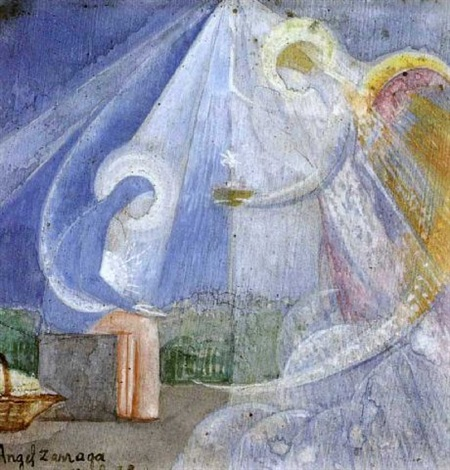
The Annunciation, by Angel Zárraga

Most of life is lived in the mundane. For the most part, we go about our business and deal with the daily grind.  That’s because we are common ordinary people.

So, we can especially relate to Mary. She is rather plain. Mary is of junior high age. If she were living in our day and age, Mary would likely be wearing clothes from the local Goodwill. She cannot read, because girls of her day rarely did.

Mary’s parents make all the decisions that affect her life, including the one that she should be married to an older man named Joseph. We don’t know if she even liked him. She lives in a small town that most people can’t even point to on a map. 

One night, this young girl is visited by the brightly beaming divine messenger Gabriel, whose name means, “God has shown himself mighty.” Mary stands there in her flannel nightgown; her life very quickly moving from the ordinary to extraordinary. The juxtaposition could not be more pronounced:

  • a mighty angel and a plain teen-ager
  • a messenger of the Most High God and a girl barely past puberty
  • holy angelic light in a simple candlelit bedroom
  • awesome power and complete vulnerability

Mary, compared to Gabriel, is defenseless, fragile, and overwhelmed. She’s in over her head. And that’s why we can relate to her. We can get our human arms around Mary. She’s like us. She has faced life with little power to make it turn out the way she planned. Forces beyond her control have rearranged her life and altered it forever. Mary is the Matron Saint of the Ordinary. We can totally understand why she responds the way she does.

Young Mary’s initial reaction was to be greatly troubled. She was disturbed, and was shaking in her ratty old slippers. The angel confidently told Mary that she had found favor with God. In other words Mary was quite literally “graced” by God. 

The situation was not that Mary had some extreme spirituality; but rather that God simply chose her to be the mother of Jesus. 

And Mary needed to come to grips with what was happening to her. This was not what she was looking for.  Becoming pregnant with the Savior of the world was not an answer to prayer for Mary. This was not on her agenda. 

Mary immediately sensed the crazy disconnect between what was being told to her and who she was. After all, she was a plain ordinary girl from the hick town of Nazareth, and she was being told that she would raise a king.  Maybe somebody in heaven screwed up. It could very well be that Gabriel got the wrong girl. Perhaps the angel’s Google map popped up the wrong town to visit. 

Relating to Mary, we can totally understand that she would question how in the world all this was going to happen. Not only is Mary ordinary, and far from royalty, but she is also very much a virgin. None of this made any sense whatsoever.

But the angel lets Mary know that God specializes in the impossible. I understand why many English translators chose to phrase the original rendering as “for nothing is impossible with God.” But I rather like a more literal translation which is “for there is nothing outside of God’s power.” 

There is nowhere we can go, no place on earth, no situation whatsoever that is beyond God’s ability, reach, and power to effect the divine will.

We do not always get straightforward answers to our questions about God. Yet, Mary asked a question and got a straight answer. She really can be pregnant with Jesus because the Holy Spirit will come upon her and overshadow her with power. 

If the story were to end here it would be a great story.  But to me the most astonishing part of this narrative is Mary’s response to what was happening to her.

Mary believed the message and took Gabriel’s words at face value. And so, having believed, she then submitted herself completely to God’s will for her life. 

I think we might totally understand if Mary simply said in her ordinary way that she was not prepared for this.  We would completely “get it” if Mary pushed back on what the angel said to her.

We could relate if Mary just dismissed it all, like Scrooge in the Christmas Carol, with the angel and his message being all humbug as if it were just “an undigested bit of beef, a blot of mustard, a crumb of cheese, a fragment of an underdone potato.  There’s more of gravy than of grave about you, whatever you are!”

And yet, Mary not only believed, but she also humbly submitted herself to what was happening. And, to me, this is what we need to relate to most about Mary – not her being just a plain ordinary person in a non-descript village, but stepping up to the calling she received. 

We, too, have received a calling in our lives. We, too, have been given the power of the Holy Spirit. And we, too, are ordinary people who have been given a very extraordinary task. 

It seems to me that our response today can and ought to be the same as Mary: “I am the Lord’s servant; may it be to me as you have said.” 

The Church is pregnant with possibilities because of the Holy Spirit. We know the end of Mary’s story. She gave birth to Jesus. She raised him in her plain ordinary way. She watched him grow up. She saw him embark on his ministry to proclaim that the kingdom of God has come near. 

Mary did not always understand what Jesus said or what he was doing. And she experienced every mother’s nightmare: seeing her beloved son killed in a terribly gruesome manner right in front of her eyes. 

Yet, just as the Holy Spirit was with the birth of Jesus, so the Spirit was with Jesus at his resurrection from the dead. Jesus, like his earthly mother, lived an ordinary life in a very extraordinary way. And today Jesus invites us to do the same. 

Because Jesus accomplished his mission of saving people from their sins and establishing a kingdom that will never end, he has given us the same Holy Spirit to follow him forever and call other people to follow him, too. 

The Christian life may often be difficult; but it is really not complicated. It’s rather simple, just like Mary. 

Mary responded to God’s revelation with faith, choosing to fully participate in what God was doing. “I am the Lord’s servant” is to be our confession, as well. “May it be to me as you have said” is to be our cry, along with Mary. 

The message Christians proclaim is that Jesus saves – he delivers from sin and Satan and will restore all things.

May you know the presence and the power of God today and always, through knowing Christ Jesus the Lord of all. Amen.

A Great Restoration (Psalm 126)

When the Lord restored the fortunes of Zion,
    we were like those who dream.
Then our mouth was filled with laughter
    and our tongue with shouts of joy;
then it was said among the nations,
    “The Lord has done great things for them.”
The Lord has done great things for us,
    and we rejoiced.

Restore our fortunes, O Lord,
    like the watercourses in the Negeb.
May those who sow in tears
    reap with shouts of joy.
Those who go out weeping,
    bearing the seed for sowing,
shall come home with shouts of joy,
    carrying their sheaves. (New Revised Standard Version)

I personally think that God is amazing. The Lord not only brings restoration and wholeness to people; God also reverses people’s fortunes so that what was lost is found again. Indeed, reversal has a prominent place in today’s psalm, inviting us to recognize that God does more than compensate persons in a loss, but also brings about a complete reversal of reality.

God is the expert at restoring people’s fortunes. For a nation who was overrun by the Babylonians, sent into exile, and then had the ability to return from that exile back to Jerusalem, it very much indeed, felt like a grand restoration. The effect it had on the people was profound. The psalmist describes it like this:

It’s like waking from a dream and realizing that it’s reality.

It’s like the best party – full of celebration, singing, and laughter – that anyone has ever experienced.

It’s like being a real live miracle.

Being invaded, attacked, violated, taken away from your home and traumatized – and then living in oppression and having forced suppression in living your life the way you believe you ought to, is an awfully sad and discouraging way to exist.

But then, fortunes are restored. The grieving and lamenting give way to laughter and joy. That feeling of a 500 pound weight on your shoulders is lifted; you now feel light as a feather. And it isn’t only a personal reversal of tangible resources; it’s also a psychological turn around.

The nations frequently mock and ridicule God’s people. They look at the suffering, as if God has abandoned them – or wonder even if there is a God, at all. The thinking of other nations, is that Israel’s God is nothing but a local god who is impotent outside of Judah. Besides, he probably doesn’t care about a bunch of losers anyway, they reason.

Don’t give the other nations a reason to say,
    “Where is their God? Can’t he help them?”
Let us see you punish those people.
    Punish them for killing your servants. (Psalm 79:10, ERV)

But the God of the Bible is no limited territorial being; the Lord is sovereign over all the earth. And this God is able to effect a radical reversal of body, mind, and spirit – even to those other nations. The disrespectful mouths that once mocked are reversed to giving praise to Israel’s God and acknowledging that the Lord has done great things for the people.

This God has both the will and the ability to intervene and effect real change that completely reverses a person’s and even a nation’s life. Once someone has experienced what God can do, they forever know that God can do it again.

One of the things which personally motivates me is that the Lord has changed my life and my fortunes on many occasions – and even used me to help effect a reversal in other people’s lives, as well. So, no matter how bad things get (and sometimes they get awfully darned bad!) I have confidence and trust that a good, merciful, and loving God sees it all, knows it all, and has the power to do something about it. I may have to wait for a while – maybe even an agonizingly long time – yet I am convinced that the same God who restored the fortunes of Israel can reverse my situation, too.

And the change is so wonderfully dramatic, that it’s like a wadi in the desert, a life-giving river that emerges in the bone dry desert, bringing new growth and sustaining animal life, after the rains finally come and reverse the landscape and the environment completely.

We are, however, reminded that a great reversal and a complete restoration does not happen immediately. When the farmer plants in the Spring, it will be months before there is a harvest of crops. It takes time for the seed to germinate, break the soil, and grow into a mature plant, ready for the harvester.

Get-rich schemes rarely work in life, and never really happen in the spiritual life. Renewal, restoration, and a reversal of fortunes is not an instantaneous event, but rather a process that develops and eventually happens. A lot of blood, sweat, and tears go into any meaningful and sustainable process of change. Yet, where there is weeping, the end will be shouts of celebration and joy.

Believers can live expectantly, and fully convinced, that their suffering will eventually give way to glory. Grief and tears will not have the last word; God’s restorative and reversing grace will.

Many of you long for restoration – either for yourselves or for others you love and care about – because you recognize there needs to be a great reversal of fortunes. Advent is the season for waiting, the time for anticipation, knowing that deliverance will come in the form of a baby. And our waiting shall not be in vain.

O Lord our God, accept the fervent prayers of your people; in the multitude of your mercies look with compassion upon us and all who turn to you for help; for you are gracious, O lover of souls, and to you we give glory, Father, Son, and Holy Spirit, now and forever. Amen.

Becoming Holy (Isaiah 4:2-6)

And that’s when God’s Branch will sprout green and lush. The produce of the country will give Israel’s survivors something to be proud of again. Oh, they’ll hold their heads high! Everyone left behind in Zion, all the discards and rejects in Jerusalem, will be reclassified as “holy”—alive and therefore precious. God will give Zion’s women a good bath. He’ll scrub the bloodstained city of its violence and brutality, purge the place with a firestorm of judgment.

Then God will bring back the ancient pillar of cloud by day and the pillar of fire by night and mark Mount Zion and everyone in it with his glorious presence, his immense, protective presence, shade from the burning sun and shelter from the driving rain. (The Message)

One of the characteristics of Holy Scripture I deeply appreciate are the wonderful prose sections letting us, the readers and listeners, know that our longings for better days will come. There is a day coming when all of our good imaginings of the future shall be realized; and our present circumstances of hatred, discord, jealousy, and envy of one another shall be a thing of the past.

Unfortunately, we will likely (and biblically!) have to see some devastating and violent loss, and experience some terrible and awful destruction of both body and soul. All of the Old Testament prophets spoke messages of both judgment and grace, suffering and glory. Although hammered with ruin, biblical readers are given glimpses of hope to see the possibility of life beyond all of the carnage.

In other words, there will indeed be restoration and renewal. All shall not be lost forever. Death does not have the last word; resurrection does. It will happen because God has a determined resolve to find resilient ways of restoring the divine/human relationship back to its original and intended peaceful good.

It takes faith to have hope, and hope to have faith, and love to win the day forever. If God can create ex nihilo, out of nothing, then the Lord can reform and renew that which already exists, even though it may be in an awfully deformed state.

The ones who remain, the survivors, are the remnant of true believers, the people who hold onto faith and patience in the face of adversity, hardship, and difficulty. These are the dreamers, the seers, the prophets who foresaw both the need for divine judgment, and equally understood the promise of divine restoration.

The earth will once again be blessed. A rainbow of promise shall rise to remind us all that the storms which ravaged us have passed, never to return again.

But let us also clearly understand that it is because of human stubbornness, of hard-hearted people failing to love mercy and show steadfast love, that got us in this pickle of judgment to begin with. There comes a point when the repeated refusal to change, and use the gifts God has given us, leads to our shelf life on this earth coming to a moldy ruin. To be thrown into the divine incinerator is something brought on by us, not God.

Evil is like a cancer which must be purged from our existence so that we can be clean and healthy. The commands of God are not meant to keep people under a heavy divine thumb, but rather to help people live well in this world in a good healthy way. Living a holy life means that we participate in productive spiritual practices that strengthen faith and support the spirit.

People become “unclean” when they take a different path which is inconsistent with how we were designed by our Creator to live. It would be a bit like believing we can ignore all traffic laws and drive how we want, and then are surprised when we are nearly killed in an accident. Sadly, the unclean perish in their self-preoccupations, with God’s generosity completely off of their spiritual radar.

Yet, no matter where we’ve come from or what we have done, there is always the possibility of rehabilitation, of renewing our relationship to God, experiencing the divine presence, and receiving divine grace.

Getting in sync with the healthy spiritual forces of this universe is like having the ancient provision and protection of God’s pillar of cloud by day and fire by night – reassuring us that we are not alone and belong securely in the merciful arms of a loving Lord.

In Christianity, a holy life and a clean heart results from the person and work of Jesus Christ. God got down to it, taking the judgment we deserved and giving us grace. All of the temporary ritual cleanings merely pointed forward to the once for all scrubbing of the cross.

The blood of goats and bulls and the ashes of a heifer sprinkled on those who are ceremonially unclean sanctify them so that they are outwardly clean. How much more, then, will the blood of Christ, who through the eternal Spirit offered himself unblemished to God, cleanse our consciences from acts that lead to death, so that we may serve the living God!…

 and since we have a great priest over the house of God, let us draw near to God with a sincere heart and with the full assurance that faith brings, having our hearts sprinkled to cleanse us from a guilty conscience and having our bodies washed with pure water. Let us hold unswervingly to the hope we profess, for he who promised is faithful. (Hebrews 9:12-14, 10:21-23, NIV)

May you experience the blessing of becoming clean, and know the blessing of being holy and pure in all your relationships and activities. Amen.

A Great Number of People Believe (Acts 11:19-26)

Now those who had been scattered by the persecution that broke out when Stephen was killed traveled as far as Phoenicia, Cyprus and Antioch, spreading the word only among Jews. Some of them, however, men from Cyprus and Cyrene, went to Antioch and began to speak to Greeks also, telling them the good news about the Lord Jesus. The Lord’s hand was with them, and a great number of people believed and turned to the Lord.

News of this reached the church in Jerusalem, and they sent Barnabas to Antioch. When he arrived and saw what the grace of God had done, he was glad and encouraged them all to remain true to the Lord with all their hearts. He was a good man, full of the Holy Spirit and faith, and a great number of people were brought to the Lord.

Then Barnabas went to Tarsus to look for Saul, and when he found him, he brought him to Antioch. So for a whole year Barnabas and Saul met with the church and taught great numbers of people. The disciples were called Christians first at Antioch. (New International Version)

The earliest of believers in Jesus Christ were Jews. Jewish converts to Christianity were not typically received well amongst their families, communities, and culture. So, when Stephen, one of those converts, retold Jewish history emphasizing a stubborn lack of awareness amongst their ancestors – and then connected it with present day attitudes – a full fledged persecution of Christians broke out.

As a result, the Church – located almost exclusively in Jerusalem – was scattered throughout Judea and across the Roman Empire in a Christian diaspora. In Christ’s ascension, he told the disciples that they would be witnesses beginning at Jerusalem, and then to Judea and outside the Middle East. Little did the small band of believers know, at the time, how that plan would come about.

As it turns out, although life was hard being a Christian refugee in a strange location, the believers spread the good news of Jesus wherever they went. Thus, gospel seeds were planted all across the land.

There is no place we can go where God is not already there.

And so, the displaced Christians discovered God was with them in their sojourning. Their faithful proclamation of good news was the impetus to bringing about many more converts to Jesus Christ.

What was happening in Judea and the Empire came back to the church leaders in Jerusalem. They then, smartly, sent one of their own, Barnabas, to Antioch in order to check out the scene and bring the new believers some encouragement. Since Barnabas was the consummate encourager, the church was emboldened, with even more converts entering into faith in Christ.

Barnabas, as an encourager, had the knack for knowing what he could do and not do; he also knew someone who could supply what he couldn’t do. He was so sure that Saul (Paul) was the right person for the job that he went to Tarsus – which was about 400 miles from Antioch – in order to find him and get him to the new believers as soon as possible. The result was an explosion of fresh converts coming to faith and into the church.

It’s no coincidence that the man with the biggest heart in the church is described in today’s text as a good man who was filled with the Holy Spirit. The Spirit is the One who makes all the difference with the growth of Christianity and the establishment of the Church.

Barnabas could see the evidence of God’s grace in the city of Antioch because he was filled to the full, with God’s own Spirit. He observed people with changed lives; an incredibly diverse and connected international community of believers; and so, encouraged them all in this good work brought about by the Spirit of God.

More and more people were added to the fellowship because of the robust spiritual dynamic that took place. This was not a matter of people using slick marketing strategies to make the name of Jesus Christ known; instead, the adding was all God. The Lord added to the Lord, and not people adding people to the Church. In other words, God is both the subject and the object, the source and the goal, of all good Christian ministry.

Then, when the Lord connected Barnabas together with Saul (Paul) who was also filled with the Holy Spirit and many spiritual gifts from God, the result was nothing less than large numbers of persons coming to faith in Christ and being added to the Church.

The believers in Antioch were so chatty about their faith that the first reference of being called “Christians” were to these converted Jewish believers in Jesus. Even though the moniker of “Christian” was probably a term of derision and meant to mock the Antiochene Church, it stuck, and was held up proudly by the believers. They were completely okay with being called “little Christ’s.”

After all, since they were truly Christ-centered in all they did, it was a fitting title for the fledging and growing Church. It clearly identified them as the people who serve and follow Christ. We, too, these many centuries later, have the very same Spirit of God that they did – and therefore, the same opportunity to speak of Jesus and see the Holy Spirit do the work of adding to the Church.

We pray, almighty God, that all who confess your Name may
be united in your truth, live together in your love, and reveal
your glory in the world.

Guide people everywhere, and of all the nations, in the
ways of justice and peace; that we may honor one another
and serve the common good.

Give us all a reverence for the earth as your own creation,
that we may use its resources rightly in the service of others
and to your honor and glory.

Bless all whose lives are closely linked with ours, and grant
that we may serve Christ in them, and love one another as he
loves us.

Comfort and heal all those who suffer in body, mind, or
spirit; give them courage and hope in their troubles, and
bring them the joy of your salvation.

Lord, in your mercy, hear our prayer. Amen.