What Is Your View of God? (Psalm 86)

Incline your ear, O Lord, and answer me,
    for I am poor and needy.
Preserve my life, for I am devoted to you;
    save your servant who trusts in you.
You are my God; be gracious to me, O Lord,
    for to you do I cry all day long.
Gladden the soul of your servant,
    for to you, O Lord, I lift up my soul.
For you, O Lord, are good and forgiving,
    abounding in steadfast love to all who call on you.
Give ear, O Lord, to my prayer;
    listen to my cry of supplication.
In the day of my trouble I call on you,
    for you will answer me.

There is none like you among the gods, O Lord,
    nor are there any works like yours.
All the nations you have made shall come
    and bow down before you, O Lord,
    and shall glorify your name.
For you are great and do wondrous things;
    you alone are God.
Teach me your way, O Lord,
    that I may walk in your truth;
    give me an undivided heart to revere your name.
I give thanks to you, O Lord my God, with my whole heart,
    and I will glorify your name forever.
For great is your steadfast love toward me;
    you have delivered my soul from the depths of Sheol.

O God, the insolent rise up against me;
    a band of ruffians seeks my life,
    and they do not set you before them.
But you, O Lord, are a God merciful and gracious,
    slow to anger and abounding in steadfast love and faithfulness.
Turn to me and be gracious to me;
    give your strength to your servant;
    save the child of your maidservant.
Show me a sign of your favor,
    so that those who hate me may see it and be put to shame,
    because you, Lord, have helped me and comforted me. (New Revised Standard Version)

The biblical psalms are first and foremost a collection of prayers. Spanning the scope of the human condition, and plumbing the depths of human emotion, we find that there are psalms for every sort of situation we may find ourselves in – whether the circumstance is good or bad.

In David’s particular case, he knew what it was like to have evil men hate him and pursue taking his life through no fault of his own. Although I have never faced adversity to such a degree as David did, I do know something about people who, to put it bluntly, just flat-out hate my guts. It feels awful, and it can be terribly draining emotionally and spiritually. Having disrespectful and rude people talk behind your back (and sometimes even to your face) is in direct contrast to who God is.

God is described by David as merciful and gracious, slow to anger, abounding in steadfast love, and faithful. Whereas insolent people objectify others and seek their own selfish agendas, God always acts in accord with a basic character of love and grace. 

Based upon the nature of just and benevolent God, we can choose to cry out, just like David did, to show us a sign of God’s favor. We can pray for God to provide us with some tangible communication of divine love in ways we can understand so that we can be helped and receive the kind of comfort we need through our adversity.

Be assured that with such a God, our pleas, cries, and tears will be noticed, affirmed, and answered. We can trust the sovereign Lord of all creation to address the insolence and injustice that exists around us and toward us.

All of this talk about adverse circumstances and unjust people, gets down to our view of God and our theological understanding of the basic Divine nature and purpose. 

For some people, God is up there, somewhere, like some white-bearded old guy who is aloof to what is going on down here – there is neither anything personal nor personable about him, at all. 

For others, God is a force which binds all things together. In this theology, God exists, but you are never quite sure how to connect – it’s like a crapshoot trying to get in touch with him. 

For yet others, God is perpetually perturbed about something; God has a bee in his bonnet, and it is apparently our job to figure out what he is so sullen and upset about all the time so that we can appease him in some way.

However, the psalmist David, sees God in wholly other ways than this. For David, God is personal, knowable, and reachable. David thought about God in ways which transcend either gendered or personality-type categories. 

Note the descriptions David provided: a willingness to forgive; an abiding, consistent, and steadfast presence of divine love; always having the time and desire to listen; possessing the power and ability to provide help and protection; being kind and merciful; not being easily angered; and extending needed comfort and consolation.

Now this is a God you can sink your teeth into – attentive, engaged, and anything but upset all the time. This is the reason why David has confidence to ask for deliverance, direction, and delight. Such a God is like a caring grandmother who seeks to always love and serve, and not a crotchety old curmudgeon who always seems bothered by everyone and everything.

If your theology and your view of God cannot support and bear the weight of life’s hardest circumstances, then you need a different view of God!

I invite you to see the God of David. Theology proper discerns the being, attributes, and works of God as fundamentally faithful and loving. This God has both the ability and the will to meet and satisfy your life’s greatest needs.

Great God of David, you are above all things and beside all things and with all things. You are uniquely positioned and powerful to walk with me through all the situations of my life. Thank you for sending the Son of David to make real your promises to me. Amen.

Mary’s Magnificat (Luke 1:46b-55)

The Magnificat, a woodcut by Sr. Mary Grace Thul

Mary said,

“With all my heart I glorify the Lord!
    In the depths of who I am I rejoice in God my savior.
He has looked with favor on the low status of his servant.
    Look! From now on, everyone will consider me highly favored
        because the mighty one has done great things for me.
Holy is his name.
    He shows mercy to everyone,
        from one generation to the next,
        who honors him as God.
He has shown strength with his arm.
    He has scattered those with arrogant thoughts and proud inclinations.
    He has pulled the powerful down from their thrones
        and lifted up the lowly.
He has filled the hungry with good things
    and sent the rich away empty-handed.
He has come to the aid of his servant Israel,
        remembering his mercy,
    just as he promised to our ancestors,
        to Abraham and to Abraham’s descendants forever.” (Common English Bible)

Mary, the mother of Jesus, was able to wrap both her head and heart around an incredible reality – that God had done great things for her. And it was enough for her to erupt into a great song of praise. Indeed, the Lord shows mercy to everyone who worships and adores the mighty acts of God.

It strikes me that Mary, instead of being full of worry and afraid of the future, and as an unmarried teen with child, is full of the Spirit and faith. Mary neither complained nor fretted for the nine months of her pregnancy; she praised God and was clear-headed about the grace shown to her.

Mary’s canticle gives us insight into the mystery of the incarnation: God chooses the weak, those of low esteem, and the powerless. Mary was quite ordinary for her day. She had no wealth and nothing which would cause anyone to pick her out of a crowd.

Yet, Mary is the one chosen by God. And her wonderful response to grace demonstrated that there is so much more to any person than what we can see with our eyes and perceive through our earthly glasses of high positions and strength of personalities.

What’s more, Mary had the wisdom to discern that her situation typified the Lord’s egalitarian work of leveling the field so that all persons have what they need. Her son, the Messiah, would carry this into his own life and ministry – declaring good news to the poor, comforting the brokenhearted, proclaiming freedom for captives, telling those who mourn that the time of the Lord’s favor has come.

We may tend to think that the work of God is surprising, only because we might often experience so little of grace and mercy in this old world. But God is always full of grace, mercy, and power to those who are powerless and in need of help. The Lord has our backs. 

Perhaps if we all, both individually and corporately, continually used our words to identify and declare the great things God has done, we would then realize the consistent blessing of the Lord. 

I encourage you to take some time today and either journal and/or speak with another about the ways in which God has been good to you in this Advent season, and like Mary, offer praise for each act of mercy. Mary exhibited no helplessness but had her heart calibrated to detect the grace of God when it was present.

May the joy of the angels, the eagerness of the shepherds, the perseverance of the wise, the obedience of Joseph and Mary, and the peace of the Christ child be yours this Christmas. And may the blessing of God almighty – Father, Son, and Spirit – be among you and remain with you always. Amen.

You Have Found Favor with God (Luke 1:26-38)

The Annunciation, by Liviu Dumitrescu

Six months after Elizabeth had become pregnant, God sent the angel Gabriel to Nazareth, a city in Galilee. The angel went to a virgin promised in marriage to a descendant of David named Joseph. The virgin’s name was Mary.

When the angel entered her home, he greeted her and said, “You are favored by the Lord! The Lord is with you.”

She was startled by what the angel said and tried to figure out what this greeting meant.

The angel told her,

“Don’t be afraid, Mary. You have found favor  with God.

You will become pregnant, give birth to a son,
and name him Jesus.

He will be a great man
and will be called the Son of the Most High.
The Lord God will give him
the throne of his ancestor David.
Your son will be king of Jacob’s people forever,
and his kingdom will never end.”

Mary asked the angel, “How can this be? I’m a virgin.”

The angel answered her, “The Holy Spirit will come to you, and the power of the Most High will overshadow you. Therefore, the holy child developing inside you will be called the Son of God.

“Elizabeth, your relative, is six months pregnant with a son in her old age. People said she couldn’t have a child. But nothing is impossible for God.”

Mary answered, “I am the Lord’s servant. Let everything you’ve said happen to me.”

Then the angel left her. (God’s Word Translation)

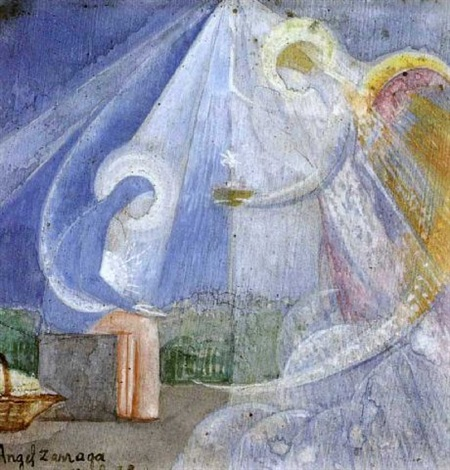
The Annunciation, by Angel Zárraga

Most of life is lived in the mundane. For the most part, we go about our business and deal with the daily grind.  That’s because we are common ordinary people.

So, we can especially relate to Mary. She is rather plain. Mary is of junior high age. If she were living in our day and age, Mary would likely be wearing clothes from the local Goodwill. She cannot read, because girls of her day rarely did.

Mary’s parents make all the decisions that affect her life, including the one that she should be married to an older man named Joseph. We don’t know if she even liked him. She lives in a small town that most people can’t even point to on a map. 

One night, this young girl is visited by the brightly beaming divine messenger Gabriel, whose name means, “God has shown himself mighty.” Mary stands there in her flannel nightgown; her life very quickly moving from the ordinary to extraordinary. The juxtaposition could not be more pronounced:

  • a mighty angel and a plain teen-ager
  • a messenger of the Most High God and a girl barely past puberty
  • holy angelic light in a simple candlelit bedroom
  • awesome power and complete vulnerability

Mary, compared to Gabriel, is defenseless, fragile, and overwhelmed. She’s in over her head. And that’s why we can relate to her. We can get our human arms around Mary. She’s like us. She has faced life with little power to make it turn out the way she planned. Forces beyond her control have rearranged her life and altered it forever. Mary is the Matron Saint of the Ordinary. We can totally understand why she responds the way she does.

Young Mary’s initial reaction was to be greatly troubled. She was disturbed, and was shaking in her ratty old slippers. The angel confidently told Mary that she had found favor with God. In other words Mary was quite literally “graced” by God. 

The situation was not that Mary had some extreme spirituality; but rather that God simply chose her to be the mother of Jesus. 

And Mary needed to come to grips with what was happening to her. This was not what she was looking for.  Becoming pregnant with the Savior of the world was not an answer to prayer for Mary. This was not on her agenda. 

Mary immediately sensed the crazy disconnect between what was being told to her and who she was. After all, she was a plain ordinary girl from the hick town of Nazareth, and she was being told that she would raise a king.  Maybe somebody in heaven screwed up. It could very well be that Gabriel got the wrong girl. Perhaps the angel’s Google map popped up the wrong town to visit. 

Relating to Mary, we can totally understand that she would question how in the world all this was going to happen. Not only is Mary ordinary, and far from royalty, but she is also very much a virgin. None of this made any sense whatsoever.

But the angel lets Mary know that God specializes in the impossible. I understand why many English translators chose to phrase the original rendering as “for nothing is impossible with God.” But I rather like a more literal translation which is “for there is nothing outside of God’s power.” 

There is nowhere we can go, no place on earth, no situation whatsoever that is beyond God’s ability, reach, and power to effect the divine will.

We do not always get straightforward answers to our questions about God. Yet, Mary asked a question and got a straight answer. She really can be pregnant with Jesus because the Holy Spirit will come upon her and overshadow her with power. 

If the story were to end here it would be a great story.  But to me the most astonishing part of this narrative is Mary’s response to what was happening to her.

Mary believed the message and took Gabriel’s words at face value. And so, having believed, she then submitted herself completely to God’s will for her life. 

I think we might totally understand if Mary simply said in her ordinary way that she was not prepared for this.  We would completely “get it” if Mary pushed back on what the angel said to her.

We could relate if Mary just dismissed it all, like Scrooge in the Christmas Carol, with the angel and his message being all humbug as if it were just “an undigested bit of beef, a blot of mustard, a crumb of cheese, a fragment of an underdone potato.  There’s more of gravy than of grave about you, whatever you are!”

And yet, Mary not only believed, but she also humbly submitted herself to what was happening. And, to me, this is what we need to relate to most about Mary – not her being just a plain ordinary person in a non-descript village, but stepping up to the calling she received. 

We, too, have received a calling in our lives. We, too, have been given the power of the Holy Spirit. And we, too, are ordinary people who have been given a very extraordinary task. 

It seems to me that our response today can and ought to be the same as Mary: “I am the Lord’s servant; may it be to me as you have said.” 

The Church is pregnant with possibilities because of the Holy Spirit. We know the end of Mary’s story. She gave birth to Jesus. She raised him in her plain ordinary way. She watched him grow up. She saw him embark on his ministry to proclaim that the kingdom of God has come near. 

Mary did not always understand what Jesus said or what he was doing. And she experienced every mother’s nightmare: seeing her beloved son killed in a terribly gruesome manner right in front of her eyes. 

Yet, just as the Holy Spirit was with the birth of Jesus, so the Spirit was with Jesus at his resurrection from the dead. Jesus, like his earthly mother, lived an ordinary life in a very extraordinary way. And today Jesus invites us to do the same. 

Because Jesus accomplished his mission of saving people from their sins and establishing a kingdom that will never end, he has given us the same Holy Spirit to follow him forever and call other people to follow him, too. 

The Christian life may often be difficult; but it is really not complicated. It’s rather simple, just like Mary. 

Mary responded to God’s revelation with faith, choosing to fully participate in what God was doing. “I am the Lord’s servant” is to be our confession, as well. “May it be to me as you have said” is to be our cry, along with Mary. 

The message Christians proclaim is that Jesus saves – he delivers from sin and Satan and will restore all things.

May you know the presence and the power of God today and always, through knowing Christ Jesus the Lord of all. Amen.

A Great Restoration (Psalm 126)

When the Lord restored the fortunes of Zion,
    we were like those who dream.
Then our mouth was filled with laughter
    and our tongue with shouts of joy;
then it was said among the nations,
    “The Lord has done great things for them.”
The Lord has done great things for us,
    and we rejoiced.

Restore our fortunes, O Lord,
    like the watercourses in the Negeb.
May those who sow in tears
    reap with shouts of joy.
Those who go out weeping,
    bearing the seed for sowing,
shall come home with shouts of joy,
    carrying their sheaves. (New Revised Standard Version)

I personally think that God is amazing. The Lord not only brings restoration and wholeness to people; God also reverses people’s fortunes so that what was lost is found again. Indeed, reversal has a prominent place in today’s psalm, inviting us to recognize that God does more than compensate persons in a loss, but also brings about a complete reversal of reality.

God is the expert at restoring people’s fortunes. For a nation who was overrun by the Babylonians, sent into exile, and then had the ability to return from that exile back to Jerusalem, it very much indeed, felt like a grand restoration. The effect it had on the people was profound. The psalmist describes it like this:

It’s like waking from a dream and realizing that it’s reality.

It’s like the best party – full of celebration, singing, and laughter – that anyone has ever experienced.

It’s like being a real live miracle.

Being invaded, attacked, violated, taken away from your home and traumatized – and then living in oppression and having forced suppression in living your life the way you believe you ought to, is an awfully sad and discouraging way to exist.

But then, fortunes are restored. The grieving and lamenting give way to laughter and joy. That feeling of a 500 pound weight on your shoulders is lifted; you now feel light as a feather. And it isn’t only a personal reversal of tangible resources; it’s also a psychological turn around.

The nations frequently mock and ridicule God’s people. They look at the suffering, as if God has abandoned them – or wonder even if there is a God, at all. The thinking of other nations, is that Israel’s God is nothing but a local god who is impotent outside of Judah. Besides, he probably doesn’t care about a bunch of losers anyway, they reason.

Don’t give the other nations a reason to say,
    “Where is their God? Can’t he help them?”
Let us see you punish those people.
    Punish them for killing your servants. (Psalm 79:10, ERV)

But the God of the Bible is no limited territorial being; the Lord is sovereign over all the earth. And this God is able to effect a radical reversal of body, mind, and spirit – even to those other nations. The disrespectful mouths that once mocked are reversed to giving praise to Israel’s God and acknowledging that the Lord has done great things for the people.

This God has both the will and the ability to intervene and effect real change that completely reverses a person’s and even a nation’s life. Once someone has experienced what God can do, they forever know that God can do it again.

One of the things which personally motivates me is that the Lord has changed my life and my fortunes on many occasions – and even used me to help effect a reversal in other people’s lives, as well. So, no matter how bad things get (and sometimes they get awfully darned bad!) I have confidence and trust that a good, merciful, and loving God sees it all, knows it all, and has the power to do something about it. I may have to wait for a while – maybe even an agonizingly long time – yet I am convinced that the same God who restored the fortunes of Israel can reverse my situation, too.

And the change is so wonderfully dramatic, that it’s like a wadi in the desert, a life-giving river that emerges in the bone dry desert, bringing new growth and sustaining animal life, after the rains finally come and reverse the landscape and the environment completely.

We are, however, reminded that a great reversal and a complete restoration does not happen immediately. When the farmer plants in the Spring, it will be months before there is a harvest of crops. It takes time for the seed to germinate, break the soil, and grow into a mature plant, ready for the harvester.

Get-rich schemes rarely work in life, and never really happen in the spiritual life. Renewal, restoration, and a reversal of fortunes is not an instantaneous event, but rather a process that develops and eventually happens. A lot of blood, sweat, and tears go into any meaningful and sustainable process of change. Yet, where there is weeping, the end will be shouts of celebration and joy.

Believers can live expectantly, and fully convinced, that their suffering will eventually give way to glory. Grief and tears will not have the last word; God’s restorative and reversing grace will.

Many of you long for restoration – either for yourselves or for others you love and care about – because you recognize there needs to be a great reversal of fortunes. Advent is the season for waiting, the time for anticipation, knowing that deliverance will come in the form of a baby. And our waiting shall not be in vain.

O Lord our God, accept the fervent prayers of your people; in the multitude of your mercies look with compassion upon us and all who turn to you for help; for you are gracious, O lover of souls, and to you we give glory, Father, Son, and Holy Spirit, now and forever. Amen.