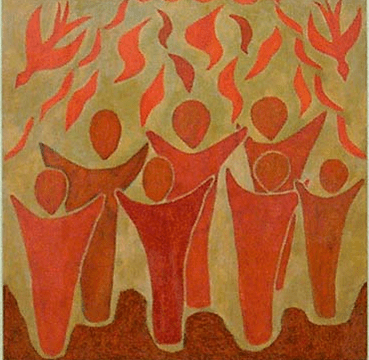
Monday of Holy Week (John 12:1-11)

Mary Anoints the Feet of Jesus, by Wayne Forte

Six days before the Passover Jesus came to Bethany, the home of Lazarus, whom he had raised from the dead. There they gave a dinner for him. Martha served, and Lazarus was one of those reclining with him. Mary took a pound of costly perfume made of pure nard, anointed Jesus’s feet, and wiped them with her hair. The house was filled with the fragrance of the perfume. 

But Judas Iscariot, one of his disciples (the one who was about to betray him), said, “Why was this perfume not sold for three hundred denarii and the money given to the poor?” (He said this not because he cared about the poor but because he was a thief; he kept the common purse and used to steal what was put into it.) 

Jesus said, “Leave her alone. She bought it so that she might keep it for the day of my burial. You always have the poor with you, but you do not always have me.”

When the great crowd of the Jews learned that he was there, they came not only because of Jesus but also to see Lazarus, whom he had raised from the dead. So the chief priests planned to put Lazarus to death as well, since it was on account of him that many of the Jews were deserting and were believing in Jesus. (New Revised Standard Version)

Sharing a meal around a table is much more than just eating some food together. There is the chance to look one another in the eye. An opportunity is afforded to truly see one another and find acceptance. The conditions are ripe for receiving the blessing of blessings.

Please notice with me that on this last week of Christ’s earthly life and ministry, the people who are around the table with Jesus. He shares his cup with his disciples, including both women and men. Mary and Martha are there, along with Peter, James, and John, and, of course, Judas Iscariot, as well.

Jesus, those various people, and others, had the great privilege of looking into the eyes of Jesus, and having Jesus look directly into theirs. It appears, however, that not everyone took advantage of this situation. But Mary did. She evidences having looked into the face of Jesus, and having Jesus gaze into her eyes with divine love.

To look, to see, to gaze, is to connect. To look away and not see, is to disconnect. It is the difference between acceptance and rejection. Jesus looked as long as he could at the friend he loved.

Let us never forget that the presence of God needs to be experienced – not just in the mind, nor even only in the heart – but as a feeling in every cell of the body.

Christ’s divine gaze communicated more than words ever could. Mary knew she belonged with God, and became convinced she was accepted and loved. So, she did what a person who has been touched with the eyes does: Mary responded with the most heartfelt devotion she could, with what she had at the time.

Mary Anointing the Feet of Jesus, by David Finley

Mary anointed the feet of Jesus with expensive perfume by using her own hair to apply it. She shared in the presence and in the love of Christ.

This really ought to make complete sense to the one reading this story whose life has been seen and touched by Jesus. For through such divine love, we become a witness in testifying to the light, much like John the Baptist. The one devoted to Jesus understands that they are not even worthy to untie the thong of Christ’s sandal.

Women never touch a rabbi. Yet, long ago in the town of Bethany in Judea, a woman was worthy to do even more than untie a sandal – Mary was permitted to anoint Christ’s feet. The house became filled not only with the fragrance of the perfume, but also with the aroma of Mary’s witness to us of Jesus and his incredible work in her life as a disciple.

In considering such a story on this Monday of Holy Week, it’s easy to focus on what Mary did, how much it truly cost her, and even on the pathetic and judgmental reaction of Judas to it all. Yet, here we see, if we are looking, what Jesus does for Mary.

The love of Jesus turned Mary into a witness. Jesus lifted her up, even above all the men. And that is what Christ continually did for the lowly, the outcast, the ostracized, the poor. For to them belongs the dominion of God.

Through a simple heartfelt response to Christ’s love, we are filled with the aroma of God, experience a cup of blessing, and see the light of Jesus for us. What’s more, the world’s judgmental spirit is undone. Judas is silenced, along with all of our petty selfish agendas.

Mary directs us to Jesus, and to all those who were previously unseen, unloved, and rejected. Mercy simultaneously puts away the judgmental spirit so it is not seen, while bringing the poor in spirit into the light of God’s grace and love.

Merciful and loving God, Your name is glorified even in the anguish of your Son’s death. Grant us the courage to receive your anointed servant who embodies a wisdom and love that is foolishness to the world. Empower us in witness so that all the world may recognize in the scandal of the cross the mystery of reconciliation. Amen.

Dealing with Disrespect and Disbelief (John 12:34-50)

Christ and the Pharisees, by Anthony van Dyck (1599–1641)

The crowd spoke up, “We have heard from the Law that the Messiah will remain forever, so how can you say, ‘The Son of Man must be lifted up’? Who is this ‘Son of Man’?”

Then Jesus told them, “You are going to have the light just a little while longer. Walk while you have the light, before darkness overtakes you. Whoever walks in the dark does not know where they are going. Believe in the light while you have the light, so that you may become children of light.” When he had finished speaking, Jesus left and hid himself from them.

Even after Jesus had performed so many signs in their presence, they still would not believe in him. This was to fulfill the word of Isaiah the prophet:

“Lord, who has believed our message
    and to whom has the arm of the Lord been revealed?”

For this reason they could not believe, because, as Isaiah says elsewhere:

“He has blinded their eyes
    and hardened their hearts,
so they can neither see with their eyes,
    nor understand with their hearts,
    nor turn—and I would heal them.”

Isaiah said this because he saw Jesus’ glory and spoke about him.

Yet at the same time many even among the leaders believed in him. But because of the Pharisees they would not openly acknowledge their faith for fear they would be put out of the synagogue; for they loved human praise more than praise from God.

Then Jesus cried out, “Whoever believes in me does not believe in me only, but in the one who sent me. The one who looks at me is seeing the one who sent me. I have come into the world as a light, so that no one who believes in me should stay in darkness.

“If anyone hears my words but does not keep them, I do not judge that person. For I did not come to judge the world, but to save the world. There is a judge for the one who rejects me and does not accept my words; the very words I have spoken will condemn them at the last day. For I did not speak on my own, but the Father who sent me commanded me to say all that I have spoken. I know that his command leads to eternal life. So whatever I say is just what the Father has told me to say.” (New International Version)

It seems that nowadays, the more one rises in popularity and garners national attention, the more some folks want to disrespect them.

Out of the many examples of this phenomenon, consider the case of a young woman from my home state of Iowa. Sportswriter Mike DeCourcy recently mused on why the University of Iowa’s Caitlin Clark has discovered that not all the greats of women’s college basketball welcome her success.

Several women – who ought to know better – have cynically reacted to Clark’s legitimate college greatness with a sort of “Why her, why not us?” attitude. They’ve indulged in misinformation and cheap shots that clearly say more about them than Caitlin Clark.

This is especially curious, since Clark has elevated women’s basketball to a level of attention that her now detractors and others have envied for decades. DeCourcy writes, “None of this [delegitimizing Clark] is a good look for NCAA women’s basketball, and neither does it appear to be the most prudent way to continue growing the sport.”

The same type of thing could be said about Jesus and the movement he was sparking during his ministry on this earth. Many of the religious leaders refused to acknowledge his greatness, nor believe in the words he was saying. Instead, they sought to knock down Jesus and the good work he was doing.

It seems the religious leaders wanted the praise and attention Jesus was getting. Even many who believed in what was happening, kept their mouths shut and let the misinformation spread, because they, too, loved the praise of others instead of praise from God.

Playing with the game of darkness, nobody wins. People end up only being a mere shadow of the person they could be. Trying to disrespect others in order to shine the light on yourself is a convoluted and misguided way of handling anyone or any situation.

Carl Jung (1875-1961) described this hidden shadow self as an unconscious aspect of the human personality. In other words, the shadow results from the conscious self being unaware or unconscious concerning areas of its own personality. Without the light of conscious awareness, the shadow self runs amok within the psyche of a person and far too often calls the shots in speaking and behavior.

“Everyone carries a shadow,” Jung wrote, “and the less it is embodied in the individual’s conscious life, the blacker and denser it is.” (Psychology and Religion, 1938)

According to Jung, the shadow side of a person is prone to psychological projection, in which a perceived personal inferiority is recognized as a perceived moral deficiency in someone else. If those projections remain hidden, they eventually come out sideways by harming others because there is a dark illusion, even delusion, that others are stealing what is rightfully mine.

Hence, the sinless Jesus is denigrated, disrespected, and disbelieved. And it is what led to him being tortured and killed by those who thought they are doing a good thing.

It’s easy to be hard on the religious rulers in the New Testament, but this is the Christian season of Lent, and so, we must shine the light of Scripture upon ourselves. This is the time to deliberately gain awareness of our own shadow selves.

Perhaps the burning question for all believers at this time of year is: Do I seek the presence of God more than the presence of anything or anyone else?  

Maybe you live in fear at work and are more concerned about the presence of people around you than the presence of God, so you keep quiet when you ought to speak up or turn a blind eye to the shadows of an organization. Or worse, you talk bad about someone good, just because they’re getting the attention you feel you deserve.

In these remaining days of Lent, as we journey with Jesus to Jerusalem, let’s let the light of his gracious ministry dispel the dark shadows of our hearts and make us aware of who we are, and what we need to change.

If we can learn to appreciate the God-given and hard-earned talents of a young woman playing basketball, then perhaps we can then also learn to glory in One who is greater than any sports celebrity, and celebrate the great work done on this earth for us and for our salvation.

Good and gracious God, we are far too often influenced by what others think of us. We sometimes pretend to be either richer or smarter or nicer than we really are. So, prevent us from trying to divert attention from others to ourselves. Don’t let us gloat over praise received from others, nor be discouraged by criticism from another. Show us, instead, how to be humble of heart, like the Lord Jesus, in whose name we pray. Amen.

How Can Young People Keep Their Lives Pure? (Psalm 119:9-16)

How can young people keep their lives pure?
    By obeying your commands.
With all my heart I try to serve you;
    keep me from disobeying your commandments.
I keep your law in my heart,
    so that I will not sin against you.
I praise you, O Lord;
    teach me your ways.
I will repeat aloud
    all the laws you have given.
I delight in following your commands
    more than in having great wealth.
I study your instructions;
    I examine your teachings.
I take pleasure in your laws;
    your commands I will not forget. (Good News Translation)

Every historical age, and every generation of people has its own struggles. Of course, the challenges vary widely depending on who you ask – young adults of different races, income levels, and geographic locations often have different concerns or prioritize the same concerns differently.

Young people today have particular challenges concerning money, school, violence, sex, climate change, social media, and many other issues. And they face them in different ways than I had to deal with them (back when I was considered young).

Yet, no matter the struggle, nor the concern, the ability to remain set apart for godly purposes is perhaps the main challenge for a spiritual young person. How can a young person keep their life pure?

The psalmist asked the question, and gave a straightforward answer: By obeying God’s commands.

Knowing the answer, however, is only part of attaining and maintaining purity of life. One must put in the hard work necessary to achieve it and hold onto it. And the psalmist helps out with that, as well.

An engagement with the following spiritual practices is how the young person can live into obedience to God and be pure. It’s necessary to frame them as “I will” statements, so that we continually understand that these spiritual practices are vital, and not optional, to a successful life of purity.

I Will Put Energy Into Prayer

It’s one thing to throw up a few prayers in the heat of the moment. But it’s an altogether different thing to devote oneself to prayer and intentionally put the time and energy into praying.

Devote yourselves to prayer, being watchful and thankful. (Colossians 4:2, NIV)

Let there be no excuses in developing a robust prayer life – with the content of those prayers including petitions to avoid falling into disobedience.

I Will Hold God’s Word In My Heart

This is the primary means of keeping sin at bay and maintaining purity and holiness. The Scriptures are meant to be read, ingested, meditated upon, ruminated on, contemplated, and lived. Bibles are not intended to adorn coffee tables; they are designed for their contents to be known.

We can only hold what we have. To keep God’s Word in the heart, it must be taken into that heart.

I have hidden your word in my heart, that I might not sin against you. (Psalm 119:11, NLT)

I Will Praise God

Praise to God arises organically whenever we truly take in the words of God. That’s because God’s Word is life. Praising the Lord is a consistent theme throughout Holy Scripture, as people experience the grace and goodness of God.

I will praise you, Lord!
    You always do right.
I will sing about you,
    the Lord Most High. (Psalm 7:17, CEV)

I’ve thrown myself headlong into your arms—
    I’m celebrating your rescue.
I’m singing at the top of my lungs,
    I’m so full of answered prayers. (Psalm 13:5-6, MSG)

I Will Repeat Aloud God’s Word

It’s a good thing to read the Bible and know the commands of God. It’s an even better thing to read, out loud, and read it more than once.

“…Ezra the priest brought the Law before the assembly, which was made up of men and women and all who were able to understand. He read it aloud from daybreak till noon… in the presence of the men, women and others who could understand. And all the people listened attentively to the Book of the Law.” (Nehemiah 8:2-3, NIV)

Ezra Reads the Law to the People, by Bernadette Lopez

This, in fact, is how we actually get God’s Word impressed on our minds and into our hearts. It’s important for Scripture to move from our short term memory into our long term memory. Then, we can draw from it, especially in those times when we need immediate wisdom or comfort or help.

Just as praise is organic, so God’s Word can spontaneously come out of us – that is, if we have prepared ourselves by filling up the soul to the full of Scripture. Then, helpful words and theology begin to overflow out of us, and benefits everyone.

I Will Delight in Obedience

Submission doesn’t come naturally to most people; it requires intentional development. We need a plan for getting the commands of God inside us. Then they can be familiar to us. And we can follow those commands with all the grace and ability the Lord grants us.

This is more than woodenly following some rules. Keeping to the letter of the Law only engages the mind. The heart needs to be involved, as well. We must also keep the spirit of the Law. And that can happen by learning to delight in obeying God.

Trust in the Lord and do good;
    dwell in the land and enjoy safe pasture.
Take delight in the Lord,
    and he will give you the desires of your heart…

The Lord makes firm the steps
    of the one who delights in him;
though he may stumble, he will not fall,
    for the Lord upholds him with his hand. (Psalm 37:3-4, 23-24, NIV)

I Will Study God’s Word

Learning to delight in God’s commands logically leads toward wanting to examine those commands more closely, to take a good hard look at the biblical teachings available to us.

We don’t necessarily need to become Bible scholars in order to study. We just need the desire and a way to take a closer examination at Scripture. A good way to begin is engaging in a practice known as Lectio Divina.

Lectio Divina is an ancient Latin term which means “spiritual reading.” It is to read Holy Scripture not just to know its contents, but to experience its power to restore, heal, transform, and draw close to God. 

This is a simple way to prayerfully read the Bible, meditate on its message, and listen for what God may be saying for us to do. The goal is to become more Christ-like.

Lectio Divina is based upon reading a selected text of Scripture three times. Each reading is followed by a period of silence after which we respond to God with what we are hearing as we listen.

First Reading

During the first reading, read the text aloud twice. Read slowly and carefully. The purpose of the first reading is to hear the text and listen for a word, phrase or idea that captures your attention. Focus your attention on it, repeating it within your mind several times.

Second Reading

During the second reading, read the text again. This time, focus your attention on how the selected word, phrase or idea speaks to your life. What does it mean for you today? How is Christ, the Word, speaking to you about your life through this word, phrase or idea? After reading, observe a period of silence, then express a brief prayer to God.

Third Reading

Read the text again. This time, focus on what God is calling you to do or to become. Experiencing God’s presence changes us. It calls us to something. During this final reading, focus on what God is calling you to do or to be. Again, observe a period of silence, then pray to God about what you believe you are being called to do or to be.

I Will Take Pleasure in God’s Word

It is probably a foregone conclusion, that when we commit our energy to prayer, hold the Word near and dear to our heart, praise God, speak aloud the words of God, delight in and study divine instruction, we will find ourselves enjoying every moment of it – and living a pure and holy life.

We will discover that God takes pleasure in us. This enjoyment of God over us is so compelling and gracious, that it’s almost as if we cannot help but reciprocate with praise, adoration, and devotion to holiness of life.

There is no arm-twisting in this realm of enjoyment. No need to gin-up motivation, nor to try and get obedience and purity out of others.

The sooner we all learn that the world truly spins on an axis of mercy, the quicker folks will realize a better way to live than endless rules and pronouncements.

For the Lord is always true to the basic divine character of pure steadfast love through what is right, just, and good. Amen.

Spiritual Confidence (2 Corinthians 3:4-11)

Such confidence we have through Christ before God. Not that we are competent in ourselves to claim anything for ourselves, but our competence comes from God. He has made us competent as ministers of a new covenant—not of the letter but of the Spirit; for the letter kills, but the Spirit gives life.

Now if the ministry that brought death, which was engraved in letters on stone, came with glory, so that the Israelites could not look steadily at the face of Moses because of its glory, transitory though it was, will not the ministry of the Spirit be even more glorious? If the ministry that brought condemnation was glorious, how much more glorious is the ministry that brings righteousness! For what was glorious has no glory now in comparison with the surpassing glory. And if what was transitory came with glory, how much greater is the glory of that which lasts! (New International Version)

The Christian religious tradition holds to the great Three-in-One of God – God is indivisibly One, and at the same time, a Trinity of Father, Son, and Spirit. Christians typically have no problem expressing their prayers and devotion to the Persons of the Father and the Son, as well as connecting their ministry efforts to them. 

However, when it comes to the Spirit, this Person of the Holy Trinity is often referred to as an “it” or a “force.” Yet, the Holy Spirit is as much God and a Person as the heavenly Father and the Savior, Jesus Christ. The Spirit is the One who provides the guidance and energy for Christian ministry – and not the Law.

We very much need the Holy Spirit of God. Without the Spirit’s help, Jesus is merely looked at as one person out of thousands of individuals crucified in history; and only an example of one who was martyred for his faith. But Jesus is infinitely more than that. 

Christ is the Son of God, the Savior of the world. Through Jesus Christ’s life, death, resurrection and ascension, people can be redeemed from empty lives, saved from destructive life-patterns, and given the kind of security and purpose in life that God intended from the beginning for people to possess. 

And the Spirit of God is the One that takes these redemptive events of Jesus and applies them to our lives. Apart from the Holy Spirit, we are lost, because we are unable to see the genuine spiritual truth about the cross of Jesus Christ unless God the Holy Spirit breaks into our lives and does an intervention – showing us our denial about how we are really doing and our delusions about who we really are (1 Corinthians 2:1-16).

This, then, is the basis for spiritual confidence. And this sort of confidence does not and cannot come from obedience to the Law.

Admitting that we absolutely need the Holy Spirit of God means that the power of Christianity does not reside with me or you; power for the Christian life rests upon Jesus Christ and him crucified, with the Spirit witnessing to us of this truth. 

In other words, we are largely powerless. 

Now, I realize this is not a popular message, especially in Western society. That sounds ridiculous to a particularly can-do kind of people, like most Americans. We believe we’ve done fairly well on our own, thank you very much. A couple of cars, a house, a job, and a family. I work hard. I’ve earned my stuff and my accomplishments. 

But the thing is, any worldly success may lead us to the delusion that we have the power to do what we want – as if I am the sole captain of my soul. I did it. And I did it my way.

“Oh, sure,” many a person may reason, “we have problems just like everybody else. After all, I can’t control everything!” Yet, we are not powerless just because we have difficult circumstances and a few problem people in our lives. “God will step in a take-over where I leave off, right?” Wrong. 

It’s all wrong, because it’s based in one’s effort to obey a personal creed, the rules of the game, or even the Law and the Ten Commandments. But if we could really do it on our own, there’s no need for any of this spiritual stuff.

In truth, apart from the Holy Spirit of God, we are unable to be Christians and live the Christian life. If we think we manage our lives just fine, with a bit of help from God, then we are likely in denial. We are probably placing ourselves at the center of the world; and believe we should be able to deal with whatever comes in life. 

Whenever the consistent response to adverse situations, or the realization that we are not handling something well, is to try and fix ourselves, then we are surely living in the delusion that we hold the power to change – independently without anyone or anything helping us.

If our first reaction to adversity or problems is:

  • Searching Google for more knowledge
  • Dealing privately with personal issues
  • Expecting that willpower should be enough

Then, we are feeding the delusion that we do not really need the Holy Spirit of God; we are actually believing that we need more effort, or information, in order to find the power to overcome whatever is in my life that needs overcoming.   

Unfortunately, it typically takes a tragedy or crisis to break our delusions of power. Let me ask: How bad must we hurt before we admit that we are not managing our lives well at all, and that the real power to change resides with the Holy Spirit?

Our spiritual power and confidence resides in the cross of Jesus Christ, with the Holy Spirit testifying to us of God’s great grace. 

The Apostle Paul believed this with all his heart. Although he was a very intelligent and learned person, he did not rely on his abilities, but on God’s. 

The cross of Jesus is not just an historical event, but an ongoing reality for us to experience victory over all the brokenness of this world, and all the mess we have made of things by putting ourselves at the center of the universe. 

We need the Holy Spirit of God to intervene and apply Christ’s finished work to us. 

None of this means that the Law, or that you, are bad. Both you and the Law are good. It’s just that we, by ourselves, and the Law by itself, are inadequate to save, deliver, and overcome. For that, we need God’s Spirit, and to tap into the spiritual reality that exists.

If the Ten Commandments were introduced with glory, and we ourselves were created with glory, then how much more glory and life is there through an intimate relation with the Spirit?

O God of peace, who has taught us that in returning and rest we shall be saved, in quietness and confidence shall be our strength: By the might of your Spirit lift us, we pray, to your presence, where we may be still and know that you are God; through Jesus Christ our Lord. Amen.