Psalm 92:1-4, 12-15 – Just Like a Cedar of Lebanon

It is good to give thanks to the Lord,
    to sing praises to your name, O Most High;
to declare your steadfast love in the morning,
    and your faithfulness by night,
to the music of the lute and the harp,
    to the melody of the lyre.
For you, O Lord, have made me glad by your work;
    at the works of your hands I sing for joy….

The righteous flourish like the palm tree,
    and grow like a cedar in Lebanon.
They are planted in the house of the Lord;
    they flourish in the courts of our God.
In old age they still produce fruit;
    they are always green and full of sap,
showing that the Lord is upright;
    he is my rock, and there is no unrighteousness in him.
(New Revised Standard Version)

The Lebanon Cedar tree is the national symbol of the nation of Lebanon, displayed on their national flag. Throughout history, this massive tree has served as a positive image of strength, stability, and uprightness.

Although the tree grows to about eighty feet, what is most impressive about the Lebanon Cedar is it’s large canopy, with branches stretching out to fifty feet. Thus, we have an apt metaphor for the spiritual life.

Whenever we engage in consistent rhythms of giving thanks for God’s steadfast love in the morning and expressing gratitude for the Lord’s great faithfulness at night, we not only grow up in our faith – stretching vertically toward God – we also grow horizontally, reaching out and being a canopy of righteousness for those who need safety, security, and sameness.

Human flourishing occurs deliberately, not by happenstance. It takes intentional work in attending to the development of the soul, the needs of the body, educating the mind, and feeling deeply about things so that the whole person thrives and enjoys life.

Yes, the body grows old and we all must die. Yet, although we might physically waste away, our inner selves can continue growing strong and spreading a wide canopy of righteousness that branches out with grace.

Unfortunately, the great forests of cedars in Lebanon have dwindled over the centuries to 13% of what they once were, due to over-harvesting its wood for shipbuilding, furniture making, and other uses. Even old King Solomon used Lebanon Cedars as the timber for the original Temple to God. Today, the oldest trees still surviving are 3,000 years old – which makes them truly biblical trees.

Indeed, in old age they are still producing cones and sap. The cedars are a testament to strength, resilience, and staying power. And that is exactly what the Lord wants to produce in us – a massive testimony of faith and patience, rooted in the soil of God’s grace, slowly but surely growing for the benefit of others.

This growth is a direct result of God’s activity. The Lord nourishes and sustains humanity, providing the right conditions of righteous soil, living water from heaven, and the warm sun of grace and mercy. We are then able to stretch both tall and wide, becoming an earthly manifestation of God’s goodness.

The Lord doesn’t keep us down but extends abundant grace so that we can extend to others that which has been extended to us. And if we keep maintaining this divine/human rhythm of grace, there is an ongoing and seemingly endless process of growth, even across three millennia.

The Lebanon Cedar is one of the most hardy trees on the planet. It’s thick trunk, expansive branches, resistance to worms and insects, and fragrance make it an apt emblem for the spiritual life. The righteous person is like this majestic unwavering tree, standing as a testimony to longevity, strength, beauty, and usefulness in the world.

I pray that out of his glorious riches he may strengthen you with power through his Spirit in your inner being, so that Christ may dwell in your hearts through faith. And I pray that you, being rooted and established in love, may have power, together with all the Lord’s holy people, to grasp how wide and long and high and deep is the love of Christ, and to know this love that surpasses knowledge—that you may be filled to the measure of all the fullness of God.

Now to him who is able to do immeasurably more than all we ask or imagine, according to his power that is at work within us, to him be glory in the church and in Christ Jesus throughout all generations, for ever and ever! Amen. (Ephesians 3:16-21, NIV)

Genesis 1:1-19 – It Is So, and It is Good

Day When God Created the Flowers by Unknown artist

In the beginning when God created the heavens and the earth, the earth was a formless void and darkness covered the face of the deep, while a wind from God swept over the face of the waters. Then God said, “Let there be light”; and there was light. And God saw that the light was good; and God separated the light from the darkness. God called the light Day, and the darkness he called Night. And there was evening and there was morning, the first day.

And God said, “Let there be a dome in the midst of the waters, and let it separate the waters from the waters.” So, God made the dome and separated the waters that were under the dome from the waters that were above the dome. And it was so. God called the dome Sky. And there was evening and there was morning, the second day.

And God said, “Let the waters under the sky be gathered together into one place, and let the dry land appear.” And it was so.God called the dry land Earth, and the waters that were gathered he called Seas. And God saw that it was good. Then God said, “Let the earth put forth vegetation: plants yielding seed, and fruit trees of every kind on earth that bear fruit with the seed in it.” And it was so. The earth brought forth vegetation: plants yielding seed of every kind, and trees of every kind bearing fruit with the seed in it. And God saw that it was good. And there was evening and there was morning, the third day.

And God said, “Let there be lights in the dome of the sky to separate the day from the night; and let them be for signs and for seasons and for days and years and let them be lights in the dome of the sky to give light upon the earth.” And it was so. God made the two great lights—the greater light to rule the day and the lesser light to rule the night—and the stars. God set them in the dome of the sky to give light upon the earth, to rule over the day and over the night, and to separate the light from the darkness. And God saw that it was good. And there was evening and there was morning, the fourth day. (NRSV)

There is so much which could be said about the opening of Holy Scripture, the first verses of the Old Testament book of Genesis. And much already has been said. I merely want to make one observation of the text and discuss its significant import for us….

God already had within himself everything needed to create.

“Duh,” you might say, “It’s God.” Yes, and we need to unpack what that means. I will phrase it a different way….

God called forth that which is already there.

The opening statement of Genesis is there to communicate a wonderful reality – that the Lord brought order from chaos. God took what was potential and actualized it. And the Lord gave us understanding through creation to discern what is happening….

Seeds are amazing. They have the potential to totally transform from tiny objects to large plants. Perhaps we take seeds for granted because we see the evidence of them everywhere. Yet, like God at creation, a seed already has within itself everything it needs to germinate, take root, break the ground, grow, and produce fruit. The end process of the seed’s maturation looks nothing like when it started as a tiny little kernel.

The seed simply needs to be called forth with the conditions of good soil and proper amounts of sunshine and water. The seed lacks nothing inherent to its very being. It already has everything it needs within itself.

We are creatures, called forth from the earth by God. Each one of us, no matter who we are, where we have come from, whether male or female, rich or poor, black or white, introvert or extrovert, happy or depressed, privileged or underprivileged, already have everything we need within ourselves to grow, thrive, mature, and flourish in this world. In other words, we lack nothing. We are not flawed. We are enough.

We are already spiritual. Our spirituality is as much a part of our DNA as our biological self. We just need the proper conditions to grow.

Sometimes when I meet a person for the first time and it is discovered I’m a pastor and a chaplain, they immediately believe that what I do is put religion into folks – as if people lack something that I must give them.

However, just the opposite is true of what I really do. I simply call forth the spiritual nature which is already present in a person. Many individuals are not aware of who they are, unaware of the magnanimous spirit which resides within them, a resilient and loving spirit which is there to support them just as much as their literal physical spine.

“If you treat people as they appear to be, you make them worse than they are. But if you treat another as if he already were what he potentially could be, you make him what he should be.”

Johann Wolfgang von Goethe

Let there be people who see beyond the five senses and embrace the sixth sense of knowing the inherent worth and majesty of humanity.

Let there be those who discern the potential of chaotic minds and hearts to become calm and rightly ordered around the love of God.

Let there be believers who embody light in all their relational dealings and are unafraid to face the darkness within.

Let there be compassionate ones who awash others with living water.

Let there be leaders who patiently and tediously tend to the garden of people’s souls, providing the proper conditions for spiritual growth and maturation.

Let us all call forth the good in one another, for God created and called us, “good.”

And that is our name: “Good.”

Psalm 118:1-2, 19-29 – Gratitude Changes Us

O give thanks to the Lord, for he is good;
    his steadfast love endures forever!

Let Israel say,
    “His steadfast love endures forever….”

Open to me the gates of righteousness,
    that I may enter through them
    and give thanks to the Lord.

This is the gate of the Lord;
    the righteous shall enter through it.

I thank you that you have answered me
    and have become my salvation.
The stone that the builders rejected
    has become the chief cornerstone.
This is the Lord’s doing;
    it is marvelous in our eyes.
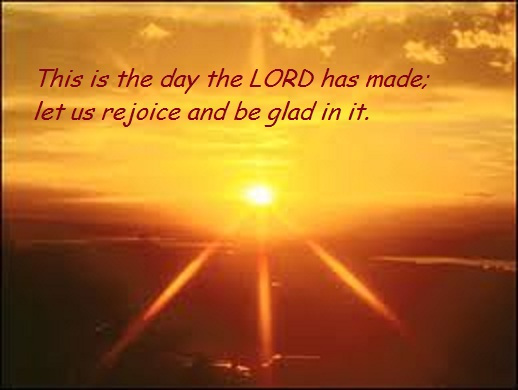
This is the day that the Lord has made;
    let us rejoice and be glad in it.
Save us, we beseech you, O Lord!
    O Lord, we beseech you, give us success!

Blessed is the one who comes in the name of the Lord.
    We bless you from the house of the Lord.
The Lord is God,
    and he has given us light.
Bind the festal procession with branches,
    up to the horns of the altar.

You are my God, and I will give thanks to you;
    you are my God, I will extol you.

O give thanks to the Lord, for he is good,
    for his steadfast love endures forever. (NRSV)

Show me a spiritual sourpuss, and I’ll show you a person who lives without daily gratitude toward God and others. But show me a gracious person who liberally gives thanks, and I will show you a person profoundly in touch with God’s steadfast love.

The psalmist chose to give thanks for God’s goodness and faithful love. I wonder how much different each day would be if we began it with the psalmist’s great call to worship: “This is the day the Lord has made; let us rejoice and be glad in it.” 

There is a misguided notion that only certain people have the attitude of gratitude – that some folks are just naturally ornery, and some are just born happy. But the truth is that gratitude and giving thanks is a practice which needs to be carefully cultivated. As it grows and develops, gratitude bears the fruit of joy. 

Thankfulness is a daily decision of faith to have the kind of attitude which pleases God and blesses others.

We now know so much more about the human brain. Research has discovered that the brain is made up of an estimated 100 billion neurons making a total of 100 trillion neural connections. That’s a lot of neural power! Most of those neural pathways are good and healthy. For example, I didn’t have to think about how to tie my shoes this morning because I have a well-developed neural pathway that automatically makes the connection to do it.

However, some of those neural pathways are not good, even unhealthy. There might be connections in our heads which lead to substance abuse when under stress, or to violently lash out when afraid or hurt, or things like plain old procrastination. If you have ever had the experience of telling yourself that you’re not going to respond a particular way, then end up doing it anyway, it is likely you have a well-worn neural pathway which connects certain events to a set of focused actions.

What this all means is that willpower won’t do the trick in changing behavior. That’s because our brains don’t work that way. The good news is that all those neural connections and pathways, like ruts in a gravel road, can fade away and new ones can be developed. Scientists call this “neural plasticity.”

There are practices which can help unhealthy neural connections go away and create new healthy pathways.

One of those practices is gratitude. Giving thanks changes our brain chemistry! Yet, it doesn’t happen overnight. But if we identify three persons or possessions which we are grateful for and say them out loud at least three times a day over the next three months, then we have developed a new neural pathway in our brain.

So, in the future, when we face a stressful event – whereas in the past we might deal with it in an unhealthy way – now our brains reflexively go to a different place and see the situation in a different way than before. And we choose different actions and behaviors.

Readers of this blog know that I continually encourage reading the psalms out loud as prayers to God. If we make this a practice, it will not only change our brains – it will create new spiritual pathways in our souls which fortify us for those times in life when things are tough and hard.

Spiritual practices have a purpose. And when we use those disciplines, we end up developing connections with the Lord which support us and sustain us for a lifetime – not to mention that we become a delight for others to be around instead of being a tedious fart.

Loving God, this is the day you have made; I rejoice in it and am glad that your steadfast love covers all things. Help me to connect every good thing with your gracious hand upon me so that I will not look and act like I was baptized in pickle juice.  To the glory of Jesus Christ, I pray.  Amen.

Psalm 107:1-16 – The Necessity of Telling Our Secrets

Photo by Brett Sayles on Pexels.com

O give thanks to the Lord, for he is good;
    for his steadfast love endures forever.
Let the redeemed of the Lord say so,
    those he redeemed from trouble
and gathered in from the lands,
    from the east and from the west,
    from the north and from the south.

Some wandered in desert wastes,
    finding no way to an inhabited town;
hungry and thirsty,
    their soul fainted within them.
Then they cried to the Lord in their trouble,
    and he delivered them from their distress;
he led them by a straight way,
    until they reached an inhabited town.
Let them thank the Lord for his steadfast love,
    for his wonderful works to humankind.
For he satisfies the thirsty,
    and the hungry he fills with good things.

Some sat in darkness and in gloom,
    prisoners in misery and in irons,
for they had rebelled against the words of God,
    and spurned the counsel of the Most High.
Their hearts were bowed down with hard labor;
    they fell down, with no one to help.
Then they cried to the Lord in their trouble,
    and he saved them from their distress;
he brought them out of darkness and gloom,
    and broke their bonds asunder.
Let them thank the Lord for his steadfast love,
    for his wonderful works to humankind.
For he shatters the doors of bronze,
    and cuts in two the bars of iron. (NRSV)

The psalmist calls upon others to give thanks to the good Lord who shows enduring love to people. The psalmist furthermore exhorts those who have been redeemed to say so, to declare God’s praises for delivering them from trouble. 

Whatever the circumstances and however difficult the experiences may have been, the believer is not to remain in silence but is to publicly thank God.

Speaking our spiritual stories to others is important for those who share them, and for those who listen, so that the community of the redeemed will be strengthened in their faith and emboldened to share with others. Far too many Christians are reticent to talk about what God has done or is doing in their lives. Shame, embarrassment, or a host of other reasons might prevent us from being vulnerable enough to let others in on God’s deep work within us. But the psalmist does not let us off the hook, even if we feel we are not articulate or are too afraid to speak.

We all likely have had the privilege of hearing another person share their heart and experience of hardship and God’s deliverance. It was uplifting, encouraging, and helpful. So, let’s not keep our stories to ourselves. Stories are meant to be told, not hidden. 

Bringing to light our faith journey is healing for all, as well as declaring the light of Jesus to the world.

Author Frederick Buechner wrote a book several years ago entitled, “Telling Secrets.” Buechner tells of his own experience of keeping some stories inside and never letting them see the light of day. One of those stories was growing up with an alcoholic father and all the other stories that went along with that singular story. It was only in finally telling the family secret of alcoholism that he discovered a better path forward to healing and blessing. He writes:

“What we hunger for perhaps more than anything else is to be known in our full humanness, and yet that is often just what we also fear more than anything else. It is important to tell at least from time to time the secret of who we truly and fully are because otherwise we run the risk of losing track of who we truly and fully are and little by little come to accept instead the highly edited version which we put forth in hope that the world will find it more acceptable than the real thing. It is important to tell our secrets, too, because it makes it easier for other people to tell us a secret or two of their own.”

“My story is important not because it is mine, God knows, but because if I tell it, the chances are you will recognize that, in many ways, it is also your story. It is precisely through these stories in all their particularity, as I have long believed and often said, that God makes himself known to each of us more powerfully and personally. If this is true, it means that to lose track of our stories is to be profoundly impoverished not only humanly but also spiritually.”

Shame is like a vampire. It lives in the shadows, thirsting for and feeding upon secrets.

But when our stories are told and see the light of day, the vampire of shame is destroyed by the bright rays of truth and vulnerability. We then become open to genuine relationships without propping up a false self to pose for others. We place ourselves in a position to receive and give love. In short, we can meaningfully connect with both God and others because we found our voice and told our story.

Great God of deliverance, I praise you that I have a story to tell of your grace and faithfulness. Help me to tell of your mercy in my life so that the name of Jesus will be exalted, and that your people might be built up in the faith.  Amen.