Restoration (Jeremiah 30:1-11a)

This is the word that came to Jeremiah from the Lord: “This is what the Lord, the God of Israel, says: ‘Write in a book all the words I have spoken to you. The days are coming,’ declares the Lord, ‘when I will bring my people Israel and Judah back from captivity and restore them to the land I gave their ancestors to possess,’ says the Lord.”

These are the words the Lord spoke concerning Israel and Judah: 

“This is what the Lord says:

“‘Cries of fear are heard—
    terror, not peace.
Ask and see:
    Can a man bear children?
Then why do I see every strong man
    with his hands on his stomach like a woman in labor,
    every face turned deathly pale?
How awful that day will be!
    No other will be like it.
It will be a time of trouble for Jacob,
    but he will be saved out of it.

“‘In that day,’ declares the Lord Almighty,
    ‘I will break the yoke off their necks
and will tear off their bonds;
    no longer will foreigners enslave them.
Instead, they will serve the Lord their God
    and David their king,
    whom I will raise up for them.

“‘So do not be afraid, Jacob my servant;
    do not be dismayed, Israel,’
declares the Lord.
‘I will surely save you out of a distant place,
    your descendants from the land of their exile.
Jacob will again have peace and security,
    and no one will make him afraid.
I am with you and will save you,’
    declares the Lord.” (New International Version)

The cry of Jeremiah the prophet, by Slovakian artist, 1937

To be restored is a beautiful thing, namely because it presupposes that someone or a group of people were dilapidated and in need of healing. Restoration implies that something was lost, but now is found.

If you have lost things like finances, a home, a car, precious memorial items, a job; or relationships such as a marriage, a friendship, estrangement from family members; or your health to disease or disaster; or even lost your mind or your soul – you can completely understand the longing for restoration and wholeness.

The Jews lost their homeland, their property, their temple, and their dignity to the invading Babylonians. Babylon took everything from Judea. The people became exiled in a strange land. Only some poor folk were left behind in a land that was ravaged.

This was the place that was once referred to as a land of milk and honey, a good home of abundance and blessing. But in the prophet Jeremiah’s day, it was becoming a thing of the past. Would the people ever recover what they had lost? Is restoration even a possibility? Could they learn to hope again?

Into a time of distress and despair, God spoke, and said that yes, it is possible; yes, restoration can and will happen. The people will not be in captivity forever.

Things can get so bad that you become physically sick, emotionally spent, mentally fearful, and spiritually disheartened – as if your life has been ripped from you without mercy and with malice. Yet, what is true of us today is not necessarily going to be true of us tomorrow.

Oppression is a terrible thing. To be constantly harassed by others or by chronic pain or by adverse situations is draining; it sucks the life out of us. Into these sorts of circumstances, God says to us, “I am with you, and I will save you.”

Perhaps tomorrow comes and nothing changes. The pain is still there. The mean-spirited people haven’t gone anywhere. The lost things are not found. And yet, there is something primal and universal which has always been here and shall never go away, no matter the circumstances: God is with us, and God loves us.

If we have the spiritual eyes to see, we will notice that God is alongside us, weeping with us. God knows a thing or two about the sort of suffering and pain that is unimaginable.

“Why does not God do something sooner, if God is so loving and powerful?” you may ask. If you are a parent, you have likely had a child ask you why you are doing something to them that feels awful. You know that emotion of feeling hurt alongside them. You also know that there is sometimes no way you can adequately explain to them what’s going on.

You commit yourself to being there, being present, and assuring the child that you aren’t going anywhere. So, when it comes to us, why is it so hard to understand that God is not a divine Santa or a cosmic Genie granting our every wish? If we want kids to understand, then perhaps we ought to first understand our own relationship as God’s children.

There will be times of trial and tribulation, even divine judgment. Yet there shall also be deliverance from evil, and salvation from sin, death, and hell. The yoke of oppression won’t last because there is the promise of restoration.

No matter how nasty, misguided, or sinful the political leadership and governmental system, none of those rulers or politicians have the last word – God does, not them. Grace has the final say, utilizing a restorative mercy which cannot be undone.

The days are coming when there will be a new future, based in the resolve of God to accomplish it. Fortunes shall be restored. Rehabilitation and renewal are ahead for the faithful. Healing will happen, whether it be in this life, or the next.

Things may seem impossibly hopeless now, but God can and will overrule the present evil machinations of oppressive rulers. Terror may be on every side, yet the Lord will break the bonds of oppression; God will burst the unjust practices. Indeed, God will save.

Therefore, we need not fear, for God is with us; and divine intervention is nearly here.

O God of heavenly powers, by your holy might, be present to us in your goodness and grace; banish all injustice and unrighteousness and restore your people in the strength of faith. Amen.


Saved for a Reason (Ephesians 2:1-10)

At one time you were like a dead person because of the things you did wrong and your offenses against God. You used to live like people of this world. You followed the rule of a destructive spiritual power. This is the spirit of disobedience to God’s will that is now at work in persons whose lives are characterized by disobedience. At one time you were like those persons. All of you used to do whatever felt good and whatever you thought you wanted so that you were children headed for punishment just like everyone else.

However, God is rich in mercy. He brought us to life with Christ while we were dead as a result of those things that we did wrong. He did this because of the great love that he has for us. You are saved by God’s grace! And God raised us up and seated us in the heavens with Christ Jesus. God did this to show future generations the greatness of his grace by the goodness that God has shown us in Christ Jesus.

You are saved by God’s grace because of your faith. This salvation is God’s gift. It’s not something you possessed. It’s not something you did that you can be proud of. Instead, we are God’s accomplishment, created in Christ Jesus to do good things. God planned for these good things to be the way that we live our lives. (Common English Bible)

Humanity is spiritually hard-wired to do good in this world. 

From a Christian perspective, we live in a fallen world and experience the evils of disasters, diseases, and decision-making that is off, as well as personal and corporate corruption. However, this is not our original design. 

In the Christian tradition, believers in Jesus are not delivered from sin, death, and hell so that they can idly sit in a worldly holding tank until Christ returns. Deliverance is the initial dimension of God’s plan – and not the end game. We are saved for good works to be done in the here-and-now.

Christians know that they are saved from individual and systemic sin through the forgiving work of Jesus Christ. It’s an act of sheer grace on God’s part. A believer in Jesus is not spiritually reborn through her effort any more than a baby’s birthed because of her own doing. It is thoroughly the work of God. Even the faith needed to believe is a gift graciously provided by God.

This, however, is far from the whole story. God has plans and purposes in mind for people. Christians are birthed into a new spiritual community with new commitments to do all kinds of good deeds. It’s as if sin is a weight or an obstacle that has been removed, so that living a life full of goodness can now move forward and do its work. 

To be saved is to be freed for a vigorous moral life that is deeply concerned with altruistic actions in a world full of need.

There is a profound spiritual wound which underlies the great problems of our world. Behind so many of our world issues are matters of the spirit. The unseen world is just as real as the world which is seen. Just as we know germs are present, are real, and we must account for them – so there is spiritual world very much real, and we ignore it at our great peril. 

And so, it seems to me that spiritual people, including Christians delivered for the purpose of good deeds, are to agitate for earthly change graciously, wisely, and lovingly. Expecting human governments or corporate systems to take the lead in moral transformation is like asking the fox to guard the hen house.

I will admit to you that I don’t much have the stomach for what seems to me to be useless emotional debates amongst some Christian communities about all sorts of political issues and religious dogmatic opinions. As redeemed people, delivered for a purpose, I believe it is sage to put our focus on discovering how we can support and bless the essential services laboring to keep humans surviving, and hopefully, thriving. God has raised us up for this, that is, if we have the spiritual eyes to see.

Christians, churches, and spiritual communities must labor at the gates of hell for the lives of women caught in sex trafficking; provide uplift and the tools to a better life for those in grinding poverty and hunger; challenge the idolatry of a materialist culture; and, hundreds of other realities of living in a fallen broken world.

As Christians, God has delivered us from sin, death, and hell so that we will do good in this world. God has sovereignly placed you and I in places and positions for just this time so that we will do good works, both big and small, tackling immense issues as well as little acts of kindness. 

Doing good comes in all sizes, and all of us are to share our lives for the betterment of humanity. After all, we really are our brother’s and our sister’s keeper.

God Almighty, I pray that your people may not lose heart in this world. May you strengthen your church with spiritual power so that the words and ways of Jesus will ground them for faithful service to this planet you have created. May Christians everywhere be rooted and established in the divine love which supports good works done in the humility of a gentle spirit; through Jesus Christ our Lord, who lives and reigns with you and the Holy Spirit, one God, now and forever.  Amen.

Who Is Jesus? (Luke 2:22-40)

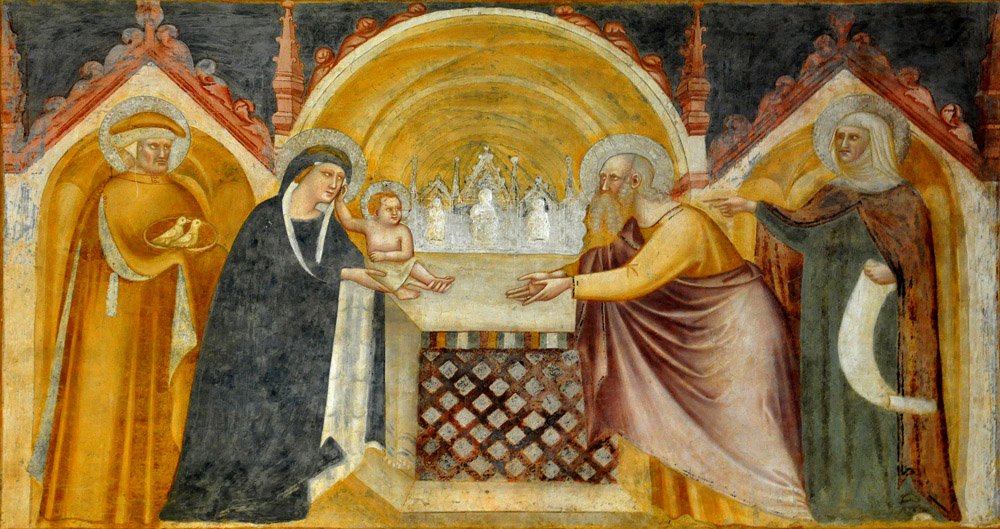
The Presentation in the Temple, 14th century fresco in Pomposa Abbey, Codorigo, Italy

When the time came for the purification rites required by the Law of Moses, Joseph and Mary took him to Jerusalem to present him to the Lord (as it is written in the Law of the Lord, “Every firstborn male is to be consecrated to the Lord”), and to offer a sacrifice in keeping with what is said in the Law of the Lord: “a pair of doves or two young pigeons.”

Now there was a man in Jerusalem called Simeon, who was righteous and devout. He was waiting for the consolation of Israel, and the Holy Spirit was on him. It had been revealed to him by the Holy Spirit that he would not die before he had seen the Lord’s Messiah. Moved by the Spirit, he went into the temple courts. When the parents brought in the child Jesus to do for him what the custom of the Law required, Simeon took him in his arms and praised God, saying:

“Sovereign Lord, as you have promised,
    you may now dismiss your servant in peace.
For my eyes have seen your salvation,
    which you have prepared in the sight of all nations:
a light for revelation to the Gentiles,
    and the glory of your people Israel.”

The child’s father and mother marveled at what was said about him. Then Simeon blessed them and said to Mary, his mother: “This child is destined to cause the falling and rising of many in Israel, and to be a sign that will be spoken against, so that the thoughts of many hearts will be revealed. And a sword will pierce your own soul too.”

There was also a prophet, Anna, the daughter of Penuel, of the tribe of Asher. She was very old; she had lived with her husband seven years after her marriage, and then was a widow until she was eighty-four. She never left the temple but worshiped night and day, fasting and praying. Coming up to them at that very moment, she gave thanks to God and spoke about the child to all who were looking forward to the redemption of Jerusalem.

When Joseph and Mary had done everything required by the Law of the Lord, they returned to Galilee to their own town of Nazareth. And the child grew and became strong; he was filled with wisdom, and the grace of God was on him. (New International Version)

The Gospel accounts of Matthew, Mark, Luke, and John actually contain very little information about the childhood of Jesus. That’s because the Gospels are not biographies – in the sense we think of them – but rather they are narratives that seek to answer a fundamental question about faith and life on this earth: Who is this Jesus?

C.S. Lewis went about exploring that very question. He reasons with us in his classis work, Mere Christianity:

“I am trying here to prevent anyone saying the really foolish thing that people often say about Him: I’m ready to accept Jesus as a great moral teacher, but I don’t accept his claim to be God. That is the one thing we must not say. A man who was merely a man and said the sort of things Jesus said would not be a great moral teacher. He would either be a lunatic — on the level with the man who says he is a poached egg — or else he would be the Devil of Hell. You must make your choice. Either this man was, and is, the Son of God, or else a madman or something worse. You can shut him up for a fool, you can spit at him and kill him as a demon or you can fall at his feet and call him Lord and God, but let us not come with any patronizing nonsense about his being a great human teacher. He has not left that open to us. He did not intend to.”

C.S. Lewis, Mere Christianity

St. Luke’s account of Christ’s childhood stories, seeks to make some important theological points about Jesus:

  • born a Jew amongst devout religious Jews in a thoroughly Jewish society, under Roman authority (Luke 2:1-7)
  • born of a woman, born under the law (Galatians 4:4-5)
  • obedient to his heavenly Father (Luke 2:49; Mark 3:35)
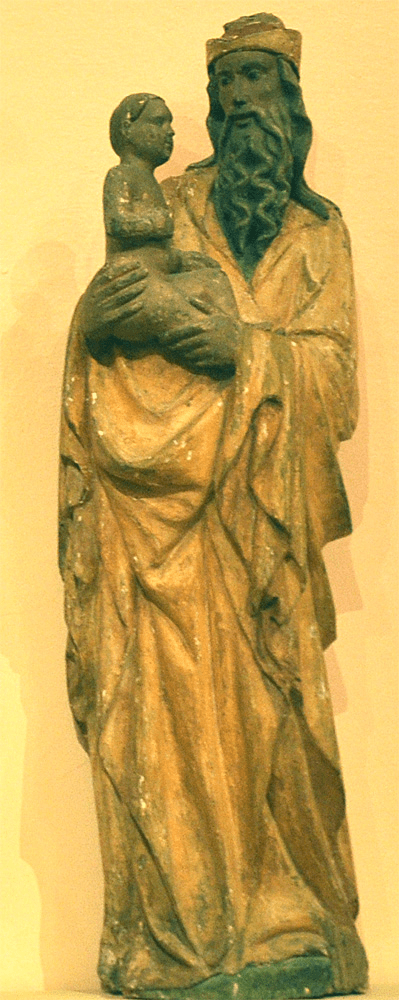
The Presentation in the Temple, 14th century marble statue in the National Museum of the Middle Ages, Paris, France

So, as such, the presentation of Jesus in Jerusalem at the temple is motivated by specific requirements of the law of Moses:

The Lord said to Moses, “Say to the Israelites: ‘A woman who becomes pregnant and gives birth to a son will be ceremonially unclean for seven days…. On the eighth day the boy is to be circumcised. Then the woman must wait thirty-three days to be purified from her bleeding. She must not touch anything sacred or go to the sanctuary until the days of her purification are over….

“‘When the days of her purification for a son… are over, she is to bring to the priest at the entrance to the tent of meeting a year-old lamb for a burnt offering and a young pigeon or a dove for a sin offering….

“‘These are the regulations for the woman who gives birth to a boy… But if she cannot afford a lamb, she is to bring two doves or two young pigeons, one for a burnt offering and the other for a sin offering. In this way the priest will make atonement for her, and she will be clean.’” (Leviticus 12:1-8, NIV)

What’s more, every first-born male (as Jesus was) specifically belongs to the Lord, and is set apart.

The Lord said to Moses, “Consecrate to me every firstborn male. The first offspring of every womb among the Israelites belongs to me… you are to give over to the Lord the first offspring of every womb….”

“In days to come, when your son asks you, ‘What does this mean?’ say to him, ‘With a mighty hand the Lord brought us out of Egypt, out of the land of slavery. When Pharaoh stubbornly refused to let us go, the Lord killed the firstborn of both people and animals in Egypt.

This is why I sacrifice to the Lord the first male offspring of every womb and redeem each of my firstborn sons.’ And it will be like a sign on your hand and a symbol on your forehead that the Lord brought us out of Egypt with his mighty hand.” (Exodus 13:1-2, 12, 14-16, NIV)

Luke was making the connection that when Joseph and Mary presented Jesus to the Lord in Jerusalem, they were essentially dedicating his life to God. Jesus will be the means of redemption for all the people.

Mary would have remembered the words the angel Gabriel told her, that her son will not only be holy, but also be called the Son of God. The life of Jesus – conception, birth, and presentation at the temple – is demonstrably dedicated fully and completely to his heavenly Father. Deliverance for both Jews and Gentiles is focused in the person of Jesus.

Simeon and the Child Jesus, 16th century statue in Zadar, Croatia

Simeon and Anna show up at the presentation of Jesus as devout Jews who are awaiting the fulfillment of God’s promises of consolation and redemption for Israel.

“I, the Lord, have called you in righteousness;
    I will take hold of your hand.
I will keep you and will make you
    to be a covenant for the people
    and a light for the Gentiles.” (Isaiah 42:6, NIV)

Break forth; shout together for joy,
    you ruins of Jerusalem,
for the Lord has comforted his people;
    he has redeemed Jerusalem.
The Lord has bared his holy arm
    before the eyes of all the nations,
and all the ends of the earth shall see
    the salvation of our God. (Isaiah 52:9-10, NRSV)

Simeon and Anna became the spokespersons for the redemption that is to come through Jesus. They both got a glimpse of the salvation that would, one day, reveal itself to the whole world. Forgiveness of sins, deliverance from death and hell, and freedom from guilt and shame all become laser focused on the suffering servant of God.

Who is Jesus? He is the ultimate meaning of Christmas, the incarnation of the Son of God, the Savior of the world. Amen.

Born to Die (Judges 13:2-24)

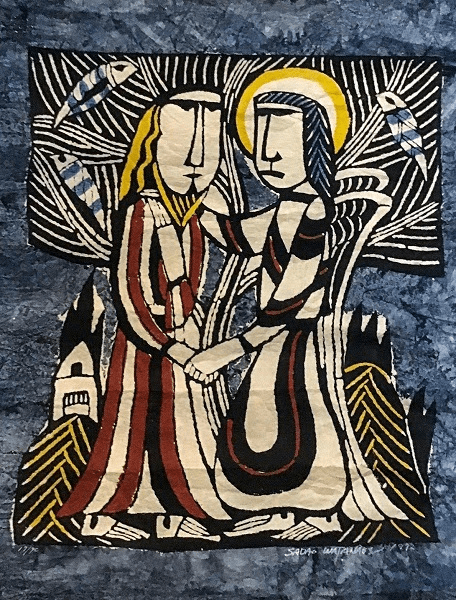
The angel and Manoah, by Sadao Watanabe, 1972

There was a man from Zorah named Manoah. Manoah was from the family of Dan. His wife was not able to have children. The Messenger of the Lord appeared to her and said, “You’ve never been able to have a child, but now you will become pregnant and have a son. Now you must be careful. Don’t drink any wine or liquor or eat any unclean  food. You’re going to become pregnant and have a son. You must never cut his hair because the boy will be a Nazirite dedicated to God from birth. He will begin to rescue Israel from the power of the Philistines.”

The woman went to tell her husband. She said, “A man of God came to me. He had a very frightening appearance like the Messenger of God. So I didn’t ask him where he came from, and he didn’t tell me his name. He told me, ‘You’re going to become pregnant and have a son. So don’t drink any wine or liquor or eat any unclean food because the boy will be a Nazirite dedicated to God from the time he is born until he dies.’ ”

Then Manoah pleaded with the Lord, “Please, Lord, let the man of God you sent come back to us. Let him teach us what we must do for the boy who will be born.”

God did what Manoah asked. The Messenger of God came back to his wife while she was sitting out in the fields. But her husband Manoah was not with her. The woman ran quickly to tell her husband. She said, “The man who came to me the other day has just appeared to me again.”

Manoah immediately followed his wife. When he came to the man, he asked him, “Are you the man who spoke to my wife?”

“Yes,” he answered.

Then Manoah asked, “When your words come true, how should the boy live and what should he do?”

The Messenger of the Lord answered Manoah, “Your wife must be careful to do everything I told her to do. She must not eat anything that comes from the grapevines, drink any wine or liquor, or eat any unclean food. She must be careful to do everything I commanded.”

Manoah said to the Messenger of the Lord, “Please stay while we prepare a young goat for you to eat.”

But the Messenger of the Lord responded, “If I stay here, I will not eat any of your food. But if you make a burnt offering, sacrifice it to the Lord.” (Manoah did not realize that it was the Messenger of the Lord.)

Then Manoah asked the Messenger of the Lord, “What is your name? When your words come true, we will honor you.”

The Messenger of the Lord asked him, “Why do you ask for my name? It’s a name that works miracles.”

So Manoah took a young goat and a grain offering and sacrificed them to the Lord on a rock he used as an altar. While Manoah and his wife watched, the Lord did something miraculous. As the flame went up toward heaven from the altar, the Messenger of the Lord went up in the flame. When Manoah and his wife saw this, they immediately bowed down with their faces touching the ground.

The Messenger of the Lord didn’t appear again to Manoah and his wife. Then Manoah knew that this had been the Messenger of the Lord. So Manoah said to his wife, “We will certainly die because we have seen God.”

But Manoah’s wife replied, “If the Lord wanted to kill us, he would not have accepted our burnt offering and grain offering. He would not have let us see or hear all these things just now.”

So the woman had a son and named him Samson. The boy grew up, and the Lord blessed him. (God’s Word Translation)

The Sacrifice of Manoah, by Charles Blanc (1813-1882)

In the anticipation of Christ’s birth, we are reminded today that there have been extraordinary births in history – a sign that the delivery of a baby will lead to a deliverance of the people.

The ancient Israelites were yet again in one of their downward spirals into apostasy. As a result, their arch-nemesis, the Philistines, had domination over them. The tribe of Dan – from which Samson was born into – was geographically situated in such a way that they would have borne the brunt of Philistine oppression.

In the case of miraculous births in Holy Scripture, an angel comes to announce the coming child. These sorts of situations always have an infertile woman who was not planning on becoming a mother. And in many cultures, including Israel, a son born to a woman who was childless for a long time is recognized as a particularly special gift from God.

There are typically, therefore, high expectations that such a special child is destined for great things in this life. Indeed, Samson would become an extraordinary person by initiating the deliverance of Israel from the Philistines.

Samson, according to the angel, was not only to make sure he never eats any unclean food, but also was to be set apart from his very conception as a Nazirite – one who has the special rules of abstinence from alcohol, cutting the hair, and touching corpses. (Numbers 6:1-8)

From the very beginning of Samson’s existence in the womb of his mother, the Spirit of God was with him and began empowering him for his destiny of deliverance.

Since we know the rest of the story, as contained in the Bible, we understand that the way the deliverance of Israel came was not by any sort of conventional means. It was a rather circuitous and complicated set of circumstances and decisions which brought about Israel’s freedom from oppression.

In a similar way, the deliverance which Jesus secured – not only for Israel, but according to Christianity, for all nations – came about through unexpected and tragic circumstances. This is why many Christians will state that Jesus was born to die – because his death, like Samson’s, brought about a great saving event that vastly outdid anything done during life.

Perhaps you existentially know something in this season about such bittersweet circumstances and events. It could be that you are experiencing a situation that is both very sad and quite joyous at the same time.

So, may you, especially, in this time of year, find satisfaction in your grief, and contentment in your lament. May the angel’s announcement stir in your soul the peace that passes all understanding. May the Lord be with you, my friend.

Soli Deo Gloria