
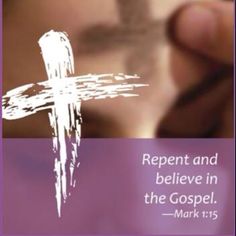
Lent and Repentance


            The Christian season of Lent encompasses the forty days before Easter.  This year it’s from February 10 (Ash Wednesday) to March 27 (Easter), 2016.  Lent is a season of the Christian Year where believers focus on simple living, prayer, and fasting in order to grow closer to God.  At the baptism of our Lord the sky opened and the Spirit of God, which looked like a dove, descended and landed on Jesus.  A voice from heaven said, “This is my Son, My Beloved, with whom I am pleased.” Jesus was then sent into the wilderness by the Spirit where he fasted and prayed for forty days (Matthew 4:1-11). During his time in the desert Jesus was tempted by Satan and found clarity and strength to resist temptation. Afterward, he was ready to begin his ministry.
 
            Lent is the ideal time of year to repent — to return to God and re-focus our lives to be more in line with Jesus. It’s like a forty-day trial run in changing your lifestyle and letting God change your heart.  Repentance is the key that unlocks the soul’s ability to connect with God.  To repent means to turn around, to stop going in one direction and start going in another one.  It is repentance that makes all the difference in the orientation of our souls in this life.
 
            Certainly, no one can really judge the heart of another.  Only God can rightly do that.  Yet, the New Testament lets us in on how to truly measure the sincerity of one’s repentance (2 Corinthians 7:2-12).  Worldly sorrow or grief does not lead to repentance, but only separation and death.  The person with worldly sorrow beats himself up but never really changes direction.  Like Judas Iscariot of old, he just metaphorically hangs himself instead of admitting his guilt to Jesus. 
 
            But godly sorrow leads to repentance, a real change of direction.  And here is the evidence from the Scriptures of the genuineness of the change:  owning up to the problem/sin; an eagerness to make things right; indignation over what has been done or said; seeing that there is more pain in avoiding the problem than there is in confronting it; a desire and energy to do what is best for the person whom we have wronged; and, a willingness to accept whatever consequences that might result from the offense.
 
            Crying and tears might occur and can even be necessary, but they can also be a cheap form of avoiding true repentance and might only be worldly sorrow.  Instead, there must be solid action that changes direction and seeks to rectify offenses, as much as it is within our control to do so.  Deliverance from the power of sin can only come through repentance.  There are no shortcuts or easy routes to the soul’s orientation to practical godliness.  There is nothing romantic about repentance; it is typically messy, usually ugly, and often painful.  Yet, there must be suffering before glory.  Trying to take repentance out of the equation is to eviscerate the Christian life and leave our souls vacuous and empty.
 
            Sometimes we do not even know we need to repent because we get caught up in the drama of school, relationships, family, and work. Our lives are filled with distractions that take us away from living a life with Christ. We might try to fill the emptiness inside us with mindless web-surfing, meaningless chatter, too many activities or other stuff that just keeps us busy without thinking too much. We run away from real life and from God.  But when we intentionally create a plan to connect with God, his Spirit begins to reveal the need for repentance.  That plan during Lent ought to include some form of fasting, prayer, and service.  For example, you could take the Christmas cards you received and pray for one of the people/families each day in the forty days, instead of eating the candy bar or drinking the soda; and, then send them a note of encouragement.  Or, get up ten minutes earlier than usual and spend those minutes in silence and prayer.


            To choose nothing is to give into worldly sorrow and feel guilty.  To choose something, whatever that something is, is to anticipate that God will work in your soul to thaw it out, warm it up, and form it to better discover Jesus Christ.


False Guilt versus Godly Sorrow


            In many ways pastors and church leaders are in the guilt business.  No, I am not talking about ministerial dopes using guilt as a tool to get congregants to serve in the church’s programs.  Instead, I mean that preachers, teachers, and leaders traffic in dealing with people who either feel a false sense of shame, or have godly sorrow.  Knowing the difference between the two is critical to having a church ministry that is truly helping people and is life-giving, or a ministry that just gins-up worldly sorrow and produces spiritual death (2 Corinthians 7:10).
 
            Because we live in a fallen world everyone exhibits tendencies toward false guilt at times in their lives.  We can all identify with these dynamics of worldly sorrow that leads to nowhere:  taking responsibility for others; being so concerned for helping others that there is a failure to take care of oneself; self-hatred; martyr syndrome; hopelessness and a victim mentality; over-emphasizing what you have done wrong.  In other words, there is plenty of true guilt to have in this life without scrambling to create the kind of guilt and sorrow that God himself does not level on us.  Heaping unnecessary guilt on ourselves or others is just plain egregious and goes against Christ’s gospel of grace.
 
            But that does not mean we should never feel guilty; it is just that we need to experience the right kind of guilt.  There are plenty of lists in the New Testament about what sinful behavior and speech really is, and we ought to stick with those things rather than add our separate list of the terrible ten or nasty nine which do not appear in Scripture.  For example, Paul said to the Galatian church that the acts of the sinful nature are obvious:  sexual immorality, impurity and debauchery; idolatry and witchcraft; hatred, discord, jealousy, fits of rage, selfish ambition, dissensions, factions and the like (Galatians 5:19-21).  Let’s be struck to the heart about gossiping about another person, slandering a fellow brother or sister in Christ, or viewing pornography rather than worrying about why someone failed to say “hi” to me in the hallway.
 
            Before mentioning Paul’s description of what godly sorrow is really like, let’s acknowledge that there are people who avoid true guilt at all costs.  When confronted with the truth, an avoider of godly sorrow will be characterized by one or more of the following:  defensiveness; rationalizing the behavior or speech; making excuses; blaming others; feeling threatened and switching the focus on the other.  In short, worldly sorrow does not take responsibility but sticks with the delusion that they caught a bad break or that others pushed them to it.  The avoider of responsibility may go on and on about how unfair life has been to them or even shed tears in order to receive empathy when they really have no intention of changing.  When a person gives you a blank affect when telling you what they have done wrong and exhibits no indication of wanting to face the consequences of their actions, beware!  They want you to agree with them.
 
            According to the Apostle Paul, godly sorrow produces several things (2 Corinthians 7:11).  It creates earnestness to hear the truth about how your actions wounded another with a sincerity to listen and care for those you have hurt.  True guilt is an eagerness to make amends and understands the person(s) they hurt need time to forgive.  Godly sorrow brings indignation – a real sense of understanding how bad the actions or words were that wounded another.  Godly sorrow is alarmed at the reality that you have and still could easily harden your heart and continue to abuse another.  Godly sorrow knows how easy it is to fall back into destructive patterns that damage others, and invites accountability and help.  Godly sorrow has a longing to restore broken relationships and desires proper boundaries so as to not hurt the other again.  Godly sorrow has a deep concern for anyone touched by the abuse.  In short, godly sorrow is the willingness to face any and all consequences that helps others feel safe.
 
            We all need to begin identifying and dealing with our own destructive patterns.  We must actively listen by welcoming confrontation and input from others; taking responsibility to remember what others tell us; telling others the truth about how we use them to help enable us in our sinful patterns; stopping the belief that hiding truth protects others; telling yourself the truth; and, being honest about your feelings even if they expose that you are in a terrible place.
 
            Every one of us has had both false guilt and avoided true guilt.  We will tend, however, to be dominant with one or the other.  It is essential to determine which we tend toward.  Most people who heap false guilt upon themselves constantly want to blame themselves.  Most avoiders of true guilt want to see themselves as struggling with false guilt.  This really cannot be done alone because, the Scripture tells us, the heart is deceitful.  This is why belonging to a church family and getting involved in the church’s ministries is essential for us – because we need one another in order to become the people God wants us to be.  And church leaders must have a solid sense of when they are talking with people who exhibit signs of genuine repentance and when they are trying to be manipulated into feeling empathy for an abuser.


            By God’s grace the church of Jesus Christ will grow together into maturity as we commit ourselves to helping one another face the truth and consequences about ourselves.  Even so, come Lord Jesus.