Work, Love, and Dignity (Proverbs 27:1-27)

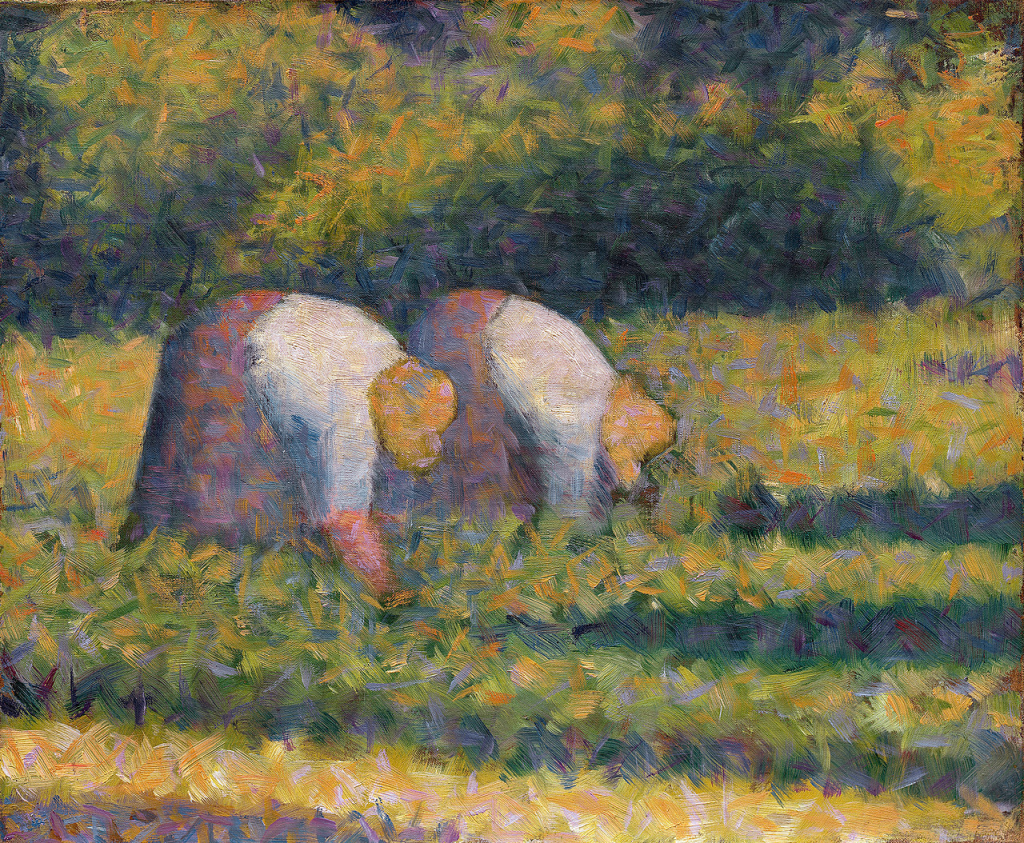
Farm Women at Work, by Georges Seurat (1859-1891)

Do not boast about tomorrow,
    for you do not know what a day may bring.

Let someone else praise you, and not your own mouth;
    an outsider, and not your own lips.

Stone is heavy and sand a burden,
    but a fool’s provocation is heavier than both.

Anger is cruel and fury overwhelming,
    but who can stand before jealousy?

Better is open rebuke
    than hidden love.

Wounds from a friend can be trusted,
    but an enemy multiplies kisses.

One who is full loathes honey from the comb,
    but to the hungry even what is bitter tastes sweet.

Like a bird that flees its nest
    is anyone who flees from home.

Perfume and incense bring joy to the heart,
    and the pleasantness of a friend
    springs from their heartfelt advice.

Do not forsake your friend or a friend of your family,
    and do not go to your relative’s house when disaster strikes you—
    better a neighbor nearby than a relative far away.

Be wise, my son, and bring joy to my heart;
    then I can answer anyone who treats me with contempt.

The prudent see danger and take refuge,
    but the simple keep going and pay the penalty.

Take the garment of one who puts up security for a stranger;
    hold it in pledge if it is done for an outsider.

If anyone loudly blesses their neighbor early in the morning,
    it will be taken as a curse.

A quarrelsome wife is like the dripping
    of a leaky roof in a rainstorm;
restraining her is like restraining the wind
    or grasping oil with the hand.

As iron sharpens iron,
    so one person sharpens another.

The one who guards a fig tree will eat its fruit,
    and whoever protects their master will be honored.

As water reflects the face,
    so one’s life reflects the heart.

Death and Destruction are never satisfied,
    and neither are human eyes.

The crucible for silver and the furnace for gold,
    but people are tested by their praise.

Though you grind a fool in a mortar,
    grinding them like grain with a pestle,
    you will not remove their folly from them.

Be sure you know the condition of your flocks,
    give careful attention to your herds;
for riches do not endure forever,
    and a crown is not secure for all generations.
When the hay is removed and new growth appears
    and the grass from the hills is gathered in,
the lambs will provide you with clothing,
    and the goats with the price of a field.
You will have plenty of goats’ milk to feed your family
    and to nourish your female servants. (New International Version)

Hard Work

The Lord God took the man and put him in the Garden of Eden to work it and take care of it. (Genesis 2:15, NIV)

Work itself is not a result of humanity’s fall. Before Adam and Eve disobeyed God, they were tasked to work and take care of the Garden of Eden. Therefore, work is inherently good. Yet, hard labor is certainly a result of the fall.

What we humans ought to have done through our created nature, now because of the fall into sin and disobedience, we have to work with focused deliberate intention. And even then, we often don’t perform our work as we would like.

“Cursed is the ground because of you;
    through painful toil you will eat food from it
    all the days of your life.
It will produce thorns and thistles for you,
    and you will eat the plants of the field.
By the sweat of your brow
    you will eat your food
until you return to the ground,
    since from it you were taken;
for dust you are
    and to dust you will return.” (Genesis 3:17-19, NIV)

This is why wise persons throughout the ages have given priority to hard work, and branded laziness as detrimental to our human welfare.

Much of our labor is menial and mundane, no matter what the work is. Yet, through vision and persistence, the fruit of our labor eventually breaks through. It is important for us to keep our nose to the grindstone, namely, because this is what it takes to produce, and to keep ourselves out of trouble!

Like a shepherd who cares for the sheep, we are to be present, pay attention, do whatever it takes to help the sheep flourish, and hang in there through the thick and thin of the job.

Diligence and consistency are vital to our hard work. The temptation of get-rich-quick schemes and other supposedly easy paths to success and wealth sometimes rear their heads to lure us away from our daily chores.

Well-kept sheep will produce wool and milk for several years. Riches and achievements and accolades, however, do not necessarily last for long.

Affectionate Love

Hard work and relationships nurtured by affectionate love are meant to go hand-in-hand. In other words, ideally, the duty and diligence of our daily tasks, and the consistency of establishing relational well-being with others, is well-balanced and works seamlessly together.

Loving another entails both encouragement and correction, heartfelt words as well as open words of rebuke. That is, we continually think of what another needs, and what is best for the community as a whole.

Our love must entail what is good for the one being loved, for the one doing the loving, and for the whole community to which both belong. Love leaves angry speeches and jealous motives behind and doesn’t utilize them, because they are tools of hate and hurt.

Gracious Dignity

Everyone is responsible to extend basic human kindness to one another, without exception. We are to listen to and honor our parents and elders; practice self-control and patience with all; and use gentle words in every communication.

Poise under pressure, and motivation to do what is right and good helps to lift the worth and dignity of others. We extend this to people for no other reason than that it is another human being who is in front of us; this is a person in God’s image.

God created mankind in his own image,
    in the image of God he created them;
    male and female he created them. (Genesis 1:27, NIV)

All persons have inherent worth as image-bearers of God. The wise person amongst us knows this and continually applies it in all their words and actions toward others.

Wise people also understand the value of hard work, and the intrinsic worth of work itself. Furthermore, they discern that love is to be the motivation and animating principle in doing work and working with others.

The bottom line of all the proverbial wise saying in today’s lesson is that we are to help and encourage others through both our words and our working actions. Our individual lives are to benefit the whole community, so that we are a blessing to others, as well as to receive blessings from those around us.

In engaging a healthy rhythm of giving and receiving, we reverse the curse, and enable the world to return to Eden.

Almighty God, we pray that You will bless all of our various labor and work in the world. Help us to pray fervently, diligently work hard, and give liberally. In all that we do, enable us to do it with all the love You provide. Amen.

Abundant Life (1 Kings 8:1-21)

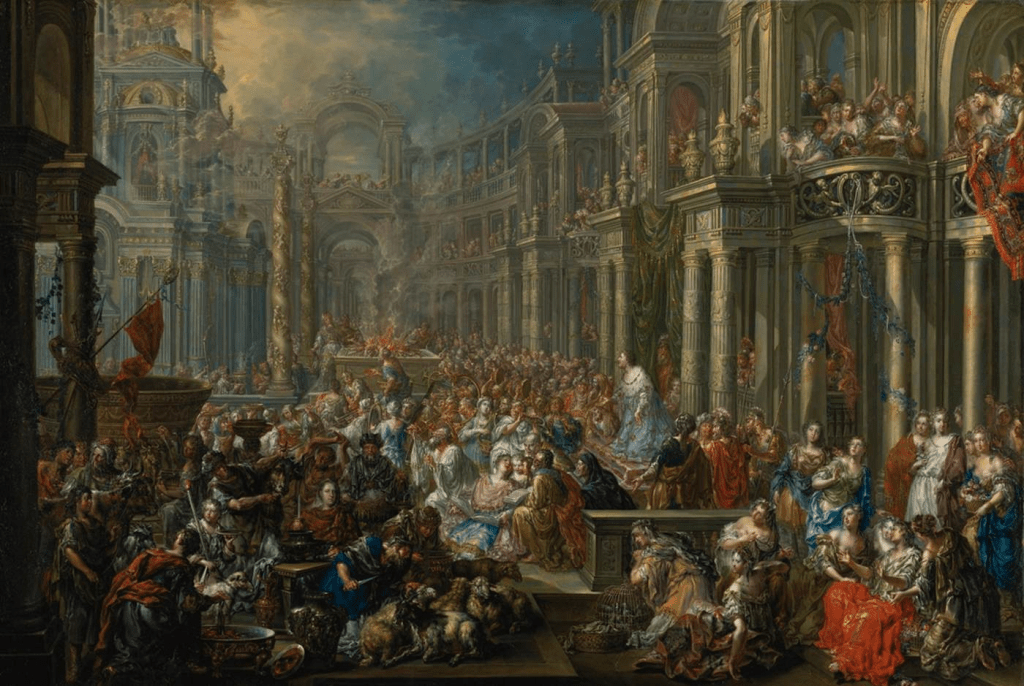
Solomon dedicates the Temple at Jerusalem, by James Tissot (1836-1902)

Solomon then summoned to Jerusalem the elders of Israel and all the heads of the tribes—the leaders of the ancestral families of the Israelites. They were to bring the Ark of the Lord’s Covenant to the Temple from its location in the City of David, also known as Zion. So all the men of Israel assembled before King Solomon at the annual Festival of Shelters, which is held in early autumn in the month of Ethanim.

When all the elders of Israel arrived, the priests picked up the Ark. The priests and Levites brought up the Ark of the Lord along with the special tent and all the sacred items that had been in it. There, before the Ark, King Solomon and the entire community of Israel sacrificed so many sheep, goats, and cattle that no one could keep count!

Then the priests carried the Ark of the Lord’s Covenant into the inner sanctuary of the Temple—the Most Holy Place—and placed it beneath the wings of the cherubim. The cherubim spread their wings over the Ark, forming a canopy over the Ark and its carrying poles. These poles were so long that their ends could be seen from the Holy Place, which is in front of the Most Holy Place, but not from the outside. They are still there to this day. Nothing was in the Ark except the two stone tablets that Moses had placed in it at Mount Sinai, where the Lord made a covenant with the people of Israel when they left the land of Egypt.

When the priests came out of the Holy Place, a thick cloud filled the Temple of the Lord. The priests could not continue their service because of the cloud, for the glorious presence of the Lord filled the Temple of the Lord.

Then Solomon prayed, “O Lord, you have said that you would live in a thick cloud of darkness. Now I have built a glorious Temple for you, a place where you can live forever!”

Then the king turned around to the entire community of Israel standing before him and gave this blessing: “Praise the Lord, the God of Israel, who has kept the promise he made to my father, David. For he told my father, ‘From the day I brought my people Israel out of Egypt, I have never chosen a city among any of the tribes of Israel as the place where a Temple should be built to honor my name. But I have chosen David to be king over my people Israel.’”

Then Solomon said, “My father, David, wanted to build this Temple to honor the name of the Lord, the God of Israel. But the Lord told him, ‘You wanted to build the Temple to honor my name. Your intention is good, but you are not the one to do it. One of your own sons will build the Temple to honor me.’

“And now the Lord has fulfilled the promise he made, for I have become king in my father’s place, and now I sit on the throne of Israel, just as the Lord promised. I have built this Temple to honor the name of the Lord, the God of Israel. And I have prepared a place there for the Ark, which contains the covenant that the Lord made with our ancestors when he brought them out of Egypt.” (New Living Translation)

Dedication of Solomon’s Temple in Jerusalem, by Johann Georg Platzer (1704-1761)

I admit, at many times, that I am prone to melancholy. I tend to be quick at accepting blame, and rather slow at owning my good work. Another way of putting this is that it is easier to give than to receive.

Those who have endured a lot of hard circumstances, and persevered through many adversities, can sometimes be reticent to accept the good, the abundant, and the beautiful, whenever it comes to us in this life.

Waiting for the other shoe to drop, far too many people hold back themselves from receiving and enjoying the really good things in life. They worry that the goodness will disappear, or be taken away; and so, they withhold gratitude and blessing, whenever they are in the presence of great abundance.

Just so you know, in case there are those of you who need to hear it spelled out plainly: That’s messed up.

People are meant to be abundantly generous, as well as wildly receptive. It’s likely why there are so many spiritually unhealthy persons in the world.

Bless their hearts, they give a lot, without receiving much, and then their spiritual diarrhea makes it so they can’t give anymore. And they oftentimes give to those who are in such a habit of receiving (and not giving) that the receiver’s spiritual constipation becomes a terrible problem.

Let’s avoid both extremes by letting ourselves both give and receive with equal abandon. No one can be spiritually growing, healthy, and mature without the dynamic of giving and receiving.

Solomon knew how to do both. King Solomon was the king of abundance. He accepted and received big; and he gave and blessed big. Nobody before him or after him received and gave more.

The Temple, in all of its glory and grandeur, with the Ark of the Covenant encrusted with gold as the central object in the building, was all for a God who doesn’t live in houses, a God who is invisible.

In Solomon’s dedication of the Temple, he made it clear that the God of Israel is not, and cannot, be restricted to, or located within, a single place. Thus, the Lord is limitless, and not subject to any human manipulation.

God is free to give with great abandon. And God is also free to take away. Blessed be the name of the Lord God. If we continually try and anticipate or predict what God will do, we will likely be a nervous ball of anxiety all of the time, wondering when the unexpected and/or unwanted will visit us.

It is much better to receive the good things the Lord gives us, and enjoy them while we have them.

“I came that they may have life and have it abundantly.”

Jesus (John 10:10)

Nothing is permanent, with the exception of relationships and love. So, if we can connect the temporal material things of this life in service to the immaterial realities of this universe, then we are in a position to experience peace, joy, and satisfaction.

If and when the material disappears, or is taken away, then it shall neither defeat us, nor destroy us. For our relational connections with God and others exist, and are free flowing, with the energy of gracious receiving and giving as the conduit of abundant life.

Melancholy is important and has its place for us in this present life; yet, so do things like celebration, dedication, joy, exuberance, emotional commitment, and open love. Indeed, to have these in abundance is a reflection of the God of abundance, in whose name we are bold to pray:

God of abundance, you have fed us with the bread of life and cup of salvation; you have united us with Christ and one another; and you have made us one with all your people in heaven and on earth. Now send us forth in the power of your Spirit, that we may proclaim your redeeming love to the world and continue forever in the risen life of Christ our Savior. Amen.

Listen Carefully (Mark 4:21-25)

Jesus went on: “Does anyone bring a lamp home and put it under a bucket or beneath the bed? Don’t you put it up on a table or on the mantel? We’re not keeping secrets, we’re telling them; we’re not hiding things, we’re bringing them out into the open.

“Are you listening to this? Really listening?

“Listen carefully to what I am saying—and be wary of the shrewd advice that tells you how to get ahead in the world on your own. Giving, not getting, is the way. Generosity begets generosity. Stinginess impoverishes.” (The Message)

Karma is a word from Hinduism which refers to the sum of a person’s actions in this life and previous states of existence, viewed as deciding their fate in the future. Contemporary Western society has picked up on this and uses the word in reference to a more universal reality.

The proverbial wisdom is that we typically get what we deserve by receiving exactly from others what we give to them in this life.

Jesus let us know that the way we treat others is the way we ourselves will be treated. A generosity of spirit toward one’s fellow humanity will come back in a similar way; and a stingy or miserly spirit will also be returned in kind. It’s a basic reality that we tend to receive what we give.

Every person has the capacity to elevate humanity, because people tend to live up to how they are being treated. What’s more, the initiator of basic human kindness and benevolence will find themselves receiving back much more than they put into it.

Now please understand that this is not some sort of ironclad law of the universe. If I give a dollar to someone, I won’t automatically get two dollars back later. If someone scratches your back, you may not be able to scratch theirs. The idea is rather that – all things being equal – if we live a wise and good life, full of giving and generosity – we will most likely not become destitute and in want.

That’s why classic movies, such as A Wonderful Life, resonate deeply with us. George Bailey went through a very trying time in his life when his business was in a pinch. But his way of living was above board and he freely lent to others, even when things were tough.

In the end, George experienced a rich encounter of his neighbors coming together to help, in the family’s time of need. George had been making a huge difference all along, and he never really knew how impactful it all was, until an angel imaginatively revealed it to him.

There is nothing that is truly hidden; all things shall be disclosed. Nor is anything really a secret; everything will come to light.

Jesus gave to his disciples (and to us) the secret of God’s rule and reign on this earth. Therefore, no one is to be complacent, rest on their laurels, or go about life with a “meh” sort of attitude. We must pay attention to the insight we’ve been given; and act on it.

God’s benevolent kingdom will be successful and have its way in this world. Although the Lord’s ethical agenda shall ultimately win out, there yet remains dark forces which temporarily oppose this good divine plan.

It’s important to be patient, and to persevere in doing good. We will see a harvest of righteousness if we don’t give up. So, keep on having a generous spirit of merciful giving. Keep going with living a humble and pure life. Continue on the path of justice and righteousness.

Whenever we encounter opposition, even persecution, or when evil appears to be having the day, don’t be discouraged. This is all part of the life and ministry to which we are called. We get up in the morning, keep planting gospel seeds of grace, and understand that it is God who gives the growth and the harvest.

Road to Emmaus, by Robert Zünd, 1877

Freely give, as freely as you have received. With the mercy and love shown to you, pass it on to others. As you become filled to the full, with the life of Christ, allow this to spill over onto others who are in need of comfort, encouragement, forgiveness, reconciliation, and hope.

Specifically, Jesus is the revealer of mysteries. In Christ, that which was hidden is now revealed; the secret things of God are on full display in the person and work of Jesus Christ.

Jesus is hope and life. Folks place faith in him, and are shown how to love and navigate this world according to the divine agenda. The magnanimous and generous spirit of Jesus Christ changes the world. The waves and ripples of his life and work are still filling the world.

In this present evil age, we have everything we need for life and godliness – because of Jesus.

I am wondering about us, about you and me. We are relational creatures, created by a good God in God’s very own image. The Lord has gone out of the way to create a divine/human connection that is supremely good, life-giving, and enjoyable.

Yet, all of us, in one way or another, have searched in all sorts of places, in vain, for the love which has been right there in front of us the entire time.

Jesus is the Light of the world, the Bread of life, the Good Shepherd, Living Water, and Savior of the world. And he is waiting patiently – to be the light at the end of the tunnel, the spiritual sustainer, the loving guide, and the deliverer from anything and everything that hinders your ability to be truly alive.

The Lord longs to be generous to us. Yet, you and I must be willing to receive, to hold out our open hands and take what God gives us. Our ears need to be open for listening to what the Lord is saying.

If our ears, hands, and hearts are open to others, there is a very good chance that God will be open to us. It isn’t necessarily karma; it’s just the way things are in the gracious and benevolent kingdom of God.

Oh God, our loving Creator and Giver of all good gifts, bless all churches and communities of faith; strengthen our faith and grant us the spirit of Christian stewardship so that we may give generously of our time, talent and treasure to spread your benevolent kingdom here and throughout the world; through Jesus Christ our Lord, in the power of the Holy Spirit. Amen.

Giving Freely for a Worthy Project (Exodus 25:1-22)

Gathering To Build the Tabernacle, by Yoram Raanan

The Lord said to Moses, “Tell the Israelites to bring me an offering. You are to receive the offering for me from everyone whose heart prompts them to give. These are the offerings you are to receive from them: gold, silver and bronze; blue, purple and scarlet yarn and fine linen; goat hair;ram skins dyed red and another type of durable leather; acacia wood; olive oil for the light; spices for the anointing oil and for the fragrant incense; and onyx stones and other gems to be mounted on the ephod and breast-piece.

“Then have them make a sanctuary for me, and I will dwell among them. Make this tabernacle and all its furnishings exactly like the pattern I will show you.

“Have them make an Ark of acacia wood—two and a half cubits long, a cubit and a half wide, and a cubit and a half high. Overlay it with pure gold, both inside and out, and make a gold molding around it. Cast four gold rings for it and fasten them to its four feet, with two rings on one side and two rings on the other. Then make poles of acacia wood and overlay them with gold. Insert the poles into the rings on the sides of the ark to carry it. The poles are to remain in the rings of this ark; they are not to be removed. Then put in the ark the tablets of the covenant law, which I will give you.

“Make an atonement cover of pure gold—two and a half cubits long and a cubit and a half wide. And make two cherubim out of hammered gold at the ends of the cover. Make one cherub on one end and the second cherub on the other; make the cherubim of one piece with the cover, at the two ends. The cherubim are to have their wings spread upward, overshadowing the cover with them. The cherubim are to face each other, looking toward the cover. Place the cover on top of the ark and put in the ark the tablets of the covenant law that I will give you. There, above the cover between the two cherubim that are over the ark of the covenant law, I will meet with you and give you all my commands for the Israelites. (New International Version)

Israel gathers to bring gifts for the construction of the Tabernacle

Details matter. Typically, when something is important to someone, they go into great detail about it. It won’t do for them to ignore the nuances of what they care about. So when God goes into intricate detail about the construction of the portable sanctuary, the Tabernacle, the people can take notice that this has great significance.

The Israelities were delivered from Egyptian slavery. Now, in the desert of the Sinai peninsula, they are to worship in a particular way with certain sacred objects for its use. The sacred tent, the Tabernacle, was the center of Israel’s religious life while wandering in the years between Egypt and the Promised Land. It became God’s dwelling place amongst the people – the place where sacrifices were offered and Moses their leader communicated with the Lord.

The instruction manual given to Moses from God for the holy implements of worship was very specific and involved a lot of people. It was such an important and technical project that it required the participation of all the people. In a national-level sort of fundraiser, God asked Moses to ask the Israelites to bring their contributions and donations as freewill offerings for the work to be done.

Moses went up Mount Sinai to meet with God. The expressed purpose was to provide divine instructions concerning the law, worship, and how to live in the Promised Land once they get there. Since the Tabernacle was a central part of the nation’s covenant with God, the Lord sought to communicate how everything was to be built.

But before it could all happen, there needed to be a collection of the materials for construction. And it was not something to be taxed or required; it was an ask. The true heart of righteousness is that giving is an opportunity to help and do the right thing; it’s a privilege.

Righteousness is a healthy dynamic of freely giving, and thus, freely receiving. It benefits everyone – both giver and receiver. The wise and righteous person understands that it is the giver who benefits most.

When everyone has an opportunity to give, all persons are of equal status; there is no charity because the whole community acts as one person together in ensuring needs are satisfied.

If everyone gives, then we benefit from living in a society where everyone’s needs are met, and none are in want. The truly righteous society that is full of justice and goodness is the one in which everyone is privileged, and everyone receives the benefits of giving.

In the New Testament, the Apostle Paul picked up on this form of right living and described it to the Corinthian Church:

“And now, brothers and sisters, we want you to know about the grace that God has given the Macedonian churches. In the midst of a very severe trial, their overflowing joy and their extreme poverty welled up in rich generosity. For I testify that they gave as much as they were able, and even beyond their ability.

Entirely on their own, they urgently pleaded with us for the privilege of sharing in this service to the Lord’s people. And they exceeded our expectations: They gave themselves first of all to the Lord, and then by the will of God also to us… For if the willingness is there, the gift is acceptable according to what one has, not according to what one does not have.” (2 Corinthians 8:1-5, 12, NIV)

Paul went on to encourage the believers that each individual should give what they have decided in their heart to give, not reluctantly or under compulsion. Why? Because God loves a cheerful giver, and not a reluctant miser. (2 Corinthians 9:7)

If something is important enough to warrant a full detailed and technical plan, then it’s worthy enough to allow others to freely give for that project as they so desire.

Everyone is blessed when we know what has to be done, and are willing to freely give what we possess to make that important thing happen.

Lord of our lives, teach us how to use our money and our possessions. Deliver us from stinginess and wasteful extravagance; inspire our giving with the spirit of true generosity. Help us always to remember your generous love for us, that we may be wise and faithful stewards of the good gifts you have given us. Amen.