In speaking of political parties in either government or church, I’m not talking about weekend benders, Washington D.C. cocktail gatherings, nor fellowship hall potlucks after church. The word “party” in the New Testament of the Bible means what we would understand as either a special interest group who lobbies to get their agenda accomplished on the backs of others, or a group of like-minded people who stand opposed to another group with a different set of ideals through belligerent, manipulative, and/or bullying tactics. The consistent ideal of the Scripture is that a “party spirit” belongs to the sinful nature, part of the old person, and has no part with the redeemed person in the kingdom of God.
The word is, in Greek, ἐριθεία (English transliteration, eritheia). It appears as a vice which the Apostle Paul condemns as being contrary to the fruit of the Spirit. It is translated in various ways throughout the different versions of the Bible as “rivalry,” “selfish ambition,” “strife,” “faction,” and “dispute,” just to mention a few. It is to have a contentious spirit that continually strives and cajoles to get its way. It’s just the opposite of scanning the horizon of human need and seeking to implement what is in the best interest of the common good of all people.
“Now the works of the flesh are evident: sexual immorality, impurity, sensuality, idolatry, sorcery, enmity, strife, jealousy, fits of anger, rivalries, dissensions, divisions, envy, drunkenness, orgies, and things like these. I warn you, as I warned you before, that those who do such things will not inherit the kingdom of God.” (Galatians 2:19-21, ESV)
“Do nothing out of selfish ambition or vain conceit. Rather, in humility value others above yourselves.” (Philippians 2:3, NIV)
“For where envying and strife is, there is confusion and every evil work.” (James 3:16, KJV)
Whenever churches, ministries, organizations, and even governments devolve into opposing groups or parties which are constantly at odds with one another, this is a situation that is not to be lauded but condemned.
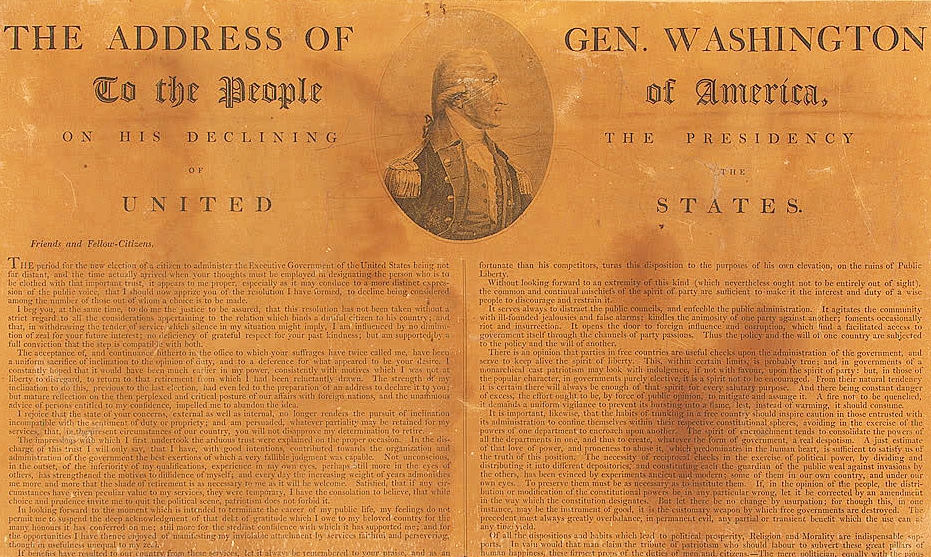
Seemingly lost to many are the comments from George Washington concerning the understanding of a party-spirit which, for him, was this biblical idea of contentious rivalries which did not have in view the interests of all people. In
George Washington’s 1796 Farewell Address when leaving the presidential office, he sagaciously and prophetically said that political parties:
“are likely, in the course of time and things, to become potent engines, by which cunning, ambitious, and unprincipled men will be enabled to subvert the power of the people and to usurp for themselves the reins of government, destroying afterwards the very engines which have lifted them to unjust dominion…. The alternate domination of one faction over another, sharpened by the spirit of revenge, natural to party dissension, which in different ages and countries has perpetrated the most horrid enormities, is itself a frightful despotism. But this leads at length to a more formal and permanent despotism. The disorders and miseries which result gradually incline the minds of men to seek security and repose in the absolute power of an individual; and sooner or later the chief of some prevailing faction, more able or more fortunate than his competitors, turns this disposition to the purposes of his own elevation, on the ruins of public liberty.”
Washington went on to say:
“In contemplating the causes which may disturb our Union, it occurs as matter of serious concern that any ground should have been furnished for characterizing parties by geographical discriminations, Northern and Southern, Atlantic and Western; whence designing men may endeavor to excite a belief that there is a real difference of local interests and views. One of the expedients of party to acquire influence within particular districts is to misrepresent the opinions and aims of other districts. You cannot shield yourselves too much against the jealousies and heartburnings which spring from these misrepresentations; they tend to render alien to each other those who ought to be bound together by fraternal affection.”
I’m grinding on this current party-spirit reality because we have gotten to a place in both our political discourse and our church rhetoric where we take opposing parties for granted – as if it’s okay. It’s not okay, and we need to resist it. Furthermore, I am in no way advocating for everyone to think and believe the same way. Monolithic groupthink is only a form of the party-spirit which seeks to conquer all opposing views and corral them under a certain group’s views.
Its possible to celebrate individual thought, identify yourself with organizations which labor to change a situation, and engage in lively debate with one another without having a party spirit. What’s not okay is a spirit of rivalry which aims to colonize other people’s minds and strip them of critical thinking skills that either advance a selfish group agenda or push power politics to maintain the powerful at any cost. God will not contend with this situation forever.
If one person dominates and determines how a church ministry operates; if one group of families holds power and refuses to listen to others; if two or more groups can be clearly identified as engaging in the power politics of fear; if the aisle down the middle of the church building is symbolic of division; or, if individuals exhibit anger and jealousy when they are not properly recognized in the church; then, there is a party spirit within that church, ministry, or organization which needs to be addressed before the spirit of rivalry destroys the Body.
Working against a party spirit, and establishing a spirit for the common good requires:
· Leaders naming the factious spirit
· Calling-out individuals with bad behavior
· Valuing the voices of others not in power
· Great courage through trust in God
· A calming presence from leadership
· Humility and wisdom
· Being filled with the Holy Spirit
· Bearing one another’s (everyone’s) burdens
· Sharing wealth, stature, recognition, and privilege
· Not hiding from or ignoring marginal people
The best antidote to a party spirit is to have the heart of servant. Recovering politics as public service, and reestablishing church ministry as sacred service puts the focus away from bad spirits of sectionalism and sensationalism, placing it squarely on those people who need the services which you have to offer.
“For even the Son of Man [Jesus] did not come to be served, but to serve, and to give his life as a ransom for many.” (Mark 10:45)
Groups are not inherently evil. But if they only look inward as to how they can benefit themselves – and do not look outward to include, help, serve, and uphold others very different from themselves – then there is a “party spirit” which is contrary to Holy Scripture.
Prayer is always the best place to begin facing down a party spirit. Only solid spiritual resources can effectively combat bad negative spirits. Party spirits won’t go away on their own – they must be faced down with the fruit of the Spirit.
Everyone and every organization must confront party spirits at various times in their existence because its just the nature of living in this fallen world. What we do when we see them is the critical step….







 Rev. Tim Ehrhardt