Show Some Basic Human Kindness and Love (Ruth 3:8-18)

Art by Chanelle Nibbelink

At midnight the man was startled and turned over, and there, lying at his feet, was a woman! He said, “Who are you?” And she answered, “I am Ruth, your servant; spread your cloak over your servant, for you are next-of-kin.”

He said, “May you be blessed by the Lord, my daughter; this last instance of your loyalty is better than the first; you have not gone after young men, whether poor or rich. And now, my daughter, do not be afraid, I will do for you all that you ask, for all the assembly of my people know that you are a worthy woman. But now, though it is true that I am a near kinsman, there is another kinsman more closely related than I. Remain this night, and in the morning, if he will act as next-of-kin for you, good; let him do it. But if he is not willing to act as next-of-kin for you, then, as the Lord lives, I will act as next-of-kin for you. Lie down until the morning.”

So she lay at his feet until morning but got up before one person could recognize another, for he said, “It must not be known that the woman came to the threshing floor.” Then he said, “Bring the cloak you are wearing and hold it out.” So she held it, and he measured out six measures of barley and put it on her back; then he went into the town. 

She came to her mother-in-law, who said, “How did things go with you, my daughter?” Then she told her all that the man had done for her, saying, “He gave me these six measures of barley, for he said, ‘Do not go back to your mother-in-law empty-handed.’” She replied, “Wait, my daughter, until you learn how the matter turns out, for the man will not rest but will settle the matter today.” (New Revised Standard Version)

Boaz was an unmarried wealthy landowner. He was pious and conscientious. Ruth was a widow, a foreigner from Moab. Naomi was Ruth’s mother-in-law, and also a widow. Naomi and Ruth only had each other.

As one in poverty did in those times, Ruth walked behind the harvesters in the fields during the barley harvest, gleaning whatever was left behind. She was gleaning in the field of Boaz. He noticed.

Boaz was kind enough to make sure that Ruth was able to glean for two people. It turns out that Boaz was an in-law to Naomi, through her late husband Elimelech. Naomi sought to play matchmaker, so that Ruth would be well cared for. So, she instructed Ruth in what to do….

A woodcut of Ruth and Boaz on the threshing floor, by Unknown Artist

Harvest time in Judah was also a time of celebration and feasting. Late one night, on the barley wheat threshing floor, Boaz lay down to sleep after a day of bringing in the grain, and an evening of eating and drinking.

Doing exactly as her mother-in-law Naomi instructed, Ruth went to threshing floor, and then quietly laid down at the feet of Boaz. At midnight, Boaz was startled and woke up. There, at his feet, was a woman!

“Who are you? What do you want?” asked Boaz. And Ruth made herself known with the humble response, “I am Ruth, your maidservant.”

Ruth continued to follow Naomi’s guidance, and asked that Boaz spread his cloak over her, because he is the next of kin, the relative who could be responsible for engaging a levirate marriage with her (that is, a legal marriage involving in-law’s).

Although sleepy, and maybe even a bit tipsy, Boaz knew immediately that Ruth was asking him to marry her. Pious man that he was, Boaz would likely have realized the imagery of his situation, as likened to the prophet Ezekiel’s description concerning God’s love toward Jerusalem:

I spread the edge of my cloak over you and covered your nakedness: I pledged myself to you and entered into a covenant with you, says the Lord God, and you became mine. (Ezekiel 16:8, NRSV)

In following Naomi’s advice, Ruth put herself in a very vulnerable situation. Yet, Naomi’s observation of Boaz was spot on. Ruth’s faith in, and love for, her mother-in-law was well-placed.

The man Boaz responded favorably to the asking and overture of Ruth. He praised Ruth for her steadfast love and faithfulness; and her willingness to be with him, instead of a younger man.

Arising organically and sincerely from within Boaz was a prayer for God’s blessing upon Ruth. Not only would Boaz act to marry Ruth, but he also assured her that she belongs to God and God’s people.

The cloak of Boaz being spread over Ruth not only symbolized their upcoming levirate marriage, but it also communicated her marriage to God. Ruth was coming into God’s covenant as one of the people, as well as entering the marriage covenant.

I like that Boaz did not regard the actions and words of Ruth as something impertinent, immoral, or inappropriate. He fully recognized that she was operating consistent with the law of God in honoring a family obligation. And Boaz reciprocated by being honored to have been asked, and honored to comply with Ruth’s wishes.

It seems to me that this is love, as it is intended to be with us. We respect one another’s character, and seek to do whatever we can to meet this person’s need. When I love, I want to go out of my way to act on behalf of this person I admire and adore.

Boaz was not under a legal obligation to marry Ruth. He could have done nothing. But love compelled him – a love for Ruth which was grounded in an abiding love for God.

It wasn’t that Boaz should have, or could have, done something to help meet the needs of Ruth and Naomi. Boaz wanted to do something. He wanted to help Ruth. Boaz wanted to show kindness and steadfast love to Ruth. He wanted to fulfill her asking.

Naomi came up with a plan, because she trusted in the mercy, kindness, and generosity of Boaz. And also because she loved her daughter-in-law Ruth, and wanted her to be loved and cared for.

To show his goodwill and intention to fulfill Ruth’s request, he gave her a significant gift of barley. That is, he loaded her up with groceries to take home. This was a sign that Boaz would indeed make sure that the needs of Ruth and Naomi would be met this day, and into the future.

I am struck with how simple this story really is, at it’s core. It’s just three people, who each care. Caring is something that all of us can do, no matter who we are, where we are, or what situation we find ourselves in.

We really can show basic human kindness to another. We can be merciful, just, and generous. We can ask for what we want and need. We can help one another.

Perhaps, then, the real question for each of us is not whether we can speak and act with love, grace, and kindness; the real question is: Will I speak and act with love and mercy?

If we want to live in a world where there is justice, mercy, and love, then we must demonstrate those very things in our own lives, today and every day.

Live the way that you yourself want to be treated. And if you want mercy, generosity, and love from others, then ask for it.

God of steadfast love, help us each day in the midst of things we don’t understand, To those of us who are afraid, give courage To those who are exhausted, give strength To those in despair, give hope.

Comfort us in our struggles, O Loving God, and meet every need. Grant us safety, security and stability, and help us learn the lessons you are giving us, so that we may all work together to make this world a better place. Amen.

Abundant Life (1 Kings 8:1-21)

Solomon dedicates the Temple at Jerusalem, by James Tissot (1836-1902)

Solomon then summoned to Jerusalem the elders of Israel and all the heads of the tribes—the leaders of the ancestral families of the Israelites. They were to bring the Ark of the Lord’s Covenant to the Temple from its location in the City of David, also known as Zion. So all the men of Israel assembled before King Solomon at the annual Festival of Shelters, which is held in early autumn in the month of Ethanim.

When all the elders of Israel arrived, the priests picked up the Ark. The priests and Levites brought up the Ark of the Lord along with the special tent and all the sacred items that had been in it. There, before the Ark, King Solomon and the entire community of Israel sacrificed so many sheep, goats, and cattle that no one could keep count!

Then the priests carried the Ark of the Lord’s Covenant into the inner sanctuary of the Temple—the Most Holy Place—and placed it beneath the wings of the cherubim. The cherubim spread their wings over the Ark, forming a canopy over the Ark and its carrying poles. These poles were so long that their ends could be seen from the Holy Place, which is in front of the Most Holy Place, but not from the outside. They are still there to this day. Nothing was in the Ark except the two stone tablets that Moses had placed in it at Mount Sinai, where the Lord made a covenant with the people of Israel when they left the land of Egypt.

When the priests came out of the Holy Place, a thick cloud filled the Temple of the Lord. The priests could not continue their service because of the cloud, for the glorious presence of the Lord filled the Temple of the Lord.

Then Solomon prayed, “O Lord, you have said that you would live in a thick cloud of darkness. Now I have built a glorious Temple for you, a place where you can live forever!”

Then the king turned around to the entire community of Israel standing before him and gave this blessing: “Praise the Lord, the God of Israel, who has kept the promise he made to my father, David. For he told my father, ‘From the day I brought my people Israel out of Egypt, I have never chosen a city among any of the tribes of Israel as the place where a Temple should be built to honor my name. But I have chosen David to be king over my people Israel.’”

Then Solomon said, “My father, David, wanted to build this Temple to honor the name of the Lord, the God of Israel. But the Lord told him, ‘You wanted to build the Temple to honor my name. Your intention is good, but you are not the one to do it. One of your own sons will build the Temple to honor me.’

“And now the Lord has fulfilled the promise he made, for I have become king in my father’s place, and now I sit on the throne of Israel, just as the Lord promised. I have built this Temple to honor the name of the Lord, the God of Israel. And I have prepared a place there for the Ark, which contains the covenant that the Lord made with our ancestors when he brought them out of Egypt.” (New Living Translation)

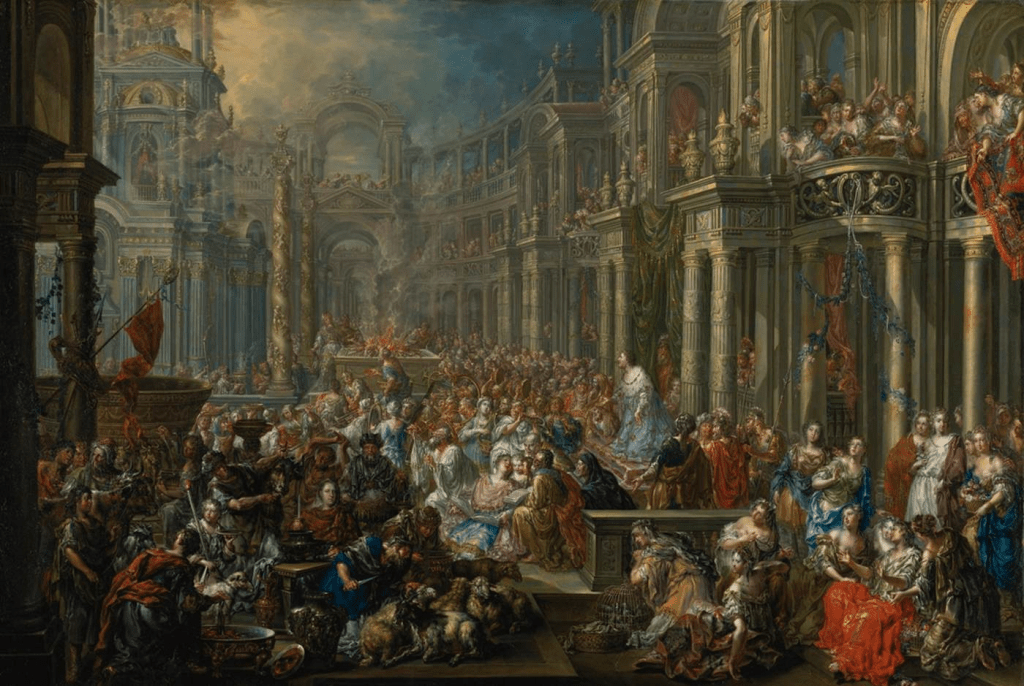
Dedication of Solomon’s Temple in Jerusalem, by Johann Georg Platzer (1704-1761)

I admit, at many times, that I am prone to melancholy. I tend to be quick at accepting blame, and rather slow at owning my good work. Another way of putting this is that it is easier to give than to receive.

Those who have endured a lot of hard circumstances, and persevered through many adversities, can sometimes be reticent to accept the good, the abundant, and the beautiful, whenever it comes to us in this life.

Waiting for the other shoe to drop, far too many people hold back themselves from receiving and enjoying the really good things in life. They worry that the goodness will disappear, or be taken away; and so, they withhold gratitude and blessing, whenever they are in the presence of great abundance.

Just so you know, in case there are those of you who need to hear it spelled out plainly: That’s messed up.

People are meant to be abundantly generous, as well as wildly receptive. It’s likely why there are so many spiritually unhealthy persons in the world.

Bless their hearts, they give a lot, without receiving much, and then their spiritual diarrhea makes it so they can’t give anymore. And they oftentimes give to those who are in such a habit of receiving (and not giving) that the receiver’s spiritual constipation becomes a terrible problem.

Let’s avoid both extremes by letting ourselves both give and receive with equal abandon. No one can be spiritually growing, healthy, and mature without the dynamic of giving and receiving.

Solomon knew how to do both. King Solomon was the king of abundance. He accepted and received big; and he gave and blessed big. Nobody before him or after him received and gave more.

The Temple, in all of its glory and grandeur, with the Ark of the Covenant encrusted with gold as the central object in the building, was all for a God who doesn’t live in houses, a God who is invisible.

In Solomon’s dedication of the Temple, he made it clear that the God of Israel is not, and cannot, be restricted to, or located within, a single place. Thus, the Lord is limitless, and not subject to any human manipulation.

God is free to give with great abandon. And God is also free to take away. Blessed be the name of the Lord God. If we continually try and anticipate or predict what God will do, we will likely be a nervous ball of anxiety all of the time, wondering when the unexpected and/or unwanted will visit us.

It is much better to receive the good things the Lord gives us, and enjoy them while we have them.

“I came that they may have life and have it abundantly.”

Jesus (John 10:10)

Nothing is permanent, with the exception of relationships and love. So, if we can connect the temporal material things of this life in service to the immaterial realities of this universe, then we are in a position to experience peace, joy, and satisfaction.

If and when the material disappears, or is taken away, then it shall neither defeat us, nor destroy us. For our relational connections with God and others exist, and are free flowing, with the energy of gracious receiving and giving as the conduit of abundant life.

Melancholy is important and has its place for us in this present life; yet, so do things like celebration, dedication, joy, exuberance, emotional commitment, and open love. Indeed, to have these in abundance is a reflection of the God of abundance, in whose name we are bold to pray:

God of abundance, you have fed us with the bread of life and cup of salvation; you have united us with Christ and one another; and you have made us one with all your people in heaven and on earth. Now send us forth in the power of your Spirit, that we may proclaim your redeeming love to the world and continue forever in the risen life of Christ our Savior. Amen.

Ministry to the Poor and Needy (2 Corinthians 9:1-5)

If I wrote any more on this relief offering for the poor Christians, I’d be repeating myself. I know you’re on board and ready to go. I’ve been bragging about you all through Macedonia province, telling them, “Achaia province has been ready to go on this since last year.” Your enthusiasm by now has spread to most of them.

Now I’m sending the brothers to make sure you’re ready, as I said you would be, so my bragging won’t turn out to be just so much hot air. If some Macedonians and I happened to drop in on you and found you weren’t prepared, we’d all be pretty red-faced—you and us—for acting so sure of ourselves.

So to make sure there will be no slipup, I’ve recruited these brothers as an advance team to get you and your promised offering all ready before I get there. I want you to have all the time you need to make this offering in your own way. I don’t want anything forced or hurried at the last minute. (The Message)

Organizing relief efforts, and giving to relief organizations, is nothing new. Poverty and need has existed as long as humans have been on this earth. The constant rub is this: Some people aren’t in poverty, and some are.

So how do we get resources from the people who have them to the people who are really in need? Just as important, and perhaps more basic, how will folks care enough about the poor to give money and basic relief?

The Apostle Paul informed the Corinthian Church that he boasted about them to the Macedonians – about their eagerness to participate in ministry toward their fellow believers in need. The Macedonian believers had been ready to participate for quite some time.

In stating this, Paul intended to stir up the Corinthians about the offering for believers in Jerusalem. He had organized a delegation of Macedonians, along with persons from Paul’s own ministry team, to go to Corinth together. The last thing Paul wanted was to have the Corinthians unprepared to give.

Paul was a person who intended to do good, and then followed through with it. He held people accountable for their actions and inactions. He organized the benevolent offering for Jerusalem’s believers, and then made sure that all of the churches good intentions became reality.

Although Paul’s concern in organization and accountability may strike some as coercion for funding, it seems to me that a more plausible reason is that Paul simply wanted to try and ensure that everyone’s giving was done from a place of love, not coaxing or guilting.

The Apostle wanted believers and churches working together for good purposes. He wanted everyone to have a positive experience of helping and being united in spirit and purpose. The churches were young, and Paul was doing everything he could to encourage their growth in grace.

A good way of fostering unity and mission would be to have the churches participate in helping needy believers in Jerusalem. It was a very worthy and needed cause – and also served the cause of Christ.

What’s more, ministry to the poor has always been a hallmark of pure religion. A concern, dedication, plan, and accountable action on behalf of the poor helps everyone, and demonstrates authentic ministry.

My dear friends, pay attention. God has given a lot of faith to the poor people in this world. God has also promised them a share in his kingdom that he will give to everyone who loves him. (James 2:5, CEV)

We are to care about the needy because God cares about persons trapped in poverty. The poor are people; and all people are important. Jesus came to this earth to have a ministry to them; and he lifted a text from Scripture (Isaiah 61:1) to give his reason for doing so:

“The Spirit of the Lord is upon me because he has chosen me to bring good news to the poor.”(Luke 4:18, GNT) 

God has a lot to say about the poor and needy because they are dear to the divine heart. The Old Testament law was quite clear about how to treat the poor: 

Poor persons will never disappear from the earth. That’s why I’m giving you this command: you must open your hand generously to your fellow Israelites, to the needy among you, and to the poor who live with you in your land.(Deuteronomy 15:11, CEB)  

Let’s keep in mind that only the poor in spirit will enter the kingdom of heaven. Our trust is to be in God, and not in our money or our stuff. 

The genuine believer has a real humility that demonstrates grace to people who cannot offer them something in return. It’s easy to be merciful to those who will turn around later and scratch our backs. But it is altogether a different thing to give without any strings attached. 

God cares about the condition of our souls, and not the balance on our bank statements. Since God does not judge people on face value, nor on the state of their finances, then neither should we.

The Apostle Paul, in his ministry, sought to teach others in the way of Jesus by:

  • Turning people from only associating with those they are comfortable with, to lovingly reaching out to people very different from themselves
  • Changing people’s thinking from what they can obtain and consume, to becoming people of love and generosity with their words and their physical resources
  • Putting to death: a proud spirit that looks to get ahead; all personal petty agendas; accumulation of more power; and exertion of control – but instead, provide humble repentance and forgiveness

Ministry to the poor is a non-negotiable for the Christian church. Beyond only dispensing benevolent funds, the poor need relationships, connections, resources, and a chance to give back in ways they can contribute.

Lord God, you came to honor the least, the forgotten, the overlooked, and the misjudged. You came to make the last, the left behind, the misunderstood, and the undervalued, first. You came to give a warm welcome to the lost, the orphaned, the abandoned and the destitute.

Help us to be your ears to listen to their cries; and your voice speaking out love and acceptance. Help us to be your feet walking beside those in need; and your hands to clothe, feed and shelter them. You came for the least, the lost and last of this world. Lord, hear our prayer. Amen.

For the Love of God, Not Money (2 Corinthians 8:1-7)

And now, brothers and sisters, we want you to know about the grace that God has given the Macedonian churches. In the midst of a very severe trial, their overflowing joy and their extreme poverty welled up in rich generosity. 

For I testify that they gave as much as they were able, and even beyond their ability. Entirely on their own, they urgently pleaded with us for the privilege of sharing in this service to the Lord’s people. 

And they exceeded our expectations: They gave themselves first of all to the Lord, and then by the will of God also to us. So we urged Titus, just as he had earlier made a beginning, to bring also to completion this act of grace on your part. 

But since you excel in everything—in faith, in speech, in knowledge, in complete earnestness and in the love we have kindled in you—see that you also excel in this grace of giving. (New International Version)

I’ll be honest: As a preacher and pastor, I don’t much like talking about money. Yet, money is always an issue, especially in churches.

Although there are contemporary pastors and churches who deal with millions of dollars, the vast majority of believers and faith communities struggle from Sunday to Sunday. Money is a topic that has to be addressed and talked about.

So, even though there are plenty of abuses out there when it comes to money, it’s good to gain a more biblical, reasonable, and compassionate view of financial resources.

Holy Scripture does not condemn economic wealth; but it does warn us against the love of money, and centering our lives around it. Perhaps Jesus said it best:

“No one can serve two masters. Either you will hate the one and love the other, or you will be loyal to the one and have contempt for the other. You cannot serve God and wealth.”

Jesus (Matthew 6:24, CEB)

Jesus clarified the issue of money as a matter of our values and commitments. To possess money in and of itself is neither good nor bad; it’s whether money is the master you serve, or God is, with money being a tool to serve the Lord.

In writing to Timothy about how to instruct the Ephesian Church concerning money, the Apostle Paul framed the issue this way:

But people who are trying to get rich fall into temptation. They are trapped by many stupid and harmful passions that plunge people into ruin and destruction. The love of money is the root of all kinds of evil. Some have wandered away from the faith and have impaled themselves with a lot of pain because they made money their goal. (1 Timothy 6:9-10, CEB)

Financial resources are tools to be used, not only in providing for oneself and one’s family, but also to do good and to think of the common good of all people.

And that is exactly what the Apostle Paul was intent on doing. He was gathering a collection for the believers in Jerusalem. So, he took some space (2 Corinthians 8-9) in writing to the Corinthian Church for addressing this issue, as well as money and wealth in general.

Paul unabashedly called upon the Corinthian Christians to give, and considered it their obligation to do so.

The Apostle broached the subject by challenging the Corinthians to follow the example of the Macedonian churches. Paul fully embraced his training in rhetoric in using the technique of comparison to evoke competition between Corinth and Macedonia.

He did so by alluding to the generosity of the Macedonians. Even though the Macedonian believers were themselves experiencing a severe ordeal of affliction and even poverty, they voluntarily gave quite generously.

What’s more, the Macedonians gave well beyond their means. Paul didn’t ask them to do that; and nobody expected it of them. If anything, the churches in Macedonia could have probably received a collection of money and resources themselves. Yet, instead, they stretched themselves financially and gave.

The motivation to give from such meager resources, and in such a difficult situation, was an overflow of the believers’ hearts. In other words, they really wanted to give, so they did. The Macedonian Christians discerned that their true calling was to give of themselves to the Lord, and therefore, to also give of themselves to the Apostle Paul.

So then, Paul encouraged the Corinthian Christians to demonstrate their own commitment and loyalty to both God and to the Apostle. Titus would show up in Corinth to receive the collection, and Paul expected them to be generous – mainly because he knew they could do so, and therefore, ought to do so.

Paul established the church in Corinth. He spent a good deal of time there amongst the people and the city. He knew them well. And Paul was often frustrated with them, even sometimes using sarcasm to get his point across.

I wonder if he was a bit sarcastic, appealing to the Corinthians’ sense of pride in their city and their wealth. After all, the Corinthians excelled in everything else – such gifted people! (or so they always thought). Surely, they would also take full advantage of this opportunity to excel in giving, and be as generous as they possibly could!

Throughout my years of pastoral ministry, I have found in every place I’ve been, ironically, that those with little give much; and those with much give little.

Indeed, the wealthy are able to give much more than the poor. But I have never seen a rich person give everything they have for a cause, whereas many times, I have seen a person in poverty give everything they have for another. That’s also the observation Jesus made when folks were giving their offerings at the Temple:

Jesus sat across from the collection box for the temple treasury and observed how the crowd gave their money. Many rich people were throwing in lots of money. One poor widow came forward and put in two small copper coins worth a penny.

Jesus called his disciples to him and said, “I assure you that this poor widow has put in more than everyone who’s been putting money in the treasury. All of them are giving out of their spare change. But she from her hopeless poverty has given everything she had, even what she needed to live on.” (Mark 12:41-44, CEB)

Indeed, money is very much needed in this life. And money isn’t everything. Economic wealth, financial resources, and money are temporary. God and relationships are permanent. Life is eternal, at least for those who haven’t centered their lives around money as their god.

Money is to be used for good in this world. It is a tool. So, let’s use it with wisdom and a generous heart, putting it in it’s proper place in our lives.

Lord of our lives, teach us how to use our money and our possessions. Deliver us from stinginess and wasteful extravagance; inspire our giving with the spirit of true generosity. Help us always to remember your generous love for us, that we may be wise and faithful stewards of the good gifts you have given us. Amen.