Wisdom (1 Kings 4:29-34)

King Solomon, by Helen Zarin

God gave Solomon wisdom and very great insight, and a breadth of understanding as measureless as the sand on the seashore. Solomon’s wisdom was greater than the wisdom of all the people of the East, and greater than all the wisdom of Egypt. 

He was wiser than anyone else, including Ethan the Ezrahite—wiser than Heman, Kalkol and Darda, the sons of Mahol. And his fame spread to all the surrounding nations. 

He spoke three thousand proverbs and his songs numbered a thousand and five. He spoke about plant life, from the cedar of Lebanon to the hyssop that grows out of walls.

He also spoke about animals and birds, reptiles and fish. From all nations people came to listen to Solomon’s wisdom, sent by all the kings of the world, who had heard of his wisdom. (New International Version)

Talking about King Solomon of old is, in many ways, like talking about any human being. That’s because Solomon was an odd combination of extremely gifted, and yet, deeply flawed.

Solomon’s reign was the greatest that Israel and Judah ever had; and perhaps the wealthiest and most impressive reign that there ever was in the world. Here we are, talking about it nearly 3,000 years later.

Yet, for all the accomplishments of Solomon, he failed to maintain faithfulness to God throughout his lifetime. His wealth and power were so vast that it was his downfall.

Although he died a great king, at his death there were many who were not sorry to see him go. And Jerusalem, the capitol, was occupied with other gods, and not the exclusive worship of Yahweh, as God’s law was so careful to warn against.

However, in today’s Old Testament lesson, we remember the unparalleled wisdom of Solomon. In this regard, there is no one like him in history.

The text of Scripture makes it plain as to where Solomon got his supreme wisdom: God gave it to him (1 Kings 3:1-15). Indeed, God is the source of wisdom, and the fount of knowledge.

Solomon was the son of King David and Bathsheba. He became king of Judah and Israel in 967 BCE, at age twenty, and reigned until his death in 928 BCE. King Solomon’s wisdom was both broad and deep. He was given to wise parables and poetry; sage insights into human nature; and a keen sense to political, social, and economic administration.

The editor of the books of the Kings compares Solomon to the eastern Babylonian sages who were famous in the ancient world; and to the sages of Egypt. Specifically, he is compared to four men: Ethan, Heman, Kalkol, and Darda – the wisest in Israel before Solomon.

Israel had its sages, well before Solomon came along, and possessed a body of wisdom for the people to learn from. The editor tells us that King Solomon surpassed them all in his wisdom, knowledge, understanding, and insight.

Even though there are sages and wise persons, wisdom is for everyone, all humans, without exception. From wisdom we learn to pay attention and observe. This is why Solomon was so wise – his powers of observation were second to none.

He took the time to pay attention to plants, animals, and all creation. He dedicated himself to looking into all the differing affairs of what humanity does. As a result of his efforts at observing humanity, we have the biblical wisdom books of Proverbs (short pithy sayings of experiential truth), Ecclesiastes (issues of ultimate meaning), and Song of Songs (an ode to Love).
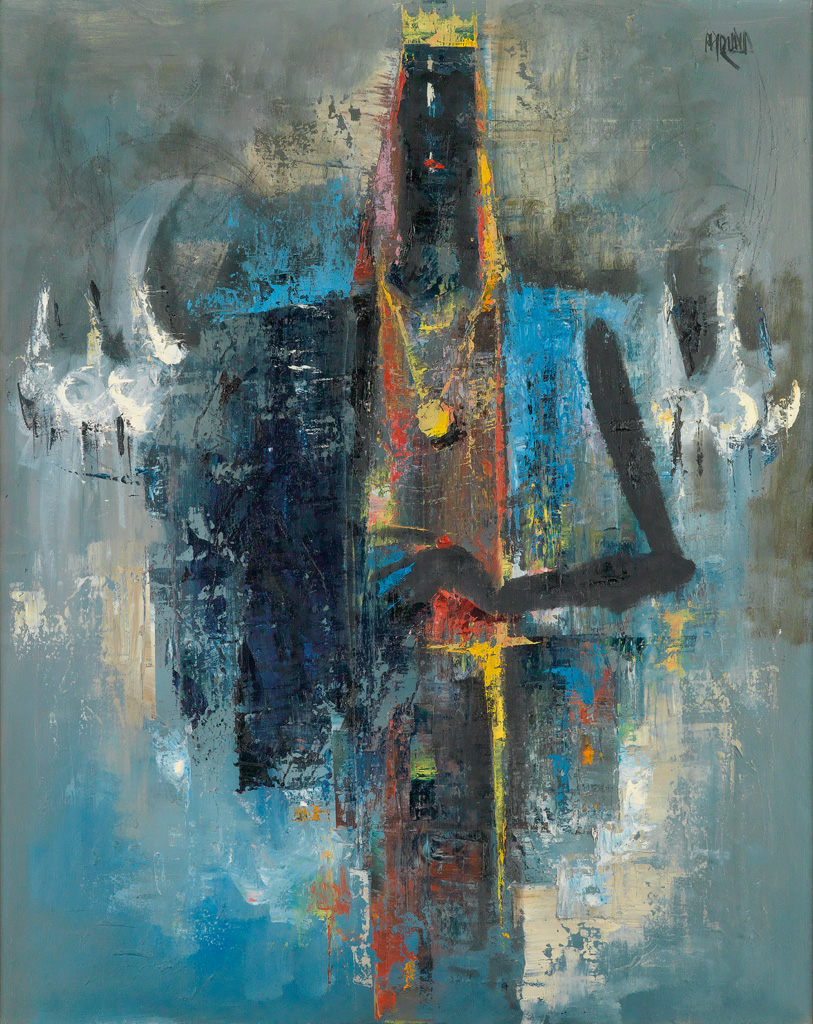
King Solomon, by William Pajaub (1925-2015)

In short, Solomon’s wisdom teaches us that those who take the time to learn, listen, and mature have a happy life; and those who don’t, injure themselves and have a sad life.

Through wisdom, we discover the importance of respecting the poor, the value of creative and fulfilling work, helpful speech, handling money well, and virtuous friends. Each person’s wise conduct benefits the wellbeing of the community, whereas foolish conduct destroys a people.

Wisdom is attuned to morality and consequences (and not to moralism and judgmentalism). Our words and actions bring either connection and encouragement, or separation and duress. Good choices bring life and peace; bad decisions lead to death and division.

One might assume that wisdom is a moral code – but it is not. Rather, wisdom is a dynamic force which brings satisfaction and fulfillment to the world. Being a wise person means that one’s conduct and way of life is in sync with unity, harmony, integrity, and peace.

Foolishness, on the other hand, goes against the grain of a moral life. A fool assumes they can do what they want, whenever they want, without restraint. They think they are an autonomous being who answers to no one. A fool lives as if God is non-existent, and other people are no more valuable than insects on a sidewalk.

Solomon became king in Israel and Judah without a vote, and ruled without democracy. Yet, he recognized that wisdom was needed in order to rule. In reality, wisdom is still needed for any and every sort of leadership.

Our present American political campaign has all the markings of a foolishness that mocks wisdom. That’s why we get so much careless, unhelpful, and downright harmful speech. There is indifference to people in debt, and an overlooking of the poor. We have words and actions without any thought to others, and policies based in greed. Most of all, there is no moral coherence at all, even with cheap religious talk.

It appears that a large chunk of Americans have never taken the time to observe, listen, and pay attention. Their faith – if there is any faith at all – is shallow and disconnected from their fellow citizens. They fail to discern that society cannot be divided into classes of rich and poor.

Wisdom is about being connected, not divided. It has an understanding of all creatures, and that we are ethically and morally bound to the rest of creation. The wise person thus builds bridges, not walls; and does everything possible to turn away from violence, both physical and verbal.

There is no political party, no neighborhood association, no corporate board, and no church council who is all wise and immune to being foolish. We must not throw our ultimate allegiance to anything or anyone other than our all-wise Creator God. And we also must keep in mind that human institutions really can be brought into line with wisdom.

Unfortunately, foolishness is alive and well – not only in the United States of America, but also around the world. Foolish political candidates and leaders of all kinds promise us short-term selfish solutions to large communal and national issues.

Yet, the fool will not prevail. Sadly, King Solomon gave into some foolishness toward the end of his life. Yet, even despite that, Solomon could tell you that wisdom has always existed, and pre-dates foolishness.

Lady Wisdom calls to us, and we have the ability and the faculties to respond and learn from her. Please do so, hopefully, before election day.

Teach me to listen, O God, to those nearest me, my family, my friends, my co-workers. Help me to be aware of the inherent dignity and worth of every person I encounter, and to listen to their voice.

Teach me to listen, O God, to the despair of the hopeless, the plea of the forgotten, and the cry of the anguished.

Teach me to listen, O God, to myself. Help me to be less afraid to trust the voice inside — in the deepest part of me.

Teach me to listen, Holy Spirit, for your voice — in busyness and in boredom, in certainty and doubt, in noise and in silence.

Teach me, Lord, to listen.  Amen.

Divine Goodness, Despite Human Ingratitude (Psalm 78:23-29)

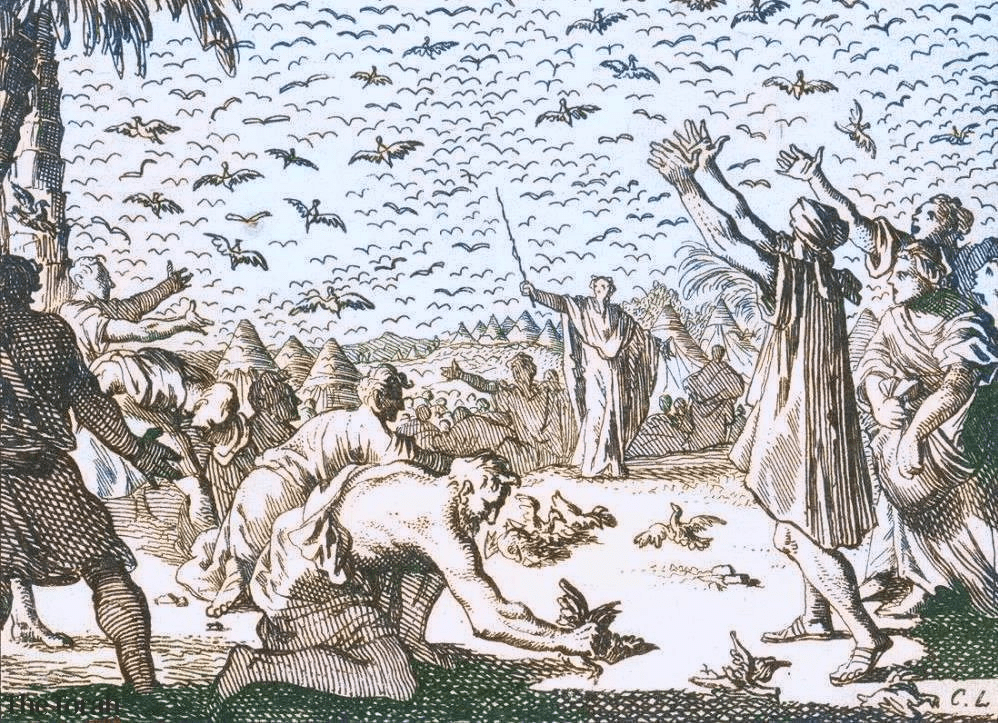
Quail in the Wilderness, by Caspar Luyken, 1698

Yet he commanded the skies above
    and opened the doors of heaven;
he rained down on them manna to eat
    and gave them the grain of heaven.
Mortals ate of the bread of angels;
    he sent them food in abundance.
He caused the east wind to blow in the heavens,
    and by his power he led out the south wind;
he rained flesh upon them like dust,
    winged birds like the sand of the seas;
he let them fall within their camp,
    all around their dwellings.
And they ate and were well filled,
    for he gave them what they craved. (New Revised Standard Version)

Today’s psalm is the second longest in the psalter (72 verses, with Psalm 119 the longest at a hefty 176 verses). Along with Psalms 105-106, Psalm 78 remembers and rehearses the history of Israel. This is a psalm which is meant for teaching and passing on important lessons.

The upshot of this psalm’s historical recollection is that the people’s ancestors were faithless; therefore, those reading the psalm now should live differently in a positive life of goodness, having observed how the past actors serve as a negative example of ingrates.

The psalmist, Asaph, viewed past events as highly informative for present circumstances. His purpose for crafting the psalm was explicit. He wanted the people:

 to put their hope in God—
        never forgetting God’s deeds,
        but keeping God’s commandments—
    and so that they won’t become like their ancestors:
    a rebellious, stubborn generation,
        a generation whose heart wasn’t set firm
        and whose spirit wasn’t faithful to God. (Psalm 78:7-8, CEB)

The verses for today’s lectionary reading have a unique place within the psalmist’s rehearsal of the past. They connect to the previous section (verses 9-22) which recounts the Lord’s angry response concerning Israel’s unbelief and rebellion.

In many ways, Psalm 78 has a consistent theme of human stubbornness, lack of faith, and wanting to do their own thing apart from God. Bucking God’s covenant code and moral law was ever-present in Israel’s history. And yet…

The Lord remained the same: Faithful and true. Furthermore, God stubbornly showed steadfast divine love and covenant loyalty to the people, despite their herky-jerky commitment and fickle faith.

Manna from heaven

Although the theme of human failure runs throughout the psalm, the dominant idea points to God’s gracious mercy, eternal faithfulness, and steadfast love. Most of all, the psalmist wanted his readers to remember the goodness and grace of God.

The people’s unbelief in no way stymied the promises of God. That’s because salvation and deliverance, faith and hope, do not originate and are not sustained by humans, but by the Lord God almighty who created heaven and earth.

Even though the people were faithless, and thus, had no trust in God’s power; nevertheless, the Lord opened the doors of heaven in order to meet the needs of people who did not deserve divine help.

The verses for today remember the story of God’s provision of manna and quail in the desert (Exodus 16). The Lord was gracious, merciful, and kind to the Israelites, despite their incessant grumbling. God responded to them because of their sheer need, and not because of any righteousness coming from them.

God not only provided food, but gave the manna in abundance, and the quail in superabundance. The contrast could not be any more glaring: Israel murmured, grumbled, complained, and demonstrated a lack of faith; God granted the Israelites a ridiculous amount of food, and evidenced steadfast faithfulness to the covenant.

The supreme goodness of God brings out, in stark relief, the incredible foolishness of Israel’s attitude. In the Exodus account, while the meat was still in their mouths, God’s anger flared because of the people’s recalcitrance.

On the surface, the divine response of judgment may appear out of sorts to the divine grace shown to Israel. Yet, the Lord cares about the holistic needs of people, and not only in giving sustenance.

God wants faithful and obedient people. The Lord desires goodness, righteousness, and justice to be the hallmark of the community.

To have your belly full and your spirit empty is an affront to God – because the Lord is good, right, and just, and does not tolerate impertinence, impudence, and impetuousness. Vice and ingratitude only makes a person an imbecile who is worthless to their fellow humanity.

Divine punishment – anywhere you find it in Holy Scripture – is meant to draw people back into relationship with God. Another way of phrasing this, is that God delivers people and grants them freedom, so that they will have no obstacles toward living a good, right, and just life.

No matter the response of God – whether it is by miraculous provision or by divine punishment – it’s always a response of grace; the Lord consistently acts from a place of compassion and commitment to doing what is best for the community.

Whereas the Israelites repeatedly cycled themselves through spirals of faith and unbelief, gratitude and grumbling, obedience and disobedience; God, however, constantly demonstrated the presence of grace and mercy, righteousness and justice, holiness and love.

The only reason the Israelites (and the entire human race, for that matter) are not wiped out is because God forgave their iniquity and did not destroy them. What’s more, the Lord didn’t even let them destroy themselves, unwittingly by their own unawareness and foolishness. (Psalm 78:36-39)

I am profoundly glad that God is the bigger person in the relationship with humanity. The Lord is continually mindful of who we are, as well as God’s own divine essence and power.

Yet he, being compassionate,
    forgave their iniquity
    and did not destroy them;
often he restrained his anger
    and did not stir up all his wrath.
He remembered that they were but flesh,
    a wind that passes and does not come again. (Psalm 78:38-39, NRSV)

As people created in the image and likeness of God, we find our highest joy and greatest fulfillment in receiving the good things from God with gratitude; and of giving goodness to others in a spirit of love – no matter what.

Gracious and almighty God: Open wide the eyes of my soul that I may see the good in all things. Grant me today a new vision of your truth. Inspire me with the spirit of joy and gladness. Make me a cup of strength to suffering souls. Amen.

Learn To Do Right (Isaiah 1:1-4, 16-20)

Statue of Isaiah the Prophet, by Salvatore Revelli (1816-1859), Rome, Italy

The vision concerning Judah and Jerusalem that Isaiah son of Amoz saw during the reigns of Uzziah, Jotham, Ahaz and Hezekiah, kings of Judah.

Hear me, you heavens! Listen, earth!
    For the Lord has spoken:
“I reared children and brought them up,
    but they have rebelled against me.
The ox knows its master,
    the donkey its owner’s manger,
but Israel does not know,
    my people do not understand.”

Woe to the sinful nation,
    a people whose guilt is great,
a brood of evildoers,
    children given to corruption!
They have forsaken the Lord;
    they have spurned the Holy One of Israel
    and turned their backs on him…

Wash and make yourselves clean.
    Take your evil deeds out of my sight;
    stop doing wrong.
Learn to do right; seek justice.
    Defend the oppressed.
Take up the cause of the fatherless;
    plead the case of the widow.

“Come now, let us settle the matter,”
    says the Lord.
“Though your sins are like scarlet,
    they shall be as white as snow;
though they are red as crimson,
    they shall be like wool.
If you are willing and obedient,
    you will eat the good things of the land;
but if you resist and rebel,
    you will be devoured by the sword.”
For the mouth of the Lord has spoken. (New International Version)

Whenever the prophet has a vision, everyone better perk up and take notice.

After the northern Jewish kingdom of Israel fell to the Assyrians in 722 B.C.E., they lost their national identity. The southern Jewish kingdom of Judah, and its capitol Jerusalem, continued to exist for nearly a century and a half – even though they were vassals of either the Assyrians or the Babylonians.

Yet, Judah still functioned as its own nation in a semi-independent state. It was during this time that the prophet Isaiah had his vision, under the kingship of those descended from King David.

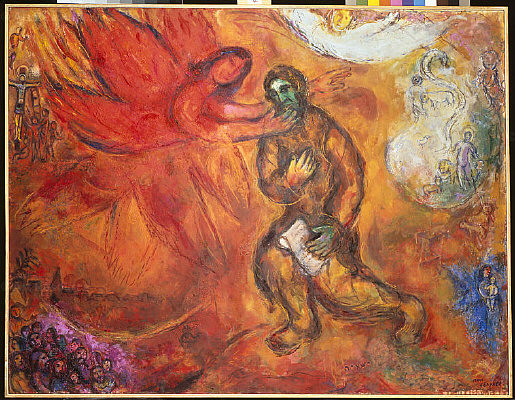
The Prophet Isaiah, by Marc Chagall,1968

The initial section of Isaiah’s prophecy is a series of oracles that establish the relationship between God and the nation of Judah, especially Jerusalem. The gist of God’s message is that the people are guilty of lots of sins.

However, the Lord left a gracious opening for them; their fate was not yet sealed. The nation could repent of their sins and experience a future restoration. God wanted to bring a resolution, and not have the people keep going in their unhealthy ways.

Throughout Isaiah’s vision, God is presented as a Father, with the children being Israel (both northern and southern kingdoms). And Father God has a complaint against them. The people’s principal sins were rebellion and ignorance. They spurned God’s authority, and did not accept their family intimacy with God.

Thus, the Lord is quite disappointed with the people. Heavenly witnesses are called to hear the charges of wrongdoing. The troubles of the nation were to be interpreted as warnings and disciplines, meant to lead them to stop and do right. Yet it seems that the warnings go unheeded by the people. It appears that God’s efforts to woo the people back are in vain.

Although the people’s continued sacrificial worship is merely done as a mere perfunctory act, and without true hearts of devotion for what is just and right, God offered them a chance to make things right, so that they could do justice and embrace righteousness.

God made it clear what it would take to repent: learn to do good; seek justice; recuse the oppressed; defend the orphan; plead for the widow. God even issued an invitation for a divine/human dialogue to happen.

Grace and cleansing from sin are possible, that is, if the people are willing and obedient, instead of remaining rebellious and refusing to do what is right, just, and good.

The nation was at a crossroads and had to make a decision. Would they choose wisely or foolishly?

Decision-making is critical. Some choices are harder than others. Yet the ability to decide is a God-given gift and ability.

Making decisions is fraught with consequences; we may try to anticipate or ignore what might happen with a particular choice. And how we go about decision-making is important. Who do we listen to? What information do we need? How will this choice shake out in the end?

Intentions are not choices, but are simply a mental resolve to do or not do something, at some point. And to not make a decision is to have already made a decision to either procrastinate or not do anything at all.

There are also decisions of duty. This may or may not be admirable. There is also the choice of attitude and energy given to the decision – because a choice of doing one’s duty can be done with joy or grumpiness, excitement or bitterness, with a bright disposition or a flat sullen affect.

It’s not really hard to guess or assess the choices of the people in Judah and Jerusalem in Isaiah’s day. They were doing an outward duty of temple worship, but without any heart to it.

Many of the people looked upon their duty as a sort of magical talisman that would ward off any trouble or army invasion. With that kind of approach, the people looked upon the rest of their time as their own, as discretionary, as the choice to do whatever they wanted to do.

If their business practices were dubious and not quite right, then big deal. After all, they give their money at the temple.

If the leaders played favorites and overlooked the needy person among them, then so what? The poor and oppressed can work harder, right?

And if orphans and widows – who were the most vulnerable persons in society – were not completely cared for, then that’s sad, but too bad for them.

I can picture an ancient city council saying something like, “We have a lot on our plate, dealing with foreign powers, the economy, and political issues. Those needy persons need to get a clue. It’s their own fault for hanging around and not leaving the city for greener pastures. Not our problem.”

Oh, but it very much was their problem. It was everyone’s problem, and each person’s responsibility, to ensure that God’s justice, goodness, and righteousness was infused throughout the entire city and nation.

Hence, the reason for the book of Isaiah. Tackle the moral and ethical problems head on before it’s too late and the gravity of judgment presses everyone out of the land.

What’s needed is a willing heart inclined to walk into divine obedience, without any talkback, and without any negotiations or deals.

God is merciful, and is willing to talk it out. But justice must be done. Needs must be met. People must be cared for. The Lord’s will must be done, here on earth, as it is always done in heaven. Is this what you are about, or not? Will you learn to do right?

Most merciful God, shine the light of your gracious love upon my cold hard heart. Enlighten my mind and dispel the darkness; speak the truth and help me obey; and have pity upon me. Forgive me yet again of my offenses, transgressions, and guilty acts. Grant me the grace to serve you with faithfulness and care for your people with love and purity, today and always. Amen.

The Seven Deadly Sins (Proverbs 12:10-21)

A 14th century personification of the Seven Deadly Sins, by Unknown artist

The righteous care for the needs of their animals,
    but the kindest acts of the wicked are cruel.

Those who work their land will have abundant food,
    but those who chase fantasies have no sense.

The wicked desire the stronghold of evildoers,
    but the root of the righteous endures.

Evildoers are trapped by their sinful talk,
    and so the innocent escape trouble.

From the fruit of their lips people are filled with good things,
    and the work of their hands brings them reward.

The way of fools seems right to them,
    but the wise listen to advice.

Fools show their annoyance at once,
    but the prudent overlook an insult.

An honest witness tells the truth,
    but a false witness tells lies.

The words of the reckless pierce like swords,
    but the tongue of the wise brings healing.

Truthful lips endure forever,
    but a lying tongue lasts only a moment.

Deceit is in the hearts of those who plot evil,
    but those who promote peace have joy.

No harm overtakes the righteous,
    but the wicked have their fill of trouble. (New International Version)

Many of the biblical proverbs are set as contrasts between the way of righteousness and the way of wickedness.

Being aware of both vice and virtue in our personal lives, the workplace, neighborhood, family, and faith communities can create an environment of trust, love, fellowship, and enjoyment. Intentionally pursuing the good, while identifying and forsaking the bad, contributes to a thriving community who intentionally cultivates righteousness.

It’s likely that you have heard of “the seven deadly sins.” In medieval Christianity, these were vices to avoid at all costs, because they eroded personal integrity and poisoned the social community. A “vice” is a bad habit which corrupts character and debases society.

The early church eventually formed a short list of the most corrosive vices, the seven deadly sins, which were considered the most heinous desires/actions of all. We find them in our proverbs for today.

The wicked covet the proceeds of wickedness. Desiring evil is a trap for them. They chase after sinister fantasies.

Lust is an intense desire, coupled with a lack of mental self-control, which is manifested in pursuing that desire in the heart. It is to have a passion for someone (or something) that is neither yours, nor meant for you. Lust leers at and indulges in selfish daydreams, without any concern for another person.

Do not desire to possess anything that belongs to another person—not a house, a wife, a husband, a slave, an ox, a donkey, or anything else. (Exodus 20:17, CEV)

The wicked have their fill of trouble. They’ve gobbled up evil as if dining at an all-you-can-eat buffet.

Whereas lust and covetousness is mostly a lack of mental self-control, gluttony is the lack of bodily self-control.

So, whether you eat or drink or whatever you do, you should do it all for God’s glory. (1 Corinthians 10:31, CEB)

Gluttony doesn’t stop eating, buying, talking, drinking, or binging. It only excessively indulges to the point of physical and/or relational sickness. Addictions and workaholism are some modern-day forms of gluttony – it consumes to the point where it cannot control the consumption any more. The thing desired and indulged becomes the master.

Observe the Sabbath and keep it holy. You have six days in which to do your work, but the seventh day is a day of rest dedicated to me. On that day no one is to work—neither you, your children, your slaves, your animals, nor the foreigners who live in your country. (Exodus 20:8-10, GNT)

The tools of greed are deceit and lies; the greedy person goes to just about any lengths to obtain more wealth. They will misrepresent another and spread gossip and slander to get what they want.

Do not tell lies about others.

The Ninth Commandment (Exodus 20:16, CEV)

Money. More money – is the mantra of the greedy person. It is to have an inordinate desire and pursuit of wealth. Just as sex and food are good, but have their proper boundaries, so money is both good and necessary. 

But money is powerful in more ways than one. It can take over a person’s life in such a way that charging exorbitant interest, rent, or price gouging is justified by satisfying the greed. The greedy person lives every waking moment for leveraging wealth to get more wealth.

People who want to be rich fall into all sorts of temptations and traps. They are caught by foolish and harmful desires that drag them down and destroy them. The love of money causes all kinds of trouble. Some people want money so much that they have given up their faith and caused themselves a lot of pain. (1 Timothy 6:9-10, CEV)

The sloth much prefers get-rich-quick schemes to actual hard work. They spend their time in worthless projects, and are easily annoyed at others.

Sloth is more than laziness. It is also failing to do good when it is in your power and ability to do so. To be slothful is to be indifferent to the great need of the world. 

Whereas the previous sins have a more active pursuit of some desire, the sloth is passive, not wanting to get involved in making a difference. The slothful person always has an excuse why they can’t participate; they expect everyone else to do the work. 

Do your work willingly, as though you were serving the Lord himself, and not just your earthly master.

Colossians 3:23, CEV

The irony is that for all of Ebenezer Scrooge’s hard work and thrift, he was really a sloth who had no intention of improving the condition of humanity; he depended on poor houses and work farms to do all the work. It took supernatural means to get him to think differently. It typically takes a lot for the sloth to go out of their way to honor, respect, and bless another.

You must honor and respect your father and your mother. Do this so that you will have a full life in the land that the Lord your God gives you. (Exodus 20:12, ERV)

A wicked person is often an angry person – so full of anger that they abuse their pets and animals who have done nothing against them. And they let their tongues wag and fly off the handle anytime they are perturbed.

Stop being angry!  Turn from your rage!  Do not lose your temper— it only leads to harm. (Psalm 37:8, NLT)

That doesn’t mean that anger itself is a bad thing. As with most things in life, anger has its proper place. For example, we ought to be angry in the face of evil perpetrators. Anger motivates us to not be slothful, but helpful. 

But excessive selfish anger is a vice. Whereas righteous anger seeks to help a victimized person or group, sinful anger is fueled by hatred. Whether it’s a violent verbal decapitation of another, or a deep seated bitterness, such anger destroys relationships – and even life itself.

No murder.

The Sixth Commandment (Exodus 20:13, MSG)

Envy and lust are kissing cousins. They both traffic in excessive desire for what they don’t possess. 

Envy rots the bones.

Proverbs 14:30, NIV

The subtle difference has more to do with the object of the affection. Lust leers at, longs for, a person who belongs to someone else. Envy fixes its gaze on a material possession or a respected position which someone else has. It is to have a passionate pursuit of taking over someone else’s job or keeping up with Jones’s.

For where there is envy and selfish ambition, there will also be disorder and wickedness of every kind. (James 3:16, NRSV)

The wicked and the proud share a table together for lunch every day. They don’t listen to anybody else, because they believe they already have the answers and know what is best.

Pride is an over-inflated view of one’s opinions, thoughts, and self. Proud persons have an overestimation of themselves. They seem to actually believe that if only others followed their thinking and advice, the world would be a better place.  

Every antagonist in the movies, comics, and classic literature are full of themselves. They justify stepping on others to achieve what they think is the greater good of imposing their agenda in the situation. It’s no wonder that in the Bible, Satan is the ultimate antagonist.

The proud must eventually contend with God. And the Lord has no allowance for the foolishness and idolatry of any human believing they know better.

“No other gods, only me.”

First Commandment (Exodus 20:3, MSG)

Consider the following questions:

How will you respond to the seven deadly sins?

In what ways and/or behaviors do you see these vices being manifested in both the church and the world?

What can the book of Proverbs bring to such a discussion?