Consider Wisdom (Proverbs 1:1-19)

By Peter Max, 2008

The proverbs of Solomon, son of David and king of Israel.

Here are proverbs that will help you recognize wisdom and good advice, and understand sayings with deep meaning. They can teach you how to live intelligently and how to be honest, just, and fair. They can make an inexperienced person clever and teach young people how to be resourceful. These proverbs can even add to the knowledge of the wise and give guidance to the educated, so that they can understand the hidden meanings of proverbs and the problems that the wise raise.

To have knowledge, you must first have reverence for the Lord. Stupid people have no respect for wisdom and refuse to learn.

My child, pay attention to what your father and mother tell you. Their teaching will improve your character as a handsome turban or a necklace improves your appearance.

My child, when sinners tempt you, don’t give in. Suppose they say, “Come on; let’s find someone to kill! Let’s attack some innocent people for the fun of it! They may be alive and well when we find them, but they’ll be dead when we’re through with them! We’ll find all kinds of riches and fill our houses with loot! Come and join us, and we’ll all share what we steal.”

My child, don’t go with people like that. Stay away from them. They can’t wait to do something bad. They’re always ready to kill. It does no good to spread a net when the bird you want to catch is watching, but people like that are setting a trap for themselves, a trap in which they will die. Robbery always claims the life of the robber—this is what happens to anyone who lives by violence. (Good News Translation)

“To educate a man in mind and not in morals is to educate a menace to society.”

Theodore Roosevelt

A proverb is a short pithy statement of experiential truth. Proverbs are meant to teach one how to live a good life. This sort of education requires a lifetime of learning. There is always wisdom to be gained.

In order to have true understanding and wisdom, there needs to be a balance of intellectual knowledge, affective feeling, and intuitive knowledge. Only possessing some of these elements makes one nothing more than a half-wit.

A commitment to virtue, morality, and ethics is a must in the acquisition of wisdom, and thus, a good life. Physical, mental, emotional, and spiritual maturity all take time. Marinading over a long period of time in the wisdom of biblical proverbs will prove to be a life saver. At the end of one’s life, they can look back with gratefulness and satisfaction, instead of sorrow and regret.

So, from the very outset of approaching the Book of Proverbs, the mindset and heart stance must not be one of popping a few proverbial pills in order to achieve a self-centered goal or gain an immediate solution.

Rather, proverbial wisdom demands daily immersion in its wise sayings. It requires implementation and experimentation every single day. There needs to be decisive action, coupled with contemplative reflection. Anything short of this truncates and stunts one’s growth.

There is yet one more necessary prerequisite toward the sagacious and good life. Without this, nothing is possible. But with this, all things are possible: Acknowledgment, awareness, and adoration of the Lord.

A fool is one who stubbornly refuses to take in the full range of epistemic knowledge. Being only book smart is to actually be stupid. To be only a walking heart of emotional intelligence is foolish. And to live only by gut instinct alone is to cut off yourself from wisdom’s teaching.

A wise life includes the head, the heart, and the gut – and to have them all aligned together as an integral whole. To live other than this is to live as a fool who believes they already have the answers and the key to knowledge and understanding.

Furthermore, this means that to take God and transcendent things off of the table, to begin with, is the most foolish decision a person can make. Conversely, to forsake the intellectual life and believe that all one needs is the spiritual, is to betray a woefully foolish approach to the good life.

There are also those who distance themselves from family, especially parents. On some level, this makes sense, if one had a childhood full of traumatic memories and difficult relationships.

However, learning to honor even these parents is to place oneself on the path of wisdom, and to learn what the good life truly entails. And this approach allows the person to see the good, and strain out the bad.

In other words, we discover that good and bad, wise and foolish, smart and stupid, exists within everyone and in every place. Wholesale jettisoning of persons and/or institutions gains us little to nothing.

This distancing from family and/or God is an attempt to assert some control, to effect one’s willpower upon life. But this will lead us away from the true path of wisdom.

That’s because wisdom is not something to be mastered. Wise sayings don’t exist to be collected, and their sagacity harnessed for one’s personal goals.

Yes, we are to avail ourselves of wisdom, yet perhaps not as we may believe or think. We do not capture wisdom, but are captured by it.

The importance of this mental, emotional, and spiritual stance must not be undervalued. We only learn wisdom by means of humility and reverence before powers greater than ourselves. Any vestige of pride in us shall cause wisdom to disappear and slip from our grasp.

Only until we both intellectually and experientially recognize that the essential operations of the universe are beyond us, shall anyone begin to trust and risk in a wisdom greater than our own.

“Without humility, all shall be lost.”

St. Teresa of Avila

Put another way, if we refuse to learn from God and from our parents, then we won’t.

Only by accepting this can anyone discern what to do and don’t do, say and don’t say, when faced with competing voices.

For there is continually a voice of foolishness, of wickedness, enticing us to get what we want quickly, selfishly, without any thought to the consequences or the effect upon others. A group of such voices becomes a gang who tries outdoing each other in competitive evil.

There is also a voice of wisdom, which admonishes us to avoid the fast, fun, and friendly gang of evil speech and behavior. The wise person discerns that what the wicked person does to another, comes back upon them.

The patient and powerful voice of wisdom communicates prudence in all things, that is, to do today what will lead to a better tomorrow.

So then, my friend, what is the thing – the decision, the action, the words – that you can and will do today which will help you accomplish a good, right, and just life for yourself (and others) for tomorrow?

Great God of all wisdom, help me to trust You and follow Your precepts in every twist and turn of my life. Grant me good understanding and guide my steps, so that Your will is done on earth, as it is always done in Your heaven. Amen.

Wisdom (1 Kings 4:29-34)

King Solomon, by Helen Zarin

God gave Solomon wisdom and very great insight, and a breadth of understanding as measureless as the sand on the seashore. Solomon’s wisdom was greater than the wisdom of all the people of the East, and greater than all the wisdom of Egypt. 

He was wiser than anyone else, including Ethan the Ezrahite—wiser than Heman, Kalkol and Darda, the sons of Mahol. And his fame spread to all the surrounding nations. 

He spoke three thousand proverbs and his songs numbered a thousand and five. He spoke about plant life, from the cedar of Lebanon to the hyssop that grows out of walls.

He also spoke about animals and birds, reptiles and fish. From all nations people came to listen to Solomon’s wisdom, sent by all the kings of the world, who had heard of his wisdom. (New International Version)

Talking about King Solomon of old is, in many ways, like talking about any human being. That’s because Solomon was an odd combination of extremely gifted, and yet, deeply flawed.

Solomon’s reign was the greatest that Israel and Judah ever had; and perhaps the wealthiest and most impressive reign that there ever was in the world. Here we are, talking about it nearly 3,000 years later.

Yet, for all the accomplishments of Solomon, he failed to maintain faithfulness to God throughout his lifetime. His wealth and power were so vast that it was his downfall.

Although he died a great king, at his death there were many who were not sorry to see him go. And Jerusalem, the capitol, was occupied with other gods, and not the exclusive worship of Yahweh, as God’s law was so careful to warn against.

However, in today’s Old Testament lesson, we remember the unparalleled wisdom of Solomon. In this regard, there is no one like him in history.

The text of Scripture makes it plain as to where Solomon got his supreme wisdom: God gave it to him (1 Kings 3:1-15). Indeed, God is the source of wisdom, and the fount of knowledge.

Solomon was the son of King David and Bathsheba. He became king of Judah and Israel in 967 BCE, at age twenty, and reigned until his death in 928 BCE. King Solomon’s wisdom was both broad and deep. He was given to wise parables and poetry; sage insights into human nature; and a keen sense to political, social, and economic administration.

The editor of the books of the Kings compares Solomon to the eastern Babylonian sages who were famous in the ancient world; and to the sages of Egypt. Specifically, he is compared to four men: Ethan, Heman, Kalkol, and Darda – the wisest in Israel before Solomon.

Israel had its sages, well before Solomon came along, and possessed a body of wisdom for the people to learn from. The editor tells us that King Solomon surpassed them all in his wisdom, knowledge, understanding, and insight.

Even though there are sages and wise persons, wisdom is for everyone, all humans, without exception. From wisdom we learn to pay attention and observe. This is why Solomon was so wise – his powers of observation were second to none.

He took the time to pay attention to plants, animals, and all creation. He dedicated himself to looking into all the differing affairs of what humanity does. As a result of his efforts at observing humanity, we have the biblical wisdom books of Proverbs (short pithy sayings of experiential truth), Ecclesiastes (issues of ultimate meaning), and Song of Songs (an ode to Love).

King Solomon, by William Pajaub (1925-2015)

In short, Solomon’s wisdom teaches us that those who take the time to learn, listen, and mature have a happy life; and those who don’t, injure themselves and have a sad life.

Through wisdom, we discover the importance of respecting the poor, the value of creative and fulfilling work, helpful speech, handling money well, and virtuous friends. Each person’s wise conduct benefits the wellbeing of the community, whereas foolish conduct destroys a people.

Wisdom is attuned to morality and consequences (and not to moralism and judgmentalism). Our words and actions bring either connection and encouragement, or separation and duress. Good choices bring life and peace; bad decisions lead to death and division.

One might assume that wisdom is a moral code – but it is not. Rather, wisdom is a dynamic force which brings satisfaction and fulfillment to the world. Being a wise person means that one’s conduct and way of life is in sync with unity, harmony, integrity, and peace.

Foolishness, on the other hand, goes against the grain of a moral life. A fool assumes they can do what they want, whenever they want, without restraint. They think they are an autonomous being who answers to no one. A fool lives as if God is non-existent, and other people are no more valuable than insects on a sidewalk.

Solomon became king in Israel and Judah without a vote, and ruled without democracy. Yet, he recognized that wisdom was needed in order to rule. In reality, wisdom is still needed for any and every sort of leadership.

Our present American political campaign has all the markings of a foolishness that mocks wisdom. That’s why we get so much careless, unhelpful, and downright harmful speech. There is indifference to people in debt, and an overlooking of the poor. We have words and actions without any thought to others, and policies based in greed. Most of all, there is no moral coherence at all, even with cheap religious talk.

It appears that a large chunk of Americans have never taken the time to observe, listen, and pay attention. Their faith – if there is any faith at all – is shallow and disconnected from their fellow citizens. They fail to discern that society cannot be divided into classes of rich and poor.

Wisdom is about being connected, not divided. It has an understanding of all creatures, and that we are ethically and morally bound to the rest of creation. The wise person thus builds bridges, not walls; and does everything possible to turn away from violence, both physical and verbal.

There is no political party, no neighborhood association, no corporate board, and no church council who is all wise and immune to being foolish. We must not throw our ultimate allegiance to anything or anyone other than our all-wise Creator God. And we also must keep in mind that human institutions really can be brought into line with wisdom.

Unfortunately, foolishness is alive and well – not only in the United States of America, but also around the world. Foolish political candidates and leaders of all kinds promise us short-term selfish solutions to large communal and national issues.

Yet, the fool will not prevail. Sadly, King Solomon gave into some foolishness toward the end of his life. Yet, even despite that, Solomon could tell you that wisdom has always existed, and pre-dates foolishness.

Lady Wisdom calls to us, and we have the ability and the faculties to respond and learn from her. Please do so, hopefully, before election day.

Teach me to listen, O God, to those nearest me, my family, my friends, my co-workers. Help me to be aware of the inherent dignity and worth of every person I encounter, and to listen to their voice.

Teach me to listen, O God, to the despair of the hopeless, the plea of the forgotten, and the cry of the anguished.

Teach me to listen, O God, to myself. Help me to be less afraid to trust the voice inside — in the deepest part of me.

Teach me to listen, Holy Spirit, for your voice — in busyness and in boredom, in certainty and doubt, in noise and in silence.

Teach me, Lord, to listen.  Amen.

Absalom’s Conspiracy (2 Samuel 15:1-13)

Absalom propitiating friends, painted 1595, in the National Museum, Warsaw, Poland

In the course of time, Absalom provided himself with a chariot and horses and with fifty men to run ahead of him. He would get up early and stand by the side of the road leading to the city gate. Whenever anyone came with a complaint to be placed before the king for a decision, Absalom would call out to him, “What town are you from?” He would answer, “Your servant is from one of the tribes of Israel.” Then Absalom would say to him, “Look, your claims are valid and proper, but there is no representative of the king to hear you.” And Absalom would add, “If only I were appointed judge in the land! Then everyone who has a complaint or case could come to me and I would see that they receive justice.”

Also, whenever anyone approached him to bow down before him, Absalom would reach out his hand, take hold of him and kiss him. Absalom behaved in this way toward all the Israelites who came to the king asking for justice, and so he stole the hearts of the people of Israel.

At the end of four years, Absalom said to the king, “Let me go to Hebron and fulfill a vow I made to the Lord. While your servant was living at Geshur in Aram, I made this vow: ‘If the Lord takes me back to Jerusalem, I will worship the Lord in Hebron.’”

The king said to him, “Go in peace.” So he went to Hebron.

Then Absalom sent secret messengers throughout the tribes of Israel to say, “As soon as you hear the sound of the trumpets, then say, ‘Absalom is king in Hebron.’” Two hundred men from Jerusalem had accompanied Absalom. They had been invited as guests and went quite innocently, knowing nothing about the matter. While Absalom was offering sacrifices, he also sent for Ahithophel the Gilonite, David’s counselor, to come from Giloh, his hometown. And so the conspiracy gained strength, and Absalom’s following kept on increasing.

A messenger came and told David, “The hearts of the people of Israel are with Absalom.” (New International Version)

Although Absalom, a son of David, began to despise his father, he learned some things from him, namely, the ability to wait and plan. He spent two years preparing to kill his half-brother Amnon, and four years getting ready to kill his father and take his throne.

I’m sure Absalom did not feel like a murderer. He likely looked at the situations and felt justified in doing away with Amnon, then going after David. To be sure, Amnon had committed a heinous crime – one in which Tamar, Absalom’s sister, was left bereft, only to be cared for by her brother. Absalom seems to have believed he was merely dispensing justice, not murder.

David, typically astute and proactive, was anything but that when it came to his family; he did not initiate very much of anything. The king’s inaction was so profound that Absalom began plotting a takeover. As in the case of Amnon, it’s likely that Absalom saw forming a conspiracy as bringing some needed justice.

After all, it appears that King David had become lax in his royal responsibilities. Seemingly, David was no longer himself – deciding cases in favor of the weak, needy, and vulnerable. Absalom was more than happy to fill the void.

Absalom evidenced an oversized ego in believing that if he were the judge in the land, everything would be okay. Whenever a person who feels the smack of injustice begins interacting with others who have not been receiving justice, rarely does that person rely upon the Divine Judge for righteousness. Absalom took matters into his own hands.

Whenever we hear the cry “It’s not fair!” there is often, not far behind, an angry person seeking to become judge, jury, and executioner.

So, Absalom worked the crowd. He spent years refining his image, and presenting the sort of reputation he sought from the people. Absalom was handsome and charming. The country became putty in his hands.

What nobody knew was that Absalom had an axe to grind, that underneath the silver tongue and the careful marketing opportunities was a person who was downright hurt, and mad enough to destroy and kill.

Finally, he began implementing his plot for taking over the kingdom. And he would need all the appearances of royal approval from some people in high positions. A religious banquet with a few hundred people, including David’s trusted counselor, would do the trick. The plan was to gain enough endorsements to gain momentum for others to join the conspiracy.

And it worked. The hearts of the people were with Absalom. They loved the guy.

Yet, the thing about it is, it wasn’t so much that Absalom loved the people, near as much as he hated his father, King David.

For the truly right, just, and good people of the land, they could observe the distinction. They knew better. The good people of the kingdom could discern that Absalom may look good, but something didn’t smell right about him.

No matter how flawed David was, or how much he had slipped in his duties, he was still nevertheless the king, the anointed one whom God had chosen. And the wise people could keep their wits about them, and begin to see what was really going on.

Anyone who comes along and tells us that they can make everything better, and do it quickly, is probably a hack preacher who, like Absalom, has a grievance against someone.

We can do better than leaders like that. And we can do better than to incessantly criticize existing leadership – no matter where it’s found – until we have done our due diligence in spending years in prayer for our leaders, and done what we could do to help them be successful in their positions.

Nurturing bitterness and hate is a one way trip to the grave. The evidence is seen in the constant vitriol we hear on a daily basis. But cultivating wisdom and discernment, along with a healthy spiritual and religious life, brings sanity and compassion where it needs to be.

Which way do you want to go?

Blessed heavenly Father: Forgive me for the things in my life which continue to keep me from the path you have chosen for me. Remove the sins from my life that block me from becoming the person you want me to be. Fill my life with your Holy Spirit that I may be a light unto others, so that they may come to know you. Amen.

The “Fool’s” Speech (2 Corinthians 11:16-33)

I repeat: Let no one take me for a fool. But if you do, then tolerate me just as you would a fool, so that I may do a little boasting. In this self-confident boasting I am not talking as the Lord would, but as a fool. Since many are boasting in the way the world does, I too will boast. You gladly put up with fools since you are so wise! In fact, you even put up with anyone who enslaves you or exploits you or takes advantage of you or puts on airs or slaps you in the face. To my shame I admit that we were too weak for that!

Whatever anyone else dares to boast about—I am speaking as a fool—I also dare to boast about. Are they Hebrews? So am I. Are they Israelites? So am I. Are they Abraham’s descendants? So am I. Are they servants of Christ? (I am out of my mind to talk like this.) I am more. I have worked much harder, been in prison more frequently, been flogged more severely, and been exposed to death again and again. 

Five times I received from the Jews the forty lashes minus one. Three times I was beaten with rods, once I was pelted with stones, three times I was shipwrecked, I spent a night and a day in the open sea, I have been constantly on the move. I have been in danger from rivers, in danger from bandits, in danger from my fellow Jews, in danger from Gentiles; in danger in the city, in danger in the country, in danger at sea; and in danger from false believers. I have labored and toiled and have often gone without sleep; I have known hunger and thirst and have often gone without food; I have been cold and naked. Besides everything else, I face daily the pressure of my concern for all the churches. Who is weak, and I do not feel weak? Who is led into sin, and I do not inwardly burn?

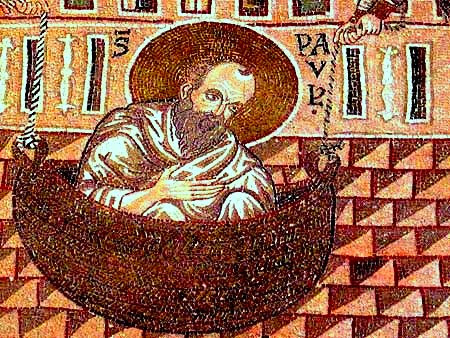
If I must boast, I will boast of the things that show my weakness. The God and Father of the Lord Jesus, who is to be praised forever, knows that I am not lying. In Damascus the governor under King Aretas had the city of the Damascenes guarded in order to arrest me. But I was lowered in a basket from a window in the wall and slipped through his hands. (New International Version)

Paul escaped the city of Damascus by being lowered in a basket at night (Acts 9: 23-25)

At this point in the Apostle Paul’s second letter to the Corinthian Church, he levels a direct and devastating attack on his proud, arrogant, and boastful opponents in the church. He points out the foolishness of their boasting, by means of playing the fool himself.

The gist of Paul’s argument was to boast of his humiliating experiences. In truth, Paul had plenty of glorious accomplishments he could have droned on about. Instead, he sought to expose the wide gulf that separated his understanding of apostolic ministry, and theirs.

With some rather hefty sarcasm behind his words, Paul offered some foolish boasting according to the human standards of his opponents. The Corinthians believed themselves to have superior strength and wisdom. Surely, they’re able to put up with these pathetic apostolic weaklings!

In reality, it is Paul’s weakness – and not humanly contrived understandings of strength – which establish his credibility and superiority as a minister of Christ’s gospel. The evidence is his hardships and trials – not his many triumphs. Paul intended for this irony to be felt by the Corinthians.

The Apostle’s litany of woes and adversities wasn’t meant to one-up the Corinthians. Rather, it was intended to be a parody of the Corinthians’ claims to superior wisdom and spiritual power.

While the church boasted of all the things that showed their strength, Paul boasted of his weaknesses – because it’s truly in weakness that the transcendent power of God is made known and manifested in this world.

Paul’s experience in Damascus not only illustrated the extreme danger he was in, but it served as an example of his weakness in contrast to the mighty strength of the Roman Empire.

In the Roman army, the soldier with the greatest strength and valor was the one who scaled the enemy wall first. The courageous ascent of the Roman soldier is viewed alongside the inglorious descent of Paul along the wall in escaping.

Christianity grew, flourished, and thrived not because of superior earthly strength, but because of humiliating weakness which allowed the power of heaven to work through it.

In light of Paul’s view of leadership and ministry, I find that many contemporary leadership theories are woefully lacking in an understanding of how people tick.

For example, some philosophies treat humans as if they were machines, and treat workers as cogs or parts in a larger mechanistic worldview, as if they could be replaceable.

Yet, leadership that relies on the factory system will inevitably demean a person’s basic humanity and see nothing of their inherent uniqueness and deserving of respect.

Instead, a more biblical, compassionate, and practical leadership style discerns that relationships are key; and that individual persons bring something special to their work, even if they are doing the same job as others.

In this understanding of leadership, every single person does their work or ministry in a way that isn’t fully reproducible by others. Our individual human uniqueness ensures that our place in the world is needed, and that what we bring to every endeavor we do is a special one-of-a-kind offering that no one else can do.

What’s more, in this view of leadership, there’s no room for boasting, at all. And no place for arrogant pride, because boasting is based upon comparison.

If every person is a unique creation of God, and everyone brings something individually special to their efforts, then comparison is a foolish waste of time, and boasting is nothing more than a fool’s game.

You can always tell the fool by how they keep talking and cannot keep their mouth shut about all of their accomplishments and everything they know. If they believe they’re right, and try and prove it with their comparative superiority to others, then you can bet that what you have in front of you is a card-carrying honest-to-goodness genuine Fool, with a capital “F.”

We can do better. And we can be better leaders and offer better leadership philosophies which are based in humility, the value of each person, sound relationships, and effective peacemaking.

Anything less than that will likely get a sarcastic comment from the Apostle Paul in heaven.

Give us, O God,
leaders whose hearts are large enough
to match the breadth of our own souls;
and give us souls strong enough
to follow leaders of vision and wisdom. Amen.