Learn by Example (1 Corinthians 10:6-13)

Now these things occurred as examples to keep us from setting our hearts on evil things as they did. Do not be idolaters, as some of them were; as it is written: “The people sat down to eat and drink and got up to indulge in revelry.” We should not commit sexual immorality, as some of them did—and in one day 23,000 of them died. We should not test Christ, as some of them did—and were killed by snakes. And do not grumble, as some of them did—and were killed by the destroying angel.

These things happened to them as examples and were written down as warnings for us, on whom the culmination of the ages has come. So, if you think you are standing firm, be careful that you don’t fall! No temptation has overtaken you except what is common to mankind. And God is faithful; he will not let you be tempted beyond what you can bear. But when you are tempted, he will also provide a way out so that you can endure it. (New International Version)

To learn by example is a whole lot better than having to learn something the hard way. One of the lessons of Holy Scripture is that it contains many stories of what not to do, and the consequences of disobedience and experiencing hard things because of anger and stubbornness.

The ancient Israelites in the desert were a group of people who ended up having to learn most things the hard way – simply because they were too stubborn and independent to listen to Moses and obey God’s commands.

Dealing with upset and recalcitrant people is a drag. But there is such a simple solution to it that you might not even believe it. If you learn to practice the one simple solution to dealing with angry, stubborn, and insecure people, your time will open much wider; your own emotions will calm down a great deal; and, you may find the kind of peace and settled conviction that you long for.

You know the type. We have all dealt with them. That chronically upset relative or in-law who demands your time and attention; the insecure co-worker who is constantly chirping about something he does not like in the company; or, the cranky neighbor who only talks to you when something infringes on his person or property.  These scenarios, and many more, you and I either have or will face.

Perhaps the religiously and perpetually upset person or group is the worst – because they hide their fears, anxieties, and insecurities behind a façade of piety and performance.

Let angry people endure the backlash of their own anger; if you try to make it better, you’ll only make it worse. (Proverbs 19:19, MSG)

I once was in a wedding in which a bridesmaid was constantly upset about something all throughout the rehearsal and into the wedding day. It got so bad that, just as we were about to walk down the aisle, she became agitated about something she did not like, and angrily stormed away. 

What would you do in such a situation? What did I do? I did absolutely nothing. I ignored her, told the rest of the wedding party to not follow her, and went about the ceremony. When she saw no one was going to rescue her, she was in line at the last minute to participate. 

If there is a person in your life, or you are in a group, who has frequent emotional meltdowns about most anything, learn the example of Holy Scripture, and hear this wisdom principle that can change your life: 

Angry, stubborn, and insecure people get upset because it works – they get their way. Someone will come to their rescue and fix their anger. But if you will practice the simple solution of letting them just be upset and stew in their own juices without coming to their aid to make it all better, they will eventually stop sucking your time and energy into their angry upset vortex.

The disobedient and upset person is typically one with some sort of entitlement mentality. The bridesmaid didn’t like the way things were being done, and she felt “entitled” to have things go her way. She wasn’t used to accepting “no” like most other people have to do. She believed everyone else ought to adjust for her behavior.

The important point to note here is that it is not your job to fix their emotions; it isn’t your responsibility to smooth everything out so that everyone feels just fine and are calmed down. Instead, it is my job and your job to practice self-control and be responsible for our own emotional well-being. 

If you keep trying to calm an angry person and assuage their emotions to an even keel, you will have to do it again, and again, and again…. Until they figure out their anger doesn’t work, it just does not pay to be upset.

This means that, deep within your soul, you must move from the fear of negative emotions in others to positive possibilities in the right direction. Not everyone is going to like you, no matter how hard you try.

“Follow my example, as I follow the example of Christ.”

The Apostle Paul (1 Corinthians 11:1, NIV)

Please understand that this does not mean we avoid helping others. It just means we don’t enable their bad behavior by solving their problems for them. We can walk beside them, encourage them, and teach them, but all without doing it for them.

Whenever we think we can handle things on our own, without anyone else’s input through consultation and collaboration, then we are setting up ourselves to have to learn the hard way. So, how will you choose to learn?

O God, by your Spirit, fashion our lives according to the example of your Son, and grant that we may show the power of your love to all among whom we live; through Jesus Christ our Lord. Amen.

Saints, Sinners, and Sacrifice (Mark 8:31-38)

Then he began to teach them that the Son of Man must undergo great suffering and be rejected by the elders, the chief priests, and the scribes and be killed and after three days rise again. He said all this quite openly. And Peter took him aside and began to rebuke him. But turning and looking at his disciples, he rebuked Peter and said, “Get behind me, Satan! For you are setting your mind not on divine things but on human things.”

He called the crowd with his disciples and said to them, “If any wish to come after me, let them deny themselves and take up their cross and follow me. For those who want to save their life will lose it, and those who lose their life for my sake, and for the sake of the gospel, will save it. For what will it profit them to gain the whole world and forfeit their life? Indeed, what can they give in return for their life? Those who are ashamed of me and of my words in this adulterous and sinful generation, of them the Son of Man will also be ashamed when he comes in the glory of his Father with the holy angels.” (New Revised Standard Version)

Saintly Sinners and Sinning Saints

People cannot be separated easily into the categories of saints or sinners. We are much more like saintly sinners or sinning saints. 

If we look closely, everyone is, at the same time, both beautiful and hideous; holy and depraved; full of faith and full of fear. And when it comes to the church, it is both the place of spiritual sensitivity toward others, as well as a den of decadent self-interested individuals. 

So, anyone searching for a church or a community that is a nice clean upward path of success with everything done to perfection with no one ever being hurt or unhappy, will be sorely disappointed. Such an organization or institution does not exist; and, it never did.

Yet, with that reality in mind, Jesus stands right alongside imperfect people, despite all their flaws, shallowness, and self-interest. Jesus is very well acquainted with people’s damaged emotions and open putrid spiritual abscesses. Yet, Christ treats everyone with mercy; Jesus never tires of rehabilitating and reforming.

Christ’s disciple, Peter, is the poster child for humanity’s mix of faith and failure. He stepped out of a boat in great faith and walked on the water, only to begin sinking because of his great fear. (Matthew 14:22-33)

It was Peter who made a bold and right confession of faith, and then turned around and bought into a satanic agenda. Yet, Jesus was right there, next to Peter all the way. Christ both rebukes and loves, all the while never abandoning us, but always working in and through us to accomplish good and right purposes.

The bald fact of the matter is that following Jesus involves pain and sacrifice. That’s the reality of living in a broken mixed-up world. What’s more, Christ’s Church is still imperfect and in the process of becoming holy. So, if we will admit it, we are all like Peter – a little devil who needs to get in line behind Jesus.

Everyone gets frustrated or disgusted with church, or really any consistent gathering of people. It’s easy to complain and even avoid others. It’s much harder to take up our cross and lose our life for the sake of Christ and others. We truly can choose to put love where love is not, even when we do not feel loved.

Imagine that your family has gathered for a holiday. Everyone is together. But you are struggling with tiredness and anger. Your spouse is sulking. Your teenage kids don’t want to be there. You worry about your aging parent. And you’re anxious about whether your crazy uncle is going to be nice or go on some weird political rant.

You want to be present, to celebrate the holiday. Your family is anything but a Hallmark card. Everyone’s hurts and hang-ups are not far from the surface. But you are together for a reason, to celebrate and experience joy. It may be a twisted human version of togetherness and spirituality, but it’s still a foretaste of the heavenly banquet that is to come. So, you deal with it all, and find some peace and satisfaction, transcending the carnal and experiencing the sacred.

In much the same way, the church gathers together in an imperfect way, a crazy mix of sinner and saint. But we gather in and around Jesus – and that makes all the difference. There’s a reason for doing this that is bigger than all our dysfunctional ways and dyspeptic attitudes. 

Jesus Christ is building his church, and he will keep it going until the end of the age. Fellow saints and sinners, Jesus isn’t finished with us yet!

The Sacrifice of Jesus Is Needed

Jesus openly stated openly that it is necessary for him to suffer deeply and die a cruel death. It’s God’s plan. But Peter didn’t like that plan, at all. So, he took Jesus aside and rebuked him, believing Jesus to be off his rocker for even suggesting such a terrible scenario. Jesus, however, turned the tables on Peter and rebuked him right back because being Christ-centered without being cross-centered is satanic.

Peter presumed to know what was best for Jesus. He believed the suffering of the cross would never happen. Peter’s perceptions were dim and limited. He did not the reality of how the world truly is; and that Jesus needed to offer himself as a sacrifice for the sins of the entire planet. 

Sometimes, like Peter, we may believe that the way I see and the way I perceive is the way things really are; or, at least, how I think they should be. 

Peter had been walking with Jesus for a few years, watching and enjoying him. It was all good. So, in his mind, it should never change; why try and fix something that isn’t broken? Oh my, but broken the world is!

Just because it was good for Peter did not mean it was good for everybody or should always be this way. If Peter had his way, we would likely be in hell. We, like Peter, are finite humans with limited understanding and perceptions.

One can easily slip into a satanic mode of believing that because something is going fine for me that everyone else is doing okay, too. I like it, I want it, so what’s the problem? 

The problem is that we too easily view life through selfish lenses. In such a state, we fail to:

  • see other people’s needs
  • perceive a lost world with any sense of reality
  • understand that Jesus has an agenda different from our own

Our limited perceptions come out in saying things such as:

  • “Oh, she’s just depressed because she is avoiding responsibility.” 
  • “People on government welfare are lazy.” 
  • “He’s addicted because he doesn’t want to help himself.” 
  • “They’re picketing because they’re a bunch of malcontents.”

Statements like those are legion, and betray a satanic worldview devoid of grace. It’s a compulsive need to find blame. It’s a belief that if there’s personal suffering, there must be personal sin. 

We belong to one human family, and therefore, we are all in this life together. One person’s joys are our joys; one person’s struggles are our struggles. The detachment we can have toward other humans is completely foreign to the words of Jesus. 

The Christian life always involves suffering, and Jesus invites us to follow him in his way of sacrifice.

The Sacrifice of Christ’s Followers Is Needed

There is a way to reverse a satanic agenda and demonic thinking: self-denial. Jesus issued an invitation to fall in line behind him and walk with him in his suffering. 

Self-denial is not so much doing something like giving up chocolate for Lent; rather, it’s giving up on ourselves as our own masters. It’s a decision to make the words and ways of Jesus the guiding direction for life. It’s the choice to quit holding onto the way I believe things ought to be, and take the time to listen to Jesus.

The logic of Jesus is relentless. Life comes through death. We give up our lives to find life. It’s unhelpful to adulterate our lives by serving the gods of success and perfectionism. Jesus invites us to quit our moonlighting job with the world, and go all in with him. In this way, we find abundant life. 

Jesus was encouraging not only submission to suffering, but also an embrace of suffering. In doing so, we find reward and joy. For those familiar with this path, suffering is a blessing. In walking this road, they find the true purpose and meaning of life. 

Few people suffered as much as the nineteenth-century missionary medical doctor to Africa, David Livingstone.  He was a pioneer explorer who opened up the interior of Africa to the outside world. He had two reasons for doing so: To take the good news of Christ’s suffering to the African people; and, to open Africa to legitimate trade, so that the illicit slave trade would end. 

Dr. Livingstone’s hand was bitten and maimed by a lion. His wife died while on the mission field. The one house he built was destroyed in a fire. He was often wracked with dysentery and fever, or some other illness in the jungle. 

Someone once commented to him that he had sacrificed a lot for following Jesus. His response: “Sacrifice? The only sacrifice is to live outside the will of God.” When asked what helped him get through the hardship, he said,  “The words of Jesus to take up my cross are always ringing in my ears.”

We may mistakenly believe that we must watch out for ourselves; push for our personal preferences; that if I accept the invitation to follow Jesus in the way of self-denial, I will be miserable and people will walk all over me. Those thoughts are merely demonic whispers in the ear.

There are two differing ways of thinking and acting: 

  1. The way of success, perfection, and a pain-free life as the evidence of God’s working. 
  2. The way of suffering as right and necessary in order to connect with God and be in solidarity with those who suffer. 

Suffering, rejection, and execution did not fit into Peter’s church growth plan. But according to Jesus, we do not exist only for ourselves, to be in some sort of spiritual country club. We exist to follow Jesus in his path of sacrifice and suffering for a world of people who desperately need to know the grace of forgiveness, and the mercy of Christ.

Since Jesus died, we are to die to ourselves. Since Christ lives, we are to live a new life. In God’s upside-down kingdom, joy comes through suffering. We follow Jesus as the mix of sinner and saint that we are. Amen.

A Desert Spirituality (Mark 1:9-15)

In those days Jesus came from Nazareth of Galilee and was baptized by John in the Jordan. And just as he was coming up out of the water, he saw the heavens torn apart and the Spirit descending like a dove upon him. And a voice came from the heavens, “You are my Son, the Beloved; with you I am well pleased.”

And the Spirit immediately drove him out into the wilderness. He was in the wilderness forty days, tested by Satan, and he was with the wild beasts, and the angels waited on him.

Now after John was arrested, Jesus came to Galilee proclaiming the good news of God and saying, “The time is fulfilled, and the kingdom of God has come near; repent, and believe in the good news.” (New Revised Standard Version)

40 Days of Desert

We are in the season of Lent in the Christian Year. Beginning with Ash Wednesday, Christians take a forty-day journey, leading to Holy Week and Easter. Jesus spent forty days in the desert being tempted by Satan. So, the Church remembers this event with the season of Lent.

This is the season in which many Christians give focus to the temptations we face on a regular basis. We intentionally practice spiritual disciplines, such as fasting, and give up something for six weeks, so that we might become aware of our attachments to other things and how much we rely on them, instead of trusting God.

It was important for Jesus to be in the desert; and it’s necessary for us, as well. Jesus retraced the steps of the ancient Israelites, who wandered in the desert for forty years before entering the Promised Land. The people needed to re-connect with God, after having failed in their faith. Trust had to be strengthened and developed before they could be ready to receive God’s promises.

Jesus accomplished what others did not: He faced down the devil and overcame temptation in the desert. 

The forty days were a necessary preparation for the upcoming three years of ministry that would culminate in Christ’s death, burial, and resurrection. Before any of that could happen, Jesus had to experience the desert.

We, like Jesus, need a desert spirituality. The desert forms us into followers of Jesus by learning to overcome temptation, so that we will not be shaped into followers of Satan. God desires to strengthen our faith, and facing down the temptations of Satan are crucial to our spiritual development.

For Christians, the desert becomes the gymnasium where we are broken down through the stress of temptation, so that we might become spiritually stronger in our faith. Without this kind of spiritual training, we become vulnerable to Satan’s accusations, and easy prey to his temptations.

Christ’s Desert

After the baptism of Jesus, the Spirit flung him into the desert. There was real danger in the desert, wild animals and all. Yet, put in that situation and having come through it, Jesus was able to deal with the crafty pursuits of Satan to distract him from his mission. 

Throughout the Gospel of Mark, after tossing demons out of people, Jesus commanded the unclean spirits not to tell anyone who he was. Part of what was going on, is that Satan wanted to tempt Jesus to gain fame and power through popularity and accolades. But that was not the way of Jesus. He was not going to bring in the kingdom of God through the avenues of careful marketing and brand recognition.

Another practice of Jesus throughout his ministry was to seek places for solitude and prayer. The needs Jesus daily faced were large and vast and never ended. Yet, he resisted working without any rest or guidance in prayer. 

A temptation could have been to please people and never get away to pray. Yet, through solitude and prayer, Jesus connected with his Father; he moved from place to place proclaiming the good news of God’s rule and reign. Jesus did not succumb to the temptation to settle in one place and build a petty kingdom of his own, apart from the Father.

As Jesus walked the countryside telling people of repentance and faith, he often spoke in parables that were designed to foster thought and reflection. Jesus was not duped by the temptation to always be black and white about everything, merely giving the bottom line of his teaching to people. 

Christ did not teach in order to get immediate results, or to let people know which side he was on concerning the issues of the day. Instead, Jesus was about the business of building something permanent that would far outlast his short three years of ministry.

Because of the desert, and through his Father’s affirmation, Jesus lived a unique three years on this earth that has never been equaled before or since.

Our Desert

Years ago, I went on a leadership retreat in the Canadian wilderness. We were so far out in the sticks that we needed special first aid training before leaving, because if someone got severely injured it would be hours before he could receive any medical attention. There was no cell phone service, no towns, no anything except mile after square mile of wilderness. 

We were continually vigilant to not attract bears. The wilderness can be a dangerous place. One day, we were each dropped off on our own personal islands for an entire day, alone. Being face to face with yourself can be hard to deal with, which is what a desert experience does – it exposes the idols of our hearts and the ways in which we are tempted.

A person does not need to be in the Canadian wilderness or in the actual desert to experience the effects of desert life. The Holy Spirit has a way of throwing us into the desert through a change of circumstance, so that we will exercise our spiritual muscles and get in spiritual shape. 

The top three temptations that people face on a daily basis are: 

  1. Worry and anxiety
  2. Procrastination and putting things off
  3. Gossip and other sins of the tongue 

So, how do we face down those temptations and retrace our steps back to the path of God? Here are some lessons I have learned in my own desert experiences:

  1. Know your weaknesses. Know yourself, and the temptations directed at you. The three I just mentioned all come from a tendency toward perfectionism. We worry about the future, of not saying or doing something perfectly. So, we procrastinate for fear of screwing up and not being perfect. And we gossip to others about their faults and weaknesses because it maintains the illusion that our perfectionism is intact, at least as compared to others. Perfectionism is slavery. For freedom Christ has set us free. Stand firm, therefore, and do not submit again to a yoke of slavery. (Galatians 5:1, NRSV)
  2. Understand the importance of timing. When are you at your weakest, and vulnerable to temptation? What triggers you to sin? Whenever kids act up, we first wonder if they are tired or hungry or have some other need. It’s the same with us. Carrying sleep debt, skipping meals, or eating junk food because we are in a hurry, will set us up for temptation. Elijah faced down four-hundred prophets of Baal, then fell apart when one woman, Jezebel, went after him. He needed food and rest. Discipline yourselves; keep alert. Like a roaring lion your adversary the devil prowls around, looking for someone to devour. (1 Peter 5:8, NRSV)
  3. Look to God and others. Don’t rely solely on your own willpower; or believe that you can resist temptation all by yourself, all the time. Even Jesus looked both to his Father and his disciples. Then Jesus went with them to a place called Gethsemane, and he said to his disciples, “Sit here while I go over there and pray.” He took with him Peter and the two sons of Zebedee and began to be grieved and agitated. Then he said to them, “My soul is deeply grieved, even to death; remain here, and stay awake with me.” And going a little farther, he threw himself on the ground and prayed, “My Father, if it is possible, let this cup pass from me, yet not what I want but what you want.” Then he came to the disciples and found them sleeping, and he said to Peter, “So, could you not stay awake with me one hour? Stay awake and pray that you may not come into the time of trial; the spirit indeed is willing, but the flesh is weak.” (Matthew 26:36-41, NRSV)
  4. Have a plan. Flying by the seat of your pants will not always work. The clever see danger and hide, but the simple go on and suffer for it. (Proverbs 22:3, NRSV) One of the ways I personally resist temptation is by having a daily plan of worshiping God, praying, and reading Scripture at set times throughout the day. For me, it’s significant to have more than a few minutes of “quiet time” in the morning.
  5. Overcome evil with good. Do not be overcome by evil, but overcome evil with good. (Romans 12:21, NRSV) Applying this to the top three temptations people face, that means worriers will love their enemy and pray for those who persecute. For the procrastinator, it means to take intentional steps of faith and risk, being real and vulnerable with others through accountable relationships. For the gossip, they will seek to speak words of encouragement that build others up.
  6. Know that you are never alone. Angels attended Jesus. Even the Son of God was not on his own.  Whatever you are facing is likely not unique to you. Others face it, too. Our brothers and sisters throughout the world are undergoing the same kind of problems when they seek to walk with Christ.

Let the desert shape and strengthen your faith. If the Holy Spirit has thrown you into a dry place, then instead of bucking the situation and complaining about it, learn all you can about resisting temptation so that you can come out the other end a stronger, more faithful follower of Jesus Christ. 

May it be so, to the glory of God.

Why Are We Here? (Matthew 9:2-13)

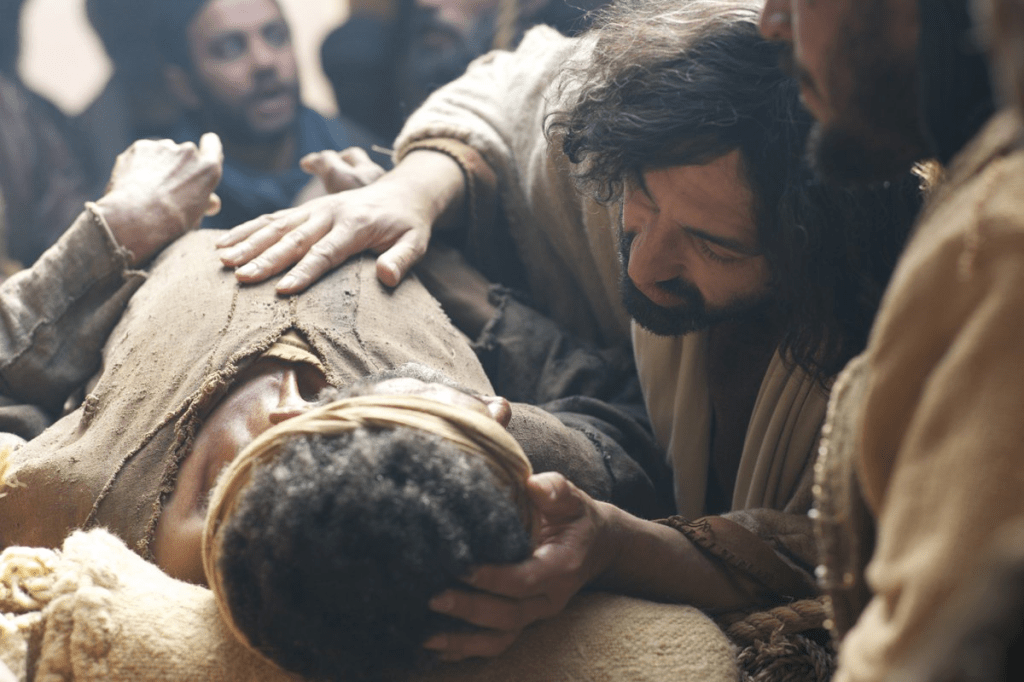
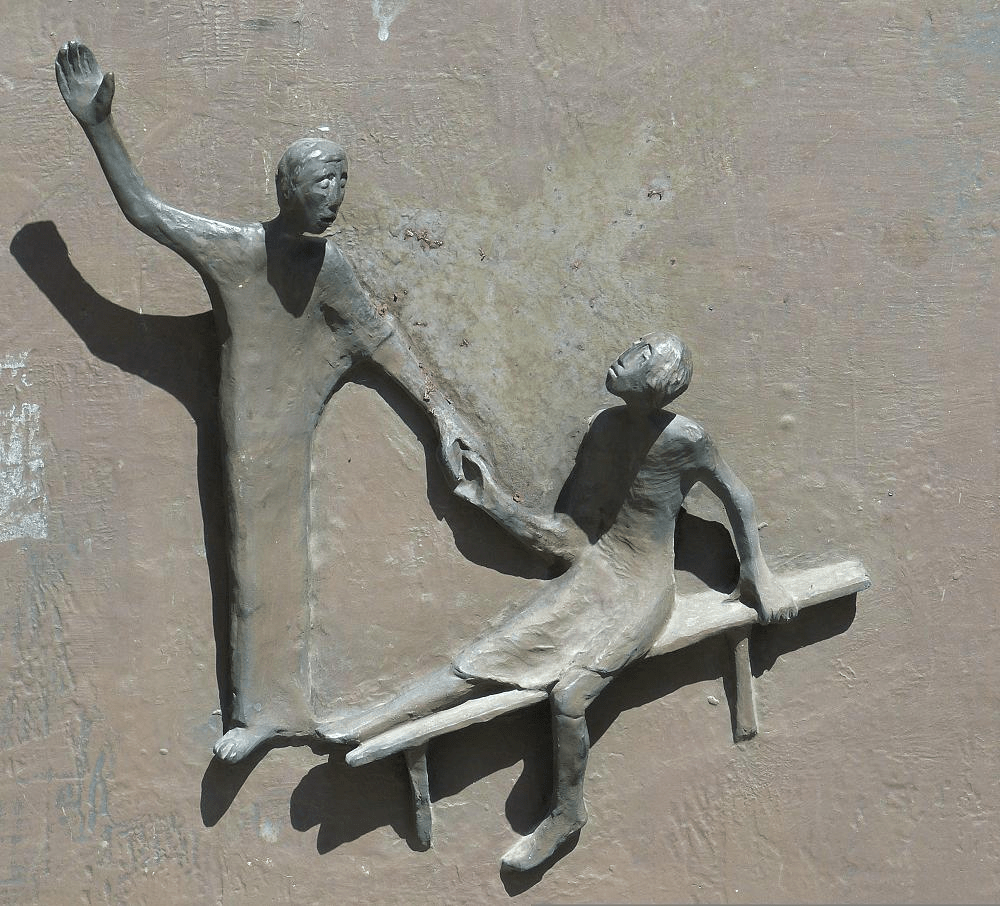
Jesus heals and forgives a paralyzed man

Some men brought to him a paralyzed man, lying on a mat. When Jesus saw their faith, he said to the man, “Take heart, son; your sins are forgiven.”

At this, some of the teachers of the law said to themselves, “This fellow is blaspheming!”

Knowing their thoughts, Jesus said, “Why do you entertain evil thoughts in your hearts? Which is easier: to say, ‘Your sins are forgiven,’ or to say, ‘Get up and walk’? But I want you to know that the Son of Man has authority on earth to forgive sins.” So he said to the paralyzed man, “Get up, take your mat and go home.” Then the man got up and went home. When the crowd saw this, they were filled with awe; and they praised God, who had given such authority to man.

As Jesus went on from there, he saw a man named Matthew sitting at the tax collector’s booth. “Follow me,” he told him, and Matthew got up and followed him.

While Jesus was having dinner at Matthew’s house, many tax collectors and sinners came and ate with him and his disciples. When the Pharisees saw this, they asked his disciples, “Why does your teacher eat with tax collectors and sinners?”

On hearing this, Jesus said, “It is not the healthy who need a doctor, but the sick. But go and learn what this means: ‘I desire mercy, not sacrifice.’ For I have not come to call the righteous, but sinners.” (New International Version)

“The church is a hospital for sinners, not a museum of saints.”

Abigail Van Buren (“Dear Abby”)

Why does the Church exist? Why did Jesus come to this earth? What are we supposed to be doing? Does Christianity make any difference in this world? Why are we here?

The Church is not on this earth solely for the benefit of Christians, any more than a hospital exists for the benefit of the doctors or insurance companies.

Rather, the Church is designed to extend the mission of Jesus through proclamation of good news with the restorative touch of grace. The Church is the community of the redeemed, gathered together for worship and encouragement, and then sent into the world to be the continuing presence of Jesus on this earth.

This mean that the Church’s calling is not to find others who can help them with their tithing and budget, or to keep the pews warm with fresh bottoms.

Some folks are not healthy. Some are sick physically, and others spiritually. Even more are emotionally brokenhearted. And then there are those who are sick-and-tired of being sick-and-tired.

Please know that Jesus came neither to condemn nor heap a pile of unrealistic expectations on us. Christ points us to the source of healing and transformation, and invites us to come to him. 

Conversely, there are many other people today who are healthy, spiritually alive, and have a good well-being. And they possess the opportunity to participate in ways that bring holistic healing to the world as Christians. The mission of Jesus is our mission, as well.

Jesus came to bring forgiveness and transformation. In today’s Gospel healing, it was a case where the person’s paralysis was both physical and spiritual. The paralytic found in Jesus healing of both body and soul.

The religious insiders observed the healing of the paralytic. Yet, they didn’t rejoice over it. Instead, they were hung up on Jesus claiming to be God. Although this may have been a hard truth to accept, Jesus labeled their response as evil – because of an inability to perceive the situation as a divine intervention. Since the religious insiders wrongly discerned who Jesus is, they wrongly interpreted the situation. 

It’s important to see Jesus as the Human One who extends compassion and forgiveness. If we fail to see this about Christ, we will get caught up in all kinds of silly matters concerning personal preferences and power plays, based in how we think things should go, rather than how God is shaking out things.

Jesus came to forgive our guilt and shame. Healing the body is good, but it’s not enough. Christ came to heal both the body and the spirit. At the heart of the human condition is spiritual brokenness, and Jesus wants to remove the obstacle of sin and create a new healthy society. This is a radical vision which seeks to encompass all persons – which means Jesus touched many people overlooked by others.

Jesus came to call the despised people of society, the “sinners.” He called Matthew, a tax collector. Tax collectors were hated. They were corrupt characters who extorted money from innocent people. And furthermore, Jesus had dinner with Matthew, along with all of his unsavory buddies. This kind of behavior by Jesus was deeply offensive to upstanding citizens.

However, Jesus did not back down, saying that it’s not the healthy who need a doctor, but the sick. And he backed up his social actions with Scripture by encouraging offended folks to meditate on what the biblical phrase, “I desire mercy, not sacrifice.” (Hosea 6:6)

It is possible to engage in outward rituals of worship, do all the right things, fulfill duty, yet still miss the heart of what God wants for humanity. Mercy is what God wants. Jesus knew this. So, Christ entangled himself with sinners to bring spiritual healing and restoration.

If we want to see God deliver people from their unhealthy situations, we must entangle ourselves with them, into complicated lives that are not pretty, with persons who have been tainted by sin. 

Lots of people are in awful predicaments. Christians, like their Lord, will need to get their hands dirty and their feet wet to extend Christ’s ministry of mercy and forgiveness.

The gospel was never intended to be proclaimed from afar, but up close and personal. The merciful mission of Jesus requires the following three activities:

  1. Intimacy with Jesus. Engaging in the spiritual disciplines of prayer, giving, fasting, reading, and meditating on Scripture. These practices help us to know Christ better and how to respond with mercy.
  2. Intimacy with fellow believers. We are hard-wired by God for community. Superficial relationships only provide superficial community. Christians need to help one another with spiritual growth, and to hold one another accountable for the mission of Christ.
  3. Intimacy with “sinners.” This world is filled with sick, needy, hurting, and lonely people who are locked in unhealthy patterns of living. They need a merciful change of life that comes from the merciful Jesus acting through merciful Christians. 

Mercy, not judgment, is at the heart of all change. For things to be different, we must be acquainted with mercy.

Most merciful God, we confess we have sinned against you in thought, word, deed, and neglect. We have not held fast to your commandments and have strayed from your teachings. We turn away from self-centered actions and pride. For the sake of your Son, Jesus, have mercy on us and forgive us so that we are released from all sinful obstacles. Empower us with your wisdom, revelation, and discernment so that we might be your merciful hands, feet, and words to one another and those who do not yet know you. Amen.