Persecuted (Acts 8:1b-8)

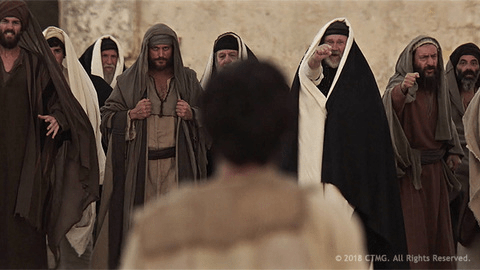
A scene from the movie, “Paul, Apostle of Christ,” in which Saul sought to wipe out Christians beginning with the stoning of Stephen

On that day a great persecution broke out against the church in Jerusalem, and all except the apostles were scattered throughout Judea and Samaria. Godly men buried Stephen and mourned deeply for him. But Saul began to destroy the church. Going from house to house, he dragged off both men and women and put them in prison.

Those who had been scattered preached the word wherever they went. Philip went down to a city in Samaria and proclaimed the Messiah there. When the crowds heard Philip and saw the signs he performed, they all paid close attention to what he said. For with shrieks, impure spirits came out of many, and many who were paralyzed or lame were healed. So there was great joy in that city. (New International Version)

Just because Christians experience the blessing of God through new life in Christ, does not mean that the rest of this earthly life will be bunnies and unicorns without any hardship.

Sometimes we forget that rabbits and horses produce manure, and we’ll have to muck out the barn. And even more than that, blessings from God are not limited to an abundance of earthly resources; blessing also comes through suffering. Jesus said:

“Great blessings belong to those who suffer persecution for doing what is right. God’s kingdom belongs to them.

“People will insult you and hurt you. They will lie and say all kinds of evil things about you because you follow me. But when they do that, know that great blessings belong to you. 

“Be happy about it. Be very glad because you have a great reward waiting for you in heaven. People did these same bad things to the prophets who lived before you.” (Matthew 5:10-12, ERV)

Saul was an up and coming Jewish Pharisee. He was intelligent, driven, and pious. Saul had the pedigree, passion, and position to go a long way and make a big splash in Judaism. And he was more than ready to do whatever it took to stamp out a heretical and dangerous sect of Jesus followers – even to the point of giving approval to the stoning of the Christian Stephen; and leading a persecution against believers like him.

Jesus not only promised abundant and eternal life to his followers, but he also promised that the cost of Christian discipleship would be persecution. Believers in Jesus Christ can expect to suffer in this life for their faithful commitment. Yet, because Christ overcame the world, we too, can accept, cope, and transcend any persecution and trouble we face in our embrace of faith. Jesus said:

“The world will make you suffer. But be brave! I have defeated the world!” (John 16:33b, GNT)

Even though the unity the believers enjoyed together in Jerusalem was disrupted and destroyed by the leadership of Saul, God bent the adverse situation toward blessing. Christians were flung all over the known world. In their going, they obeyed the words of their Lord Jesus to proclaim the message they so wholeheartedly embraced.

When Jesus came near, he spoke to them. He said, “All authority in heaven and on earth has been given to me. So wherever you go, make disciples of all nations: Baptize them in the name of the Father, and of the Son, and of the Holy Spirit. Teach them to do everything I have commanded you.

“And remember that I am always with you until the end of time.” (Matthew 28:18-20, GW)

The ancient prophesies were becoming realized. Grace, mercy, and peace were overcoming bitterness, judgment, and enmity toward one another. Even though persecution was happening, there was now a very different response to it, which will lead to a new outcome. In the last days…

The Lord will mediate between nations
    and will settle international disputes.
They will hammer their swords into plowshares
    and their spears into pruning hooks.
Nation will no longer fight against nation,
    nor train for war anymore. (Isaiah 2:4, NLT)

Suffering can be tolerated, even embraced, whenever we are aware that it can lead us to peace and joy – both personally and communally. Instead of evil taking root amongst a people, good seeds can be planted in the heart of humanity. And when those seeds are watered and nurtured, they grow to become a blessing for the world.

Finally, Jesus said, “What is God’s kingdom like? What story can I use to explain it? It is like what happens when a mustard seed is planted in the ground. It is the smallest seed in all the world. But once it is planted, it grows larger than any garden plant. It even puts out branches that are big enough for birds to nest in its shade.” (Mark 4:30-32, CEV)

Spiritual growth is built into Christianity. The faith formation and development of both individual believers and churches is important. Without it, Christians devolve into cliques of special interest groups.

But with it, Christianity becomes a blessing to the world, that is, if believers focus on producing and harvesting the spiritual fruit of love, joy, peace, patience, kindness, generosity, faithfulness, gentleness, and self-control. (Galatians 5:22-23)

Whenever and wherever believers and followers of Jesus are spiritually growing in their faith, they become like exorcists who organically purge unhealthy institutional systems of their moral corruption, selfishness, idolatry, hate, in-fighting, obsessions, bitterness, rage, competitive oppositions, conflict, and polarizing group rivalries. (Galatians 5:19-21)

Christianity is meant to bring joy and healing of both body and soul. If it doesn’t do this, then it has become just another unjust and unhealthy organization that is in need of purging its impurities; and embracing its mandate to uphold the common good of all persons through proclamation of good news and committed to a lifestyle of loving one another as Christ has loved us.

For people pay attention to that which is right, just, and good – because righteousness, justice, and goodness are in everyone’s spiritual DNA.

Almighty and gracious God of all:
Remember Christ, your Son, who is peace itself,
and who has washed away our hatred with his blood.
Because you love all men and women everywhere,
look with mercy on all who are engaged in battles of the flesh and the spirit.
Banish the violence and evil within all combatants of both body and soul
so that one day, we may all deserve to be called your sons and your daughters.
Grant this through Christ our Lord, in the enablement of the Spirit. Amen.

Holy Saturday (John 19:38-42)

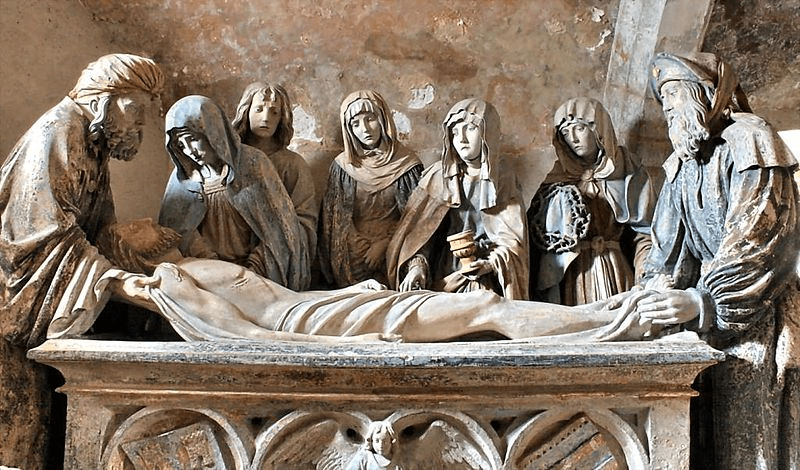
The Entombment, by the French sculptor Maître de Chaource, 16th century

After these things, Joseph of Arimathea, who was a disciple of Jesus, though a secret one because of his fear of the Jews, asked Pilate to let him take away the body of Jesus. Pilate gave him permission, so he came and removed his body. Nicodemus, who had at first come to Jesus by night, also came, bringing a mixture of myrrh and aloes, weighing about a hundred pounds. 

They took the body of Jesus and wrapped it with the spices in linen cloths, according to the burial custom of the Jews. Now there was a garden in the place where he was crucified, and in the garden there was a new tomb in which no one had ever been laid. And so, because it was the Jewish day of Preparation and the tomb was nearby, they laid Jesus there. (New Revised Standard Version)

Today is Holy Saturday – a quiet place sandwiched between the ignominy of the cross and the celebration of resurrection – a day of solitude, silence, and stillness. 

This isn’t a particularly popular day. People don’t rave about Holy Saturday, in fact, many Christians haven’t had a thought that this day could have any significance. Yet, this very day has its place in the scheme of the Christian life.

There cannot be resurrection and new life without a death and dying to self. There must be suffering before there can be glory. Whenever Christians quickly jump to triumphal language about victory and speak little-to-nothing about suffering, then we are left with a cheap grace which has been purchased with the counterfeit currency of velocity. 

This day is meant for us to get out of our heads and wrap our hearts around the important reality that Jesus Christ was truly in the grave – very much dead. 

It was real suffering on Good Friday, and it is a real death in the grave on Holy Saturday. There is no movement.  All is silent and still. Jesus is in the solitude of a dark tomb. 

My friends, there is absolutely no getting around the fact that if we want a Resurrection Day with all its celebration and glory, then we cannot and must not circumvent Holy Saturday. 

On Holy Saturday, Christ’s disciples were experiencing an awful and real grief. Jesus suffered. He was tortured and humiliated. Jesus died. It was surreal for the disciples. They could barely believe there could ever be a day like today. Their Lord was dead and buried in a tomb.

Holy Saturday sits us down and asks some hard questions:

  • Are you ready to follow Jesus and suffer as he did? 
  • Are you willing to stop your striving, manifested through constant movement, and embrace solitude, silence, stillness with its contemplation and embrace of suffering?
  • Will you have sense enough to pray? 
  • Will you practice a Christian counter-cultural shift and face the ridicule of friends so that you might take some much-needed time to be with Jesus in the tomb?
  • Are you so antsy and anxious that you just want to leap into Easter with no solidarity with your Lord who is in the grave?

You may think that I’m being a bit too hard, or harsh, or cold…. That’s because Jesus is cold. He has a bonified cold dead body. It’s no fake death. There’s no “swoon theory” here, as if Christ only passed-out and did a weird divine fainting spell. No, he is dead. And if you and I want to live with Jesus, we must die with Jesus. 

Anyone who tries to promise a new life apart from journeying with Jesus into the grave is a spiritual charlatan. 

Only through death can there be life. 

On this Holy Saturday, let us intentionally slow down, do less, give ourselves a large chunk of unstructured time, and put aside routine things for a while. In its place, fill the time with unfettered access to God in Christ.

O God, Creator of heaven and earth: Grant that, as the crucified body of your dear Son was laid in the tomb and rested on this holy Sabbath, so may we await with him the coming of the third day, and rise with him to newness of life; who now lives and reigns with you and the Holy Spirit, one God, for ever and ever. Amen.

Tuesday of Holy Week (John 12:20-36)

Now among those who went up to worship at the festival were some Greeks. They came to Philip, who was from Bethsaida in Galilee, and said to him, “Sir, we wish to see Jesus.” Philip went and told Andrew, then Andrew and Philip went and told Jesus. 

Jesus answered them, “The hour has come for the Son of Man to be glorified. Very truly, I tell you, unless a grain of wheat falls into the earth and dies, it remains just a single grain, but if it dies it bears much fruit. Those who love their life lose it, and those who hate their life in this world will keep it for eternal life. Whoever serves me must follow me, and where I am, there will my servant be also. Whoever serves me, the Father will honor.

“Now my soul is troubled. And what should I say: ‘Father, save me from this hour’? No, it is for this reason that I have come to this hour. Father, glorify your name.” Then a voice came from heaven, “I have glorified it, and I will glorify it again.”The crowd standing there heard it and said that it was thunder. Others said, “An angel has spoken to him.” 

Jesus answered, “This voice has come for your sake, not for mine. Now is the judgment of this world; now the ruler of this world will be driven out. And I, when I am lifted up from the earth, will draw all people to myself.”He said this to indicate the kind of death he was to die. The crowd answered him, “We have heard from the law that the Messiah remains forever. How can you say that the Son of Man must be lifted up? Who is this Son of Man?” 

Jesus said to them, “The light is in you for a little longer. Walk while you have the light, so that the darkness may not overtake you. If you walk in the darkness, you do not know where you are going. While you have the light, believe in the light, so that you may become children of light.”

After Jesus had said this, he departed and hid from them. (New Revised Standard Version)

We continue to journey with Jesus during this Holy Week, on Tuesday. A mix of both Jews and devout Gentiles made their way to Jerusalem for the Passover festival. It was amongst this group of people that Jesus delivered his final public teaching to the crowd.

There were some Greeks who really wanted to see Jesus, and they saw an opportunity to do so when everyone was gathering at Passover time. They asked some of Christ’s disciples if they could do so, and the word was passed to Jesus. This occasion prompted Jesus to let the disciples know that the time has come for death, and therefore, life.

For those with the eyes to see what was happening, many of the people were being drawn to Jesus, rather than the temple. The Lord Jesus was gathering the nations – foreigners and outcasts – to the holy mountain to meet with him. Salvation would be found in him.

Do not let the foreigner joined to the Lord say,
    “The Lord will surely separate me from his people,”
and do not let the eunuch say,
    “I am just a dry tree.”
For thus says the Lord:
To the eunuchs who keep my Sabbaths,
    who choose the things that please me
    and hold fast my covenant,
I will give, in my house and within my walls,
    a monument and a name
    better than sons and daughters;
I will give them an everlasting name
    that shall not be cut off.

And the foreigners who join themselves to the Lord,
    to minister to him, to love the name of the Lord,
    and to be his servants,
all who keep the Sabbath and do not profane it
    and hold fast my covenant—
these I will bring to my holy mountain
    and make them joyful in my house of prayer;
their burnt offerings and their sacrifices
    will be accepted on my altar,
for my house shall be called a house of prayer
    for all peoples.
Thus says the Lord God,
    who gathers the outcasts of Israel:
I will gather others to them
    besides those already gathered. (Isaiah 56:3-8, NRSV)

Jesus does the work of connecting the disconnected, of bringing together disparate humanity into a needed and peaceful wholeness and integrity. Christ is the ultimate gatherer, fostering get-togethers that bring the opportunity for divine/human connection, as well as the chance for unity and reconciliation between people.

Christ was about to die on behalf of the nations. He was sacrificing himself in order to bring Jews everywhere scattered in diaspora together. And he was giving himself for the sake of Greeks and all sorts of ethnicities, so that both Jew and Gentile might be gathered together as the one people of God. In other words, Jesus Christ offers himself for the life of the whole world.

There was certainly a gathering of people on Palm Sunday with Christ’s triumphal entry. Yet, this was not the event that truly brings everyone together. It is the death of Christ that does that.

Up to this point, on Holy Tuesday, Jesus had already communicated several times in various ways about his upcoming death. (i.e. John 2:20; 3:14-15) On this day he refers to it again through the cryptic language of stating that the hour has come for the Son of Man to be glorified.

Using an agricultural metaphor that surely connected with his hearers, Jesus let the gathered ones know that he is the seed who will fall, and die, yet produce an incredible harvest. He is the one who willingly gives up his soul on behalf of the world. Jesus does this in obedience to his Father’s will.

In fact, Jesus is so sure about his mission as Savior of the world, that he confidently proclaims he will face death without asking for divine deliverance from it.

The confused and divided crowd of people were given a direct voice from heaven. This was not to assure or reassure Jesus, but was for the sake of the gathered folks in Jerusalem. They were provided some light, so that there was some guidance in the midst of the darkness which was about to happen in a few days.

Wanting to see Jesus needs to become more than a desire to meet a celebrity, or to fawn over him as a fan or a groupie following him around. Our ears need unclogging. Our eyesight requires some correction. The crucifixion and resurrection of Jesus will unclog us and correct us.

The darkness will always be around the corner, this side of heaven. And death will persist, too, until Christ returns. Therefore, we must trust that God will bring about life through death. In the darkest of times, a light will illumine the path.

Holy and immortal God, from earliest times you have named us and called us into discipleship. Teach us to follow the One whose light scatters the darkness of our world, so that we may walk as children of the light. Amen.

The Irony of Christ’s Followers (Mark 10:32-34, 46-52)

A 10th century depiction of Christ healing a blind man

The disciples were confused as Jesus led them toward Jerusalem, and his other followers were afraid. Once again, Jesus took the twelve disciples aside and told them what was going to happen to him. He said:

We are now on our way to Jerusalem where the Son of Man will be handed over to the chief priests and the teachers of the Law of Moses. They will sentence him to death and hand him over to foreigners, who will make fun of him and spit on him. They will beat him and kill him. But three days later he will rise to life….

Jesus and his disciples went to Jericho. And as they were leaving, they were followed by a large crowd. A blind beggar by the name of Bartimaeus son of Timaeus was sitting beside the road. When he heard that it was Jesus from Nazareth, he shouted, “Jesus, Son of David, have pity on me!” Many people told the man to stop, but he shouted even louder, “Son of David, have pity on me!”

Jesus stopped and said, “Call him over!”

They called out to the blind man and said, “Don’t be afraid! Come on! He is calling for you.” The man threw off his coat as he jumped up and ran to Jesus.

Jesus asked, “What do you want me to do for you?”

The blind man answered, “Master, I want to see!”

Jesus told him, “You may go. Your eyes are healed because of your faith.”

At once the man could see, and he went down the road with Jesus. (Contemporary English Version)

“Irony” and “ironic” are terms describing when an outcome of an event is contrary or different from what would be expected.

Here are a few examples of irony: The firehouse burnt down. The police officer got arrested. When I was a kid, my family physician’s name was Dr. Fail (really!). There is an overarching ironic lesson to our Gospel story today:

The people following Jesus with 20/20 vision were spiritually blind.

Their great need is the same as blind Bartimaeus: To have their eyes opened to Jesus and to what God was doing around them. Bartimaeus was marvelously and miraculously given sight by Jesus – the others, however, remained unchanged and in the dark. 

Irony #1: Many followed Jesus, but only a few were his followers.

All kinds of people physically followed Jesus around for various reasons while he was here on this earth. Some wanted to bask in the latest celebrity buzz that Jesus generated. Others wanted to see the cool stuff Jesus did, like healing people. Some were plain curious. And a few were interested in being like Jesus by showing selfless compassion.

Jesus continually sought to press the crowd following him into spiritual seekers who would learn to follow his teaching.

Many people conform to the group and go with the flow. That’s great if the crowd is good, and not so good if they’re going in a bad direction.

In the Old Testament, a few unruly complainers got the Israelites stirred up. The result was making a golden calf and turning away from God. Sometimes it is right and necessary to go against the crowd.

Irony #2: Out of all Christ’s followers, it is a blind man that sees Jesus for who he is: The Son of David.

Bartimaeus discerned it was Messiah who was walking by him. So, he went against the crowd and shouted to Jesus. Blind Bartimaeus didn’t care how he looked to others; it didn’t matter to him that he stuck out like a sore thumb to all the spiritually blind people.

Jesus often avoided crowds. Most of his earthly life occurred away from the centers of power and influence. Jesus swam upstream of the prevailing notions of righteousness. Christ did not cow-tow to the crowd. Instead, he paid attention to the needy and forgotten.

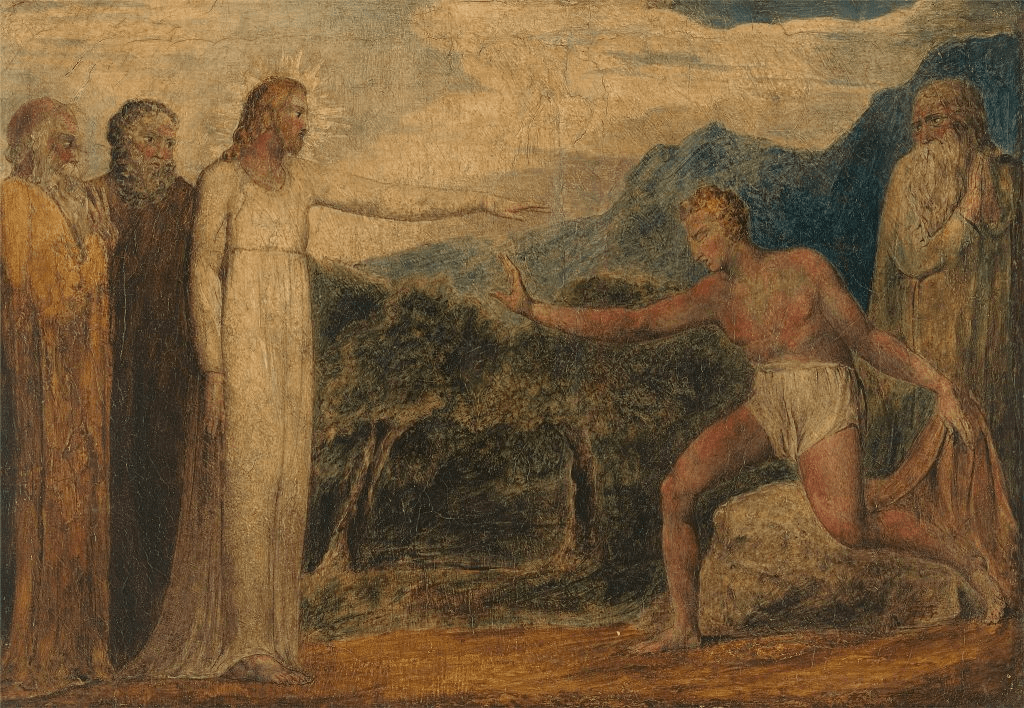
Christ Giving Sight to Bartimaeus, by William Blake (1757-1827)

And while in a large group of people, Jesus did not “work the crowd” to get ahead and further his agenda. He did not cozy-up to the rich and powerful. And Christ deliberately avoided celebrity status. Jesus showed extraordinary love to an overlooked person. He used his immense power for one powerless person.

Irony #3: The ones following Jesus were the ones trying to keep a blind man from Jesus.

One irony of the church is that Christ’s own followers can be the biggest obstacle to others following him.

I can just imagine a group of gossipy church folk shushing Bartimaeus: “Don’t bother Jesus, he is such a busy man! He has important work to do!” I can also picture them standing next to blind Bartimaeus saying, “Just stop, man, you’re embarrassing yourself.” 

But Bartimaeus would not stop. He shouted all the louder. That’s because true and genuine faith is a needy person crying out in desperation for Jesus to help.

Jesus asked a beautiful question: “What do you want me to do for you?”

“I want to see,” Bartimaeus responded. So, Jesus had compassion on him, and gave him his sight. Here we have two men, Jesus and Bartimaeus, ignoring all the people around them, and having a divine encounter.

This encounter raises my curiosity as to why it is so hard for us to simply say what we want.

It could be that we don’t want to buck the crowd, or to look different. Maybe we don’t want to admit our need in front of others. So, we simply stick to superficial conversations and insist that everything is okay, when it isn’t.

Jesus said, concerning the crowd, “Although they see, they don’t really see.” (Matthew 13:13)

If we are concerned about how we are seen by others, we will not be seen by God; we will miss Jesus when he walks by, right in front of us.

Conclusion

How might we raise our ability to see Jesus and truly follow him as he desires us to?

Listen to Jesus

Jesus was headed to Jerusalem and had a lot on his mind and heart with anticipating his passion and death. Christ became attentive to Bartimaeus, out of all the people around him, because he was listening.

If we want to see Jesus and follow him, we must be listeners,  and be attentive to compassion, like Jesus, to the needy and lowly among us. 

I recently read a story from a Christian who lived during Nazi Germany. He said:

“I considered myself a Christian. We heard stories of what was happening to the Jews, but we tried to distance ourselves from it, because what could anyone do to stop it? A railroad track ran behind our small church, and each Sunday morning we could hear the whistle in the distance and then the wheels coming over the tracks.

“We became disturbed when we heard the cries coming from the train as it passed by. We realized it was carrying Jews like cattle in the cars! Week after week the whistle would blow. We dreaded to hear those wheels because we knew we would hear the cries of the Jews in route to a death camp. Their screams tormented us.

“So, when we heard the whistle blow, we began singing hymns. By the time the train came past our church, we were singing at the top of our voices. If we heard the screams, we sang more loudly, and soon we heard them no more.

“Years have passed, and no one talks about it anymore. But I still hear that train whistle in my sleep. God forgive me. Forgive all of us who called ourselves Christians yet did nothing to intervene.” 

Respond to Jesus

Once Jesus listened, he responded by asking a question. Christ took the time to heal Bartimaeus.

Jesus could have simply healed him without even stopping. He could have started a healing factory where everyone with a need just moved through a line and got healed. But Jesus was doing more than giving sight; he was giving a blessing – the blessing of time and relationship.

The gospel is personal, which is why we ought to resist being non-relational in ministry to others.

Christian ministry is about blessing other people with the gift of relationship. It begins with recognizing self as the one who needs Jesus; and it starts with having our own eyes opened to see our own need, and then the great need of people around us.

God of all compassion, I confess that it is natural for me to do things my way. I recognize that I am limited, but that you know all things. I yield my spiritual eyesight to you so that my spiritual vision will be clear. Jesus Christ came to give sight to the blind and to open our eyes. I commit my ways to you so that I can see your ways and not just my own. Amen.