1 Corinthians 9:1-16 – Showing Tolerance

Tolerance, statue by Spanish artist Jaume Plensa

Am I not free? Am I not an apostle? Have I not seen Jesus our Lord? Are you not the result of my work in the Lord? Even though I may not be an apostle to others, surely, I am to you! For you are the seal of my apostleship in the Lord.

This is my defense to those who sit in judgment on me. Don’t we have the right to food and drink? Don’t we have the right to take a believing wife along with us, as do the other apostles and the Lord’s brothers and Cephas? Or is it only I and Barnabas who lack the right to not work for a living?

Who serves as a soldier at his own expense? Who plants a vineyard and does not eat its grapes? Who tends a flock and does not drink the milk? Do I say this merely on human authority? Doesn’t the Law say the same thing? For it is written in the Law of Moses: “Do not muzzle an ox while it is treading out the grain.” Is it about oxen that God is concerned? Surely, he says this for us, doesn’t he? Yes, this was written for us, because whoever plows and threshes should be able to do so in the hope of sharing in the harvest. If we have sown spiritual seed among you, is it too much if we reap a material harvest from you? If others have this right of support from you, shouldn’t we have it even more?

But we did not use this right. On the contrary, we put up with anything rather than hinder the gospel of Christ.

Don’t you know that those who serve in the temple get their food from the temple, and that those who serve at the altar share in what is offered on the altar? In the same way, the Lord has commanded that those who preach the gospel should receive their living from the gospel.

But I have not used any of these rights. And I am not writing this in the hope that you will do such things for me, for I would rather die than allow anyone to deprive me of this boast. For when I preach the gospel, I cannot boast, since I am compelled to preach. Woe to me if I do not preach the gospel! (NIV)

A person who cannot tolerate small misfortunes can never accomplish great things.

Chinese Proverb

There is a reason for tolerance. You and I employ it in all kinds of ways and contexts so that we might achieve an important purpose.

Parents of newborn babies put up with a lot from the little one. As a father myself, who has raised three daughters with my wife, I can testify that over the course of many years I have been puked-on, peed-on, poked in the eye, and kicked in places I would rather not discuss. I have patiently helped with homework, taken time out to play with dolls, and stayed up late waiting for teenagers to come home. None of those things ever showed-up on my bucket list.  So, why did I do them?

Yes, you already know that was a rhetorical question with a decisive answer. It is because I love my girls. I would do anything for them. I was committed to doing whatever it took to raise virtuous, fun-loving, well-adjusted, God-seeking, responsible persons. I was willing to put up with a lot to see that happen.

The Apostle Paul was passionate and committed about reaching lost people and raising them in the Christian faith.  He was willing to put up with a lot to see that purpose come to fruition. Paul was determined not to put any obstacle in the way of gospel proclamation.

Paul was motivated by seeing the good news of Jesus Christ take root in people. He did all that he could to communicate the message. Paul had a committed personal conviction to not let his personal rights stand in the way of what was most important.

“Toleration is the greatest gift of the mind; it requires the same effort of the brain that it takes to balance oneself on a bicycle.”

helen keller

Mature faith in Christ patiently, lovingly, and deliberately helps others know Jesus Christ better. Mature people will put up with a lot to raise godly disciples. They refuse to let themselves or anything else stand in the way of a young Christian’s spiritual growth. They willingly set aside personal agendas and even rights and needs to see them grow up in faith. They protect and serve, teach, and nurture, all while enduring all kinds of unpleasant stuff.

Tolerance for tolerance sake means nothing. But tolerance purposely used to spiritually form others in Jesus Christ is part of being a devoted follower of God.

Patient God, you know all about enduring humanity’s failings, immaturity, weaknesses, and sins.  Yet, you put up with a lot to see us born again, grow in faith, and become productive Christians.  Enable me to persevere for the grand purpose of seeing others come to discover you, know Christ, and experience the power of the Holy Spirit.  Amen.

1 Corinthians 7:32-40 – Relational Worries

 I would like you to be free from concern. An unmarried man is concerned about the Lord’s affairs—how he can please the Lord. But a married man is concerned about the affairs of this world—how he can please his wife— and his interests are divided. An unmarried woman or virgin is concerned about the Lord’s affairs: Her aim is to be devoted to the Lord in both body and spirit. But a married woman is concerned about the affairs of this world—how she can please her husband. I am saying this for your own good, not to restrict you, but that you may live in a right way in undivided devotion to the Lord.

If anyone is worried that he might not be acting honorably toward the virgin he is engaged to, and if his passions are too strong and he feels he ought to marry, he should do as he wants. He is not sinning. They should get married. But the man who has settled the matter in his own mind, who is under no compulsion but has control over his own will, and who has made up his mind not to marry the virgin—this man also does the right thing. So then, he who marries the virgin does right, but he who does not marry her does better. A woman is bound to her husband as long as he lives. But if her husband dies, she is free to marry anyone she wishes, but he must belong to the Lord. In my judgment, she is happier if she stays as she is—and I think that I too have the Spirit of God. (NIV)

Everyone experiences worry and anxiety. It is part of our human condition in this broken world. You may have even woken up this morning with deep furrows of anxiety about the state of your life – and maybe God was lost somewhere in your worry. The Bible addresses worry many times, and the Apostle Paul brings it out here in our New Testament lesson for today.

Throughout the letter to the Corinthians, the Apostle Paul dealt with several issues effecting the life and health of the church. One of the topics of discussion was the prospect of marriage for unmarried persons (sounds like Paul spoke at a lot of college campuses). Paul went back and forth with the people as if he had a daisy in his hand giving a pre-marital counseling illustration of “she loves me, she loves me not” as he pulled petals off the flower.

“We must make the choices that enable us to fulfill the deepest capacities of our real selves.”

thomas merton

Paul vacillated between whether to get married or not because of his larger concern about individual and congregational anxiety. The Apostle wanted everyone in the church to be free from worry. This, then, becomes a sage grid from which to make an important life decision: Does being unmarried create worry and anxiety within you, to the point that you cannot think about pleasing God? 

If that is the case, then drop the long engagement and get married, or put yourself out there to connect in a relationship. If being unmarried does not cause one to worry, then Paul would say to stay in your current state and be unconcerned for pursuing a marriage relationship. Instead, use your station in life to serve God freely, liberated from the worry of caring for a spouse.

Pleasing and serving the Lord is Paul’s highest good. If we are in life circumstances which make it difficult for us to serve God, then we ought to work to change the situation so that we can focus better on Christ. This is one of the most simple and wise ways of making decisions for the Christian devoted to Jesus, and discerning God’s will.

Having said that, it is important not to overthink this – because it only adds to the anxiety and really goes nowhere in making sound decisions. When it comes to issues about marriage and relationships, some folks get paralyzed wanting to make the “right” decision, and so, get too scared to even talk about their worry with others. Throw into the mix a possible underlying anxiety about being rejected, and decision-making can get quickly stymied. If we are too nervous to voice our concerns, we will likely miss out on the opportunity to potentially get reassurance and help.

Whenever we experience decision-making anxiety, there are some ways to address it…

  • Breathe. Take some deep breaths and feel your feet on the ground. When you have an internal conflict, it creates inner drama, and we easily get stuck. Take a deep breath to take the edge off.
  • Be curious. When we are conflicted on the inside, be curious about what you want or need. Explore your true intentions without judgment. It is when our inner-critic chimes in with the harsh rhetoric of judgment that we often become anxious and worried. It is okay to identify and express what we really need and want.
  • Write it out. The act of writing not only helps clarify our thought process; it also calms our brains and our spirits – which allows us to calmly ask ourselves: “What is the best move at this point?”

May you blessed because you care. Although relational anxiety can vex our spirits, it is a sign that we want what is best for ourselves and others.

Gracious God, you in every way want me to be healthy and content. Help me not to be overcome by anxiety, and in all I do direct me to fulfilling of your purposes; through Jesus Christ, my Lord, along with you and the Holy Spirit.  Amen.

1 Corinthians 6:12-20 – An Embodied Spirituality

Welcome, friends! The body is important. Our physical bodies are the vehicle to accomplishing the will of God in the church and the world. Click the videos below and let us discover the connection between the spirit and the body…

1 Corinthians 6:12-20
This Body Is Your Temple by Matt and Joanna Black

Go forth into the world in peace;
be of good courage;
hold fast that which is good;
render to no one evil for evil;
strengthen the fainthearted;
support the weak;
help the afflicted;
honor everyone;
love and serve the Lord in body, mind, and spirit,
rejoicing in the power of the Holy Spirit;
and the blessing of God almighty,
the Father, the Son, and the Holy Spirit,
be among you and remain with you always. Amen.

An Embodied Spirituality

By Unknown artist

It is normal to feel guilty at this time of year about our bodies. Some of the more common goals for a new year are to lose weight, stop smoking, get in shape, have better sleep hygiene, and generally learn better self-care.  I am not going to add to the burden of guilt but emphasize something important: Our bodies are the vehicle given to us to glorify God. Our spirituality is quite embodied. (1 Corinthians 6:19-20)

One of the reasons we fail our bodies is that we do not always make the biblical connection of seeing our material selves with the same importance as the immaterial.  The Apostle Paul brought up a discussion about the body to the Corinthian Church because Corinth was a Greek city thoroughly imbibed with a Platonic philosophy of life.  At the core of Plato’s view of humanity was that the immaterial and the spiritual were of higher value than the body.  For Plato, the body is a necessary evil.  He referred to our souls as being imprisoned within the flesh.  When we die the soul is released and is freed from its bodily prison.

Western civilization has been significantly influenced, even today, by Plato’s view of humanity. Yet, that is not a biblical view of the body.  Instead of being a prison, the body is a temple, a sacred place which is no better and no worse than the soul.  When we die, we will not be disembodied souls, but will experience a bodily resurrection at the end of the age.  Eternity will be spent existing in a real glorified body free from sin. (1 Corinthians 15)

Since the body is sacred, and we glorify God with our bodies, then we must steward them just like we would steward any other physical material possession we own.  We have bought into Platonic philosophy when we treat our cars better than we treat our bodies.  If a warning light comes on in our cars, we get it checked by the mechanic.  He fixes the issue and tells us what we need to do to prevent it from happening again, and we listen to him. 

Far too often, when warning lights go off in our bodies, we ignore them until our bodies literally break down and we must go to the doctor.  And even then, the doctor tells us to do something, and we do not do it.  We never avoid the advice of our mechanic, and yet we do it with our doctor.  We need to adopt the biblical wisdom of glorifying God on this earth through our bodies. 

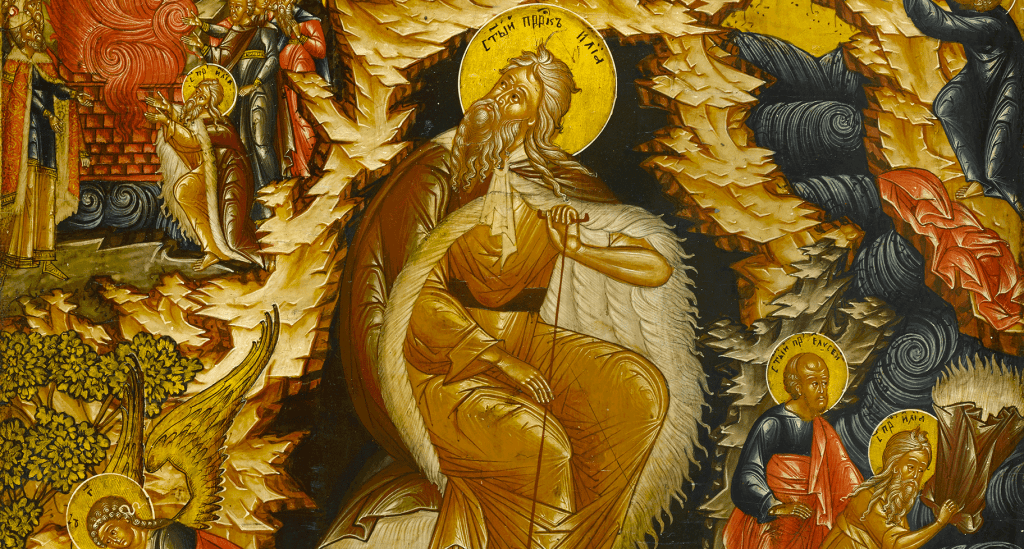
God’s care for our bodies can be found, for example, in the Old Testament prophet, Elijah. After Elijah experienced a great spiritual victory, he became the target of evil Queen Jezebel.  Elijah ran for his life and was severely burned-out from intense spiritual struggles with the queen’s prophets of Baal (1 Kings 19:1-3).  At that point, God did not come to Elijah and give him a sermon or exhortations about getting over it.  No, God restored Elijah’s body. And the Lord wants to restore our bodies, as well.

19th century Russian Orthodox icon of the prophet Elijah in the wilderness

First, Elijah needed sleep (1 Kings 19:5-6).  Millions of Americans are sleep deprived and live with a significant sleep debt (thus being continually cranky and out of sorts).  Insurance companies know this is a major issue because improper sleep habits have caused various auto accidents and fatalities. I once kept a crazy schedule with not many hours for sleep.  One day, during rush hour, I drove through a downtown expressway in bumper-to-bumper traffic and fell asleep.  I woke up about two minutes later and was still alive driving down the highway.  I sincerely believe God graciously drove the car for me.  That was my “wake up” call to change the way I was treating my body.

Second, Elijah needed to eat well (1 Kings 19:6-8).  For us, that means eating healthy.  One source of being overweight is failing to make the connection that eating is a spiritual activity.  Food is important to the kingdom of God.  It was eating that got us into trouble to start with and resulted in the fall of humanity.  Eventually, we will come full circle with eating being the activity we engage in at the end of the age – a redeemed view of food and eating together with Jesus at the marriage supper of the Lamb (Revelation 19:1-10).  God cares about food – what we eat and how much of it we consume.  He cares because we do not own our bodies – we steward them for God.

Third, Elijah needed some vigorous exercise (1 Kings 19:8-9).  He walked all the way to Mount Horeb, which was over a month’s travel.  But that exercise was essential to his well-being, both physically and spiritually.  It was only after he slept, ate well, and walked that Elijah was ready to meet with God in a powerful experience.

Our physical fitness is a spiritual issue, and so, needs prioritization.  I am under no illusions or delusions about the difficulty of this. I prefer brownies to broccoli and rather like sleeping instead of exercise. Yet, I work at being physically fit and caring for my body.  I am personally motivated toward health because I love God and want to please the Lord with my body. After all, my body was important enough to be redeemed through the Cross of Christ.

This is not about willpower – it is about Christian stewardship. I look at my body the same way I look at borrowing something from another person: I return it in the best condition I can. When the Lord takes me someday, I do not want it to be because I hastened my own death through disregard of my God-given body.

If I were God, donuts would be health food, sitting back in the recliner would build muscle, and two hours of sleep at night would be sufficient. But I am not God, so I submit to doing what it takes to have an embodied spirituality. We are to enjoy life through making the connection between the spiritual and the physical because that is the way God created us.

It is never too late to be a proper steward of the body.  Our physical anatomy is an amazing work of God and incredibly receptive to healthy choices. Here are a few of the choices we can make…

Remember the positives

Remember that care of the body is worth it.  Being fit feels great and equips us for the will of God.  Keep the long view in mind.  Sacrificing a temporary pleasure is worth the eventual gain.

Start small

I will not be doing any triathlons anytime soon, or ever. We need to be realistic and set appropriate goals without comparison to others. Start small and build up over time with slow incremental change. The place to begin is by rearranging our schedules so that our bodies become a priority.  Maybe it is time to make that doctor’s appointment you have been putting off.

Join others

Accountability and fun can and ought to go together. For example, preparing meals together is a chance to connect with a friend or family member. Discover and maintain a consistent rhythm of health that works for you and is enjoyable.

Reframe it

People often give up their best laid plans because they are disconnected from the rest of their lives. Reframing our view of the body as a spiritual activity helps connect and align our mind, body, and spirit in the wholeness God designed for us.

Start today

It takes time for something to become a habit. All good things are a process of realization. Consider and plan today, asking for God’s direction. Get the Lord in on it from the beginning and let it be an offering to him.

May you find the joy, contentment, and satisfaction of living with a body properly cared for and ready for use to the glory of God.