
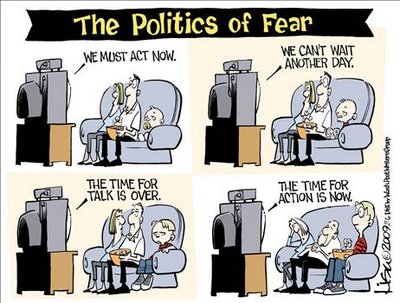
The Politics of Fear


            We all have personal fears.  They may be different, all the way from snakes and creepy clowns to public speaking and talking on the phone.  Whatever the fear, being afraid can multiply exponentially when a group of people collectively fear something.  When that happens, the politics of fear takes over and faith is replaced by what a church thinks might happen.  Most church problems and conflicts do not arise out of doctrinal differences, but out of a clash of fears. 
 
Consider just a few scenarios.  One group of people think women should serve in leadership capacities the same as men, and another group believes that women can only serve in limited leadership roles.  The former group fears that if women are not allowed leadership status that the church will wither for lack of fully utilizing the giftedness of half or more of the congregation; they fear the church will not grow.  The latter group is afraid that if women attain leadership roles that the men of the church will become lazy and not serve; it is only, they fear, a slippery slope to an all-female run congregation with no men leading.
 
A more obvious scenario is the so-called “worship wars.”  One group holds to a more traditional and liturgical form of worship with hymns and responsive readings.  They fear that if this form changes it will dilute the true worship of God and degenerate into an unfamiliar form that they will not like; they are afraid of change.  Another group believes that “contemporary” worship (usually understood as praise songs and choruses with a simple sing and speak liturgical model) is the way to go because they fear people will leave the church for another if things do not change.  One group fears change, the other fears not changing.
 
Fear is a reality that all pastors and church leaders must navigate.  And God himself knows it.  This is why the command to not be afraid is common throughout Holy Scripture. We find, as well, that the command to not be afraid is given often to leaders.  The patriarch Isaac was told to not be afraid because God was with him (Genesis 26:24).  The prophet Jeremiah was told to not be afraid because God was with (Jeremiah 1:8).  Jesus was pointed with the synagogue ruler concerning his dead daughter:  “Don’t be afraid; just believe” (Mark 5:36).
 
Non-anxious leaders help congregations deal with fear because their calm presence in the face of competing anxieties creates the environment that everything is going to be okay, that engaging in faith will work out, and that God’s promises and presence trumps all realities.  Before facing the conquest of the Promised Land, the Lord commanded Joshua to be strong and courageous and boldly engage the enemy, with the result that the people acted in faith and took Jericho.  David courageously and confidently faced down Goliath, and later led the people of Israel and Judah as king because he understood that the Lord was his strength, and, so, fear could melt away.  David’s best friend, Jonathan, acted in faith while all his fellow Israelites were hiding in fear from their Philistine enemies.  His courageous stepping out emboldened everyone else to win the battle.
 
Jesus Christ has promised that he will build his church, and the gates of Hades will not prevail against it.  We have the promised presence of the Holy Spirit as we engage in Christ’s mission to be witnesses.  God’s steadfast love is with us.  Therefore, we choose to live above the fray of naked fear and trust the kingdom values of humility, meekness, mercy, purity, and peace-making in facing down whatever issues are gripping the church.  God, in his sovereignty, has ordained certain persons to take the lead in recognizing the presence of the Spirit and moving forward in faith, not fear.  Faith and fear cannot co-exist.  “Everything that does not come from faith is sin” (Romans 14:23) is the Apostle Paul’s way of saying not to give in to the politics of fear within the church.
 
So, how will you live?  How will you lead?  In what ways can you bring a non-anxious presence to the people for whom you minister?  How does knowing that God is with us change how you face difficult problems and people?  Can you think the thought that courage is a spiritual discipline?  How will you stretch your faith muscle so that the weakness of fear can take a back seat to your decision making?


May the power and presence of God’s Spirit fill us all now and always with faith to accomplish God’s will.

Fear Factor


Several years ago I spent about six months working in an assisted living facility.  One of the residents, who still had a house he had not sold yet, admitted to me that he had nearly $100,000 dollars in cash in his house.  It was well hidden, he assured me, within every door jamb of the house!  Having experienced the run on the banks that began the Great Depression, this man had no trust for institutions and was afraid to invest his money.
            Investment is only as good as our level of trust.  When Jesus told his story about three servants whom he gave a pile of money, he was saying something about the servants’ level of trust (Matthew 25:14-30). Two of the servants saw the master as gracious and generous and freely took their talents and confidently used them to create even more money.  They took risks, they invested, they worked, and they acted all with the idea that they were secure in their relationship with their master.  However, the third servant’s view of his master was different.  This servant saw his master as stern and serious and angry, and, so this is why he did nothing with his money because he was afraid.
He was afraid because his view of the master was not accurate.  If we see God as primarily being angry all the time, then we will not use the incredible gifts he has given us for fear of messing up and bringing his wrath upon us.  The truth is:  God is a gracious and generous God.  He has generously and graciously gifted each and every one of us, and he expects us to use those gifts and not hide them away in a door jamb!  He wants us to be like Him:  generous and gracious.  We must address this fear if we want to hear the saying:  “well done, good and faithful servant.”
            Fear is maybe the devil’s greatest tool to prevent God’s people from being productive Christians in serving the church and the world.  Beneath that fear are powerful feelings of inferiority, inadequacy, and a low view of self which is really born of a low view of God.  Fear paralyzes a person’s potential to serve God’s kingdom.  Being afraid wastes what impact a person could have for God, and waters-down life so that it is ineffective.


Fear destroys dreams and godly desires.  Psalm 37:4 encourages us to delight ourselves in the LORD, and he will give us the desires of our hearts.  We are to enjoy the gracious and generous God, and in our enjoyment of Him He will place within us godly dreams that He will absolutely delight to fulfill.  Our enjoyment of God gives us the security and confidence to act upon those godly desires and produce a wonderful harvest that we can turn right around and give back to God.  
But put fear in the mix, and it dilutes and destroys everything.  It makes you do nothing.    Not only did the third servant do nothing, like his ancestor Adam he went into hiding and didn’t put his life to work.  One of the things that church leaders need to understand is that Christian discipleship is not primarily about getting parishioners to have the answers right on some bible study workbook; it is about action and service and that will only rightly happen as we have a solid robust view of God instead of a wrong view of God that leads to us being immobilized by fear.
In the Old Testament book of Numbers, the Israelites were immobilized by fear.  God had a grand vision and a big dream for his people to enter the Promised Land.  But ten of the twelve spies who came back after checking out the land were paralyzed by fear.  “The land has giants, and we are like grasshoppers” they said.  Caleb and Joshua, however, had a different view of taking the land because they had a different view of God.  They didn’t see giants – they saw a gracious and generous God who could easily take care of whoever might be in the land, and they wanted to act on the faith they had in a mighty and merciful God.  The God of the other spies wasn’t big enough to handle the giants.  Their low view of themselves as grasshoppers betrayed their low view of God.
Pastor David Seamands has rightly observed that “we wrap a lot of our fears in morbidly sanctified self-belittling.  We piously cover this self-despising and call it consecration and self-crucifixion.”  In other words, we feel good about feeling bad.  We use those feelings to make spiritual excuses for not exploring what God’s dreams and vision is for us.  It is high time we have bold God-sized dreams!  It is time for us to get into the world with our witness in a far greater way because we serve a God who sees giants as gnats, and we will, too, if we have a high view of God.
What holds us back?  Fear of criticism; fear of taking a risk; fear of going outside of the way we’ve always done it; and, the crippling fear of what others may think or say.  If you once dreamed something and you think your dream is dead because you destroyed it by your sins and bad habits, you are wrong.  Dreams are destroyed by fear, by being tricked into thinking that we are nothing but grasshoppers and God doesn’t care, and so we do nothing.
Fear ruins relationships, with both God and others.  Seeing God as angry and belittling is right where Satan wants all of us.  Fear ends up isolating us from people.  The most common way of coping with feelings of fear, insecurity, and inferiority is by withdrawing from other people.  You cannot give yourself fully to your spouse, your kids, your church, and to the world without a healthy robust view of and relationship with God. 
 
Fear sabotages Christian service.  “I can’t!” is the cry of the person locked in fear.  Perhaps you have noticed that God isn’t typically in the business of using superstars to do His work.  Moses was tongue-tied, Abraham was really a wimp, Matthew a lowly tax-collector, and the disciple Mark was a momma’s boy.  The less talented a person is the more God gets to show off His power and His ability through him or her.
            So, give God a chance.  Give him a chance to work in and through your life.  Explore the dimensions of church ministry because you have a God behind you that is gracious and generous.  May your mustard seed of faith grow to produce a harvest of righteousness.