Living Without Answers (Job 41:12-34)

“I will not keep silent concerning its limbs
    or its mighty strength or its splendid frame.
Who can strip off its outer garment?
    Who can penetrate its double coat of mail?
Who can open the doors of its face?
    There is terror all around its teeth.
Its back is made of shields in rows,
    shut up closely as with a seal.
One is so near to another
    that no air can come between them.
They are joined one to another;
    they clasp each other and cannot be separated.
Its sneezes flash forth light,
    and its eyes are like the eyelids of the dawn.
From its mouth go flaming torches;
    sparks of fire leap out.
Out of its nostrils comes smoke,
    as from a boiling pot and burning rushes.
Its breath kindles coals,
    and a flame comes out of its mouth.
In its neck abides strength,
    and terror dances before it.
The folds of its flesh cling together;
    it is firmly cast and immovable.
Its heart is as hard as stone,
    as hard as the lower millstone.
When it raises itself up the gods are afraid;
    at the crashing they are beside themselves.
Though the sword reaches it, it does not avail,
    nor does the spear, the dart, or the javelin.
It counts iron as straw
    and bronze as rotten wood.
The arrow cannot make it flee;
    slingstones, for it, are turned to chaff.
Clubs are counted as chaff;
    it laughs at the rattle of javelins.
Its underparts are like sharp potsherds;
    it spreads itself like a threshing sledge on the mire.
It makes the deep boil like a pot;
    it makes the sea like a pot of ointment.
It leaves a shining wake behind it;
    one would think the deep to be white-haired.
On earth it has no equal,
    a creature without fear.
It surveys everything that is lofty;
    it is king over all that are proud.” (New Revised Standard Version)

In a long anticipated response, God finally spoke to Job with his companions present. And it was nothing like anyone expected.

Today’s Old Testament lesson continues God’s questioning of Job, and talking of the great Leviathan – a large and uncontrollable creature.

Trying to figure out exactly what Leviathan is or was (e.g. a dragon, a dinosaur, or some dang demon) is not the point of having this chapter in Holy Scripture.

We can become obsessed with having our questions answered, everything neatly categorized and understood, every problem and mystery solved to our satisfaction.

If the Book of Job teaches us anything, it is that there are questions for which there are no answers this side of heaven. There are problems which we humans cannot logically and scientifically solve.

Ironically, we discover the presence of God through God’s absence; and hear the voice of God through God’s silence.

Any encounter we may have with God will typically shatter any preconceived notions about divinity. Any experience with God shall prevent us from packaging up an answer with some nice pretty paper and bows, as if we were enjoying a delightful Christmas at home.

Facing God is much more like coming face to face with who you really are, and what motivations and intentions are really in your heart. It’s more like Halloween than Christmas. It’s staring at a scary monstrous Leviathan, and not a bright jolly Santa Claus.

Coming to grips with our fears and anxieties, struggles and weaknesses, mortality and vulnerability, is the real sort of encounter people have with God. It’s not so much that God is scary; it’s we who are scary.

It’s scary what people will sometimes do in order to try and get answers to their questions. And it is equally scary what we will do to avoid the questions asked of us.

We don’t like hearing there are some things which are unanswerable. Yet, the mystery of God is real, which means that we are never going to know about everything we want to understand.

And we also don’t like being questioned. But what can you do, whenever you cannot move, and God begins peppering you with his own questions?

We would like to justify and vindicate ourselves – even rationalize our words and actions, if that’s what it takes. Yet, it is God alone who has the power to absolve and exonerate, to bring justice while in the teeth of injustice.

Furthermore, such justification comes in God’s own timing, not ours. Again, this is one of those realities which is far above us, for which we have only a very limited perspective on.

As we move ever closer to the end of the Book of Job, Job’s quest for answers and vindication hasn’t come, at least yet. We, along with Job, must handover the entire affair thoroughly to God in complete trust – without insisting that God say or do what I want God to say or do.

Living by faith is the only real option we have. All other options leave us in an existential angst, sliding toward nihilism.

Anyone who believes they can govern the world better than God, better brace themselves for some serious questioning.

There is not a person on this earth, including myself, that I would trust to run it for ten minutes. Because within ten seconds the world would be burning.

I don’t want that world.

I want a world with God – because I wholeheartedly believe that grace is the real and true operative force on this earth.

The grace of God allows us to see the divine without having to have our puny questions answered. Grace reassures us that we are not lost, that God sees and knows what is happening, and will do something about it.

So therefore, I can rest assured that everything is held in the sinewy strong arms of God. And no person, no monster, no Leviathan, is outside of God’s ability to effect justice and righteousness in the world.

It may take some time to realize complete and total justice, but God has given me enough faith to rest in mystery, and to live with uncertainty.

May it be so, to the glory of God.

Creator of the world, we pray

That you, with steadfast love, would keep

Your watch around us while we sleep.

From evil dreams defend our sight,

From fears and terrors of the night;

Tread underfoot our deadly foe

That we no sinful thought may know.

O Father, we ask your will to be done

Through Jesus Christ, your only Son;

And Holy Spirit, by whose breath

Our souls are raised to life from death. Amen.

For Such a Time as This (Esther 4:1-17)

When Mordecai learned of all that had been done, he tore his clothes, put on sackcloth and ashes, and went out into the city, wailing loudly and bitterly. But he went only as far as the king’s gate, because no one clothed in sackcloth was allowed to enter it. In every province to which the edict and order of the king came, there was great mourning among the Jews, with fasting, weeping and wailing. Many lay in sackcloth and ashes.

When Esther’s eunuchs and female attendants came and told her about Mordecai, she was in great distress. She sent clothes for him to put on instead of his sackcloth, but he would not accept them. Then Esther summoned Hathak, one of the king’s eunuchs assigned to attend her, and ordered him to find out what was troubling Mordecai and why.

So Hathak went out to Mordecai in the open square of the city in front of the king’s gate. Mordecai told him everything that had happened to him, including the exact amount of money Haman had promised to pay into the royal treasury for the destruction of the Jews. He also gave him a copy of the text of the edict for their annihilation, which had been published in Susa, to show to Esther and explain it to her, and he told him to instruct her to go into the king’s presence to beg for mercy and plead with him for her people.

Hathak went back and reported to Esther what Mordecai had said. Then she instructed him to say to Mordecai,“All the king’s officials and the people of the royal provinces know that for any man or woman who approaches the king in the inner court without being summoned the king has but one law: that they be put to death unless the king extends the gold scepter to them and spares their lives. But thirty days have passed since I was called to go to the king.”

When Esther’s words were reported to Mordecai, he sent back this answer: “Do not think that because you are in the king’s house you alone of all the Jews will escape. For if you remain silent at this time, relief and deliverance for the Jews will arise from another place, but you and your father’s family will perish. And who knows but that you have come to your royal position for such a time as this?”

Then Esther sent this reply to Mordecai: “Go, gather together all the Jews who are in Susa, and fast for me. Do not eat or drink for three days, night or day. I and my attendants will fast as you do. When this is done, I will go to the king, even though it is against the law. And if I perish, I perish.”

So Mordecai went away and carried out all of Esther’s instructions. (New International Version)

Mordecai and Esther (Bible Project)

King Xerxes was the royal sovereign over the greatest empire up to that time in history. Haman was the king’s right hand man who arranged a sinister plot to destroy the Jewish people. Queen Esther was a Jew, for which neither Haman nor Xerxes knew; she rose from obscurity to become the queen. And Mordecai was Esther’s cousin, having taken her in and raised her.

The Jewish people were exiles, due to the Babylonians capturing Jerusalem and taking the people into captivity. Although the Persians, who overthrew the Babylonians, began allowing some of the Jews to return to Judah, there were still many diaspora Jews who made a life for themselves in Persia.

Esther was an unlikely candidate as both a queen and a heroine. She was an orphan and not well-known, even within her own community. Yet, Esther was taken from her foster home with Mordecai, and was thrown into all the perturbations of Persian life in the empire’s court and the nation’s culture.

She was the ultimate outsider, thrust into insider status. Esther was a minority in a majority culture; a resident alien; and a foreigner to Persian society and royalty. It was a lot for her.

Try and put yourself in her shoes. Do you hide your Jewishness, or make it known, and how much? How do you navigate being raised in a culture very different than the one you are being immersed and assimilated in? Who am I? What am I really supposed to be about? Why am I here?

Expressing one’s spiritual identity requires some significant consideration and careful application. And it will be dynamic, with ongoing considerations of how to grow and sustain a healthy sense of self so that it will be impactful and lasting.

We may reflexively think that since Esther was queen, she could freely exercise power and leverage her position to achieve anything she wanted. However, Esther was in a totally new reality. She didn’t enter it with political savvy or understanding about how things work or get done. Esther was very much subject to the whims and plans of King Xerxes.

Queen Esther must have thought she was in an impossible position. Haman had hatched a strategy to rid the empire of her own people, the Jews. And they were beside themselves. Mordecai entreated Esther to do something. But Esther was green and scared and way out of her element.

And yet, the heroine was inside her all along; it just needed the proper experience to bring her out.

We might understand if Esther saw herself as a mere orphan Jew who was just trying to fake-it-till-you-make-it in a world and a situation that was way over her head. We could understand if she saw herself without any real agency to effect anything in a large overwhelming empire.

Yet, here we are, all these millennia later, talking about Queen Esther and her bravery. There is even a Jewish holiday, Purim, celebrated because of her extraordinary courage… But I am getting ahead of myself. Today’s piece of the story begins in tension, and ends with even more.

Mordecai arose and gave a coach’s speech to Esther. He told her that she must step up and step into this particular historical moment in time. Providence had led her to be in her unique position; and the Jewish people were in an awful position.

It was precisely the right time for Esther to dig deep and release the heroine within. Esther could save her own people. Nobody else could. Only her.

Like it or not for Esther, her Jewishness was part of the whole gnarly situation. She could deny it and hide it – which would mean suppressing and stuffing the heroine. Or she could put herself out there, speak truth to power in love, and let the consequences come what may.

What impresses me about Esther is that not only did she listen to Mordecai, but she took the further step of calling upon the support of her own Jewish community. Esther was straightforward in telling them exactly what she needed from them, and what she would do herself.

Esther staked out her identity and faith, and risked her life for an entire nation of people… but we are not to the end of the story yet.

For now, we need to sit with this painful and awkward tension between life and death. Three days of sorrowful and heartfelt prayer. Three days of darkness. Three days of seeming as if one is in a grave with a huge stone boulder in front of it.

Like Esther, it is important for us to struggle with our own identity, and to take risks in soliciting the help of the believing community. We all must grapple with the nature of faith, the challenges of living in this present culture, and the politics of it all.

We need to take a good hard look at ourselves and discern who we truly are – people created in the image and likeness of God, who have majesty stamped on our very souls; and who truly have it within ourselves to make a difference in this big world of ours.

If we are to truly become aware of our majesty as people, we shall be willing to take the risk of helping those who are vulnerable, powerless, and threatened. That’s because our identity shapes our choices and actions. We live into who we believe we are.

By realizing that we belong to God, we avoid becoming complicit in evil. Instead, we leverage our place and position in life to do what is right, just, and good. There is confidence, even if afraid, of doing what is right.

I am wondering if you can think the thought, and embrace the reality, that you were sovereignly placed here on this earth by God “for such a time as this.”

Just and right God, you sent your servant Esther into a life of privilege, so that those without would be taken care of. In our privilege, show us how to advocate for those who have less, so that your world might be peaceful and good. Amen.

True Greatness (Mark 9:30-37)

They went on from there and passed through Galilee. He did not want anyone to know it, for he was teaching his disciples, saying to them, “The Son of Man is to be betrayed into human hands, and they will kill him, and three days after being killed, he will rise again.” But they did not understand what he was saying and were afraid to ask him.

Then they came to Capernaum, and when he was in the house he asked them, “What were you arguing about on the way?” But they were silent, for on the way they had argued with one another who was the greatest. 

He sat down, called the twelve, and said to them, “Whoever wants to be first must be last of all and servant of all.” Then he took a little child and put it among them, and taking it in his arms he said to them, “Whoever welcomes one such child in my name welcomes me, and whoever welcomes me welcomes not me but the one who sent me.” (New Revised Standard Version)

In the Gospel of Mark, especially, there is an inexorable movement toward the Cross. It’s as if Jesus gets right down to it, and has a clarity of purpose and thought toward the future which shaped his words and actions in the present.

Today’s Gospel lesson has Jesus being forthright about what’s really important. Christ predicted his resurrection; chastised his disciples for their petty arguing; and lifted up a child as the model for what Christian discipleship truly looks like.

Even though Jesus was talking to his disciples about things that matter, things which they needed to wrap their heads and hearts around, they were afraid to ask him about it. Just so you know, that’s not healthy.

Sometimes Christ’s disciples were tight-lipped about things they ought to be asking about and openly discussing; and flapping their tongues about things they should have kept to themselves.

The motley crew of disciples were afraid to ask Jesus about his own words on his own death; and yet, they had no problem freely voicing and asking about who’s the greatest disciple amongst them. *Sigh*

The text doesn’t tell us why the disciples were afraid to ask and talk. But if they were anything like us today, it’s likely they were concerned about looking stupid or not in the know.

The disciples didn’t understand Christ’s words, but wanted to look like they understood just fine. After all, they may have reasoned, why risk getting ribbed or made fun of? Why risk the disappointment of Jesus concerning my cluelessness?

Typically, our internal fears about how we look to others is often greater than our desire to understand and know the truth.

We choose the shame of ignorance and hide-out deep within the soul’s secret lounge, where it’s dark, musty, and smells of inexpensive wine and cheap cigars. The longer we dwell in that poorly lit basement lounge, the harder it is to walk out and up the stairs to the light of grace, freedom, and understanding.

Jesus isn’t like whatever relative who hurt you with their calloused words and flippant attitude about your feelings, hopes, or desires.

Christ isn’t the teacher who ridiculed you in front of the whole class. That’s because Jesus Christ has the class to be gracious when we come out and admit what’s really going on within us.

I suspect Jesus was hard on his disciples because they should have known better than to be afraid in his presence. It demonstrated a profound lack of faith and trust.

Inevitably, whenever we opt to remain in the shame lounge of our soul, we then begin considering how to take the offensive in order to demonstrate our greatness and worthiness. And usually, there’s no better way than to do that than have a competition, and size up one another.

If Jesus could just affirm this competitive game and judge me as the best, we reason within the emptiness of our inner shame lounge, then I’ll forever be able to hide under that ratty old blanket of shame, and feel safe in this smelly place.

Prayer is really nothing more than addressing God and talking to the Lord. Oftentimes, the lack of consistent daily prayer is a telltale sign of being afraid to ask for help, clarification, or anything of substance, at all.

When we don’t pray, foolishness and bad decisions are close behind. Spiritual growth is then absent. Spiritual maturity is non-existent. And worldly tactics fill the spiritual vacuum.

Rather than being open about their questions concerning Christ’s words, the disciples’ fear led them to wonder how they stood with Jesus. In order to feel secure through one’s own efforts, we easily harbor resentment toward each other, and compete with one another to gain Christ’s approval.

Worry and anxiety, when coddled for too long, brings out an inordinate focus on one’s reputation with others; and a concern to look better in front of other people than one actually feels on the inside.

But Jesus is not one to play favorites, or to play childish games of posturing for attention. That’s because the way to greatness is not through impressing Jesus, or by being the Rabbi’s pet, but through focusing outward on something other than oneself.

It turns out that true greatness lies in humbly welcoming all – especially the ones who are the least, lost, and lonely, on the fringes of society.

We are to welcome the children, who are on the bottom rung, who need the help and assistance of others, as Christ did. We are to value them as fellow humans who are worthy of our time, attention, and effort.

Jesus did it for us. He showed us that the true measure of greatness is through humility and willingly loving others to incredibly great degrees. His disciples can and must do no less.

O God, our teacher and guide, you draw us to yourself and welcome us as beloved children. Help us to lay aside our envy and selfish ambition, so that we may walk in your ways of wisdom and understanding as servants of your peace. Amen.

How To Live When Things Are Bad (Isaiah 33:10-16)

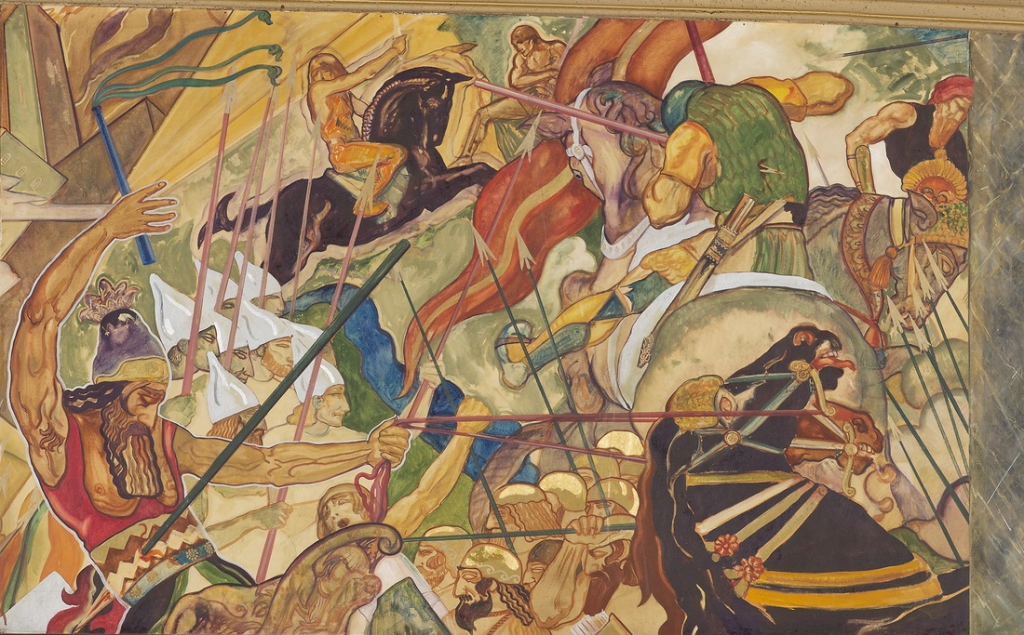
Mural depicting the wars of Israel and Judah with the surrounding nations, Wilshire Boulevard Temple, Los Angles

But the Lord says: “Now I will stand up.
    Now I will show my power and might.
You Assyrians produce nothing but dry grass and stubble.
    Your own breath will turn to fire and consume you.
Your people will be burned up completely,
    like thornbushes cut down and tossed in a fire.
Listen to what I have done, you nations far away!
    And you that are near, acknowledge my might!”

The sinners in Jerusalem shake with fear.
    Terror seizes the godless.
“Who can live with this devouring fire?” they cry.
    “Who can survive this all-consuming fire?”
Those who are honest and fair,
    who refuse to profit by fraud,
    who stay far away from bribes,
who refuse to listen to those who plot murder,
    who shut their eyes to all enticement to do wrong—
these are the ones who will dwell on high.
    The rocks of the mountains will be their fortress.
Food will be supplied to them,
    and they will have water in abundance. (New Living Translation)

The Assyrians were a nasty bunch. So were the people of Jerusalem, at the time of Isaiah’s prophecy. Maybe the folks in Judah played the comparison game and thought they were better than their foe. After all, the Assyrians were experts in war and torture.

Jerusalem was understandably terrified of the Assyrian army. And they trusted God, that is, to a degree. There’s a difference between looking to the Lord because you’re between a rock and a hard place, and placing faith in God because that is the default response of your life.

Easy for me to say. I’ve never stood on a city wall watching a powerful army surrounding me like a bunch of bullies on the playground.

Jerusalem was intimidated to the point of letting the Assyrian ruffians take their gold and silver. Well, actually, it wasn’t their gold; it was God’s. And when the army left, the city was still intact. But for how long?

It was humiliating. Being the victim of a bully always is. And because they’re bullies, it’s never enough. Like feeding the neighbor’s cat, the Assyrians end up going nowhere. They want more. In fact, they never really intended on leaving anyway. It was all a double-cross.

Judah, out of their fear and anxiety, made a bargain with the devil. A bully is a bully because they can be. Give in to them, and it only enables them to keep bullying. The Assyrians were ready for battle. It’s what they always did: fight and conquer.

It was at this point that Jerusalem finally got the clue that they’d been living with God in the background, not the foreground. They did their own thing, much like the hated and dreaded Assyrians.

So, the only recourse the people of Judah had was the mercy of their God. Yet, even though they ought to have petitioned the Lord from the get-go, at least they noticed the Lord is still there.

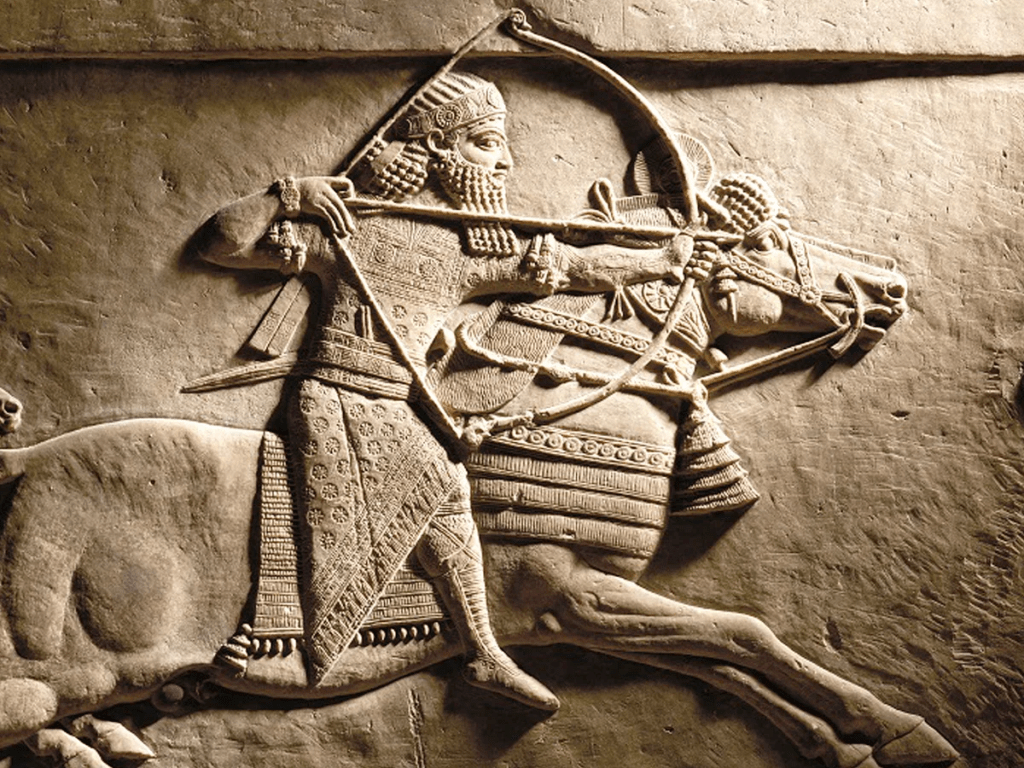
Assyrian king, British Museum

Unfortunately, most of our repentant overtures are way overdue. And yet, because of divine grace, the crazy mess we make of our lives is the very same place where a merciful God meets us.

Any sort of help is surely undeserved. It always is. The Lord, however, avoids making us grovel in our own vomit. God accepts us where we are, and not where we ought to be.

In truth, we all need to make a change, and not just the bullies. The sheer reality of God demands that we pay attention to what is right, just, and good. And the prophet Isaiah informed the people exactly how we must live in a world full of bullies and busted dreams.

We are to have an awareness of ethics and morality, a concern for humanity, and an orientation to help everyone thrive and flourish in this life.

The answer to life’s question of how to exist in this world and do more than just survive comes down to human morality:

  • Live right
  • Speak the truth
  • Despise exploitation
  • Refuse bribes
  • Reject violence
  • Avoid evil pleasures

The safe and stable way to live is to participate in the rhythms of mercy and justice that are woven into the fabric of the universe. The path to a contented and satisfying life is through goodness, not hatred.

Security and satisfaction don’t come through control of all circumstances; it comes by discerning that God has ultimate control, and that this God is good, not evil; just, not unjust; and righteous, not capricious.

According to the prophet, God will determine when the suitable time for assistance will come for us. And the Lord will deal with the ungodly according to the divine timetable, and not when we believe judgments should be rendered.

None of this is in our purview. Sometimes, talking about this sort of theology is a way of taking the focus off of our own need for an ethical and moral life. Sometimes, it is a helpful way of coming to grips with what is happening. Discernment is needed with oneself in these matters.

Trusting God means to exercise patience and perseverance, to focus on faith, to discipline ourselves in prayer, and to express confidence in hope.

We are not necessarily ruined whenever our circumstances are dire. The worse things become, the greater the display of divine power that can come.

By orienting ourselves around God and God’s strength and will, we grow in courage and develop in faith. We learn to trust in the worst of situations. We discover that the Lord knows the score of things, that God understands what’s going on.

And God laughs at the ungodly who believe they can bully the godly around. The most brilliant of military commanders is like a little toddler before the sovereign Lord of the universe. The fiery words they blow will blow back on them and consume their arrogance.

So, let us not harden our own hearts, but exercise a change of heart to let God be God, and to want for nothing but the courts of the Lord.

Let us not be like the bullies of Assyria who lived without a thought to the divine reality in front of them. Let us not become tormented, as if a fire were devouring us with inward anguish of soul, but instead:

  • Walk in right relations with others and with the Lord
  • Maintain truth and integrity in everything
  • Be free from corruption and offending others and God
  • Act with love toward your neighbor and your God
  • Refuse to accept a bribe
  • Restrain evil impulses
  • Open wide the spigot of goodness and justice

God is our refuge and strength, an ever-present help in trouble. Safety and abundance of good things is provided by the Lord. God protects. And God supplies. Rely upon God’s promises, and not the empty bellowing of others.

Be safe. Be strong. Be spiritual. We are all in this life together.

O God, my refuge and strength: In this place of unrelenting light and noise, enfold me in your holy darkness and silence, so that I may rest secure under the shadow of your wings. Amen.