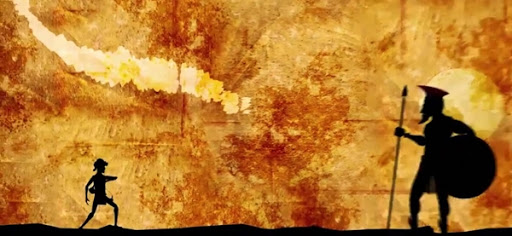
1 Samuel 17:1-49 – Faith in Action

The story of David and Goliath is one of the best known stories in the entire Bible. It’s a classic example of what can be accomplished through one person who chooses to exercise faith. Puny David taking on giant Goliath has served as one of the greatest inspirations for believers through the centuries – seeing God give victory to people against dramatically overwhelming odds.

Whereas the New Testament exhorts us to live by faith, this Old Testament narrative demonstrates what can happen when a person of faith decides to put that faith into action.

Old Testament stories are framed in a way to help the reader or listener discern the differences between the characters of the story – to understand the contrasts between good and bad. So, then, the account of David and Goliath revolves around four character contrasts so that we will learn the lessons of faith God wants to teach us.

First Contrast: David and Saul

David is brave. Saul is fearful. In the ancient world, a typical tactic of warfare, when the battle lines were drawn, was to choose a champion from each side. They would fight together, just the two of them, on behalf of the entire army. It was a fight to the death, and the losing side would submit to the winning side. 

This was a way of preventing the terrible carnage of war. It also created some incredible individual champions.  A champion would be selected not only for his ability to fight, but also for his impressive stature so that there was an intimidation factor to it all.

Saul was the King of Israel. He was the logical choice for the combat since he was a head taller than all the other Israelites and a rather impressive looking soldier. But compared to Goliath, Saul looked like a midget.  The intimidation factor worked. Saul was downright afraid and not about to put himself out there to face a giant.

David is brave because he has faith in God. Saul is fearful because he is not a man of faith in God. The opposite of faith is not unbelief, but fear. As the muscle of faith grows through trusting God in the daily stresses of life, fear is better confronted and managed. The development of faith is a process, and it takes time.

Considering this story in light of Father’s Day, Dads have the daily opportunity of being a hero to their kids through faith in God. That means dealing with two great fears: being found inadequate; and, being controlled by another person or circumstance.

Those two fears were evident in Saul. He felt inadequate because he compared himself to Goliath. He felt controlled by the situation because the Philistines were picking a fight. So, he froze. There are many men who would rather do nothing than be labelled as inadequate or controlled.

David, in contrast, had plenty of practice facing down foes as a shepherd – the bear and the lion – who threatened the sheep. David was often out in the countryside all by himself, guarding the sheep, and his skills were improved in a place where no one was looking.

The way to progress our faith is to be assertive in owning our relationship with God through prayer and Bible reading (or listening on a Bible app) on a daily basis. It’s something everyone can do.

Second Contrast:  David and the Israelites

It was not only Saul who was intimidated by Goliath; the entire army of Israel was hiding behind the battle lines cringing in fear. David, however, discerned no reason to avoid this bullying blowhard. It appears he is the only person able to see Goliath as a small person in comparison to a big God. By faith, David understands Goliath is no match for God.

So, we see that one person full of faith can accomplish the impossible – whereas an army full of fear cannot accomplish a thing. 

We might tend to believe everything has to be large with a big splash to it – that only then can we accomplish big things for God. But really, if we want to achieve something for God, we need to step out in faith and do it – instead of recruiting an army of people or hiding in the group, nursing our fears and anxieties.

No one can do your personal faith work for you; you must do it. The Beaver Cleaver philosophy of life says, “Gee, Wally, if I get in trouble or in a pickle, I’ll just ignore it and hope it goes away….” But Goliath is not going anywhere. He will still be there tomorrow.

Third Contrast: David and Goliath

Goliath represents the other extreme to the fear of Saul and the Israelites. He had absolutely no fear, including any fear of God. Goliath trusted in himself, his abilities, and his stature. David, however, trusted in God alone.

The story gives a detailed description of Goliath’s weapons and physical appearance because Goliath trusted in his aptitude and the ancient technology of his day to face down the Israelites. Conversely, David was small and too young to even be considered for military service. He was too small to wear anybody’s armor. But David did not need any of that – he just needed his faith.

Humanly speaking, David appears insignificant; there is nothing about him that caused anyone to think there was something special or different about him. Goliath, however, was the Arnold Schwarzenegger of his day, ready to terminate anybody who got in his way.

It can be easy to trust in ourselves, another person, or our technology to accomplish something in the face of insurmountable odds, instead of looking to God. The battle is not ours; it is the Lord’s.

Most things in life take a great deal of bravery – especially parenthood! It takes more than copious Dad speeches (and I had a lot of speeches for my kids). Fatherly courage requires modeling for boys what they are expected to become and modeling for girls what they should expect from males.

Children need to observe men who have courage to do the right thing, even when it has personal cost. They need to see them bravely shouldering responsibilities – even when they don’t feel like it. Kids need to see men who demonstrate the courage to be vulnerable, as well as strong and self-disciplined. They need to experience fathers and men with courage to pay attention to them – even, and especially, when those men are angry or disappointed with their own choices.

Fourth Contrast:  David and Eliab

Eliab was David’s big brother. Eliab was a soldier in the army. David was just a kid. It did not matter he was a kid; David was concerned for God’s name and glory. In contrast, Eliab was concerned about his little brother being an embarrassment and superseding him.

When we choose to step out in faith and act, there will likely be opposition, even among family and fellow believers. But David did not let a little criticism stop him. Criticism and opposition will inevitably happen. David was determined to please God, not his brother. He did not wilt and was not deterred from his concern to face down Goliath.

Conclusion

If we want to be brave in the Christian life; if we desire to live a life full of faith in Christ that deals with problems; then, the story of David and Goliath will serve as an inspiration in those times we feel less than mighty for God. 

Goliath was defeated and fell because David trusted God. The issue is not how much faith we have, but in whom our faith is placed. David trusted God. Saul did not even acknowledge God. Goliath trusted in himself. Eliab was too busy quibbling about things that didn’t matter. 

What is your response?

John 7:37-39 – Come and Ask for What You Need

On the last and greatest day of the festival, Jesus stood and said in a loud voice, “Let anyone who is thirsty come to me and drink. Whoever believes in me, as Scripture has said, rivers of living water will flow from within them.” By this he meant the Spirit, whom those who believed in him were later to receive. Up to that time the Spirit had not been given since Jesus had not yet been glorified. (New International Version)

Anyone Can Come

Let’s take Christ’s words at the end of the Jewish Festival of Booths (or Tabernacles) at face value. Jesus said that if anyone is thirsty, they could come to him and drink. This is an unconditional statement with no caveats, qualifications, or fine print to it. Jesus did not say if anyone is spiritual enough or strong enough or committed enough that then they could come to him.

The only qualifications one must have in coming to Jesus is to be needy. To be thirsty and want a drink is it, period. No interviews. No jumping through any hoops. No red tape. No having to go through one of the disciples to get to Jesus. No obstacles whatsoever. Sheer need and want gets anybody an audience with Jesus.

“Thirsty” is Christ’s simple metaphor for need. Whenever we long to have our needs met, there is always the opportunity and possibility of going to Jesus. And we know that all of us are thirsty because every single person has needs that aren’t getting met. These important and vital words of Jesus to us encourages us to admit and say to him, “I need you, Lord.”

And what is the Lord’s response to such a humble expression of need? “Please come here to me and drink till you are full.” No judgment. No condemnation. No big sighs. No snarky comments. No disappointed looks. Our confession of need accesses divine compassion and help. Who will help?

Anyone Can Receive Help through the Helper

The Holy Spirit will help. Christ ascended and gave us the Spirit. On this day before the Christian celebration of Pentecost, we are reminded that Jesus delivered on his promise to give help. There is no better assistance in all the world than having a permanent live-in guide, helper, and advocate who is continually alongside us, even in us.

Ask. Seek. Knock. That’s it. We have a popular commercial figure in my city, a lawyer, whose one-liner is, “One call. That’s all!” And help will come. All we need do is express our needs and wants. And yet, that is so awfully hard for so many people. It seems weak or selfish to come right out and say what we need and what we want. Yet, if we are to embrace any sort of Christian discipleship, straight forward asking will be involved.

Believers simply can state their needs to be breathed on by the Spirit and have their thirst satiated. If we make it more complicated than that, we lose the incredible simplicity of the gospel – that it is good news for needy people. Yet, we sometimes make it complicated by not coming out and saying what we need. Why do we do that?

Why Don’t We Come?

For many people, they have never been given permission to do so. They were never encouraged to express their needs and wants. However, it is perfectly acceptable to state what you want, and what you really need. Ask for what you want, and you may be surprised at how often you get it.

The lack of asking goes much deeper than this. Our fear of vulnerability and being judged by God (and others) prohibits us from asking for what we really want. We must come to the point of seeing that vulnerability is crucial to having our needs met. Only through being open enough to share what you need will relational connection happen. A relationship with Jesus is based on such humility and vulnerability. Without it, there is no relationship.

We also might be afraid of not getting what we ask for, so we don’t ask, at all. Or, conversely, we may be afraid of receiving our asking! On some level, it’s more comfortable to stay in a familiar situation. We think we want something different, but we’re worried about the downside of getting it. We fret and wonder about it, not trusting ourselves. So, we become paralyzed, unable to say what we really want or need.

All of this comes down to our own image of self. It’s as if we don’t believe we deserve to be treated well. But the reality is: This isn’t about whether you deserve to have something; it’s about your needing or wanting it. Plain and simple. There’s no shame being in want or need.

Some people are so used to putting others first and meeting another’s need that they become stymied by their own inability to state what they need. So, they try and feel better by meeting everyone else’s need. And when they become bitter about being emotionally depleted, when they are thirsty for someone to meet their needs, they don’t ask for help. Because they feel they can’t.

Anyone Can Ask, Seek, Knock

You can and you must. Jesus says so. We don’t always get what we want in life. But we won’t get it if we don’t ask. It’s good to focus on what you want or need in life, instead of questioning whether you’re worthy to receive it. Jesus said:

“Keep on asking, and you will receive what you ask for. Keep on seeking, and you will find. Keep on knocking, and the door will be opened to you. For everyone who asks, receives. Everyone who seeks, finds. And to everyone who knocks, the door will be opened.” (Matthew 7:7-8, NLT)

So, what are you waiting for!?

Psalm 23 – God Is Bigger Than Your Valley

Photo by Temo Berishvili on Pexels.com

You, Lord, are my shepherd.
    I will never be in need.
     You let me rest in fields
    of green grass.
You lead me to streams
of peaceful water,
    and you refresh my life.

You are true to your name,
    and you lead me
    along the right paths.
 I may walk through valleys
as dark as death,
    but I won’t be afraid.
You are with me,
    and your shepherd’s rod
    makes me feel safe.

 You treat me to a feast,
    while my enemies watch.
You honor me as your guest,
    and you fill my cup
    until it overflows.
Your kindness and love
will always be with me
    each day of my life,
    and I will live forever
    in your house, Lord. (CEV)

Psalm 23 is a familiar place in Holy Scripture, even for many who are not followers of God.  Far from just a funeral prayer, this psalm contains a singular and timeless message:

No matter the circumstance, nor whatever the need, God is enough. The Lord of all creation is bigger than your darkest valley.

That’s what I remind myself every time life hands me a knuckle-sandwich. God is here. God is with me. Despite all that is wrong, unjust, and askew in this old fallen world, the Lord’s will and way overcomes everything.

Divine beauty has a way of breaking through to the most challenging and desperate of experiences. We have everything we need with God. Spring reminds us there is always the hope of new life. The anticipation of trees budding and flowers blooming help us remember that the dull hibernation of winter shall break out with glorious warmth and color. Everything will change, even if it doesn’t seem like it, at the time.

The Lord provides no matter the need.

God protects despite the overwhelming dilemma. Divine power overshadows the darkest of valleys. The presence of God is everywhere. Even though we sometimes sit flummoxed about how our financial budget is going to budge or whether we have the continued energy to deal with that person or situation, with the God of the Bible, we shall never be in want of anything.

Today is a good day to punctuate your schedule with a prayerful reading of Psalm 23. As you can well see, it only takes a minute to read, maybe a few to read carefully and slowly. Use your cellphone alarm or some other means for some set times today. When the alarm goes off, take a few minutes for Psalm 23 to decenter your thoughts from worry, anxiety, and the fatigue of the day. Let it center you in the sovereignty and grace of God. Maybe use a different translation each time you read.  Here is Psalm 23 again in another version of the Bible:

The Lord is my shepherd;
    I have all that I need.
He lets me rest in green meadows;
    he leads me beside peaceful streams.

     He renews my strength.
He guides me along right paths,
    bringing honor to his name.
 Even when I walk
    through the darkest valley,
I will not be afraid,
    for you are close beside me.
Your rod and your staff
    protect and comfort me.
You prepare a feast for me
    in the presence of my enemies.
You honor me by anointing my head with oil.
    My cup overflows with blessings.
Surely your goodness and unfailing love will pursue me
    all the days of my life,
and I will live in the house of the Lord
    forever. (NLT)

Amen.

Psalm 4 – Rhythms of Trust

God, you are my righteousness, my Champion Defender.
    Answer me when I cry for help!
    Whenever I was in distress, you enlarged me.
    I’m being squeezed again—I need your kindness right away!
    Grant me your grace, hear my prayer, and set me free!
Listen to me, you elite among men:
    How long will you defame my honor
    and drag it down into shame?
    Will you ever stop insulting me?
    How long will you set your heart on shadows,
    chasing your lies and delusions?
May we never forget that Yahweh works wonders
    for every one of his devoted lovers.
    And this is how I know that he will answer my every prayer.
Tremble in awe before the Lord, and do not sin against him.
    Be still upon your bed and search your heart before him.
Bring to Yahweh the sacrifice of righteousness and put your trust in him.
Lord, prove them wrong when they say, “God can’t help you!”
    Let the light of your radiant face
    break through and shine upon us!

The intense pleasure you give me
    surpasses the gladness of harvest time,
    even more than when the harvesters
    gaze upon their ripened grain
    and when their new wine overflows.
Now, because of you, Lord, I will lie down in peace and sleep comes at once,
    for no matter what happens, I will live unafraid! (TPT)

This is a psalm of David. It is a heartfelt and confident plea for deliverance.

David had a track record with God. For most of his life, David had a spiritual and relational rhythm of looking to God, trusting God, and resting secure in God.

Small Faith

I’m not sure where the idea popped up amongst some Christians that faith and trust in God means everything in life is going to be hunky-dory and a bowl of cherries. That was not true of any godly character in the Bible. In fact, it seems the more integrity one has in Scripture, the more they faced trouble and suffering.

It is the pea-brained, small-hearted, and gutless who have the time and privilege of leveling criticism and defamation on the ones sincerely trying to make a difference in this world. On the one hand, it is unfortunate that the spiritually devoted must put up with the petulance of puny people. Yet, on the other hand, the faithful recognize God controls all things and uses anything and anyone to shape them as persons who have grown expansive spiritual faculties, enlarged hearts, and gut-feeling compassion. The wise truly learn from all things.

“Trust the Lord completely, and don’t depend on your own knowledge. With every step you take, think about what he wants, and he will help you go the right way.”

Proverbs 3:5-6, ERV

Big Faith

The godly have become so because they have learned over-and-over again to let God champion their cause and defend their personhood. The faithful reflexively cry out to the Lord with all their troubles. The devoted aren’t shy in boldly telling God exactly what they want and need. They find joy in their spirituality, and they let it support them in stressful times.

God has shown them steadfast love. And they are supremely secure in the settled conviction that God has their backs. They believe it so much that followers of God can lay their heads on their pillows at night and fall asleep – despite the reality there are those who would take their life, if given half the chance.

No Sleep

Insomnia happens for a lot of reasons. Many, like me, have sleep apnea and restless leg disorder, both diagnosed medical conditions. Others can’t get a good night’s rest because of poor sleep hygiene by not planning for adequate sleep, drinking too much caffeine during the day, inattention to a healthy diet, or a host of other habits. Some, like my dear wife, have issues of chronic pain which can make it difficult to sleep well.

And then there are yet others who suffer from racing thoughts, anxiety, and depression. The stress of their waking life is so significant that several hours of deep sleep seems only like some pipe dream. It’s impossible to sleep when the weight of the day is pressing on you. Finding a sense of calm before bed isn’t easy—especially when you can’t unplug from the demands of your day.

I am wondering if many of us will even allow ourselves to unplug and establish some quiet wind-down time. Reading a real book – not one on a backlit tablet device – or talking with a friend or family member are simple ways of easing our anxiety and letting rest come.

Sleep ZZzz

The psalmist, David, had a regular practice of meditating on Scripture, recalling the events of God, and expressing gratitude and praise for answered prayer. Each of us has a built-in spiritual rhythm just like we have a circadian rhythm. Always trying to buck those God-given rhythms will inevitably result in being “off,” at the least, and experiencing debilitating depression, at worst.

Yet, when we learn to move with the unforced rhythms of grace, there is a groove we slip into which serves us well. In other words, allowing ourselves to be human brings health.

David had neither delusions nor illusions about his enemies, friends, others, and himself. He didn’t try to be somebody he was not. Instead, David had firm and confident convictions about God and the place of prayer. A steady diet of David’s psalms teaches us to hold together both faith and doubt, confidence and confusion, perseverance and perplexity in ways which strengthens belief.

Christ be with you: Christ within you;
Christ before you: Christ behind you;
Christ on your right: Christ on your left;
Christ above you: Christ beneath you;
Christ around you: now and ever. Amen.