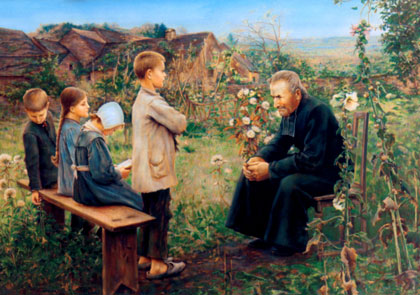
Deuteronomy 11:18-21 – Leave a Spiritual Heritage

You shall put these words of mine in your heart and soul, and you shall bind them as a sign on your hand and fix them as an emblem on your forehead. Teach them to your children, talking about them when you are at home and when you are away, when you lie down and when you rise. Write them on the doorposts of your house and on your gates, so that your days and the days of your children may be multiplied in the land that the Lord swore to your ancestors to give them, as long as the heavens are above the earth. (New Revised Standard Version)

Remember God’s Law

The book of Deuteronomy is a farewell address by Moses to the Israelites. Moses was about to die. The Israelites were about to enter the Promised Land. So, Moses restated God’s law and called the people to remember all that God had done. He exhorted the people to communicate the law and their heritage to the next generations. If God’s Word and God’s ways are continually observed, then the people would prosper in the land.

The overarching command and call to the people is to love God with everything they have and everything they are. God’s people are to have a total commitment of mind, body, emotions, and spirit to the law of God. Each ability and gift, and all that makes a person a person, is to have its clear direction and orientation toward loving God through obeying God’s commands.

Talk About God’s Word

The love of God is meant to become a habit in the normal daily rhythms of life. And we are told how to do that:  impress God’s commands in the family; talk about them at home; talk about them when you are out and about; talk about them in the morning and the evening; even write them out and have them before you continually.  The entire day is an opportunity to love God by talking about God’s Word.

The privilege of discussing God’s Word doesn’t need to be forced or awkward. Yet, it is something which needs some intention and purpose to it. Most people like talking about things which are important to them. If someone is really into classic cars, he does not have to try and force a conversation about it because it just comes out of him. Because they go to car shows, maybe own a classic car that they are continually tinkering with, and read up on car magazines, a discussion about the subject is quite natural to them.

So, then, the best way to live into God’s law is to spend time with God through regular Bible reading, focused and earnest prayer, conversing with others, and taking advantage of opportunities to learn and know about God.  For the Christian, talking about Jesus is meant to be organic, springing from a heart which loves God and observes God’s law.

Discuss God with Family

When it comes to family, we don’t need to be an expert on God or the Bible. We just need a willingness and a curiosity to ask questions. Typically, when raising my girls, most of our conversations at the table centered around one question I would ask. We discussed it, talked about it, and mulled it over. Sometimes it was a deep theological question. At other times, it was a practical question. My wife and I often had others share a meal with us, so I usually asked our guests to tell their God story or participate with us in the question. If they were not Christian, I would ask them what they thought about Jesus, and why.

God loves it when we have conversation in the home around biblical teaching. God also loves it when we have discussions in public. Some Orthodox Jewish persons still to this day wear a “phylactery” on their foreheads – a small box with little Scripture passages inside of it – testifying to their value of the written Word.

I’m not sure that’s what Moses had in mind when he talked about binding God’s commands on the forehead and tying them as symbols on the hands. Much of the Hebrew language is metaphorical, speaking about concrete things as a way of communicating something intangible. So, I wonder if the big idea here is simply to be open about faith and love for God and the law.

Keep Tangible Reminders of Scripture

Although I don’t believe we have to take these verses quite so literally, there is, however, something to be said for keeping Holy Scripture in front of us, continually, to remember divine commands and promises. It’s good to write some Bible verses and place them on your bathroom mirror, the dash of your car, in your pants pocket, or anywhere you will see them on a regular basis. It’s a practical way of remembering to observe all that God has commanded.

Physical reminders of significant spiritual events can help us keep God’s Word in our lives. When the Israelites experienced God in some significant way, they built an altar. For example, when they approached the Jordan River to enter the land, God caused the water to stop flowing so that they could cross over. Here is what happen next: 

Joshua erected a monument, using the twelve stones that they had taken from the Jordan. And then he told the People of Israel, “In the days to come, when your children ask their fathers, ‘What are these stones doing here?’ tell your children this: ‘Israel crossed over this Jordan on dry ground.’

“Yes, God, your God, dried up the Jordan’s waters for you until you had crossed, just as God, your God, did at the Red Sea, which had dried up before us until we had crossed. This was so that everybody on earth would recognize how strong God’s rescuing hand is and so that you would hold God in solemn reverence always.” (Joshua 4:20-24, MSG)

Passing the spiritual baton and leaving a heritage for future generations is a sacred trust. The best way for that to happen is within the home, talking about God and Scripture as a daily routine, as well as freely conversing about spirituality in public.

Pass Faith to the Next Generation Church

Hopefully, God and Jesus get talked about in the church! There are several ways churches can impress God’s Word to younger generations: 

  1. Train them to lead.  Adults do not have to do everything in the church. Every generation can be empowered to engage in ministries on a regular basis. Everyone needs a mentor to do anything well – which means taking others with us along the journey of ministry so they can both shadow and participate.
  2. Empathize with young people and young families. That means avoiding criticism. It’s easy for older generations to be critical about millennials – their lack of involvement, or how they live their lives. They don’t need our criticism; they need our help. To have empathy means we recognize they’re just trying to do the best they can in a crazy world. A world, I might add, which is quite different than the one many of us grew up in. This is an extremely competitive world, requiring more energy and drive than previous generations. Being a student today is not like being a student when I was a kid.  Being a young parent is not the same today as it once was. Today’s family structure is completely changed; what we think of as a traditional family only makes up 7% of the American population. The stance to take on this is not to criticize, but to encourage and help.
  3. Take Jesus’ message seriously.  Discussion, conversation, questions, and mutual sharing are the ways Jesus developed his followers, and it is a way we can reach younger generations. Dialogue goes a lot further than just telling others what they should believe and do.
  4. Adopt a young person, or a young family. If you consider yourself part of an older generation, seriously consider taking a younger person or even family under your wing who is not related to you. Invite them to a meal, read these verses, and discuss them together. Commit to praying for them daily for a set period.
  5. Look for ways to support children, teens, and young families. Prioritizing younger generations means they don’t have to do everything our way. Rather, it means we will listen to what they need in loving God and building into their own kids’ lives.
  6. Be great neighbors. Discuss, teach, empower, and develop young people without criticism into good neighbors who engage their local community by addressing issues with great love and lots of compassion.

There are certainly more ways to engage. The idea here is that we think about how to embody the teaching we have in Deuteronomy by passing on God’s love and God’s Word. Where will you start? Is there a way that resonates with you?  If you are a younger generation, who are some people you believe could be helpful to you? Let’s work together to realize God’s Word springing to life!

Malachi 3:16-4:6 – Turning Hearts

Then those revering the Lord,
    each and every one, spoke among themselves.
        The Lord paid attention and listened to them.
Then a scroll of remembrance was written before the Lord
        about those revering the Lord,
            the ones meditating on his name.
On the day that I am preparing,
says the Lord of heavenly forces,
        they will be my special possession.
        I will spare them just as parents spare a child who serves them.
You will again distinguish between the righteous and the wicked,
        between those serving God and those not serving him.

Look, the day is coming,
        burning like an oven.
All the arrogant ones and all those doing evil will become straw.
    The coming day will burn them,
says the Lord of heavenly forces,
        leaving them neither root nor branch.
But the sun of righteousness will rise on those revering my name;
        healing will be in its wings
            so that you will go forth and jump about like calves in the stall.
You will crush the wicked;
        they will be like dust beneath the soles of your feet
            on the day that I am preparing,
says the Lord of heavenly forces.
Remember the Instruction from Moses, my servant,
        to whom I gave Instruction and rules for all Israel at Horeb.
Look, I am sending Elijah the prophet to you,
        before the great and terrifying day of the Lord arrives.
Turn the hearts of the parents to the children
    and the hearts of the children to their parents.
            Otherwise, I will come and strike the land with a curse. (CEB)

According to the U.S. Census Bureau, twenty-five million children in America — one out of every three — live in biological father-absent homes. The National Fatherhood Initiative reports that nine in ten American parents agree this is a “crisis.”  Consequently, there is a “father factor” in many social issues today. Children with involved fathers do better across every measure of child well-being than their peers in father-absent homes.

From a biblical perspective, the relationship between fathers and children is hugely important not only for the well-being of family and society, but for God’s people.  Fathers in ancient Israel were the primary instructors of God’s covenant to their children.  This responsibility was critical to ensuring success in Israel and obeying their God. 

The fact of the matter in the prophet Malachi’s day was this: The fathers blew it.  The last verse of the Old Testament ends on a note of coming judgment. However, that is not the end of the story because the prophet Elijah will come to turn the hearts of the fathers to their children and vice versa.

John the Baptist, Jesus said, was the Elijah to come:

From the days of John the Baptist until now, the kingdom of heaven has been subjected to violence, and violent people have been raiding it. For all the Prophets and the Law prophesied until John. And if you are willing to accept it, he is the Elijah who was to come. Whoever has ears, let them hear. (Matthew 11:12-15, NIV)

In the Christian tradition, Jesus is the fulfillment of God’s covenant promises to the people. Therefore, fathers who follow Jesus have a sacred responsibility to gently guide their kids to Christ. It is important for Christian dads to take up the mantle of teaching children the ways of God especially as expressed by Jesus.  

God is on a mission of restoration, and a good place to begin is with restoring relationships between fathers and children. In fact, it behooves all fathers to step back and slow down enough to consider what the nature of their family relationships are really like – taking action to instruct kids in both word and deed.

The word catechism derives from the Greek language and means “instruction.” Ever since the start of the Protestant Reformation, learning about God has often taken the form of catechetical teaching. Catechisms vary in length with a pedagogical question and answer format. Typically included are explanations on the Apostle’s Creed, the Ten Commandments, and the Lord’s Prayer.

Question and answer 104 of the Reformed Confession, the Heidelberg Catechism, says this:

Q. What is God’s will for you in the fifth commandment?

A. That I honor, love, and be loyal to my father and mother and all those in authority over me; that I submit myself with proper obedience to all their good teaching and discipline; and also that I be patient with their failings – for through them God chooses to rule us.

Here is a simple observation: Children cannot obey what they have not been taught. Underpinning all submission and obedience of both divine and human authority is the basic assumption that parents will instruct their children in the way of sound theology, biblical ethics, and religious piety.

What is more, we are all spiritual fathers and mothers to a host of children in our sphere of influence. This is a foundational way of relating to one another, and so, deliberate intention and effort needs to be placed here. Otherwise, there is religious decline with neither social nor familial cohesion.

So, let us love one another through careful training, effective teaching, and gracious tutoring so that righteousness will shine like a cloudless dawn and rise to warm the world with the love of God.

Gracious God, thank you for the gift of children.  Teach me your ways of grace so that I might pass them on to children in the merciful name of Jesus Christ through the power of the Holy Spirit.  Amen.

Family Faith Formation


            The default setting for most people is that they continue being in the present what they have been in the past.  For many persons, the only way they really know how to live their lives is by drawing upon how they have been raised.  Rarely do people’s thoughts and behavior change dramatically without some big-time exposure to new relationships or to completely different experiences.  As a generalization, only when people face insurmountable challenges and unsatisfying solutions do they consider a different path from the one that they have always known.  In other words, people don’t usually change unless they have to.
 
            This is why faith formation within a family is so very important.  If a family’s modus operandi is mostly doing their own thing, like watching their own TV shows in separate rooms or pursuing only personal goals, then faith formation will likely be negligible.  But if a family makes it priority and intentionally pursues eating meals together, discussing shared experiences, and reading Scripture and other works of literature as a family, then the likelihood of a significant faith formation will occur. 
 
            Families may place importance on church attendance.  Yet, if that attendance is not followed through with family discussions and by looking for ways to put the sermon or worship event into practice, then church may have little impact upon any given family member.  Sociologist Christian Smith has discovered in his research that in order to sustain high levels of religious commitment through the adolescent and emerging adult years, several factors are present, including:  a strong faith commitment among parents that provides significant modeling; shared faith experiences in families; personal and family practice of prayer; other supportive faith-minded adults; close relationships between family members; and, frequent Scripture reading, along with the openness to ask questions.  Smith furthermore found that within such families kids had few religious doubts and tended to place a much higher importance on religious faith.
 
            This combination of a teenager’s parental spiritual practice, the importance placed on faith, prayer, and Bible-reading within a family makes an enormous difference in what will happen to that teen when he/she enters the twenty-something years – a time when many young adults dropout of church.  Perhaps one of the most significant reasons why a twenty-something moves away from a sustained faith commitment is that he/she never really had a firm foundation of faith as demonstrated and lived-out within the home.  If our past family situations hold such a prominent place in how we shape our lives, then it behooves us to ensure that as parents, grandparents, and significant others that we make the default setting one of confident faith and serious engagement with Holy Scripture.


            “Train a child in the way he should go, and when he is old he will not turn from it” (Proverbs 22:6) is not a promise of the Bible, but a short pithy statement of experiential truth for most people.  A significant way of helping kids to grow a strong faith is by helping families grow strong in their own faith formation.  Churches and Christian organizations would do well to put their energies in such directions.  In so doing, they can be a default setting for a generation of emerging adults.